Aleksei Grigorievich Stakhanov ( December 21, 1905 [ January 3, 1906 ] - November 5, 1977 ) - Soviet miner, innovator of the coal industry , founder of the Stakhanov movement , Hero of Socialist Labor ( 1970 ).
| Alexey Grigoryevich Stakhanov | |||||||||||||
|---|---|---|---|---|---|---|---|---|---|---|---|---|---|
 Alexey Stakhanov | |||||||||||||
| Date of Birth | |||||||||||||
| Place of Birth | Lugovaya , Livensky district , Oryol province , Russia | ||||||||||||
| Date of death | |||||||||||||
| Place of death | Torez , Donetsk region , Ukrainian SSR , USSR | ||||||||||||
| A country | |||||||||||||
| Occupation | miner , nomenclature worker | ||||||||||||
| Awards and prizes |
| ||||||||||||


In 1935, a group consisting of the Stakhanov slayer and two fasteners produced 14.5 times more coal per shift than was prescribed by the norm for one slaughterer. However, Soviet propaganda attributed all the coal mined for the shift to Stakhanov personally. The record change was planned in advance, equipment was rechecked, coal export was organized, face lighting was carried out. The achievement was used by the CPSU (b) for the campaign known as the " Stakhanov Movement " [1] .
Content
Biography
Alexey Stakhanov was born in the village of Lugovaya, Livensky district, Orel province [2] . Russian [3] . There is a version that the real name of Stakhanov is Andrey, and Alexey appeared due to a journalistic error [4] . However, the daughter of Stakhanova, Violetta Alekseevna, denies this fact [5] . Since 1927, he worked at the Tsentralnaya-Irmino mine in the village of Irminsky mine in the Luhansk region as a brake, horse-drawn driver , and chipper. Since 1933 he worked as a chaser on a jackhammer. In 1935 he graduated from the mine training courses at the mine.
In August 1935, he carried out a record shift, extracting 102 tons, in September of that year he raised the record to 227 tons.
The load of fame that fell on him, universal attention and material wealth Stakhanov could not stand. He was arrogant, started drinking , lost a party card in a drunken brawl and married a minor, which got away with him [6] [7] .
Outwardly, his career developed quite safely. In 1936-1941 he studied at the Promacademy in Moscow . In 1941-1942 - the head of the mine number 31 in Karaganda . In 1943-1957 he worked as head of the socialist competition sector at the People's Commissariat of the USSR Coal Industry in Moscow . He lived in the famous “House on the Embankment” [8] .
After the death of Stalin , who patronized him, in 1957, at the direction of N. S. Khrushchev, he was returned to the Donetsk region , where he had to rent a corner, and then live in a hostel for several years. The Stakhanov family refused to follow him into exile and remained in Moscow. Stakhanov was very upset by what had happened and drank a lot [7] . Until 1959, he was deputy manager of the Chistyakovanthracit trust, and since 1959, an assistant to the chief engineer of the mine department No. 2/43 of the Torezanthracit trust. Since 1974 - retired.
After a record change, Stakhanov turned into a tool of Soviet propaganda and actually became its victim: his name existed as a symbol, separate from him. He himself, taking advantage of the benefits and protection granted to him, having turned from a miner into a nomenclature worker , began to drink himself [7] .
He died on November 5, 1977, at the 72nd year of his life in a psychiatric hospital, where he fell from the grave consequences of chronic alcoholism ( multiple sclerosis with partial memory loss , delirium tremens ), before having even suffered a stroke [6] [7] . He slipped on the skin of an apple, hit his head and died without regaining consciousness [9] [7] . He was buried in the city cemetery in the city of Torez, Donetsk region .
Record Change
On the night of August 30–31, 1935, for a shift (5 hours 45 minutes), together with two fasteners, he mined 102 tons of coal, with a rate of 7 tons per coal miner, exceeding that rate by 14 times and setting a record. All coal was burned to the coal miner, although he did not work alone. However, even with all shift workers, success was significant. The reason for the success was in the new division of labor . Until this day, several people worked simultaneously in the face, who cut coal with the help of jack hammers, and then, to avoid a collapse, they strengthened the shaft of the mine with logs. A few days before setting a record in a conversation with the slaughterers, Stakhanov proposed a radical change in the organization of labor in the face. The miner must be freed from fasteners so that he only cuts coal. “If you divide the labor, then it is possible to chop not 9, but 70–80 tons of coal per shift,” Stakhanov noted. On August 30, 1935, at 10 p.m., Stakhanov, the builders Gavrila Shchigolev and Tikhon Borisenko, the head of the section Nikolay Mashurov , the party organizer of the mine, Konstantin Petrov, and the editor-in-chief of the multi-run Mikhailov went down to the mine. We included the countdown time for the start of work.
Stakhanov worked confidently, masterfully chopping coal seams. Schigolev and Borisenko, who were fastening behind him, were far behind. Despite the fact that Stakhanov needed to cut through 8 ledges, cutting each piece, which took a lot of time, the work was done in 5 hours 45 minutes. When they calculated the result, it turned out that Stakhanov chopped 102 tons, fulfilling 14 standards and earning 220 rubles.
This record proved the effectiveness of this method and contributed to a change in the miners' labor technology. The record date was dedicated to the International Youth Day. An example was followed at other mines of Donbass , then in other areas of production. A movement of followers — the Stakhanovites — encouraged by the Communist Party. Similar propaganda campaigns were later launched in other socialist countries. The initiator of the action of Stakhanov was the party organizer of the mine K. G. Petrov . He also picked up the performer, choosing him from several candidates, guided by their moral appearance, origin and enthusiasm [9] . One of the candidates for a record change was MD Dyukanov [9] , who a few days later, with the assistance of the same Petrov, brought the record to 114 tons, just as Stakhanov was awarded the Order of Lenin and the Red Banner of Labor, but it was Stakhanov who gained fame pioneer [1] [9] . The director (manager) of the mine, Joseph Ivanovich Zaplavsky, was subsequently arrested and opposed for serving a record in Norilag , where he died [10] , and party leader Petrov took his place . For the sake of the record, the work of the mine was paralyzed. In other places where the "Stakhanov" movement began to be introduced, bosses and engineers were often against: it is impossible to exploit equipment so intensively, it breaks down. The engineers and chief directors of the mines went on strike [11] . In addition, an increase in output by individual workers led to a general increase in labor standards, while wages remained unchanged. Front-line workers were often persecuted because other workers had to work harder because of them, receiving virtually the same salary.
Highest Reward
By decree of the Presidium of the Supreme Soviet of the USSR of September 23, 1970 for great achievements in the development of mass socialist competition, for achieving high labor productivity and many years of activity in introducing advanced methods of work in the coal industry, to the assistant to the chief engineer of the mine department No. 2-43 of the Torezanthracite plant Alexei Grigoryevich Stakhanov awarded the title Hero of Socialist Labor with the award of the Order of Lenin and the golden star " Hammer and Sickle " [12] .
Memory
- Several settlements in the USSR were named Stakhanovo .
- February 15, 1978 the city of Kadievka was renamed Stakhanov [13] .
- Stakhanov’s name was given to two mines in the Donbass and Kuzbass , vocational school No. 110 in the city of Torez , where he performed many times and where Stakhanov was buried.
- The street in the city of Torez , on which the house of A. G. Stakhanov was located, is also named after him, the streets in Lipetsk , Vladikavkaz , Samara , Perm , Kirov , Pskov , Krasnodar , Monchegorsk , Tyumen , Salavat , Ishimbay , Mednogorsk are also named after Stakhanov also in Moscow, Minsk [14] and other cities.
- Established 26 scholarships to them. A. G. Stakhanov for the best students of vocational schools of the republic [15] .
Awards and titles
- He was awarded the Order of Lenin , by decision of the Politburo of the Central Committee of the All-Union Communist Party of Bolsheviks (b), he was accepted into the party without a seniority (1936).
- By a decree of the Presidium of the Supreme Soviet of the USSR of September 23, 1970 he was awarded the second Order of Lenin and awarded the title Hero of Socialist Labor .
- He was awarded the Order of the Red Banner of Labor and medals.
- He was awarded the badge " Mining Glory " of three degrees.
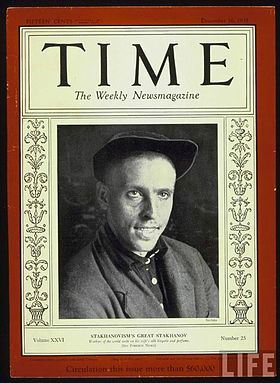
- A photograph of Stakhanov was placed on the cover of Time magazine in December 1935 [16] .
Notes
- ↑ 1 2 Implementation of industrialization in the second five-year plan. Stakhanov movement. history-x.ru [1] Archived January 9, 2014 on the Wayback Machine
- ↑ now Lugovaya in the rural settlement of Preobrazhensky Village Council of Izmalkovsky District, Lipetsk Region
- ↑ Website "Heroes of the country" .
- ↑ Feat of Stakhanov. Myths and Reality
- ↑ Alexey Stakhanov's daughter: “The famous surname only harmed me”
- ↑ 1 2 Pride of Donbass “on demand”: Alexey Stakhanov
- ↑ 1 2 3 4 5 Dump. The tragedy of Stakhanov
- ↑ House on the Embankment // Arguments and Facts
- ↑ 1 2 3 4 7 true facts about the slaughterman Stakhanov
- ↑ Martyrology of Zan Zai . // Memorial.krsk.ru. Date of treatment August 30, 2017.
- ↑ Alexey Stakhanov: The worker who changed the world // Moscow 24 , 05/30/2014.
- ↑ Decree of the Presidium of the Supreme USSR "On the appropriation of the title Hero of Socialist Labor comrade Stakhanov A.G. ”of September 23, 1970 // Vedomosti of the Supreme Council of the Union of Soviet Socialist Republics. - No. 39 (1541). - September 30, 1970. - Art. 400 .-- S. 536.
- ↑ According to the Ukrainian law on decommunization, in 2016 its historical name was returned to the city. The renaming will take effect upon the return of the city to the control of Ukraine, which is also determined by the rules of mediation VP:
- ↑ Vulitsa.by - Stakhanova Street
- ↑ Kvasha B.F., Subetto A.I. Working pedagogy of Alexey Stakhanov // "Russian Land". - No. 13-14. - 1996.
- ↑ Time magazine cover dated 12/16/1935
Literature
- Stakhanov A.G. Mining life. - K: Politizdat, 1986.
- Sapitsky K.F. Coal: novel, short stories, humoresque, play about Alexei Stakhanov. - Donetsk, 1999 .-- 124 p.
Links
- Stakhanov, Alexey Grigorievich . Site " Heroes of the country ".
- Alexey Stakhanov: Worker who changed the world
- Biography in the newspaper "Gazeta.ru"