"45" ( "Forty Five" ) is the debut studio album of the Kino group, recorded together with the musicians of Aquarium and released on reels in 1982 . At that time, "Cinema" consisted of only two people - Viktor Tsoi and Alexei Rybin ; the musicians were not widely known, and the opportunity to record material accumulated over three years was obtained thanks to the assistance of Boris Grebenshchikov . The album was mixed underground in the House of Pioneers of the Krasnogvardeisky district, where Andrei Tropillo set up a semi-legal recording studio " Antrop ".
| 45 | ||||
|---|---|---|---|---|
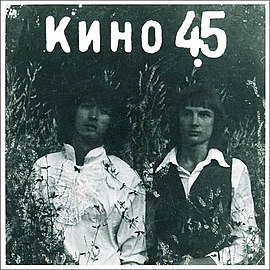 | ||||
| Studio album " Cinema " | ||||
| Date of issue | 1982 | |||
| Recorded by | 1982 | |||
| Genres | Rock new wave post punk | |||
| Duration | 39:54 43:04 (bonus edition) | |||
| Producer | Boris Grebenshchikov | |||
| A country |  the USSR the USSR | |||
| Labels | Antrop | |||
| Professional reviews | ||||
| ||||
| Chronology " Cinema " | ||||
| ||||
Forty Five was one of the first rock albums in the Soviet Union to use a drum machine instead of a real drum kit. To create the required sound, in addition to acoustic, electric and bass guitars , flute , cello and bells were actively used. The lyrics turned out to be almost completely devoid of urgency and any ideological appeals - due to the predominance of positive and lyricism in them, the duet of the musicians called the “ new romantics ”. The presentation of the program took place at a concert in the Leningrad Rock Club before the completion of the studio work. The album received moderate reviews and was not very popular among critics. The recording turned out to be the only studio work in the discography of the group in which Aleksey Rybin took part: the latter soon left Kino due to ideological disagreements with Viktor Tsoi, and more than two musicians intentionally never met - only crossed a couple of times at national concerts (“hodgepodge” "), But never talked to each other.
Unlike the other albums of the group, “Forty-five” until 2012 did not go on vinyl . During the recording, a serious technical error was made, which in the future did not allow reprinting the material in the format of a record , and until 1994 it existed only on magnetic tape . In the mid-1990s, Frost Records produced several digital editions on a CD . In 2012, the album was first released on vinyl with digital remastering with a circulation of only 1,000 copies by Moroz Records . The print run was printed in Germany as part of the Cinema Collection on vinyl. Many of the album’s songs gained great popularity, entered into numerous collections and became entrenched in the concert repertoire of the group until its collapse in 1990 .
Content
Record prerequisites
In the mid-1970s, an art school student Viktor Tsoi began to become interested in music, but at first he was “embarrassed” to sing, limiting himself to playing bass in the groups “ Ward No. 6 ” and “ Automatic Satisfactors ” [3] . The first solo performances and active writing began in late 1980; at that time he made friends with Alexei Rybin and Oleg Valinsky , with whom in the summer of 1981 went to rest in the Crimea , where it was decided to create a group with the working title "Garin and Hyperboloids". In autumn, the group was enrolled in the Leningrad Rock Club, after which Valinsky was suddenly drafted into the army and left the team (in fact, he had already passed the medical examination for a long time, but simply did not want to upset friends with such news) [~ 1] [4] . Left together, Tsoi and Rybin began rehearsing the accumulated material and preparing for the recording of their debut album, and also changed the name of the group to “Cinema”:
Let it be - “Cinema” - why are we breaking our heads? What is the difference in principle? And the word is good - only four letters, you can write beautifully, draw something on the cover of the album ...
- Victor Tsoi [5]
Work on the recording of the album began thanks to the acquaintance of young musicians with Boris Grebenshchikov . Judging by the recollections of eyewitnesses, the first meeting took place at a concert in honor of the thirtieth birthday of Andrei Tropillo , where “ Automatic Satisfactors ” performed, with whom Choi played the bass and then performed several of his things [6] . The acquaintance itself took place in an electric train, at which the musicians returned from Peterhof , from a concert organized by Grebenshchikov in the building of Leningrad University . Tsoi had a guitar with him, and he sang two songs, including “My Friends,” which B. G liked very much: “When you hear the right and necessary song, there is always such a tremor of the discoverer who found a gem or, there, God knows the amphora of what age - then I had the same thing ” [7] . On the other hand, the acquaintance took place through Mike. At the request of Tsoi, they went to visit Grebenshchikov to get acquainted. The next significant meeting took place at Rybin's birthday - after drinking a large amount of alcoholic drinks, two friends performed almost all of their then repertoire, which subsequently formed the basis of “Forty-Five” [~ 2] :
When I hear a classic song, I recognize it. And when people, almost unknown to anyone, sit down and sing in a row a set of classical songs - this introduces into complete astonishment. I left from there with the thought that it was necessary to immediately raise the Tropillo and, while this miracle was functioning, write it down. And you need to do it right now.
- Boris Grebenshchikov [7]
Studio Work
Until 1986, in the USSR, the state-owned company Melody [8] had a monopoly on recording music albums and releasing records, therefore, to circumvent censorship, many rock musicians at that time were writing in underground studios. In particular, the Aquarium musicians recorded their albums in the Pioneer House of the Krasnogvardeisky district, where Andrei Tropillo created the so-called Antrop studio from several rooms. At the end of the Triangle information, Boris Grebenshchikov immediately invited the members of the Kino group there (Tropillo had already seen them in action, so he agreed to record without first listening). “Once in a real studio, we listened to Tropillo as a god-father, and Grebenshchikov as a god-son,” Rybin recalls. “We looked obedient and fearful and were already happy that we had the opportunity to record.” Since the group at that time consisted of only two people, Grebenshchikov asked for help from his Aquarium colleagues: Vsevolod Gakkel ( cello ), Andrei Romanov ( flute ) and Mikhail Fainshtein-Vasiliev ( bass ). Due to the lack of a drummer, it was decided to use a drum machine , the domestic rhythm box “Electronics”. The mechanical sound of this electric device, reminiscent of a “home-made partisan mine,” recorded Tsoi's 12-string acoustic guitar and the electric guitar borrowed by Rybin from Grebenshchikov. The programming of the drum machine was done by Vasiliev [9] .
We never imagined that we would have so much fuss with the drum machine. Then we first encountered this thing and could not keep up with the right rhythm - we flew forward all the time. The whole point was that the car was very hard to hear, and Vitkin’s guitar clogged the puffing of this device, and when there was a pause, it turned out that we again got out of rhythm. Since it was otherwise impossible to commute the car, Fan ( Vasiliev ) found a solution to the problem - he began to conduct us sweepingly from the control room; we looked at him and somehow recorded a few discs, adhering to the desired rhythm.
- Alexey Rybin [5]
At first, instrumental blanks were recorded for all the songs, and only then vocals and guitar solos were superimposed on them (in addition, for some compositions Tsoi played additional parts for bass). In “Sunny Days” and “Aluminum Cucumbers,” Grebenshchikov played on bells , and in some other songs he played on an electric guitar. Tropillo, along with other musicians, sang along with a demonic voice in the refrain “There is time, but no money” (B. G. played the guitar through the reverb ), and in the lyric composition “Tree” he sincerely performed the part on the recorder . During the recording of “Eighth Grader” a funny thing happened: instead of the required thirty-eighth speed, the ninth was turned on, so the track turned out to be defective, and this circumstance prevented the release of the album on vinyl in the future [~ 3] . Recording continued for a month and a half; In total, 14 compositions were reduced, 13 of which were on the album [5] [9] .
I think that Choi wanted, probably, not quite what happened. Most likely, he wanted a rock and roll sound - the sound of “Cinema”, which arose on their albums subsequently. But due to the lack of people, because of my inability to do what they want, and their inability to explain exactly what they want, it turned out 45 .
- Boris Grebenshchikov [9]
Song Story
Aluminum Cucumbers
The song "Aluminum Cucumbers" was written by Tsoy in the wake of the autumn agricultural work , to which he was sent from the school, where at that time he studied as a woodcarver [10] . Many fans subsequently tried to unravel the hidden meaning of “planting aluminum cucumbers on a canvas field,” but in a 1987 interview, Tsoi said there was no sense in the text, and in fact, it was an attempt to “completely destroy reality” [~ 4 ] [11] .
Sunny days
In December 1981, Leningrad filled up with “white muck”, as a result of which the depressing song “Sunny days” was born, showing Tsoi’s dislike for the cold season: “I am crushed in winter, I am sick and sleep, // And sometimes I'm sure that winter is forever " [12] .
Slacker No. 1
“Loafer No. 1” was reworked from the song “Idiot”, which Choi wrote before the creation of “Cinema”, but he never performed at any concert [13] . Also, Mike Naumenko had a hand in writing this song, advising me to add the phrase “mom-mom” to the text [14] .
Train
Both members of the group had to get up early in the morning in order to come to school and work on time, resulting in a “semi-mystical” and “creepy” song called “Electric Train” with the words “electric train takes me where I do not want to.” The line “I probably should have gone to the doctor in the morning” is sent to psychiatrists , whom Tsoi and Rybin had to visit in order to “deflect” them from military service. The song is built on only two chords, and the guitar solo is played at small “very cutting ears” intervals [4] .
Eighth grader
“ Eighth grader ” Tsoi called the girl whom he met in vocational schools . From time to time he played in a small rock band at the school, performing not only famous foreign hits, but also songs of his own composition. At that time, several of her fans appeared in such a work, and Viktor Tsoy became close to one of them - he began to spend a lot of time with her, to meet in the evenings and to accompany him home. After one of these romantic walks, he returned especially soulful, sat down and composed a song of the same name in just twenty minutes. As Aleksey Rybin recalled, he didn’t even compose it, but simply retold what really happened to him that evening, shifting everything from “eat candy” to “triple in geography” to poetry. “I would never have thought that I was still capable of such a romantic relationship,” commented the author himself [15] .
My friends
“ My Friends ” - one of the first songs written by Viktor Tsoi - appeared even during the collaboration with “Automatic Satisfactors”, when large-scale musicians lived and slept in Pig’s apartment, and when they woke up, they immediately went to “beer stalls” [6 ] .
Other songs
The musicians had the opportunity to watch Sitar from the song “Sitar played” in Moscow, visiting Sergei Ryzhenko : “At the end of the rehearsal, he let us get acquainted with the sitar, and this thing fascinated us so much that we were ready to sit with this instrument all day, just extracting any sounds and, putting your ear to the upper resonator, meditate ” [12] . The song “I am asphalt” ending the track list is supposedly dedicated to a certain chief of the road service, who was friends with the band members and helped them in every way. According to Andrei Tropillo, this man associated himself with asphalt and believed that the text was written about him [16] . The song was already created in the studio and was built without any refrain and with only one guitar riff . Her recording was not originally planned, but Grebenshchikov, who heard the melody from the control room, insisted on it [9] .
Choi was very scrupulous in writing songs, for a long time sorting out words in texts; very seriously approached the arrangement of arrangements. “Vitka replaced some chords with others until he achieved complete harmony,” Rybin recalled. “There are no dubious places in the early songs of Kino, and changing something in them is practically impossible.” [4] Among other things, in 1979 a song was written entitled “Vasya loves disco, disco and sausages”, but among rockers and punks, the attitude to disco music was sharply negative then, so they decided not to include it in the album and removed it from the repertoire altogether [6] .
Album
The name in the form of the numeral "45" is taken in accordance with the total duration of the songs on the album - about 45 minutes . It is noteworthy that the three-minute song “I am the asphalt” was deleted from the list of songs at the very last moment, so the album should be called “42”. The design was done by a young photographer and musician friend Alexei Vishnya ; he made the cover, on which was depicted Victor Tsoi, holding the word "CINEMA" in his hands [16] . It was originally planned to photograph both members of the group in tailcoats , frills and pistols against the backdrop of some Kupchinsky wasteland, but later they refused this option and left just an image of Tsoi. On the back of the cover, in addition to the names of the songs, two more inscriptions were placed: “songs - Choi, producer - Grebenshchikov” [9] . In 1994, the Frost Records company reissued the album, on the cover of which was placed one of Tsoi's paintings, which depicts a yellow ship floating in the night sea. The 1996 and 1998 reprints did not differ from one another in terms of design; the only difference is that the booklet inserted inside the box contained photographs of the band members and the lyrics of all the songs.
Rock Club Concert
In the spring of 1982, the musicians of the Kino group performed for the first time in their history at the Leningrad Rock Club . This concert, in fact, was the presentation of the upcoming album, since the participants in the Aquarium also played with Tsoi and Rybin, and the songs were performed in exactly the same order as they were recorded at the studio. Boris Grebenshchikov suggested using a drum machine at the concert, but since the apparatus had to be tuned for each song for a long time, in the end we decided to record its sound on tape and just turn on the soundtrack during the performance. The accompaniment was recorded to the seven most “fighting” compositions, and the phonogram of the song “Once you were a hipster” was written with some margin - during its performance it was planned to arrange a small jam [~ 5] . The day before the concert, a dress rehearsal was held at the Tsyurupa Culture House (someone from the Aquarium was listed there as the head of some vocal and instrumental ensemble, and he had access to a fairly large room with all the necessary equipment). In order not to go to work, Rybin feigned a cold and took a sick leave from a doctor, while Choi took leave of the school for family days for family days [17] .
Marianna Rodovanskaya was responsible for the appearance of the musicians: she dressed Tsoi in a gilded vest with lace and fake diamonds, and from Rybin with the help of makeup , hairspray and wardrobes of the Young Spectator Theater she made Frankenstein . The hard rockers prevailing in the audience reacted very negatively to this image, having met the group with shouts like “snotty pop,” however, after the first song (“I am asphalt”) the disgruntled audience calmed down, and, in general, the concert went well. The performance lasted about thirty minutes, while the breaks between the drum parts in the phonogram were about seven to eight seconds, the film was not stopped, and all the songs had to be played continuously. During the performance of the final composition (“Once you were a hipster”), Boris Grebenshchikov left the recorder on and went on stage with a huge drum on his stomach. Then Mike Naumenko joined the group and played an energetic guitar solo in the style of Chuck Berry , and the musician's friend Igor “Mono-tooth” Gudkov finished the song, playing a long part on the saxophone . The audience was pleased, and the management of the rock club gave a favorable response [17] .
Reviews and criticism
The first negative review of the work of the newly formed group came during an examination concert upon entry into the Leningrad Rock Club. His then head, Tatyana Ivanova, after listening to six or seven songs from the album, accused the musicians of deviating from the ideals of rock:
So what do you want to say with your songs? What is the idea of your creativity? What are you a slacker? It is very good? And stops only at beer stalls - is that all should now get drunk? Do you want to say that? What kind of music do you have? This, excuse me, is some kind of gateway ...
- Tatyana Ivanova to Viktor Tsoi [4]
At first, the Leningrad rock party took the album without enthusiasm or did not perceive it at all, and the Moscow Samizdat magazine Ukho called the songs “a relaxed rattle on the strings”, in which “all meaning and content are etched” [9] . However, later reviews were exceptionally positive. Alexander Zhitinsky , a columnist for the underground Roxy magazine, called the resulting material “phenomenal in freshness and musical identity” [18] . The well-known producer-journalist Alexander Kushnir included “Forty-five” among the most significant magneto-albums of the Soviet period and described him as one of the brightest and most lyrical albums in the history of Russian rock [9] . The song “Eighth grader” was included in the list of “ 100 best songs of Russian rock in the XX century ”, compiled by Our radio based on the choice of radio listeners, rising in it to the 47th position. Fellow musicians also spoke positively about the album:
Once the routine of our regular meetings was broken. Instead of “Beatles” and “Grateful Dead” Borya ( Grebenshchikov ) put a film with unusual music. She immediately hooked us, so much so that to this day every winter I look at my brother’s portrait in mourning frames and turn on the tape recorder with this recording - “Sunny Days” by Viktor Tsoi.
- Alexander Lipnitsky [19]
Despite the fact that many songs from the album subsequently became hits, the members of the Kino group themselves spoke rather coolly about it. In an interview with Roxy magazine, Viktor Tsoi called the album’s songs “a bardic version” and admitted that he was against its release, since, from his point of view, the record was crude. After many years, Rybin also appreciated the album with no less skepticism: “The only thing that is good in“ 45 ”is the touching spontaneity of the songs. The songs themselves are presented on the album very naively, and the arrangements are absent as a class ” [9] .
Cultural Impact
In 2000, in memory of Viktor Tsoi, a double tribute album was recorded called “ Cinema Tests ”, which included seven cover versions of songs from “Forty-Five”: “Aluminum Cucumbers”, “Sunny Days”, and “Loafer” (two versions) ), "Electric Train", "Eighth Grader" and "Once upon a time you were a hipster." Immediately after the release, the album was supported by two large-scale stadium concerts in Moscow and St. Petersburg , where songs of the same name were sounded also in a live version [20] . In 2002, at a concert organized in honor of Viktor Tsoi's birthday , the DDT group performed the songs “Just Want to Know” and “Once You Were a Hipster”, which were subsequently published on the corresponding concert collection [~ 6] [21 ] [22] .
I chose the song “Aluminum Cucumbers” for the simple reason that I enjoyed listening to the album where it was in the 1980s, and when the offer came in, I gladly beat it.
- Edmund Shklyarsky about the song “Aluminum Cucumbers” [23]
We recorded the song "Sunny Days", and not only in Russian , but also in Ukrainian and French . Both of these languages very well fell into the music of Tsoi. My head immediately developed how it would sound; I quickly sketched translations into both languages, even with rhymes. We decided to record three versions, and then choose which one is better. But all the versions turned out to be good, and then we recorded another version in three languages at once.
- Oleg Skripka about the song “Sunny Days” [24]
“Cinema” and “Aquarium” - in general, these were two recordings of Russian-language rock, which I got to listen to. This, in my opinion, was in 1983–84. And on one reel was recorded on one side the album "Aquarium", and on the other hand - the album "45" "Cinema". Therefore, in general, the choice of song for the tribute was quite natural.
- Ilya Lagutenko about the song “Eighth grader” [25]
The song “There is time, but no money” hit the thrillers “ Tin ” (2006) and “ Cargo 200 ” (2007): in the first case it was performed by two drunken heroines, and in the second it was added to the soundtrack and sounded during the final credits [ ~ 7] [26] [27] . In addition, in 2006, a film concert about Victor Tsoi's work “Just Want to Know” was released, which included the song of the same name, as well as “Loafer” [28] .
Editions
| Region | date | Label | Format | Catalog |
|---|---|---|---|---|
| the USSR | 1982 | Antrop | Bobbin | not |
| Russia | 1994 | Moroz Records | CD | MR 94014 CD |
| CS | MR 94001 MC | |||
| 1996 | CD | MR 96146 CD | ||
| CS | MR 96001 MC | |||
| MR 96001 MC | ||||
| Lithuania | ||||
| Russia | 1998 | CD | dMR 01398 CD | |
| 2002 | MR 96146 CD | |||
| 2005 | dMR 01398 CD | |||
| 2012 | MR 12001 CD | |||
| dMR 01398 CD | ||||
| LP | MR 12016 LP |
List of Songs
Words and music of all songs are written by Viktor Tsoi.
| Side a | |||||||||
|---|---|---|---|---|---|---|---|---|---|
| No. | Title | Duration | |||||||
| one. | “There is time, but no money” | 4:08 | |||||||
| 2. | “You just want to know” | 3:29 | |||||||
| 3. | "Aluminum Cucumbers" | 2:56 | |||||||
| four. | "Sunny days" | 3:12 | |||||||
| five. | "Loafer" | 3:14 | |||||||
| 6. | "Loafer number 2" | 3:06 | |||||||
| 20:05 | |||||||||
| Side b | |||||||||
|---|---|---|---|---|---|---|---|---|---|
| No. | Title | Duration | |||||||
| one. | "Train" | 2:36 | |||||||
| 2. | " Eighth grader " | 2:45 | |||||||
| 3. | " My friends " | 4:27 | |||||||
| four. | “Sitar played” | 1:34 | |||||||
| five. | "Tree" | 1:43 | |||||||
| 6. | “Once you were a hipster” | 3:41 | |||||||
| 7. | "On the kitchen" | 3:03 | |||||||
| eight. | “I Am Asphalt” (bonus track in the 1996 reissue) | 3:10 | |||||||
| 10:59 p.m. | |||||||||
Record Members
| Back cover |
Notes
- Comments
- ↑ Before leaving, Valinsky promised that upon returning from the army he would join the group again, however, after serving two years, he abandoned his musical career and preferred to work in the state system.
- ↑ Of all the songs of the album during this apartment, only “I am asphalt” was not performed, which was already written in the studio during the recording.
- ↑ As the story goes, at the moment of recording Tropillo left the room, and Grebenshchikov, trying on Brian Eno’s toga, said: “Motor!” - and turned the speed knob on the tape recorder in the wrong direction. And only later it became clear that this performance of “Eighth Grader” - by the way, autobiographical in content - was the most successful.
- ↑ He also said that in the rain, on a muddy field, the cucumbers that future artists were ordered to collect looked like completely inorganic objects - cold, gray, slippery, heavy things, aluminum cucumbers.
- ↑ According to Alexei Rybin, “Kino” was the first Leningrad group to use a phonogram with a drum machine on stage - in 1982 no one had thought of such technical innovations.
- ↑ This event is especially significant in that the 1980s Yuri Shevchuk was quite negative towards the Kino group, accused them of “pop music” and even threatened to fill Viktor Tsoi’s face.
- ↑ In the final scene of the film “Cargo 200”, they show how the musicians of the Kino group perform this song during a concert, but in fact the studio recording taken from the album “45” sounds.
- Sources
- ↑ Dmitry Tselikov. Overview of the album "45" (Eng.) . Allmusic . Date of treatment November 1, 2009. Archived on August 27, 2011.
- ↑ Alexander Kushnir. Overview of the album "45" (Eng.) . Sounds.Ru (August 28, 2008). Date of treatment November 1, 2009. Archived on August 27, 2011.
- ↑ Maxim Pashkov. V. Tsoi and the CINEMA group: If not him, then who? . www.rockarchive.ru. Date of treatment October 27, 2009. Archived August 27, 2011.
- ↑ 1 2 3 4 Rybin, Chapter 6.
- ↑ 1 2 3 Rybin, Chapter 8.
- ↑ 1 2 3 Andrey Panov . When you compose music, a drum should knock on your head . www.kinoman.net. Date of treatment October 29, 2009. Archived August 27, 2011.
- ↑ 1 2 Boris Grebenshchikov . We were like pilots in neighboring fighters . www.kinoman.net. Date of treatment October 23, 2009. Archived August 22, 2011.
- ↑ History of the FeeLee Records Record Company . Official site. Date of treatment November 3, 2009. Archived on August 27, 2011.
- ↑ 1 2 3 4 5 6 7 8 Kushnir, Kino 45 (1982).
- ↑ Yuri Leving. Redrawing the legacy: figures and styles in the children's book of the 1950–2000s (four studies) (Pdf). The culture. - Note No. 10. Date of treatment November 2, 2009. Archived on August 27, 2011.
- ↑ Dubna , 1987, answers to questions from spectators who came to the concert.
- ↑ 1 2 Rybin, Chapter 7.
- ↑ Rybin, Chapter 4.
- ↑ Mikhail Naumenko . He was not an angel, nor was he a demon . www.kinoman.net. Date of treatment October 30, 2009. Archived August 27, 2011.
- ↑ Rybin, Chapter 5.
- ↑ 1 2 Andrey Tropillo . Tragedy cannot be pop . www.rockarchive.ru. Date of treatment October 30, 2009. Archived August 22, 2011.
- ↑ 1 2 Rybin, Chapter 9.
- ↑ Alexander Zhitinsky . From the review of the album "Blood type" . Roxy (1988). - No. 14. Date of treatment October 31, 2009. Archived August 27, 2011.
- ↑ Alexander Lipnitsky . He could raise a man from his knees like no one . www.kinoman.net (June 7, 1991). Date of treatment October 30, 2009. Archived August 27, 2011.
- ↑ Exact dates: Cinema concert and Cinema album . Sounds.Ru (September 28, 2000). Date of treatment November 1, 2009. Archived on August 22, 2011.
- ↑ Dmitry Nikitinsky. Patriarch and his "Autumn" . www.peoples.ru. Date of treatment November 1, 2009. Archived on August 27, 2011.
- ↑ A-Lena. Each song “Cinema” is a complete hymn . Sounds.Ru (June 28, 2006). Date of treatment October 29, 2009. Archived August 22, 2011.
- ↑ Edmund Shklarsky . Interactive interview "Chat with a star" . New Alphabet (May 30, 2005). Date of treatment October 29, 2009. Archived August 27, 2011.
- ↑ Svetlana Gudezh. MOVIES: Direct speech . Sounds.Ru (March 30, 2009). Date of treatment October 29, 2009. Archived August 22, 2011.
- ↑ Andrey Shevelev. Excerpt from the press release “Cinema Tests. Tribute Victor Tsoi " . The official website of the Mumiy Troll group (October 19, 2000). Date of treatment October 29, 2009. Archived August 27, 2011.
- ↑ Maxim Semelyak. Tin. Original movie soundtrack . Poster (June 15, 2009). Date of treatment November 1, 2009. Archived on August 27, 2011.
- ↑ Olga Sherwood. “Cargo 200”: It hurts me and I hate . www.yuga.ru (June 15, 2007). Date of treatment November 1, 2009. Archived on August 27, 2011.
- ↑ Oleg Flyangolts. A film-concert about the work of Viktor Tsoi . The official website of Oleg Flyangolts. Date of treatment November 3, 2009. Archived on August 27, 2011.
- Bibliography
- Alexey Rybin . Cinema from the very beginning to the very end . - Moscow: Phoenix, 2001 .-- 278 p. - ISBN 5-222-01924-1 .
- Alexander Kushnir . Cinema 45 (1982) // 100 magneto-albums of Soviet rock . - Moscow: Kraft +, 2003 .-- 400 p. - ISBN 5-7784-0251-1 .
- Marianna Tsoi , Alexander Zhitinsky . Victor Tsoi. Poems. Documents. Memories . - Issue 1. - St. Petersburg: New Helikon, 1991. - 368 p. - (Stars of rock and roll). - ISBN 5-85-395-018-5 .
- Artemy Troitsky . Rock music in the USSR: the experience of the popular encyclopedia . - Issue 1. - Moscow: Book, 1990. - S. 156. - ISBN 5-212-00240-0 .
- Anatoly Tooth. Victor Tsoi . — Минск: Современный литератор, 1999. — 256 с. — (Жизнь знаменитых людей). — ISBN 985-6524-98-9 .
- Последний герой. Виктор Цой и группа Кино . — Москва: Мороз рекордс, 1997. — ISBN 5-89267-014-7 .
- Марианна Цой . Точка отсчёта . — Санкт-Петербург: Лениздат, Шок Records, 1997. — 15 с. — ISBN 5-289-01938-3 .
Links
- 45 (англ.) на сайте MusicBrainz
- 45 (англ.) на сайте Allmusic .
- Альбом «Сорок пять» на сайте Discogs (англ.)
- Статья об альбоме «Сорок пять»
- 52 факта об альбоме "45" группы "Кино"