Mariupol ( Ukrainian Mariupol , Greek -αριούπολις ) is a city in the Donetsk region in southeastern Ukraine , the largest city on the banks of the Taganrog Bay at the mouth of the Kalmius and Kalchik rivers. Center of the Mariupol agglomeration . The population of the city as of January 1, 2016 is 449,498 people [2] ; within the framework of the City Council (taking into account urban settlements of the Old Crimea , Sartan , Talakovka , the villages of Gnutovo , Vinogradnoye and the village of Lomakino , subordinate to the City Council) - 470 968 people as of January 1, 2017 [2] . Since mid-2014 - the seat of the Donetsk Regional Council .
| City | |||||
| Mariupol | |||||
|---|---|---|---|---|---|
| Ukrainian Marіupol | |||||
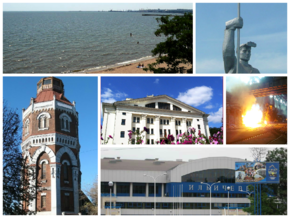 | |||||
| A country |  Ukraine Ukraine | ||||
| Status | city of regional significance | ||||
| Region | Donetsk region | ||||
| Internal division | 4 districts | ||||
| Mayor | Vadim Boychenko | ||||
| History and Geography | |||||
| Based | X century | ||||
| Former names | until 1734 - Adamaha (Domah) until 1778 - Kalmius Palanca until 1779 - Pavlovsk until 1948 - Mariupol before 1989 - Zhdanov | ||||
| City with | 1778 | ||||
| Square | 244 [1] km² | ||||
| Center height | |||||
| Timezone | UTC + 2 , in summer UTC + 3 | ||||
| Population | |||||
| Population | ▼ 449,498 [2] people ( 2017 ) | ||||
| Density | 1842 people / km² | ||||
| Agglomeration | ▼ 470 968 (as of 01/01/17) [3] , [2] ( City Council ) | ||||
| Nationalities | Ukrainians , Russians , Greeks , Belarusians , Jews | ||||
| Denominations | Orthodox , Protestants , Jews | ||||
| Katoykonim | mariupolets, mariupolchanka, mariupolites | ||||
| Digital identifiers | |||||
| Telephone code | +380629 | ||||
| Postal codes | 87500-87590 | ||||
| Car code | AH, KN / 05 | ||||
| KOATUU | 1412300000 | ||||
| Other | |||||
| Awards |   | ||||
| marsovet.org.ua (Ukrainian) (Russian) (English) | |||||


One of the most important centers of metallurgy and engineering , a large seaport. Climatic and mud resort . Mariupol is one of the ten largest cities in Ukraine , is the most important industrial and large economic center of the country. The area of compact residence of the Greeks in the Sea of Azov . In 2012, it was recognized by the Cabinet of Ministers of Ukraine as one of the most comfortable cities in the country [4] .
Geography and Ecology
Geography
Height above sea level - 67 meters. Mariupol is a rather large city located in the south of the Donetsk region , on the northern coast of the Sea of Azov , at the mouth of the Kalmius River. The city covers an area of 166.0 km² (with suburbs, that is, territories subordinate to the Mariupol City Council - 244.0 km² [1] ). The area under development is 106.0 km², green areas - 80.6 km². The soils of the city are mostly solonetzic chernozems, with a significant amount of groundwater, which often leads to landslides.
Climate
The local climate is temperate continental (close proximity to the sea affects) with long hot summers (frequent droughts and dry winds) and mild winters (there are temporary thaws, fogs). The region has large heat resources with prevailing clear sunny days in the warm season (the duration of sunshine from May to September is 1544 hours). The annual rainfall is 420 mm per year. Agroclimatic conditions allow growing heat-loving crops with a long vegetative period (sunflower, melons, grapes) in the suburbs of Mariupol. However, water resources in the region are slightly inadequate, and therefore ponds and various reservoirs are used for the needs of the population and industry.
The direction of the wind in the winter is mainly eastern, in the summer - the southeast direction.
Mariupol is located in the center of the Priazovskoy recreation zone of Donetsk region. Thanks to the breeze phenomena, the Azov coast acquires special attractiveness - the abundance of the sun, the removal from the sea of enormous masses of clean air saturated with ozone, mineral salts and trace elements (sodium chloride, iodine, bromine, etc.). Breezes contribute to the formation of natural ventilation of the coast, dramatically reduce the feeling of heat. Mariupol is a summer resort for many tourists.
The length of the recreation period, which in Mariupol begins in mid-May and ends in the second decade of September, when the average daily air temperature exceeds 15 ° C (in July August it reaches 23-26 ° C), is important. The daily day-night temperature difference in summer is around 10 ° C. This period corresponds to the swimming season, when the water in the sea warms up to 18–23 ° C, and in June – August on some days –– up to 26–29 ° C.
Frosts in May for more than 55 years were not recorded, and in September the last time was noted more than 35 years ago [ specify ] . The average air temperature in January is 2.5 ° C, in July + 24.0 ° C.
The absolute maximum of air temperature is +38.0 ° C (August 2017), the absolute minimum is −27.2 ° C (January 2006) [5] .
| Climate of Mariupol | |||||||||||||
|---|---|---|---|---|---|---|---|---|---|---|---|---|---|
| Indicator | Jan | Feb | March | Apr | May | June | July | Aug | Sep | Oct | Nov | Dec | Year |
| Absolute maximum, ° C | 10.0 | 15.0 | 19.6 | 30,0 | 33.9 | 37.0 | 37.8 | 38,0 | 34,4 | 27.1 | 18.0 | 14.1 | 38,0 |
| Average maximum, ° C | −0.2 | 0.2 | 5.1 | 13.1 | 19.8 | 24.5 | 27.5 | 26.9 | 20.9 | 13.6 | 5.9 | 1,0 | 13,2 |
| Average temperature, ° C | −2.6 | −2.6 | 1.9 | 9.5 | 15.9 | 20.3 | 23 | 22.4 | 16.7 | 10.1 | 3.2 | −1.4 | 9.7 |
| Average minimum ° C | −4.9 | −5.1 | −0.6 | 6.2 | 11.8 | 15.9 | 18.3 | 17.6 | 12,4 | 6.8 | 0.8 | −3.6 | 6.3 |
| Absolute minimum, ° C | −27.2 | −25 | −20 | −7.3 | 0,0 | 5,6 | 8.9 | 5,0 | −1.1 | −8 | −17 | −24.5 | −27.2 |
| Precipitation rate, mm | 44 | 40 | 38 | 34 | 35 | 48 | 48 | 35 | 44 | 35 | 48 | 49 | 507 |
| Source: Weather and Climate | |||||||||||||
| Sunshine, hours per year [6] . | |||||||||||||
|---|---|---|---|---|---|---|---|---|---|---|---|---|---|
| Month | Jan | Feb | Mar | Apr | May | Jun | Jul | Aug | Sep | Oct | But I | Dec | Year |
| Sunshine, h / month | 59 | 80 | 145 | 210 | 290 | 308 | 352 | 334 | 260 | 171 | 80 | 51 | 2340 |
| Water temperature (data for 1977-1995) | |||||||||||||
|---|---|---|---|---|---|---|---|---|---|---|---|---|---|
| Indicator | Jan | Feb | Mar | Apr | May | Jun | Jul | Aug | Sep | Oct | But I | Dec | Year |
| Absolute maximum, ° C | 4.4 | 2.9 | 10.5 | 16.8 | 24.4 | 27.7 | 29.5 | 28.0 | 27.0 | 21.3 | 11,4 | 8.6 | 29.5 |
| Average temperature, ° C | 0.1 | 0,0 | 2.0 | 9.3 | 16.8 | 22.0 | 24.2 | 23.6 | 19,4 | 12.8 | 5.7 | 1.3 | 11,4 |
| Absolute minimum, ° C | −0.7 | −0.7 | −0.6 | 0.7 | 7.6 | 16.3 | 19.8 | 19.1 | 12.6 | 2.0 | −0.6 | −0.6 | −0.7 |
| Source: ESIMO | |||||||||||||
Ecology
Mariupol is one of the first places in Ukraine in terms of emissions of harmful substances by industrial enterprises [7] . The largest environmental pollutants in the city are the Azovstal metallurgical plants and its coke production and MMK im. Ilyich ", especially sinter plant and blast furnace shop. Not the last role is played by the poor location of the Azovstal iron and steel works (actually a few kilometers from the city center). The plant was built in the 1930s near the mouth of the Kalmius River, in fact, on the coast of the Sea of Azov , without taking into account the “wind rose”. Since winds of east and south-east directions prevail in this region, a significant part of emissions from the steel mill falls on the most densely populated areas of the city. The main share of water pollution in the Mariupol region, of course, belongs to steel mills. The seaport does not lag behind with the constant transshipment of such cargoes as sulfur, coal pitch, coal and other types of minerals. Vessels entering the port water area do not always comply with environmental legislation. The constant advance of the berths and warehouses of the seaport under construction leads to the gradual disappearance of the pearl of the city - the beach of the village of Peschany, which was once very popular among citizens and guests of the city. [8] Sulfur has not been processed in Mariupol port since 2007, and coal pitch is being overloaded by the Shipyard.
History
Until 1917
In pre-revolutionary encyclopedic sources (such as GSS [9] and ESBE [10] ), the opinion is indicated that in ancient times there was a settlement of Adamakh on the site of Mariupol (according to Ukrainian historiographers it was an outpost of the Zaporozhye Cossacks of Domakh). The city of Mariupol itself was founded in 1778, when the county town of the Azov province Pavlovsk (sometimes called Pavlograd) was founded, which in 1779 was named Mariupol . In 1780 in Mariupol and its environs settled the Orthodox Greeks ( Rumei and Urumahs ) removed from the Crimean Khanate in 1778.
Significant damage was done to Mariupol during the Crimean War of 1853-1856. Maritime trade was suspended due to hostilities. In the spring of 1855, the Anglo-French squadron entered the Sea of Azov . On May 24, under the cover of naval artillery in Mariupol, an enemy landing was landed, which destroyed warehouses in the port, burned several houses in the city.
Of paramount importance for the city was the holding in 1882 of the railway connecting it with the Donbass and other economic centers of the country. Donetsk coal began to flow into the port of Mariupol, located at the mouth of the Kalmius River. The increase in cargo turnover caused the construction of a new Mariupol commercial port, which was carried out in 1886-1889. The new port caused a revival of trade, an influx of people into the city. The city opened consulates and consular agencies of Greece , Italy , Austria-Hungary , Turkey , Belgium , Germany , and Great Britain .
Mariupol became the industrial center at the end of the 19th century, when metallurgical plants of the Nikopol-Mariupol Mining and Metallurgical Society and the Russian Providence Society were built here, which produced steel sheet, oil pipes, rail rails and other products. At the end of the 19th century, in addition to metallurgical plants, Mariupol operated factories: agricultural engineering, an iron foundry, 6 tanneries, 27 brick-and-tiled, a pasta factory, two steam mills.
In 1878, a resident of Mariupol V.L. Shapovalov created a professional theater troupe in the city, and in 1887, the city theater opened. Later, other cultural institutions were created - printing houses, the city public library, cinemas, and the first city newspaper was published.
Civil War
On December 30, 1917, Mariupol captured parts of the Red Army under the command of Antonov-Ovseenko . May 1, 1918 the city was occupied by German troops. In November 1918, after the withdrawal of German-Austrian troops, Mariupol came under the control of the Don army. In February of the following year, a volunteer army landing in the city came to the aid of the Don Cossacks. On March 29, 1919, Mariupol was captured by the 3rd Brigade (brigade commander N.I. Makhno ) and the 1st Zadniprovsky Soviet Rifle Division (having begun with P.E.Dybenko). At the end of May, having launched a counterattack, the Allied forces captured the Azov and Mariupol, but in December 1919 the city was again captured by the Bolsheviks.
Soviet period
In March 1920, the Red Azov Naval Flotilla was created in Mariupol, the first commander of which was S. E. Markelov. The flotilla conducted a series of successful military operations on the Sea of Azov against the White Guard fleet of Wrangel. After the civil war, the Red Azov military flotilla was relocated to Sevastopol and on its basis the revival of the Black Sea Fleet began .
In 1920, the Nikopol-Mariupolsky and Russian Providence metallurgical plants were nationalized and merged into one plant, which was named after Ilyich in 1924 . In the early 1930s, the Azovstal metallurgical plant became the main construction site of the city.
By the end of the 1930s, Mariupol had grown significantly and transformed. If in 1925 a little more than 50 thousand people lived in it, then by 1941 the population had increased to 241.1 thousand people. New multi-storey buildings appeared in factory districts; individual housing construction was widely developed. In 1925, the first buses began to run between the city center and remote areas - the port and the plant. Ilyich. In 1933, the first tram line was launched, connecting the city with the factory, and later with the port. The streets were lit and landscaped. New parks appeared in factory towns and in the port.
In 1937, mass arrests of Greek Romanians took place in Mariupol and Taganrog .
- The Great Patriotic War
When the Great Patriotic War began , the Mariupolites, together with all the people, came to the defense of the Motherland. Thousands of city residents went to the front.
In the city, evacuation hospital No. 1335 began to work [11] .
The enterprises rebuilt production for the needs of the front. Ilyichevsk metallurgists produced armored steel for T-34 tanks , torpedo boats and IL-2 attack aircraft. Pontoon bridges, armored caps for machine-gun nests, armored platforms for pillboxes, anti-tank hedgehogs were made at the metalwork factory. At the Azovstal plant they manufactured hulls for air bombs and barrels of battalion mortars [12] .
When the front line approached the city, the evacuation of industrial enterprises and people to the Urals and Siberia was organized. It is known that the train on which the equipment was brought and people during the evacuation fell under the bombing in the Taganrog region. Some accompanying people died, some were injured, and traveled to Mariupol on foot. By that time there were German troops in Mariupol and people who had come from Taganrog were dying of wounds, lack of medicine and the lack of treatment.
During the days of German occupation, which lasted almost 2 years (from October 8, 1941 to September 10, 1943), the Nazis shot about 10 thousand people in the city. About 50 thousand young men and women were hijacked to Germany . About 36 thousand Soviet prisoners of war died in the concentration camp from hunger and disease. Despite the mass executions, the brutal occupation regime, underground patriotic groups acted in the city.
September 10, 1943 the city was liberated from invaders by the forces of the 44th Army of the Southern Front and the naval landing of the Azov military flotilla.
The following people participated in the liberation of Mariupol: the 44th Army of the Southern Front under the command of Lieutenant General V. A. Khomenko ; 221st Infantry Division , commander - Colonel Ivan Ivanovich Blazhevich; 130th Taganrog Rifle Division , commander - Colonel Konstantin Vasilievich Sychev; 4th Guards Kuban Cossack Cavalry Corps, commander - Lieutenant General Nikolai Yakovlevich Kirichenko ; 133rd Separate Guards Mortar Regiment (Katyusha), 1101th Cannon Artillery Regiment, 230th Fighter Anti-Tank Regiment, 2nd Engineering Combat Brigade; Azov military flotilla of the Black Sea Fleet, commander - Rear Admiral Sergey Georgievich Gorshkov; 8th Air Army , commander - Hero of the Soviet Union, Lieutenant General Timofei Timofeevich Khryukin , composed of: 9th Guards Fighter Air Division Colonel Ibrahim Magometovich Dzusov , and the division - the famous 16th Guards Fighter Aviation Regiment led by Nikolai Vasilievich Isaev, in which Major Aleksandr Ivanovich Pokryshkin and twice the 104th Guards Fighter Aviation Regiment of the Hero of the Soviet Union were twice the head of the air and rifle service Lieutenant Colonel Vladimir G. Semenishin.
- After World War II
After the war, restoration work began actively in the city, the city's industry was restored, metallurgical giants — the factories named after him — were lifted from the ruins. Ilyich and Azovstal, a seaport and other enterprises. By the end of 1950, all 48 industrial enterprises not only reached the pre-war level of production, but also exceeded it by 30%.
On October 22, 1948, by the Decree of the Council of Ministers of the USSR, the city was given the name Zhdanov.
In 1953, the Azov Regional Department of the Black Sea Shipping Company was created in Zhdanov, which in 1967 was transformed into the Azov Shipping Company. His ships visited about 400 ports in more than 70 countries . In connection with the expansion of industrial and housing construction in the city, powerful construction organizations were created.
In April 1958, the Kuybyshev pipe rolling plant was merged with the plant named after Ilyich. At the same time, a heavy machine-building plant was created from the machine-building and part of the metallurgical shops of the Ilyich plant, which a few years later became one of the largest enterprises in the industry - the Zhdanovtyazhmash production association, and later - Azovmash . The enterprises of the light and food industries continued to develop. New marinas and entire areas were being built in the port.
In these years, new high-rise micro-districts grew, new schools, children's plants, medical institutions, dispensaries, shops and catering facilities were built.
Two higher educational institutions, 8 technical schools, 14 vocational schools, 66 general education schools, 5 working youth and correspondence schools, 8 children's music schools, 16 children's sports schools, a children's art school, a station for young technicians, a flotilla of young sailors, worked in the city. three district houses of pioneers and schoolchildren, the city house of pioneers, which came into operation in 1987. The network of preschool institutions amounted to 167 kindergartens, kindergartens.
Institutions of culture, physical education and sports continued to develop. In 1959, the activity of the Russian Drama Theater was restored in the city, and in 1960, a beautiful new theater building adorned the city center. A music school and an exhibition hall named after A. I. Kuindzhi were opened, the city library named after V. G. Korolenko received a new building, several palaces of culture and sports, stadiums and swimming pools were built.
With the development of the city's economy, the number of its inhabitants grew: 1958 - 280.3 thousand people .; 1970 - 436 thousand people; 1989 - 540.3 thousand people.
The city’s enterprises gave the country steel sheets and pipes, railway rails and metal structures, railway tank cars and gondola cars, converters, gantry and portal cranes, fire extinguishers, radiators for heavy vehicles, washing machines, crystal glassware, sewing, hosiery and confectionery , fishing nets and canned fish and many other products.
By the end of the 1980s, there were 44 industrial enterprises, 44 construction and 10 transport organizations in Zhdanov.
Modern Period
In the second half of the 80s, perestroika began in the country, which entailed economic and political changes in Zhdanov. On January 13, 1989, at the request of its inhabitants, the historical name was returned to the city - Mariupol.
In April 2014, as a result of the aggravation of the political crisis in Ukraine, the Donetsk People's Republic tried to take control of the city. After the events of May 9, all power structures subordinate to the Ukrainian government were withdrawn from the city [13] . Однако сил для удержания города под своим контролем у самопровозглашённой ДНР не было. Действующий мэр сохранял власть и пытался договориться с ДНР [14] . 25 мая в городе прошли выборы президента Украины [15] . Несмотря на низкую явку избирателей ЦИК признал их состоявшимися. 13 июня 2014 года, после ликвидации в Мариуполе формирований ДНР, по распоряжению президента Украины Петра Порошенко , областные власти переехали временно в Мариуполь [16] и с этого времени, и фактически до 11 октября 2014 года, город стал областным центром Донецкой области , но официально гражданские органы власти области были перенесены только 13 октября 2014 года, о чём сообщил губернатор области Александр Кихтенко . С этого времени Донецкая областная государственная администрация расположена в Краматорске , который стал временным центром Донецкой области , а силовые структуры региона остаются в Мариуполе [17] .
Administrative Division
| Районы Мариуполя: Кальмиусский Левобережный Приморский Central | Населённые пункты: 1 — Сартана 2 — Старый Крым 3 — Талаковка 4 — Гнутово 5 — Ломакино |
- Кальмиусский район — на севере города, самый большой по площади и по развитию промышленности район. Старое название: Ильичевский район
- Левобережный район — на востоке города, на левом берегу Кальмиуса. Старое название: Орджоникидзевский район .
- Приморский район — на юге города, на берегу Азовского моря.
- Центральный район — центральный район города. Старое название: Жовтневый укр. Жовтневий — «Октябрьский» район .
Population
Численность наличного населения города на 1 января 2017 года составляет 449 498 человека [2] ; в рамках горсовета (с учётом посёлков городского типа Старый Крым , Сартана , Талаковка , сел Гнутово, Виноградное и посёлка Ломакино подчинённых горсовету) — 470 968 человека [2] , что составило 11 % от численности населения области. За последний век количество населения выросло почти в 12 раз. В городе живут украинцы , русские , греки , белорусы , армяне , евреи и представители других национальностей. В общении абсолютно преобладает русский язык .
Назвали родным язык (на 5 декабря 2001 года): русский — 457 350 человек (89,53 %), украинский — 50 420 человек (9,87 %).
Количество на начало года.
| Year | Количество жителей [18] |
|---|---|
| 1778 | 168 |
| 1782 | 2948 |
| 1795 | 2623 |
| 1823 | 2848 |
| 1826 | 2998 |
| 1840 | 3659 |
| 1850 | 4579 |
| 1855 | 4600 |
| 1858 | 5289 |
| 1862 | 6089 |
| 1863 | 7000 |
| 1864 | 7440 |
| 1867 | 7644 |
| 1874 | 9774 |
| 1887 | 16815 |
| 1890 | 19069 |
| 1895 | 30922 |
| 1897 [19] | 31116 |
| 1903 | 38000 |
| 1910 | 51300 |
| 1913 | 53900 |
| 1923 [20] | 28707 |
| 1925 | 29320 |
| 1927 [21] | 40825 |
| 1928 | 73000 |
| 1931 | 115000 |
| 1933 [22] | 152806 [23] |
| 1934 | 165000 |
| 1936 | 193000 |
| 1937 | 192146 |
| 1939 [24] | 221529 |
| 1941 | 241408 |
| 1956 | 273000 |
| 1959 [25] | 283570 |
| 1962 | 321000 |
| 1970 [26] | 416927 |
| 1971 | 423600 |
| 1977 | 474000 |
| 1979 [27] | 502581 |
| 1984 | 520000 |
| 1985 | 523450 |
| 1987 | 529000 |
| 1989 [28] | 518933 |
| 1992 | 522900 |
| 1993 | 524000 |
| 1994 | 520700 |
| 1998 | 499800 |
| 2002 [29] | 492176 |
| 2003 | 487522 |
| 2004 | 484454 |
| 2005 | 482440 |
| 2006 | 479959 |
| 2007 | 477585 |
| 2008 | 474715 |
| 2009 | 471975 |
| 2010 | 469336 |
| 2011 | 466665 |
| 2012 | 464457 |
| 2013 | 461810 |
| 2014 | 458533 |
| 2015 | 455063 |
| 2016 | 453623 |
| 2017 | 449498 |
| |||||||||||||||||||||||||||||||||||||||||||||||||||||||
Рейтинг города (по численности населения) по состоянию на 1 января 2015 года :
| Место в мире | Место в Европе | Место в бывшем СССР | Место на Украине | Место в области |
|---|---|---|---|---|
| 1011 | 107 | 66 | ten | 2 |
Symbols
Герб города представляет собой исторически традиционный щит, в основе которого прямоугольник со сторонами в пропорциях золотого сечения.
Щит разделён на две равные части по горизонтали волнистой линией — графическим изображением моря. Верхнее поле — серебряного (серого) цвета, символизирующего сталь (основную продукцию промышленности города). Нижнее поле — синего цвета, символизирующего море (географию расположения города). Центральный изобразительный символ герба — «якорь» — символ приморского портового города, международной торговли, а также как изделие машиностроения. Кольцо якоря (золотой круг на сером фоне) символизирует ковш, из которого льётся металл, образуя контуры якоря. Цифровой символ «1778» обозначает год основания города.
Основной смысл изобразительных и цветовых решений герба города Мариуполя — южный город у моря, город металлургов, моряков, машиностроителей, город международной торговли (морские ворота Донбасса), город-труженик.
Композиционное, изобразительное и цветовое решение герба города построено по законам науки о геральдике с учётом преемственности композиционных принципов первого (1811 г.) герба Мариуполя. Таким образом, соблюдены каноны видоизменения гербов с течением времени, отражена историческая преемственность основного символа городского суверенитета. [43]
Облик города
Сегодня Мариуполь является центром металлургии и машиностроения Украины , важнейшим для экономики регионом, одним из основных доноров, источником валютных поступлений в бюджет страны (более 10 % от общего уровня), крупнейшим морским торговым портом. Мариуполь входит в десятку крупнейших городов страны, делит девятое/десятое места (с городом Николаев ) по численности населения на Украине. Вместе с тем сохраняется его значение и как курортного города. После провозглашения независимости Украины значительно возросло влияние Мариуполя, как одного из спортивных центров страны. Мариуполь — центр греческой культуры на Украине.
Architecture
Старый Мариуполь (район, ограниченный с юга побережьем Азовского моря, с востока — рекой Кальмиус , с севера — бульваром Шевченко , с запада — проспектом Металлургов ) застроен главным образом малоэтажными домами и сохранил свою дореволюционную архитектуру. Только улица Куинджи и проспект Мира после Великой Отечественной войны застроены зданиями так называемой «сталинской» архитектуры: 2 дома со шпилем , здание Драмтеатра , ДОСААФа, Детского Мира (современное здание банка ПУМБ) , универмаг «Украина» (бывший ЦУМ) и другие. Архитектурную ценность имеют также дома на площади Победы в Левобережном районе (так называемый 3-участок). Мариупольская мечеть Центральный район Мариуполя (от проспекта Металлургов до проспекта Строителей ) — это почти сплошная административная и коммерческая застройка вперемешку с жилым фондом: здание горсовета, почтамта, кинотеатр «Лукоморье» (бывший имени Лукова), Мариупольский государственный университет , Приазовский государственный технический университет — ПГТУ, центральная городская библиотека имени Короленко, крупные магазины (стоматологическая поликлиника, «Тысяча мелочей» и т. д.) на звание «памятники архитектуры» могут претендовать лишь некоторые одно-двухэтажные здания в старой части города (улицы Торговая , Итальянская, Греческая , Харлампиевская и др.). Мариупольский морской торговый порт Архитектура остальных жилых районов («Западный», «Восточный», «Кировский», «Черёмушки», 5-й, 17-й, 23-й микрорайоны и других) не отличаются особой оригинальностью и представлены типовыми 5-, 9-, 12-, 14-этажными домами.
Жилой фонд города — это 9,82 млн м² общей площади. Обеспеченность населения жильём — 19,3 м² в среднем на 1 жителя. Удельный вес приватизированного жилья (на 2003 год) — 76,3 %.
Здание банка ПУМБ (бывший «Детский Мир»)
Дом со шпилем (западный)
Дом со шпилем (восточный)
Драмтеатр (западный фасад)
Драмтеатр (восточный фасад)
Старая водонапорная башня
Телевизионная вышка Мариупольского РТПЦ
Институт Азовгипромез
Центральный универмаг «Украина» (до реконструкции в 2011 году)
Стандартная девятиэтажка по просп. Металлургов
Мариупольский городской совет (в 2014 году здание сгорело и не было восстановлено)
Дом связи (главпочтамт)
Новый жилой дом на просп. Builders
Важнейшие улицы
- Проспекты: Мира (центральный проспект) , Металлургов (соединяет 3 правобережных района города), Победы , Свободы, Единства (в Левобережном районе), Строителей , Нахимова (2 последних соединяют Центральный и Приморский районы), Никопольский, Карпова (в Кальмиусском районе), Адмирала Лунина (в Приморском районе).
- Улицы: Куинджи , Итальянская, Торговая , Митрополитская, Куприна, Пилипа Орлика (Центральный район), Карпинского, Макара Мазая, Мамина-Сибиряка (в Кальмиусском районе), Олимпийская, Азовстальская (в Левобережном районе), Гагарина, Флотская (в Приморском) и другие.
- Бульвары: Шевченко , Богдана Хмельницкого (в Центральном районе), Морской и Меотиды (в Левобережном районе), Приморский (в Приморском районе) и другие.
- Площади: Административная, Освобождения, Театральная, Кирова (в Центральном районе), Независимости, Машиностроителей (в Кальмиусском районе), Победы (в Левобережном районе), Воинов—освободителей (в Приморском районе) и другие.
В декабре 1991 года решением городского совета Мариуполя были переименованы (возвращены дореволюционные названия) следующие улицы в старой части города:
- st. 1 Мая — ул. Георгиевская,
- st. III Интернационала — ул. Торговая,
- st. Донбасская — ул. Николаевская,
- st. Ивана Франко — ул. Фонтанная,
- st. Карла Либкнехта (часть — к востоку от проспекта Металлургов ) — ул. Митрополитская,
- st. Карла Маркса — ул. Греческая,
- st. Комсомольская — ул. Евпаторийская,
- st. Красноармейская — ул. Готфейская,
- st. Куинджи — ул. Карасевская,
- st. Пролетарская — ул. Каффайская,
- st. Розы Люксембург — ул. Земская,
- st. Советская — ул. Харлампиевская.
В 1990—2000-х годах также были переименованы следующие улицы и площади:
- st. Апатова (часть — к востоку от проспекта Металлургов ) — ул. Итальянская,
- st. Карла Либкнехта (часть — к востоку от проспекта Металлургов ) — ул. Митрополитская,
- st. Серго — ул. Якова Гугеля (в Орджоникидзевском районе) — в честь руководителя стройки и первого директора «Азовстали»,
- per. Республики — ул. Университетская (в центре города),
- pl. Конституции — пл. Машиностроителей (у парка Петровского),
- pl. у плавбассейна «Нептун» — пл. Независимости.
Парки
Городской сквер («Театральная площадь») , Экстрим-парк (парк аттракционов), Лугопарк имени Н. А. Гурова (бывший Лугопарк имени 200-летия Мариуполя), парк имени Петровского, Городской сад (Горсад, «Детский ЦПКиО») , парки «Веселка» и «Азовсталь», Приморский парк с аллеей и смотровой площадкой (ранее — ЦПКиО им. 50-летия Октября).
Городской сад зимой
Детская площадка в сквере около драмтеатра
Площадь Свободы
Парк "Веселка"
Киоски в парке "Веселка"
Район магазина "1000 мелочей"
Вид на Приморский бульвар со стороны моря
Вид на комбинат " Азовсталь " с моря
Перекресток просп. Мира и ул. Леваневского
Морской бульв. ( Левобережный район )
Аллея Морской бульв.
Парк «Азовсталь» ( Левобережный район )
Пирс на пляже у Приморского бульвара.
Monuments
В городе установлены памятники А. И. Куинджи , Т. Г. Шевченко , А. С. Пушкину , В. С. Высоцкому и другим выдающимся людям. Монументы в честь освобождения Донбасса, памятник воинам Интернационалистам, композиция «Металлург», памятник князю Святославу Храброму и многие другие.
Городские праздники
Кроме общегосударственных праздников в Мариуполе отмечают:
- День города (следующее после дня освобождения Мариуполя воскресенье сентября)
- День освобождения города от незаконных вооружённых формирований. ( 13 июня ) [44]
- День металлурга — профессиональный праздник для многих жителей города (третье воскресенье июля)
- Engineering Day
- День освобождения города от немецко-фашистских захватчиков ( 10 сентября )
- День моряка и другие профессиональные праздники
Гостиницы города
- Дружба (пр. Металлургов, 211);
- Европейская (бульв. Приморский);
- Меридиан (пр. Адмирала Лунина, 3);
- Монтажник (ул. Морских десантников, 2);
- Морская (пер. Кузнечный, 2);
- Моряк (пр. Адмирала Лунина, 85);
- Приазовье (пр. Победы, 20);
- Рейкарц Мариуполь (ул. Георгиевская, 79);
- Снайпер (ул. Сеченова, 63);
- Спартак (ул. Харлампиевская, 13);
- Турист (бульв. Приморский, 1/5);
- Чайка (бульв. Приморский, 7);
- Якорь (пр. Строителей, 52);
Власть и политика
В городе сформирован городской совет , который возглавляет городской голова. В городе традиционно высокая поддержка левых и пророссийских политических сил. На парламентских выборах 2007 года Партия регионов получила 42,6 % голосов избирателей Мариуполя, Социалистическая партия Украины 42,4 %, Компартия Украины 4,1 % избирателей. Несмотря на огромную поддержку Соцпартии в Мариуполе (в одном из двух избирательных округов она даже получила более половины голосов), СПУ не прошла в парламент.
В апреле-мае 2014 года Мариуполь оказался вовлечён во всеукраинский политический кризис . 13 апреля в Мариуполе перед зданием городского совета прошёл митинг сторонников федерализации Украины, собравший около 1 тысячи человек. В результате сторонники ДНР провозгласили в городе власть ДНР . В апреле—мае в городе неоднократно происходили столкновения между силовиками, представляющими украинские власти, и сторонниками ДНР. Наибольшего накала противостояние в Мариуполе достигло в ночь с 16 на 17 апреля 2014 года, когда сторонники ДНР попытались штурмовать расположенную в черте города воинскую часть.
13 июня 2014 года боевики добровольческих батальонов и Национальной гвардии Украины восстановили контроль украинской власти над городом.
Градоначальники Мариуполя
Economics
Industry
В Мариуполе действуют 5 промышленных предприятий различных форм собственности. Промышленность города многоотраслевая с преобладанием тяжелой индустрии. По данным рейтингового отчёта агентства «Эксперт-Рейтинг» крупнейшими промышленными предприятиями Мариуполя являются: Мариупольский металлургический комбинат имени Ильича , « Азовсталь », концерн « Азовмаш », Мариупольский морской торговый порт , « Азовэлектросталь », «Термический завод», Азовский судоремонтный завод , завод «Электробытприбор», Мариупольский опытно-экспериментальный завод (бывший завод «Сельмаш»), завод «Октябрь», предприятие «Марвей» (окна и пластик), завод «Магма». Среди предприятий лёгкой промышленности можно выделить швейную фабрику «Фея», кондитерскую фабрику « Roshen », а также предприятия пищевой отрасли ММК.
Общий объём реализованной промышленной продукции в отпускных ценах предприятий за 2014 год составил по Мариуполю 50,5 млрд грн. или 30,8 % от общеобластного объёма реализованной продукции. В структуре промышленности около 82,5 % — металлургия, 8,4 % — добывающая промышленность, 2,8 % — пищевая, 2,7 % — машиностроение, 1,0 % — производство газа, электроэнергии, 0,4 % — химическая промышленность. К 2014 году практически приостановил деятельность Концерн «Азовмаш».
Transport
Мариуполь является точкой пересечения трасс национального и международного значения. Славянск — Донецк — Мариуполь (P19,Н20) и Ростов-на-Дону — Одесса (E58,М14).
Из Мариуполя осуществляется прямое железнодорожное сообщение с рядом городов Украины, России, Белоруссии. В городе функционирует международный автовокзал и пригородная автостанция АС-2. Мариупольский морской торговый порт (крупнейший на Азовском море и один из крупнейших на Украине, грузооборот около 15 млн.т в год) круглогодично осуществляет грузоперевозки в десятки стран мира. В последние годы просматривается четкая тенденция на уничтожение транспортного сообщения Мариуполя с городами Украины и зарубежья, аналогичная ситуация наблюдается и с городским коммунальным транспортом.
В Мариуполе полностью уничтожено внутригородское автобусное сообщение. На смену вместительным городским автобусам пришли многочисленные маршрутные такси, принадлежащие десяткам мелких транспортных фирм и частных предпринимателей.
Троллейбусный парк сокращался почти на половину и был изношен на 70-80 %. Новые машины практически не приобретались. Из 15 троллейбусных маршрутов оставались 10-12, с интервалом движения на некоторых 1 час и более. Однако, с 2016 года ситуация с этим видом транспорта стала улучшаться: стали закупаться троллейбусы, аварийный подвижной состав вывели из эксплуатации. Вследствие этого, интервалы на маршрутах уменьшились.
Трамвайный парк изношен ещё более, полностью закрыт один из трамвайных парков.
За последние годы полностью прекращены рейсы из мариупольского аэропорта, наблюдается устойчивая тенденция переориентирования мариупольского пассажиропотока на соседний Донецк.
Давно не функционирует пассажирский морвокзал. В преддверии Евро-2012 наблюдалось планомерное уничтожение железнодорожного сообщения Мариуполя с городами Украины и России. Были отменены поезда, формировавшие по ст. Мариуполь на Львов, Брянск, Воронеж, Липецк. Однако, через некоторый промежуток времени, поезда вновь стали курсировать по ранее отменённым маршрутам.
- Мариупольский троллейбус
- Мариупольский трамвай
- Мариупольский автобус
- Железнодорожная станция Мариуполь
- Международный аэропорт Мариуполь
- Морской порт Мариуполь
Construction
Преобладает промышленное строительство. Массовая застройка жилых кварталов в городе окончилась в 80-х годах XX века. Сейчас строится главным образом комфортабельное жильё.
Строительными организациями города за 2014 год выполнен объём подрядных строительно-монтажных работ на 666 млн гривен. Удельный вес города по этому показателю в общегородском — 15,7 %. Максимальный объём наблюдался в 2008 (1 815,8 млн грн) и 2007 году (1 600,0 млн грн).
Communication
В городе работают все ведущие украинские операторы мобильной связи. В советское время в городе работало 10 АТС, в последнее время добавилось 8 цифровых АТС.
В 2000-х годах произведена замена следующих мариупольских АТС:
- 35-XX-ХХ заменён на 50(51)-XX-ХХ (с изменением последних цифр),
- 39-XX-ХХ заменён на 43-XX-ХХ (без изменения последних цифр),
- 22-XX-ХХ заменён на 58-XX-ХХ (без изменения последних цифр),
- 23-XX-ХХ заменён на 57-YY-YY, 58-YY-YY (c изменением последних цифр).
См. также:
- Почтовые индексы города Мариуполя .
Финансы
Доход бюджета города в 2014 году составил 1 582,9 млн грн, в том числе более 600 млн грн — дотации из государственного и областного бюджетов. Мариуполь до середины 2000-х годов являлся одним из крупнейших доноров государственного бюджета Украины.
Средняя зарплата в 2019 году по городу — 14 076,00 грн (при курсе доллара США на 1 мая 2019 года 25,62 грн, средняя зарплата равна 549,71 USD). Динамика средней зарплаты:
- 2019 — 14 076,00 грн (или 549,71 USD, курс 25,620)
- 2014 — 3 890,50 грн (или 246,70 USD, курс 15,770)
- 2013 — 3 750,50 грн (или 469,22 USD, курс 7,993)
- 2012 — 3 474,00 грн (или 434,63 USD, курс 7,993)
- 2011 — 3 108,00 грн (или 389,00 USD, курс 7,9898)
- 2010 — 2 597,00 грн (или 326,19 USD, курс 7,9617)
- 2009 — 2 131,00 грн (или 266,88 USD, курс 7,985)
- 2008 — 2 178,38 грн (или 282,91 USD, курс 7,7)
- 2007 — 1 837,44 грн (или 363,85 USD, курс 5,05)
- 2006 — 1 306,96 грн (или 258,80 USD, курс 5,05)
- 2005 — 1 262,04 грн (или 249,91 USD, курс 5,05)
Средняя пенсия в 2014 году по городу — 2 162,00 грн (при курсе доллара США на 31 декабря 2014 года 15,77 грн, средняя зарплата равна 137,11 USD). Динамика средней пенсии:
- 2013 — 1 777,20 грн (или 222,34 USD, курс 7,993)
- 2012 — 1 683,40 грн (или 210,61 USD, курс 7,993)
- 2011 — 1 539,33 грн (или 192,66 USD, курс 7,9898)
- 2010 — 1 476,00 грн (или 185,39 USD, курс 7,9617)
- 2009 — 1 227,00 грн (или 153,66 USD, курс 7,985)
- 2008 — 1 119,47 грн (или 145,39 USD, курс 7,7)
- 2007—689,89 грн (или 136,61 USD, курс 5,05)
- 2006—562,93 грн (или 111,47 USD, курс 5,05)
- 2005—423,15 грн (или 83,79 USD, курс 5,05)
Среднегодовая численность штатных рабочих на 2014 год — 137,1 тыс. чел. Динамика численности: 2013—146,6 тыс., 2012—160,7, 2011—147,8, 2005 год — 173,7. Фонд заработной платы Мариуполя — 6,4 млрд гривен в год (в 2005 году — 2,63 млрд). Долги предприятий города по зарплате сократились за 2005 год на 1,1 % и составляют 5,1 миллионов гривен.
Объём оказанных услуг за 9 месяцев 2005 года — 860,4 миллионов гривен, объём розничной торговли за тот же срок — 838,7 миллионов гривен. Объём оказанных услуг за 2004 год — 805,6 миллионов гривен. Предприятиями города за 9 месяцев 2005 года получен положительный финансовый результат (прибыль) суммой 3,2 миллиардов гривен, что на 23,6 % больше прошлогоднего. Прямые иностранные инвестиции (на начало 2004 года) — 21,2 миллионов долларов США, то есть 42 долларов США на 1 человека. Количество малых предприятий — 3 430 (68 на 10 тысяч человек) на 2004 год. Их удельный вес в общем производстве товаров и услуг — 1,8 %. Количество предприятий-экспортёров — 108. стоимость общего экспорта товаров Мариуполя в 2003 году — 2,1 миллиардов долларов США.
Culture
Культурно-просветительские организации
- Театры
- Областной академический русский драматический театр . В 2008 году старейший театр области отметил своё 130-летие. В театре работает талантливый коллектив актёров, среди которых два народных и два заслуженных артиста Украины. За вклад в духовное воспитание региона драмтеатр в 2000 году стал лауреатом конкурса « Золотой скиф ».
- Театр кукол (создан в 1999 году)
- Экспериментальный театр-студия «МЕОТИДА»
- Кинотеатры:
- «Победа» (пр. Мира, 34);
- “Savona” (134 Stroiteley Ave.);
- “Union” (Mira St., 1; closed);
- Komsomolets (172 Nakhimova Ave .; closed);
- "Petrel" (65, Lunin Ave.; closed);
- "Jubilee" (Karpinsky St., 95a; closed);
- "Multiplex" (Zaporizhia highway, 2) [45]
- Palaces of culture (together with clubs - 16 units):
- Metallurgists (pr. Metallurgists, 150);
- “Youth” (Kharlampievskaya St., 17; former “Azovstal”)
- “Spark” (143 Boyko Ave.);
- "Markohim" (avenue Metallurgov, 52);
- The Seagull (71, Lunin Ave.);
- Palace of Children and Youth Art ("Palace of Pioneers") (19 Metallurgov Ave.);
- City Palace of Culture, the former recreation center "Builders" (Azovstalskaya St., 13).
- Exhibition halls, museums:
- Mariupol Museum of Local Lore and its branches
- Mariupol Art Museum named after Kuindzhi
- Kuindzhi Exhibition Hall
- Museum of Folk Life (formerly A. A. Zhdanov Museum)
- Museum of the History of the Azov Greeks (Sartan Village)
- Gallery of wooden sculpture by George Korotkov
- Harbarbond Art Gallery
- Azov Maritime Museum named after V.A. Pavly
- museum halls of industrial enterprises and their divisions, institutions and organizations of the city, etc.
- Mariupol Museum of Local Lore and its branches
- Libraries (total 35 units):
- Central named after V. G. Korolenko;
- Central Children`s named after M. Gorky;
- The oldest library of the city named after A.S. Serafimovich;
- as well as: named after A.P. Gaidar, Gonchar, M.S. Grushevsky, N.K. Krupka, Kuprin, Lesia Ukrainka, S. Ya. Marshak, P. Morozov, A.S. Novikov-Priboy, A. S Pushkin, M. A. Svetlova, I. S. Turgenev, I. Ya. Franko, Chekhov, K. I. Chukovsky, industrial enterprises, institutions and organizations of the city.
In the vicinity of the city, on the shore of the Sea of Azov, a monument of archeology was discovered of the Late Neolithic tribal burial ground of the late III millennium BC. During excavations, more than 120 skeletons were discovered here. Near them, stone and bone tools and beads, jewelry from mollusk shells, and animal teeth were found.
Literature and Art
Creative organizations of artists, associations of journalists of Mariupol.
- Mariupol literary associations:
- Mariupol city branch of NSPU (since 2001) [46]
- Mariupol City Branch of the All-Ukrainian Creative Union "Congress of Writers of Ukraine" (since May 30, 2010) [46]
- Literary club "Azovye" under the editorship of the newspaper "Priazovsky Worker" (since 1924) [46]
- Literary club "Moryana" (from May 23, 1970) [46]
- Literary and poetry club "Prometheus" (since June 6, 1995) [46]
- Author's club "Illichivsk Zorі" (since 2003) [46]
- Literary club "Perlina" (since September 2008) [46]
- Literary club "Suzirya Liri" (since September 30, 2005) [46]
- Literary and poetry club "Svitanok" (from March 1, 2012) [46]
Mariupol writers used Russian, Ukrainian, Greek, Rumeian languages in their works.
- Mariupol poets and writers:
- Alymov Sergey Alexandrovich (b. 1954) - poet, member of the NSPU since 1997 [47]
- Bessonov Pavel Aleksandrovich (1926-2018 [48] ) - poet, prose writer, member of MSPU since 2001 [47]
- Anatoly Vasilievich Bilous (b.1938) - poet, prose writer, member of the USSR SP, NSPU since 1988 [47]
- Berilov Nikolay Titovich (1921-1996) - poet, member of the USSR SP, NSPU since 1977 [47]
- Gavrilov, Anatoly Nikolaevich (b. 1946) - prose writer, poet
- Goldberg Semyon Isaakovich (b. 1933) - writer, journalist, member of MSPU since 2001 [47]
- Zhikharev Nikolai Semenovich (1936-1989) - prose writer, member of the USSR SP, NSPU since 1975 [47]
- Zaruba Anatoly Leonidovich (1936-1994) - poet, prose writer, member of the USSR SP, NSPU since 1982 [47]
- Kior Valery Ivanovich (b. 1951) - poet, translator, member of the USSR SP, NSPU since 1992 [47]
- Kiryakov, Leonty Nestorovich (1919-2008) - poet, translator, member of the USSR SP, NSPU since 1978 [47]
- Kostoprav, Georgy Antonovich (1903-1938) - poet, translator, playwright, member of the USSR SP since 1934 [47]
- Mamnev Vasily Ivanovich (1939-1994) - poet, member of the USSR SP, NSPU since 1985 [47]
- Molchanov Alexander Sergeevich (1931-2010) - poet, member of MSPU since 2002 [47]
- Moroz Gennady Arkadevich (b. 1948) - poet, member of the USSR SP, NSPU since 1983 [47]
- Nikolin Anatoly Gnatovich (b. 1948) - poet, prose writer, member of the Union of Crimean Writers [47]
- Novoselov Nikolay Nikolaevich (b. 1950) - poet, bard, member of the NSPU since 1998 [47]
- Petrovay Vasily Nikolaevich (b. 1940) - prose writer, journalist, member of the USSR SP, NSPU since 1988 [47]
- Slushchinsky Bogdan Vasilievich (b. 1947) - poet, prose writer, member of the NSPU since 2002 [47]
- Soldatov Vitaliy Ivanovich (1937-2004) - poet, member of the NSPU since 2001 [47]
- Sopilnik Anatoly Nikolaevich (b. 1955) - poet, prose writer, publicist, member of the NSPU since 1999 [47]
- Sugalova Tatyana Ivanovna (b. 1956) - poet, member of the NSPU since 2001 [47]
- Character Natalya Georgievna (born in 1935) - prose writer, journalist, member of the NSPU since 1998 [47]
- Chirkin Alexey Andreevich (born in 1940) - prose writer, essayist, member of the USSR SP, NSPU since 1981 [47]
- Shapurma, Anton Amvrosievich (1911-1987) - poet, translator, member of the USSR SP, NSPU since 1970 [47]
- Shepetchuk Alexey Valerievich (b. 1963) - poet, prose writer, member of MSPU since 1996 [47]
Every year in the surrounding villages there is a festival of Greek culture Mega Yurt .
Religious Organizations
- 11 churches of the Ukrainian Orthodox Church of the Moscow Patriarchate , which are subordinate to the Donetsk-Mariupol diocese .
- 3 churches of the Ukrainian Orthodox Church of the Kiev Patriarchate .
- 52 different religious communities.
The city is decorated with St. Nicholas Cathedral (Central District, Novoselovka) - in 1989, a new church building was laid in the traditional style of Russian Orthodox churches. It was built at the expense of parishioners. Consecrated in 1991. There are two great shrines in the temple - a copy of the miraculous icon of the Mother of God “Crimean-Mariupol”; and the relics of St. Ignatius of Mariupol . Every Monday (except holidays), a sanctuary is held in the church in front of the icon of the Most Holy Theotokos "The Tsaritsa", which helps with oncological diseases. There is also a Sunday school for children at the temple. The patron day is December 19th.
Other temples of the city:
- St. Nicholas Portovskaya (Primorsky district) - for a long time there was a cross on the site of the church. As a parish, he appeared in 1999. The new temple was built in 2001. The consecration was performed by the Primate of the UOC - His Beatitude Vladimir, Metropolitan of Kiev and All Ukraine. Every Thursday (except during Lent), a sanctuary service is held in the church with the reading of an akathist to St. Nicholas the Wonderworker. The patron day is May 22.
- The Holy Archangel Michael (Left Bank District) - opened in 1997. In the temple there is a copy of the miraculous icon of the Mother of God “Life-giving Source”. In honor of this icon, the lower temple was consecrated. Every Friday and Sunday in front of this icon, a blessed prayer is held. A monument to Metropolitan Ignatius of Mariupol was erected on the territory of the temple. Patron days - November 21 and Friday of the Bright Week (the first Friday after Easter).
- Holy Trinity Church (17 microdistrict, city hospital number 2) - the church was opened in 2006. On the territory of the city hospital number 2, the construction of a typical temple. Currently, the construction of the temple is completed, it has been operating since mid-2008. The throne day is 50 days after the Holy Resurrection of Christ (Easter).
- Holy Transfiguration (Primorsky district, Cheryomushki)
- Prophet Elijah (Kalmius district, town of Old Crimea)
- Holy Assumption (Left Bank District)
- Holy Prince Vladimir (Left Bank District, East)
- Rev. Ambrose of Optina (Kalmius District, Volunteering)
- Holy Martyr Kharlampiya (Kalmius District, Mirny Village)
- Great Martyr George (Kalmius district, Sartana settlement)
- Nativity of the Virgin (Kalmius district, Talakovka village)
- Boris and Gleb (Primorsky district, the village of Sailors)
Since 2010, the construction of a new Holy Protection Cathedral in the city center has been underway.
Media
Regular TV broadcasting in Mariupol began on April 28, 1958. The first channel of the Central heating of the USSR was broadcast from Moscow to 5 TVKs. In the 70s and 80s, Mariupol residents could already watch 3 programs of Soviet TV, “UT” from Kiev on 31 TVKs and the second program of the Central Television of the USSR from Moscow on 25 TVKs appeared on television screens. The first live broadcast from Mariupol was held in 1969 at 5 TCEs. The first telecasts of the Mariupol TV "Priazovye" appeared in 1992 on 25 TVKs. The first full-fledged Mariupol television company, Sigma , began broadcasting in the spring of 1992. At the moment, Mariupol television is filled with 3 local broadcasting companies, as well as 12 national TV channels in the capital.
TV channels broadcast by the Mariupol RTC:
- 5 “UA: First” / “Era” (Kiev)
- 21 “ TV-7 ” (Mariupol)
- 23 "M1" (Kiev)
- 25 "1 + 1" (Kiev)
- 28 " Sigma " (Mariupol)
- 31 Inter (Kiev)
- 35 "K1" (Kiev)
- 38 " MTV " (Mariupol)
- 41 "TET" (Kiev)
- 43 "ICTV" (Kiev)
- 48 "New Channel" (Kiev)
- 51 "Ukraine" (Kiev)
- 59 "STB" (Kiev)
- 61 “Channel 5” (Kiev)
- 64 "NTN" (Kiev)
According to the website ukrtvr.org, in some coastal areas of the city it is possible to receive signals from Russian TV channels (the 1st Russian digital multiplex and the Kuban-24 analogue signal) broadcasting from the RTSC in Yeysk on the opposite shore of the Sea of Azov [49] , this is the number of Ukrainian TV channels whose signal reaches Yeysk, more than Russian broadcasting in the opposite direction.
In connection with the implementation of the government program on the introduction of digital television in Ukraine, since 2011, 32 national and regional digital television channels in the DVB-T2 format have been broadcasting.
There are about a dozen cable TV service companies in Mariupol.
Broadcasting in Mariupol began in the 60s in the NE band - 549 kHz / 1458 kHz / 1584 kHz. In the 80s, broadcasting began in the VHF band at frequencies of 67.34 MHz and 69.44 MHz. Broadcasting was conducted from Moscow and Kiev. The first Mariupol FM radio station “Radio Lavensari” began broadcasting in Mariupol on September 10, 1996 at a frequency of 105.3 MHz. As of November 2016, the air of Mariupol is represented by 19 radio stations.
Radio stations:
- Lower Range (VHF)
- Channel 3 of the National Radio of Ukraine (Radio "Culture") - 69.44 MHz
- Upper Range (FM)
- “Voice of Donbass” - 88.0 MHz
- Gromadske Radio - 89.1 MHz
- Army FM - 89.5 MHz
- Retro FM - 90.4 MHz
- Radio Melody - 91.1 MHz
- Hit FM - 100.8 MHz
- Radio Friday - 101.3 MHz
- Kiss FM - 101.7 MHz
- "Best FM" - 102.8 MHz
- " NRJ " - 103.2 MHz
- Era FM - 103.6 MHz
- Autoradio - 104.0 MHz
- Radio Rocks - 104.6 MHz
- Russian Radio Ukraine - 105.3 MHz
- Stylish radio "Pepper FM" - 105.8 MHz
- Our Radio - 106.5 MHz
- Radio Chanson - 106.9 MHz
- “Channel 1 of the National Radio of Ukraine” - 107.3 MHz
Note: Sometimes it is possible to receive radio stations from neighboring cities: most often from Yeysk, Donetsk, Berdyansk, less often from other cities.
The first print media appeared in Mariupol at the end of the 19th century. Now the city publishes more than 20 local newspapers and magazines, including:
- "Azov Mechanical Engineer"
- "Azov Sailor"
- "Poster"
- "Bulletin of the Sea of Azov"
- "Evening Mariupol"
- Domaha
- "House of Soviets"
- “Weekly 7YA”
- "Hedgehog + www"
- "Women's logic"
- " Illichivets "
- " True Master "
- In-Pulse
- Mariupol City Newspaper
- "Mariupol life"
- “Mariupol week” (since 2000 “Week”)
- "Mariupol time"
- "On the couch"
- "It is necessary!"
- "New Azovstalets"
- “Popular weekly“ I “”
- " Priazovsky Worker "
- "Hi guys!"
- "Public"
- “Work and training in Mariupol”
- Renata
- "Light of the lighthouse"
and etc.
Tourism
Of tourist interest is mainly the coast of the Sea of Azov and the museum of local lore. Around the city stretched a strip of resort villages: Urzuf , Yuryevka , Yalta , Belosarayskaya Spit , Melekino , Grape , Primorsky , Pionersky , Sopino , Berdyansk , Shirokino , Bezymennoye , Samsonovo , Novoazovsk , Sedovo and others.
The first sanatoriums were opened in the city in 1926. Along the sea here for 16 km stretches a narrow strip of sandy beaches. Water temperature in summer + 22 ... 24 ° C. The duration of the swimming season is more than 120 days, warm sea water is rich in iodine and minerals.
Sport
In the Paris League the Match of the season 2017/2018 is represented by the Mariupol Football Club. Basketball club " Azovmash " is a seven-time champion of Ukraine, a regular member of the European Cups FIBA and ULEB. In the 2006/2007 season, he reached the final of the FIBA Challenge Cup, where he lost to the Spanish Girona. The water polo club " Mariupol " is a permanent champion of Ukraine and a participant in European competitions for many years. In the recent past, Mariupol was represented by the Markohim volleyball club, winner of the Ukrainian championship. The school of Mariupol boxing, Greco-Roman wrestling, rhythmic gymnastics, etc., achieved significant success. Mariupol athletes are repeated participants and prize-winners of the World, European and Olympic Games.
Every year in Mariupol, an international boxing tournament of class “A” is held - the Makar Mazay Memorial .
Sports facilities of the city (total 586):
- Indoor Sports Complex "Illichivets" (opened May 9, 2007, the largest in Ukraine)
- The stadium named after Vladimir Boyko (former "Innovator", "Illichivets")
- sports complex "Azovstal" (stadium, arena)
- Azovec stadium (formerly Lokomotiv)
- stadium " Western "
- sports complex "Azovmash" (sports and wrestling club "Helikon")
- sports complex "Sadko"
- sports complex "Vodnik"
- swimming pool "Neptune"
- chess club "Azovstal"
- yacht club "Azovstal"
- water stations "Markohim", combine named after Ilyich, "Azovzhelezobeton"
- Ice complex "Iceberg", where the future skaters of the Olympic Reserve School train.
In 2009, Mariupol and Donetsk hosted the UEFA European Under-19 Football Championship , which took place at the Illichivets and Zapadniy stadiums.
Science and Education
There are 81 general educational institutions, including 67 secondary schools (where 48,500 students study), three universities (including two universities: Mariupol State University and Priazov State Technical University ), representative offices and branches of nonresident universities, 2 gymnasiums, 3 lyceums, 4 evening shift schools, 3 boarding schools, 2 private schools, 11 vocational schools (6,274 students), 94 kindergartens (12,700 children).
- Consulate General of the Republic of Greece in Mariupol.
- Consulate General of the Republic of Cyprus in Mariupol.
Famous scientists:
- Balabanov, Konstantin Vasilievich (b.1949) - Doctor of Political Sciences, Professor , Rector of Moscow State University
- Voloshin, Vyacheslav Stepanovich (b. 1952) - Doctor of Technical Sciences , ecologist , professor , rector of the Perm State Technical University since 2003
- Zhezhelenko, Igor Vladimirovich (born in 1930) - Doctor of Technical Sciences , Professor , Rector of the Perm State Technical University from 1981 to 2003
- Kapustin, Alexey Evgenievich (b. 1958) - Doctor of Chemical Sciences, Professor , owner of the Crystal Owl for 2008
- Kapustin, Evgeny Aleksandrovich (1922-2011) - Doctor of Technical Sciences , Professor , Rector of the Perm State Technical University from 1969 to 1981
Research Institutes:
- Azovvagonproekt
- Azovgipromez
- Azovinggeodesy
- Azovproject
- GSTKTI (as a part of OJSC Concern Azovmash OJSC)
- Donbassreconstruction
- Donbasstroy
- Mariupolgrazhdanproekt
- Metnauchprom
- Build a project
Health
In the city there are about 70 medical, health-improving and medical institutions. Several large hospital complexes, clinics, health centers, dispensaries, etc.
Twin Cities
- Valencia , Spain
- Gyumri , Armenia
- Zheleznogorsk , Russia [50]
- Savona , Italy
- Qiqihar , China [51]
- Gdansk , Poland [52]
Former twin cities
- Naryan-Mar ( Russia )
- Taganrog ( Russia )
Отношения с Нарьян-Маром установлены в 1992 году по инициативе И. Н. Просвирнина . Отношения с Нарьян-Маром и Таганрогом разорваны Мариупольским горсоветом 29 июня 2017 года [53] .
Статьи о Мариуполе
|
|
Notes
- ↑ 1 2 Административно-территориальное устройство Мариупольский городской совет
- ↑ 1 2 3 4 5 6 Чисельність наявного населення України на 1 січня 2017 року с оценками численности наличного населения по регионам, районам, горсоветам и городским населённым пунктам на 1 января 2015, 2016 и 2017 гг. // Публикации Укрстата
- ↑ державна служба статистики "Чисельність наявного населення України на 1 січня 2017 року"
- ↑ Рейтинг самых комфортных для проживания украинских городов . Bagnet.org. Дата обращения 25 апреля 2016.
- ↑ Погода и Климат
- ↑ «Справочник по климату СССР» ( Справочник по климату СССР. Выпуск 10. Украинская ССР. Часть 1. Солнечная радиация, радиационный баланс и солнечное сияние / Отв. редактор В.И.Гришко. — Л. : Гидрометиздат, 1966. — С. 99. — 124 с. ).
- ↑ Мариуполь окутан густым смогом (ФОТО) . Bagnet.org. Дата обращения 25 апреля 2016.
- ↑ На пляже Песчаный снова обнаружили «чёрные» пески
- ↑ Мариуполь статья в Географическо-статистическом словаре Российской Империи
- ↑ Мариуполь статья в Энциклопедическом словаре Брокгауза и Ефрона
- ↑ Н. И. Завьялов . Версты мужества. Киев, Государственное издательство политической литературы Украины, 1981. Стр. 41
- ↑ Алексей Попов. Этот день мариупольцы приближали, как могли… // газета «Приазовский рабочий» от 20 марта 2015
- ↑ Силы Нацгвардии вышли из Мариуполя , UNIAN.NET (10.05.14).
- ↑ В Мариуполе директора заводов, глава милиции, мэр и ДНР подписали меморандум , Сайт города Мариуполя (15.05.14).
- ↑ Глава Донецкой обладминистрации признал выборы в области состоявшимися , РИА Новости Украина (25.05.14).
- ↑ Тарута переїхав до Маріуполя , Deutsche Welle (13.06.14).
- ↑ Кихтенко: ДонОГА разместят в Краматорске, силовые структуры – в Мариуполе , UNIAN.NET (13.10.14).
- ↑ Население городов и сел Украины
- ↑ 28.01.1897
- ↑ 15.03.1923
- ↑ 17.12.1926
- ↑ Довідник адмінподілу УСРР. Київ. 1936
- ↑ С подчинёнными 12 сельсоветами — 195 056 чел.
- ↑ 17.01.1939
- ↑ 15.01.1959
- ↑ 15.01.1970
- ↑ 17.01.1979
- ↑ 12.01.1989
- ↑ 05.12.2001
- ↑ Городские поселения в Российской Империи: Т. 2 — 1861. — Т. 2. — С. 195.
- ↑ Мариуполь // Географическо-статистический словарь Российской Империи — СПб. : 1867. — Т. III. — С. 179–180.
- ↑ Перепись населения Российской империи (1897)
- ↑ Перепись населения СССР (1926)
- ↑ Перепись населения СССР (1939)
- ↑ Перепись населения СССР (1959)
- ↑ Перепись населения СССР (1970)
- ↑ Перепись населения СССР (1979)
- ↑ Census of the USSR (1989)
- ↑ Всеукраинская перепись населения 2001 года
- ↑ том 6 — 2003. — С. 509.
- ↑ https://ukrstat.org/uk/druk/publicat/kat_u/2016/zb/06_1/zb_chnnu2016pdf_.zip
- ↑ http://www.ukrstat.gov.ua/druk/publicat/kat_u/2017/zb/06/zb_chnn_0117pdf.zip
- ↑ Описание герба города Мариуполя - Наш город - Городская символика - Мариупольский городской совет (англ.) . marsovet.org.ua. Дата обращения 3 августа 2017.
- ↑ Третья годовщина освобождения Мариуполя: что украинцы вспоминают об этом дне в соцсетях - 24 Канал
- ↑ Кинотеатр "Мультиплекс" .
- ↑ 1 2 3 4 5 6 7 8 9 сайт Центральной городской библиотеки им. В. Г. Короленко г. Мариуполь / Мариупольские творческие организации литераторов
- ↑ 1 2 3 4 5 6 7 8 9 10 11 12 13 14 15 16 17 18 19 20 21 22 23 24 сайт Центральной городской библиотеки им. В. Г. Короленко г. Мариуполь / Писатели Мариуполя - члены творческих объединений
- ↑ Сайт Межрегионального союза писателей и Конгресса литераторов Украины / Апельков А. В память о Павле Бессонове
- ↑ Archived copy (inaccessible link) . Дата обращения 4 марта 2018. Архивировано 4 марта 2018 года.
- ↑ План совместных мероприятий городов-побратимов: город Железногорск Курской области (Россия) и город Мариуполь Донецкой области (Украина) на 2011 год.
- ↑ Цицикар /КНР/ и Мариуполь /Украина/ — города-побратимы
- ↑ Мариуполь и Гданьск — города-побратимы
- ↑ Мариуполь разорвал дружественные отношения с Нарьян-Маром и Таганрогом
Literature
- Жданов. — К : Мистецтво, 1971.
- Пухнаревич О. А. Жданов : иллюстрированный проспект. — Донецк : Донбасс, 1973.
- Черемных В. Н. Жданов : путеводитель. — Донецк : Донбасс, 1981.