Mongol conquests - wars and campaigns of the armies of Genghis Khan and his descendants in the 13th century in Asia and Eastern Europe. The conquests of the Mongol Empire led to the devastation of vast regions, the conquest of many peoples, the destruction of cities and cultural monuments. In the occupied territories, states arose: the Golden Horde , the state of the Hulaguids and others.
| Mongol conquests | |
|---|---|
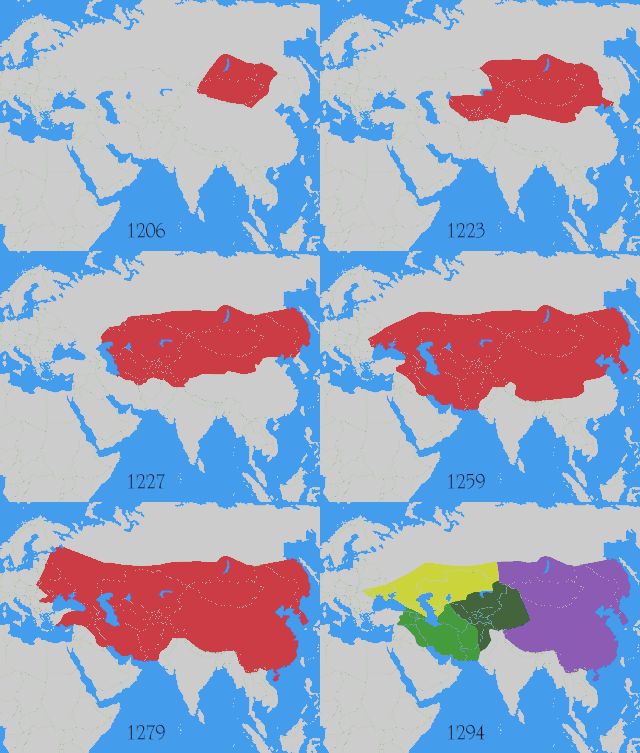 The expansion of the Mongol Empire Golden Horde Chagatai ulus The State of the Hulaguids Empire Yuan | |
- 1207-11 subjugation of many peoples of Siberia and East Turkestan
- 1211–34 the conquest of North China
- 1215 conquest of the Seven Rivers
- 1219-21 the conquest of Central Asia
- 1222-23 hiking in the Caucasus and the North Caucasus
- 1223 battle on the Kalka river
- 1231-1273 years. the conquest of Korea
- 1232 defeat of the Volga-Kama Bulgaria
- 1237-1241 the invasion of Khan Batu (Batu) in Russia
- 1241–42 wars in Poland, Hungary, the Balkans
- 2nd half of the 13th century seizure of territories in East and Southeast Asia [1]
East Asia
China
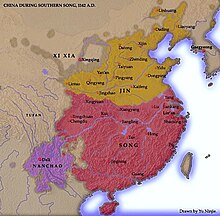
The Mongol-Jin War (1209-1234) - the war between the Mongol Empire and the Jurchen state of Jin, which ended in the defeat of the Jin power and the establishment of Mongolian control over the territory of modern northern China. The beginning of this stage of conquest can be dated to 1209. In 1211, the Mongol forces led by Genghis Khan opposed the Jurchen state of Jin (now Northern China), which could not resist the Mongols. By 1215, the state was almost completely conquered, Yanjing was taken.
The Mongol conquest of Si Xia - the fighting between the Mongol empire and the state of Si Xia , culminating in the defeat of the Tangut power and the inclusion of its territory in the Mongol state. In 1226, Genghis Khan begins a campaign against the Tangut state of Xi Xia , in 1227 it was completely destroyed. On the way back, Genghis Khan died. After him, Ugadei became ruler , who in 1231, together with Toluy, led troops to the Jin empire. Having concluded a temporary alliance with him against South Song, by 1234 they jointly seek the defeat of the Jin state.
The Mongol conquest of the South Song empire (1235–1279) - the fighting between the Mongol empire and the Chinese state of South Song, which ended with the destruction of the Chinese state and the inclusion of its territory in the Yuan empire. In 1235, the war of the Mongols with the Song empire begins. Initially, active hostilities declined in the forties. In this region, the Mongols concentrated on the war with other states ( Dali , Vietnam ). In 1258, a new attack was launched on the Song, but the Chinese put up stubborn resistance, and the death of the Mongol commander Munke forced them to leave. Khan Hubilai began the campaign in 1267, besieged the cities of Xianyang and Fancheng , taken in 1273. After which the offensive continued. On March 19, 1275, the Chinese army was defeated in a decisive battle near Dingjiazhou , after which the Mongols easily continued to seize the territory. In 1276 they captured the capital of Linan and the emperor. In 1279, the Mongols defeated the last resistance forces in Yaishan , thus ending the conquest of China.
The Mongol conquest of the state of Dali - the fighting between the Mongol empire and the Bai state of Dali , culminating in the destruction of Dali and the inclusion of its territory in the Mongol empire. The Mongol offensive on three sides began at the end of October 1253. Gao Taishian, who refused to surrender to the Mongols, gathered his troops in a single fist on the banks of the Jinshajiang River and expected the enemy to approach. Khubilai’s troops reached the opposite bank of the river in November. Khubilai instructed Bayan to build a floating bridge from the sacks to cross the river. Bayan, having made a night throw across the river, took the enemy by surprise and quickly inflicted complete defeat on him, having killed a significant part of the enemy army and forced Gao Taishian to flee to the capital [2] [3] .
Korea
In the period from 1231 to 1259 there were six main invasions of the Mongol Empire against Korea ( Koryo ). As a result of these invasions, Korea suffered significant damage and it became a tributary of the Mongol Yuan Dynasty for the next 80 years.
In 1225, the Mongol empire demanded tribute from Koryo, but was refused, and the Mongolian ambassador Chu Ku Yu was killed. In 1231, Khan Ugedei launched an invasion of Koryo, which was part of the Mongolian operations to seize the northern Chinese territories . The Mongols reached Chunju in the central part of the Korean Peninsula , but after several battles the offensive was stopped.
In 1235, the Mongols began a new campaign on Koryo, devastating the provinces of Gyeongsangdao and Chollado . Resistance was stubborn, the king seriously strengthened his castle on the island of Kanghwado, but the army of Koryo could not cope with the conquerors. In 1238, Koryo surrendered and requested a truce. The Mongols retreated in exchange for an agreement that Koryo would send the royal family to Mongolia as hostages. However, Koryo sent dummies instead of members of the royal family. Opening the trick, the Mongols began to insist on banning Korean ships from going to sea and on arresting and executing anti-Mongol activists. Koryo had to send one of the princesses and ten children of the nobility to Mongolia. The remaining claims were rejected.
In 1247, the Mongols launched their fourth campaign against Koryo, insisting on the return of the capital from Kanghwado to Kaesong . With the death of Khan Kuyuk in 1248, the Mongols retreated again. Until 1251, the year Khan Munke ascended the throne, the Mongols repeated their demands. After the failures of Koryo, they began a new large campaign in 1253. Kojon finally agreed to move the capital back and sent one of his sons, Prince An Gyeonggon (安慶公), to Mongolia as a hostage, after which the Mongols retreated. Upon learning that most of the Korean nobility remained in Kanghwado, the Mongols began a new campaign on Koryo. Between 1253 and 1258, they carried out a series of attacks against Korea. After a series of battles, the Mongols surrounded Kanghwado and in December 1258, Koryo finally surrendered.
Burma
The Mongol conquest of Burma took place in the second half of the 13th century and included several invasions of the troops of the Mongol Empire into the kingdom of Pagan . In 1277, the troops of Burma advanced against the Kaungai District, whose head declared himself a subject of Khubilai . A Mongol garrison of 700 men came out to meet them, supporting up to 12 thousand local representatives of the Thai people. The battle between the Mongols and Burmese ended in the defeat of the latter. In November 1277, a Mongol detachment invaded Burma and defeated their army, but was forced to leave due to the heat and malaria. This invasion led to the fall of the Bagan kingdom, which fell into two parts: in the north there remained the Thai people, and in the south - the mon tribes.
In 1283, a Mongol army of up to 10,000 left the Sichuan province to subjugate the kingdom of Bagan. Near Bamo, they easily defeated the army of Burma, King Naratihapate fled with a handful of associates and was forced to hide in the mountains. Due to defeat, he lost authority among his subjects and received the nickname "the king who escaped from the Chinese." As a result, when Khubilai organized another campaign in 1287, Naratihapate was killed by his son Tikhat. The Burmese were not capable of resistance and the Mongols seated the puppet ruler on the throne, however, the former kingdom of Bagan finally disintegrated and passed into the period of feudal fragmentation, which lasted until the middle of the XVI century. North Burma recognized the power of the Yuan Dynasty, and then was captured by the Shans , who organized an uprising in 1299, killing the puppet ruler and about 100 governors. The Shans also managed to repel the punitive detachment in 1300, and pay off in 1301, but later the ruler of North Burma began to ask for pardon and was forgiven, and his dependence on the Yuan Empire was restored.
Japan
Attempts to invade the Mongols in Japan were made by the Mongol-Korean-Chinese empire of the grandson of Genghis Khan Khubilai twice: in 1274 and 1281 . Both times in a short time powerful invasion fleets were created, the second of which was the largest in the history of mankind before Operation Overlord of World War II . However, those who had no experience in navigation, navigation and sea battles, and also did not know enough shipbuilding technology, the armada of the continental empire were both scattered both by a slightly more maneuverable Japanese fleet and defensive forces, and mainly by strong winds. The invasion failed. According to legend, the strongest typhoons that arose during the landing of the invaders on the Japanese islands and destroyed most of the ships were called by the Japanese historians " kamikaze ", which means "divine wind", making it clear that this is divine help to the Japanese people.
During the first attack in 1274 , the Mongolian-Korean fleet with up to 23-37 [4] thousand men was operating. The Mongols easily defeated the Japanese troops on the islands of Tsushima and Iki and devastated them. Then they approached the island of Kyushu and launched an attack, which included shelling from flamethrowing guns. However, the typhoon began, in addition, Commander-in-Chief Liu died, as a result of which the Mongols were forced to retreat. [five]
Khubilai began to prepare for a new attack . The Japanese also did not waste time - they built fortifications and prepared for defense. In 1281, two Mongolian-Korean-Chinese fleets - from Korea and from South China - sailed to Kyushu Island. The fleet reached 100,000 people. The first to arrive was a small eastern fleet, which the Japanese were able to repel. Then the main fleet sailed from the south, but the repeated story of the typhoon destroyed most of the conqueror's fleet. [five]
India
The Mongol invasions of India included a series of attacks by the troops of the Mongol Empire on the Delhi Sultanate , which occurred in the 13th century . For the first time, the Mongols entered the territory of the Delhi Sultanate in 1221, pursuing the army of the Khorezm ruler Jalal ad-Din , who had previously defeated the Mongolian detachment at the Battle of Parvan . On December 9, a battle took place on the Indus River , in which the army of Jalal ad-Din was defeated. After that, the Mongols devastated the areas of Multan , Lahore and Peshawar and left India, capturing about 10,000 prisoners.
In 1235, the Mongols captured Kashmir [6] , leaving the governor there, but the rebellious Kashmiris expelled the invaders in 1243 [7] . In 1241, they invaded India and captured Lahore. In 1246, Multan and Uch. In 1253, Kashmir was conquered a second time by the Mongols [7] .
In 1254–1255, the Kashmiris revolted, which was crushed [8] . After that, for other purposes, the Mongols temporarily stopped major operations against India, and its rulers used this to return the occupied territories, as well as to increase their defenses. Sultan Ala ud-Din Khalji introduced the “mobilization economy” in the 1290–1300s and strengthened the army, largely modeled on the Mongolian organization [9] .
In the 90s of the XIII century, raids resumed from the Chagatai ulus . In 1292, they invaded the Punjab , but the vanguard was defeated, and the sultan managed to pay off the rest of the army. Later, the Mongols organized a series of invasions of northern India. In 1297, in a major battle near Delhi, the Mongols defeated the Indians, but retreated due to heavy losses [10] . In 1299, Ala ud-Din Halji made a trip to the ulus. After a long retreat, the Mongols attacked and defeated part of his troops, the Indian general Zafar Khan was killed. After that, the Mongols made a quick attack, reached Delhi and devastated the city itself and its surroundings; Ala ud-Din could only sit out in the fortress of Siri for about 2 months. After that, the sultan built new fortifications and strengthened the army. However, the Mongols managed to burn and plunder the Punjab and its environs during the next raid. But later, as a rule, they failed to achieve such successes. In 1306, under the leadership of Kebek, they carried out an invasion. The detachment crossed the Indus near Multan, but suffered a major defeat from the ruler of the Punjab. According to overstated Indian data, up to 50,000 people were captured. In 1307-1308, the last invasion took place, which was also repelled. After this invasion ceased, although during the fourteenth century there were still separate attacks by pro-Mongol states.
Java
In 1289, Ambassador Khubilai Meng Qi arrived in Java, and demanded that Kertanagara, the ruler of the state of Singasari, express his humility. In response to this demand, Kertanagar ordered the ambassador's face to be burned. This incident gave occasion to Khubilai to begin preparations for a military campaign in Java . Mongol Shibi, Chinese Gao Sin and Uigur Ikemusa were ordered to gather troops and supplies in the provinces of Fujian , Jiangxi and Huguang (modern Hunan and Hubei ). Shibi was entrusted with the supreme leadership, Gao was appointed commander of the ground forces, and Ikemusi was to lead the fleet. Kertanagara, notified of the impending threat, suggested that the Mongols would move through Champa and the Malacca Peninsula , and sent significant forces there. He did not expect the Mongols to assemble a large fleet and go directly to Java.
At the end of 1292, the 20,000th army went to sea from Quanzhou in 100 ships. She brought with her an annual supply of grain and 40 thousand lan silver for the acquisition of additional reserves. In early 1293, Gao Sin's troops landed in Java; Ikemusi ships remained offshore. Since the bulk of Kertanagara’s army was far from Java, he was in an extremely vulnerable position, making it possible to raise his head to the pacified and unconquered Javanese. One of their leaders, Jayyakatwang, the head of the rebellious state of Kediri , defeated his troops and killed him. The state of Kertanagara passed to his son-in-law, Prince Vijaye. Setting out to avenge the murder of his father-in-law, Vijaya proposed to express humility to the Mongols in exchange for help in the fight against impudent rebels. His subordinates supplied the Yuan troops with important information about the ports, rivers and topography of Kediri, as well as a detailed map of the province. The Mongols accepted the offer and agreed to enter the war with Jayyatkavang. The Sino-Mongolian fleet went to Kediri and defeated the naval forces sent against him along the way. Gao Sin landed at Kediri, and in a week the Mongols broke the resistance of the defenders.
Vijaya asked that he be allocated 200 unarmed Mongol soldiers as an escort, so that he could go to the city of Majapahit , where he was going to formally bring declarations of humility to the representatives of the great khan. The chiefs of the Mongols agreed to fulfill this request without suspecting something was amiss. On the way to Majapahit, Prince’s detachments ambushed the Sino-Mongolian escort and secretly surrounded the main forces of the Mongols. They acted so successfully that Shibi barely saved his life. He had a long way to go to his ships; during the retreat, he lost 3 thousand people. When all the expedition leaders gathered to decide what to do next, they could not come to a consensus. As a result, diverging in views, they took their fleet and moved back to the shores of China.
Dayviet and Tampa
The Mongol invasions of Dayviet and Tampa are three military operations during which the Mongol Empire , which had conquered China by then, invaded the territory of the states of Dayviet ( Chiang Dynasty ) and Tampa , located on the territory of modern Vietnam . These invasions took place in 1257-1258, 1284-1285 and 1287-1288. The Mongols were defeated by the Dayviet state and were forced to withdraw their troops from Dayviet and Tampa [11] . As part of the agreement, both states agreed to recognize themselves as subordinates of the Mongol Empire and pay tribute to it, but in practice not a single head of Daiviet personally appeared to honor Khubilai’s court.
Central Asia
The Mongol conquest of Central Asia took place in two stages. In 1218, the Mongols defeated their old adversary, Kuchluk , who had recently become the gurkhan of the Kara-Khitan state , and the Kara-Khitan territory was divided between the Mongol empire and Khorezm . By the fall of 1219, the war with Khorezm began, which lasted until the spring of 1223 . During this period, the main part of the state of Khorezmshahs from the Indus to the Caspian Sea was conquered. The last Khorezmshah Dallaliddin Manguberdy , who for several years resisted the Mongols , was eventually defeated and died in 1231 .
Conflict Background
After conquering the main part of the Jin empire, the Mongols began a war against the Kara-Khitan Khanate , defeating which established the border with Khorezmshah Muhammad ibn Tekesh . Khorezmshah Urgench ruled over the huge Muslim Khorezm state , stretching from North India to the Caspian and Aral Seas, as well as from modern Iran to Kashgar . While still at war with the Jin empire, Genghis Khan sent ambassadors to the Khorezmshah with a proposal for an alliance, but the latter decided not to stand on ceremony with the Mongolian representatives and ordered them executed.
The beginning of the war
In 1219, Genghis Khan personally went on a campaign with all his sons and with the main military forces. The conquering army was divided into several parts. One was commanded by his sons Chagatai and Ogedei , left by the father to besiege Otrar ; the second was headed by the eldest son - Jochi . His main goal was to conquer Sygnak and Jenda . The third army was sent to Khojent . The main forces led by Genghis Khan and his son Toluy were to capture Samarkand .
The siege of Otrar by the forces of several tumens began in September 1219 and lasted about five months. Kaiyr Khan , knowing that the Mongols would not spare him, defended himself fiercely. The betrayal of one of the military leaders accelerated the fall of Otrar. Coming out of the city gates at night, he surrendered to the Mongols. Through the same gate the besiegers burst into the city. Part of the troops and residents locked themselves in the fortress and continued to defend themselves. Only a month later, the Mongols were able to take the citadel. All her defenders were killed, the fortress was destroyed, Kayyr Khan was executed, and the city was razed after the plunder. The captives ( hashar ) from Otrar were then used in the assault on Khojent and Samarkand .
The Juchi detachments, which made campaigns along the Syr Darya, in the spring of 1220 approached Sygnak. The siege lasted seven days, after which the Mongols broke into the city and destroyed all its fortifications. For a short time, the Mongols obeyed Uzgen, Barchynlykent and Jend. A 10,000th unit took Yangikent and headed to the lower reaches of the Syr Darya [12] , mobilized 10,000 Turkmens there. They rebelled, were partially defeated, and partly retreated south, in the direction of Merv . The main forces of Jochi are located in the Jenda area.
In 1220, the third army of 5 thousand people. took Benakent and surrounded Khojent , also located on the Syr Darya. During the siege, the number of Mongolian troops increased to 20 thousand people, the number of prisoners used in the siege - up to 50 thousand people. Timur-Melik , who led the defense of the island fortress, sailed down the Syr Darya. The Mongols organized the persecution, and when Timur-Melik reached the area of Juchi's troops, he was forced to land on the left bank of the river and was able to escape the pursuit in battle, then kill the Mongol governor in Yangikent.
The fourth army, led by the ruler of the Mongols and his son Toluy, approached Bukhara (according to various sources, the garrison was 3,000 or 20,000), which after a short siege fell into the hands of the Mongols in March 1220. Residents were brutally abused, and the city was plundered, destroyed and burned by the Mongols, captives were sent to the siege of Samarkand. Leaving Bukhara in ruins, Genghis Khan headed for Samarkand along the Sogdiana valley (according to various sources, the garrison was 40 thousand or 110 thousand; 20 fighting elephants). On the third day, part of the clergy opened the gates to him and surrendered the city without a fight. 30 thousand Kangl warriors who were the backbone of the Khorezmshah Muhammad and his mother Turkan Khatun were executed by the Mongols. [13]
The same thing happened in the city of Balkh . But in neither case, voluntary surrender did not save the residents of the city from violence and robbery. According to the Chinese pilgrim Chang Chun, only 50 thousand were left alive from the 400 thousandth population of the city of Samarkand.
Without a fight, Muhammad, having lost the war and having no support , fled to one of the deserted islands of the Caspian Sea, where he died in the village of Astara in February 1221 , transferring power to his son Jalal-ad-Din . Three tumens , led by Jaebe , Subaedei-Bagatur and Tohuchar-noion, pursued Muhammad. Passing through the possessions of Khan-Melik , Tohuchar, in violation of the preliminary agreement, began to rob and capture the inhabitants, as a result of which he was defeated by Khan-Melik (killed or, according to the “Secret Tale”, after returning to Genghis Khan demoted).
Genghis Khan did not go further than Samarkand, but sent Toluy with the 70,000th army to conquer Khorasan , and at the beginning of 1221 the 50,000th army of Jochi, Chagatai and Ugadei approached the capital of Khorezm - the city of Urgench . After a seven-month [14] siege, the Mongols took him, defeated him, and captured the inhabitants. Then Genghis Khan instructed Jochi to continue the conquests in Eastern Europe [15] , where his troops were to join [16] with the Jebe and Subadai sent there , but he declined to fulfill it.
Conquest of Eastern Iran
Meanwhile, Toluy, together with his army, entered the province of Khorasan and stormed Nessa, after which he appeared in front of the fortress walls of Merv . Near Merv, captives from almost all the cities previously captured by the Mongols were used. Using the betrayal of the inhabitants of the city, the Mongols captured Merv and, in their usual manner, plundered and burned the city in April 1221 .
From Merv, Tolui went to Nishapur . For four days its inhabitants fought desperately on the walls and streets of the city, but the forces were unequal. The city was taken, and, with the exception of four hundred artisans left alive and sent to Mongolia, the remaining men, women and children were brutally murdered. Herat opened his gates to the Mongols, but this did not save him from ruin. At this stage of his advancement in the cities of Asia, Toluy received an order from his father to join his army in Badakhshan. Genghis Khan was going to, after a short break, during which he captured Ghazni, resume the persecution of Jalal-ad-Din, who, having gathered a 70,000th army, defeated the 30,000th Mongol detachment led by Shigi Kutuku under Pervan . Genghis Khan, who at that time was connected by the siege of Talcan, soon took possession of the strong city and could himself with the main forces oppose Jalal ad-Din; its rear was provided by the Toluya detachment in Khorasan. The leader of the Mongols at the head of the 30,000th army [17] overtook Jalal-ad-Din in December 1221 on the banks of the Indus River . The Khorezm army consisted of 50 thousand people [17] . The Mongols carried out a roundabout maneuver in rugged rocky terrain and struck the Khorezmians on the flank. Genghis Khan also introduced into the battle the elite guards unit "Bagatura". The army of Jalal-ad-Din was defeated, and he himself was sailed with 4 thousand soldiers.
In pursuit of the young Sultan, who fled this time to Delhi , Genghis Khan sent a 20-thousand army. Devastating the provinces of Lahore, Peshawar and Melikpur, the Mongols returned to Ghazni. For another 10 years, Jalal-ad-Din fought with the Mongols until he died in Anatolia in 1231 .
For three years (1219-21), under the blows of the Mongols, the kingdom of Muhammad Khorezmshah fell, stretching from the Indus to the Caspian Sea, its eastern part was conquered.
Jabe and Subaday Campaign
The campaign under the command of Jaebe and Subaedei ( 1220 - 1224 ) began on the orders of Genghis Khan as a pursuit of the Khorezm sultan Al ad-Din Muhammad II . After the death of Khorezmshah, the campaign was directed against the states of the Caucasus and Eastern Europe.
Caucasus
In the winter of 1220, the Mongols went to the coast of the Caspian Sea, to the Mugan steppe . On the way there, they took Ardabil and approached Tabriz , who paid off with “money, clothes and cattle”, and after that there were two battles with the Georgians. In the first 10 thousandth army of Georgians was defeated. In January 1221, the second battle took place, in which the combined forces of the Mongols and the Turk of Akush inflicted a new defeat on the Georgians. Kirakos Gandzaketsi tells the story of the battle in the Hunan Valley, between the rivers Khrami and Akstafa , when the Georgian king George IV and the military commander Ivane Mkhargrdzeli put the enemy to flight, but after the attack of the ambush detachment of the Mongols, the Georgians were forced to retreat [18] . According to A. G. Galstyan, there was only one battle - at the end of 1220 in the Hunan Valley (otherwise - Kotman) [19] .
In spring, the Mongol commanders, having received a second tribute in Tabriz, took Maraga (March 30, 1221) and Nakhichevan . Atabek expressed humility and received al-tamga and wooden payzu . In August-September, the Mongols returned to Hamadan to suppress the uprising of the townspeople who killed the appointed governor. According to Rashid al-Din, when they learned about the death of Muhammad and the flight of his son Jalal al-Din to Khorasan, Jabe and Sub-eday sent the news to Genghis Khan (when it happened, it is unclear). According to J. Boyle , the pursuit of the Sultan was only the first stage of the campaign [20] .
The Mongols, having entered Arran , captured Baylakan (Ramadan 618 CE / October-November 1221 AD) and without a fight took tribute from Ganja . After another invasion of Georgia, they approached the Shamakhi in Shirvan . Having taken the city by storm and plundered it, the Mongols through the Derbent passage penetrated the North Caucasus . Devastating the lands of Lezgi peoples, Laks and Dargins , they invaded Accident . Avars led by nutsal blocked the way to the conquerors. All attempts by the Mongols to conquer Avaria were unsuccessful. Then they decided to conclude an alliance with the Avars, which "was based on friendship, harmony and fraternity", supported by the same thing and the bonds of dynastic marriages [21] . Bypassing Avaria, the Mongols encountered the combined forces of the Alans and Kipchaks - Polovtsy . Not having achieved success in the first clashes, the Mongols resorted to cunning. Saying "we are of the same kind", the Noyons presented the Polovtsy and promised not to attack if they left the Alans. The Polovtsians dispersed to their nomads. Having thus split in the ranks of the enemy, the Mongols defeated the Alans, and then attacked the Polovtsy, who did not expect this. [22] The khans Yuri Konchakovich and Danila Kobyakovich died in the clash, and the remnants of their hordes moved west and merged with the horde of Kotyan , who roamed between the Dnieper and the Dniester [23] . The Mongols invaded Crimea , where they took the city of Surozh ( Sudak ).
2) Daniil Volynsky;
3) Mstislav Udatny;
4) Oleg Kursky;
5) Mstislav Chernigov;
6) Mstislav the Old;
7) Subedei and Jaebe.
Battle of Kalka
In 1223, a battle broke out on the Kalka river between the combined Russian-Polovtsian army and the Mongol corps. At the beginning of 1223, a princely congress was convened in Kiev , deciding that the forces of the Kiev, Galitsky, Chernihiv, Seversky, Smolensky and Volyn principalities should support the Polovtsy. The Mongolian envoys invited the Russians to oppose the Polovtsy, but Mstislav executed the ambassadors. However, the Mongols managed to win over the wanderers who inhabited the southern Russian steppes.
The Mongol guard detachment on the left bank of the Dnieper was defeated, and after 8-9 days, the Russian-Polovtsian army approached the Kalka River in the Sea of Azov , where it encountered the main enemy forces. Mstislav Udatny, not notifying the other princes, decided to deal with the Mongols on his own and crossed over to the other shore with the Polovtsy, led by his governor , and the Volyn squads. On May 31, 1223, all of them, as well as Chernihiv, were completely defeated. The prince of Kiev, having fenced in a tyne on the elevated opposite bank of the Kalka, held the defense for three days after the battle. Then, believing the promise of the governor of the Wanderers of Ploschyn to release the princes alive, he left the fortification. However, he, his princes and governors were captured by the Mongols and crushed by the boards on which the Mongol commanders sat down to feast. After the victory, the Mongols chased the remains of the Russian-Polovtsian army to Svyatopolch , ruining the border cities.
During the return to the east, the Mongols were defeated in the Volga Bulgaria at the end of 1223 or the beginning of 1224. According to Ibn al-Asir, from the Mongol side, 4 thousand people survived in this battle. Through Saksin , located, presumably, on the Lower Volga , they proceeded to Desht-i Kipchak , where they connected with the army of Jochi .
Anatolia
From 1241 to 1243 there was a quick and rather successful conquest of the territory of Anatolia . After the defeat of the Seljuk army in the battle of Köse-dag in 1243, the territory was controlled by the Mongols until 1335 [27] . Due to several rebellions against the Seljuk Sultan, in 1255 the Mongol horde easily overcame central and eastern Anatolia. In Turkey , you can still find traces of the cultural heritage of the Mongols, in particular the burial of various rulers, in particular the son of Hulagu .
By the end of the 14th century, most of the territory of Anatolia was under the control of various beyliks until the collapse of the Seljuk dynasty. Turkmen Beiliks also recognized themselves as vassals of the Mongol khans, remaining virtually independent rulers of the regions [28] [29] . They did not mint coins with the image of their own rulers, right up to Osman I , who issued small silver coins named acce , on the model of Ilkhanov coins with their own image [30] . In accordance with Islamic traditions, coin printing was the prerogative of sovereigns , thereby declaring Osman I independence from the Mongol Khanate [31] . There is an opinion that the Ottomans continued to some extent pay tribute to the Mongolian Ilhans until 1335 , that is, they achieved complete independence only after the death of Osman.
Middle Eastern Campaign
The Middle East campaign under the command of Khulagu ( 1256 - 1260 ) was one of the largest military campaigns of the Mongolian army, directed against the Iranian Ismailis - Nizaris , Caliphate Abbasids , Syrian Ayyubids and Mamelukes of Egypt ; since the Central Asian Nestorian Christians played a large role in actions against Middle Eastern Muslims, it was called the Yellow Crusade by some historians ( R. Grusset , G. V. Vernadsky , L. N. Gumilyov ).
Nizari
In 1256, the Mongols defeated the Nizari. In January 1256, Hulagu, replenishing his army with the Jochid units provided by Sartak , forced the Amu Darya and besieged the Nizari fortresses in Kuhistan ( Elburs ). Not relying solely on military strength, Hulagu launched a diplomatic offensive, demanding surrender from the Nizari imam Rukn-ad Din Khurshah . Among the Ismailis there was a pro-Mongol party, to which the famous Persian scholar Nasir al-Din at-Tusi and the doctor Muwaffik al-Doule belonged. Under the influence of this party, Khurshah agreed to surrender the fortress in exchange for the preservation of life and possessions. However, as soon as Khulagu felt that Khurshah was trying to gain time and drag out negotiations, he began the assault on the Meimundiz fortress, in which the imam was located. As a result, Khurshah was forced to surrender. Most Ismaili fortresses in Kuhistan surrendered without a fight during the year and were destroyed. Only a few, including the famous Alamut , who capitulated on December 15, 1256 , showed little resistance. The most difficult was the Mongols during the siege of Hirdekukh , which lasted for years.
Baghdad
Ending the Nizari, in 1258 Hulagu moved to Baghdad . He demanded obedience from the Baghdad caliph al-Mustashim . The Caliph, arrogantly rejecting the ultimatum of the Mongol commander, did not have, however, the strength to resist him. The Abbasid field army under the command of Fatah al-Din ibn Kerr was defeated on the banks of the Tigris by the Baiju forces. At the beginning of 1258, Hulagu, Baiju and Kit-Bug completed the encirclement of Baghdad. First, siege weapons came into action, and then the assault began. By mid-February, the city was in the hands of the Mongols. In the same period, Noyon Uruktu was sent to take the city of Irbil . Its ruler Taj ad-Din ibn Salaya submitted to the Mongols, but the Kurds defending the fortress refused to surrender. A long siege did not bring success. Only the summer heat forced the Kurds to leave Irbil, and it was occupied by the ally of the Mongols Badr ad-Din Lulu , Atabek Mosul .
Syria
After the conquest of Baghdad, the Syrian campaign of the Mongols began. Having settled in the vicinity of Maragha in Azerbaijan, Hulagu began to receive Muslim rulers who arrived to express humility, in particular Badr al-Din Lu'lu, Atabek Sa'd from Fars , the brothers Izz al-Din Kay-Kavus II and Rukn al-Din Kilich- Arslan IV of the Koni Sultanate . Badr al-Din Lu'lu sent his son Salih to the service of the Hulag. On September 12, 1259, the Hulagu army marched west. At the forefront were Kitbuki forces, on the right wing - Baiju and Shiktur, on the left - Sunjak, the center was commanded by Khulag himself. The Mongols occupied Akhlat , defeated the Kurds in the surrounding mountains. Salih was sent to conquer Amid (now Diyarbakir ), and Hulagu captured Edessa . Then Nishibin and Harran were taken.
The Mongols crossed the Euphrates and called on the governor of Aleppo ( Aleppo ) al-Muazzam Turan Shah III to surrender the city. In response to the refusal on January 18, 1260, they besieged Aleppo. The troops of Christian allies of Hulagu - Getum Armenian and Boemund of Antioch also participated in the siege. The city was occupied a week, but the citadel held out until February 14 (according to other sources, February 26). After its capture, the Mongols staged a massacre that was stopped six days later on the orders of Khulag. Of the defenders of the citadel, only one Armenian goldsmith was left alive. Hetum burned the Aleppo mosque, preserving the Jacobite church. Hulagu returned to the Armenian king some areas and castles taken from him by the Aleppo rulers. Bolemund was given the land of Aleppo, which was in the hands of Muslims from the time of Salah ad-Din . On January 31, the Ayyubid Sultan al-Nasir Yusuf , learning of the fall of Aleppo, retreated with an army from Damascus to Gaza . Damascus surrendered to the Mongols without a fight, and on February 14 (according to other sources - March 1) Kitbuk entered the city, appointing a Mongol manager there.
In early September 1260, a battle broke out at Ain Jalut between the army of Egyptian Mamluks under the command of Sultan Kutuz and Emir Beibars and the Mongol corps from the army of Hulagu under the command of Kitbuq - Noyon . After receiving news of the death of the great khan, Munke Khulagu with the main part of the army retreated to Transcaucasia (June 1260). Relatively small forces were left to the Kitbook (10–20 thousand [32] or even 10–12 thousand [33] including reinforcements from allied Armenians and Georgians ). Hulagu left his commander with such a small army and ordered him to conquer the Ismaili fortresses in northern Syria.
Palestine
The Kitbuk continued its conquest from Syria to the south - to Palestine , capturing Baalbek , al-Subeyba and Ajlun [34] , the Mongols entered Samaria and brutally cracked down on the Ayyubid garrison of Nablus . Then the Mongol detachments unhindered occupied Gaza , the Ayyubid Sultan al-Nasir Yusuf was captured and sent to Khulag, the Mongol garrisons of 1,000 people were stationed in Gaza [35] [36] [37] and Nablus [38] . An army of Egyptian Mamluks under the command of Kutuz and Baybars I moved towards Kitbook. On September 3, 1260, at the battle of Ain Jalut, the Mongolian army was defeated. Kitbug was captured and executed.
Western Campaign
The western campaign of the Mongols in Eastern and Central Europe , led by Genghisides Batu and the military commander Subedey took place in 1236 - 1242 .
Volga Bulgaria
The Mongol conquest of the Volga Bulgaria took place from 1229 to 1239 and ended with the inclusion of the territory of the Volga Bulgaria in the Golden Horde . In 1229, the Mongols, under the command of Subedei and Kokoshai, defeated the Bulgars border detachment on the Ural River . A few years later, in 1232 , the Mongol cavalry conquered the southeastern part of Bashkiria and occupied the southern part of the Volga Bulgaria itself. In 1235, the Mongolian kurultai decided to strengthen the Subedei corps with the forces of all the uluses , and a new Mongol invasion of the Volga Bulgaria occurred in the autumn of 1236. The strength of the Mongol army of 120-150 thousand among historians is the most popular [39] [40] . Mongolian troops led by Batu besieged and captured Bilyar , Bulgar , Suvar , Dzhuketau and a number of other cities and fortifications of the Volga Bulgaria. During the Mongol campaign in North-Eastern Russia (1237/38), the Bulgars led by the nobility revolted. But the main forces of the Mongols, who returned to the Middle Volga region next winter, managed to suppress the rebellious Bulgars and their vassals.
Russia
The Mongol invasion of Russia took place in 1237-1241. during the Western campaign of the Mongols 1236-1242. led by Genghis Batu and military commander Subedei [41] .
In the fall of 1236, the entire Mongol army was divided into four parts, three of which were preparing for the invasion of Russia. After the defeat of the troops of the Principality of Ryazan, the Mongols captured Ryazan on December 21, 1237 , after the battle of Kolomna with the combined forces of North-Eastern Russia in early January 1238 , in which the son of Genghis Khan Kulkhan died, Kolomna fell. Then the rearguard of the Mongolian army experienced the blow of Eupatius Kolovrat, who returned from Chernigov . The most stubborn resistance to the Mongols was provided by Moscow (taken on January 20), Vladimir (February 7), Pereslavl-Zalessky , Tver , Torzhok (March 5), Kozelsk (early May 1238 ). In early March 1238, the Mongol corps under the command of one of their largest commanders, Burundai, due to the suddenness factor, was able to destroy the United Russian army in the parking lot and kill Grand Duke Yuri Vsevolodovich Vladimirsky in the Battle of the City . After a long siege and capture of Torzhok, the Mongols did not go to Veliky Novgorod and returned back, ruining Chernigov and Smolensk lands. In the spring of 1238, after the capture of Kozelsk , the Mongols retreated to the southern Russian steppes for fattening horses and regrouping.
Since the main opponents of the Mongols east of the Dnieper had already been neutralized, Batu decided to divide his troops into several corps, each of which, acting independently, solved local tasks to eliminate the remaining centers of resistance. Perhaps it was in the summer of 1238 (and not in the summer of 1237 ) that Munke and Buchek suppressed the Polovtsian uprising and defeated the Alans .
At the end of 1238, the troops of Munke , Kadan , Guyuk and Storm launched an offensive on the city of Minkas ( MKK , Mikes [42] ). In the summer of 1238, Shiban , Butchek and Storms took a campaign in Crimea, where: “ Tatkara was captured from the Chinchakan tribe (Kipchaks?) ” [43] . In the summer of the same year, in 1238, Batu Berke , the independently acting brother, captured three Polovtsian military leaders.
With the onset of 1239, sources record the return of Mongol interest in the forest-steppe region, where they consistently inflict a number of strong blows throughout the entire length from the Dnieper to the Volga. March 3, 1239 the Mongols stormed Pereyaslavl-Yuzhny ("Pereyaslavl Rusky") - the possession of the Vladimir princes in Southern Russia. Cathedral Church of St. Michael was destroyed, and Bishop Simeon was killed.
In the fall of 1239, the Mongols (possibly [44] [45] , under the leadership of Munke ) struck the Chernigov Principality . Not hoping for his strength, Mikhail Vsevolodovich fled first to Hungary , trying to woo the daughter of the Hungarian king Bela IV Anna for his son Rostislav (unsuccessfully), and then to Poland to Konrad Mazowiecki . From there, reconciled with Daniil Galitsky , he already in 1240 returned to Russia and stopped in Lutsk .
Not later than October 18, 1239 Chernigov was taken. During the siege, an army led by cousin Mikhail Vsevolodovich , Rylsky prince Mstislav Glebovich , tried to break through to help the city, but was defeated. Lands and cities along the Desna and the Seimas were plundered and devastated, including Putivl , Glukhov , Vyr, and Rylsk [39] . According to archeology, Gomel was also burned [46] .
In the winter of 1239-1240. according to the Laurentian Chronicle , a new campaign in the Volga-Oka region took place. The objective at this stage was probably the land of Erzi , whose prince refused to submit to the Mongols back in 1236.
Judging by the silence of the sources, having dealt with their opponents east of the Dnieper, the Mongols paused. The corps under the leadership of Bukday in the spring of 1240 was sent through Derbent to the south, to help the Mongol forces operating in the Caucasus . Around the same time, Batu decided to send home Munke , Guyuk and Storms , relations with which he did not work out. In the summer of 1240 they were already in Mongolia, and the remaining troops regrouped, replenished a second time at the expense of the Polovtsy and Volga peoples [39] .
The next goal of the Mongols was the Russian lands on the right bank of the Dnieper. By 1240, most of them ( Galitsky , Volyn , Kiev , and, presumably, the Turo-Pinsk principalities ) were united under the rule of the sons of the Volyn prince Roman Mstislavovich : Daniil and Vasilka .
Not counting himself able to independently resist the Mongols, on the eve of the invasion (that is, around the fall of 1240), Daniel went to Hungary , probably trying to persuade King Bela IV to help him, but achieved nothing. He later moved to Poland: first to Sandomierz (where he met with his family), and then to Mazovia , to his ally Konrad . Daniel Vasilko’s brother also appeared there. In Mazovia, the princes remained until they learned about the departure of the Mongols from their lands.
The first point on the way of Batu was Kiev . In the autumn of 1239, during the conquest of the Chernigov Principality , Munke approached the Dnieper opposite Kiev . At that time, the city of Chernigov, Prince Mikhail Vsevolodovich, who controlled the city, responded with a refusal to the Mongol peace offerings. A new attempt to seize Kiev was made by the Mongols almost a year later. In the autumn of 1240, Batu again gathered his fist at his disposal. The Mongols began their offensive with the conquest of the Piglands , an area dependent on the Kiev princes of the Black Klobuk . After the Piglets, Mongol troops besieged Kiev [39] [44] .
The fall of Kiev was a landmark event - among the ruling circles of Galich and Volhynia , panic began. Sitting in Lutsk, Mikhail Vsevolodovich again fled with his son to Poland. The wife of Prince Daniel and his brother Vasilko fled there. The rulers of the Bolokhov land expressed submission to the conquerors. Taking this into account, Batu was able to freely conquer the conquest of Russian cities. The main part of the Mongol army (up to 70 thousand people [39] ), led by Batu himself, Kadan and Subudai took Galich .
Poland
The Mongolian troops allocated for the campaign in Poland led Baidar and the Horde : by circling the Carpathians from the north, they proceeded to Poland through the southern part of the Berestey land [47] . There is evidence of the destruction by the Mongols of Berestye [48] . In January 1241, they captured Lublin and Zavihost . On February 13, 1241, Sandomierz fell [49] . On the same day [50] they defeated the Lesser Poland militia near Tursk . The Krakow troops of governors Vladislav Klemens and Sandomierz - the governors of Pakoslav and Castellan Jakub Ratiborovic tried to close the path to Krakow , but were defeated at Khmelnik (Szydlowiec) on March 18 and at Torkik on March 19 . On March 22, the Mongols occupied Krakow , and then Bytom . Prince of Cracow Boleslav V with his mother fled to Hungary, and then hid for some time in a Cistercian monastery in Moravia .
In early April, the Mongols through Raciborz and Opole broke through to Wroclaw , whose inhabitants fled, after which the village was burned by the soldiers of the Silesian prince. On April 9, in the battle of Legnica, the Polish-German army of Henry the Pious suffered a terrible defeat. Taking advantage of the death of Henry, Konrad Mazowiecki occupied Krakow . The Czech troops, led by King Wenceslas I , were late for 1 day near Legnica and were sent to Luzitsy across the supposed route of the Mongols.
Hungary
Subedea’s operational plan involved invading Hungary from several directions, in order to apparently force the enemy to fragment their forces to the maximum and thereby make it possible to break them into pieces:
The small detachment of Batu passed through the so-called. "Russian Gate" (Veretsky Pass in the Carpathians ). The Kadan and Storm Corps [43] followed through Moldova , crossing the Carpathians through Rodna and Transylvania , ravaging the Hungarian cities of Bistrita , Oradea and Temeshvar . Bucek's detachment proceeded to Hungary in an even more southern way: through Wallachia . Having reached the Middle Danube lowland later than others, Bucek’s troops occupied the cities of southern Hungary: Arad , Perg and Egres.
The main forces of the Mongols led by Subudai began the campaign with a victory over the Polovtsy in the river basin . Siret (on the lands of the Polovtsian bishopric), after which they proceeded to Hungary through one of the passes in the eastern Carpathians (possibly the Kadana road through Rodna ). There are no data on the initial goals of this grouping; probably Subaday planned to use these troops as a kind of reserve in the direction where the Mongols would achieve the greatest success or where the main enemy forces would be noticed.
The Hungarian king Bela IV believed that the Mongols would inflict their main blow through the so-called. "Russian Gate" ( Veretsky Pass ) and it was there that the Palatine Dionysius sent in advance with the army. The king himself continued to gather his troops near Pest . The conflict with the barons prevented him from doing this promptly, as a result of which the Palatine Dionysius could not get help on time and on March 12, 1241 was defeated by the troops of Batu. This victory allowed Batu about 2 weeks earlier than the rest of the corps to reach the Pannonian plain, and already on March 15 advanced Mongolian detachments led by Shiban went to Pest, setting up thus contact with the main forces of the Hungarians. Having set up his camp about 20 km from the Hungarian army, Batu was able to keep the royal army in constant tension. Meanwhile, separate detachments of his corps robbed the neighborhood and prevented individual Hungarian formations from reaching the main army: on March 17, Vac , approx. At the same time, the Mongols took Eger and defeated a detachment of the Barad Varadin .
At the military council, the Hungarians decided even before the complete concentration of troops, Bela IV to speak on Batu. Such a decision, despite its apparent expectation, took the Mongols by surprise. - Unable to stand alone against the united Hungarian-Croatian army, for the first time in the entire Western campaign, Batu was forced to dodge the battle and begin to withdraw his troops from Pest . A leisurely retreat lasted several days, and during this time both troops managed to make more than half the way to the Carpathians. Probably, it was at this time that the main forces under the leadership of Subedea managed to join the Batu corps , after which the Mongols felt strong enough to accept the general battle. It took place on April 11 at the river. Chaillot ended in a crushing defeat for the forces of Bela IV .
According to its results, the king fled under the protection of the Austrian Duke Frederick II , and the entire Transdanubian part of the Hungarian kingdom came under Mongol rule. Having finished the persecution of the Hungarians in Pest , the Mongols set about organizing an interim administration on the conquered territory: all the lands were divided into districts, headed by officials who were close in function to French bali .
During the summer-autumn of 1241, the Mongols made repeated attempts to occupy the bridgeheads on the southern bank of the Danube and transfer hostilities to the lands of the Holy Roman Empire , but, as a rule, failed. One of the Mongol detachments went to Neustadt , however, faced with the combined Czech-Austrian army, retreated behind the Danube. There is also information about the defeat of the Mongols from the troops of the Bavarian Duke, as well as from the German king Konrad IV . (Sources?).
In turn, the Germans, initially planning to oppose the Mongols in early July 1241, first postponed the date of the general offensive by several weeks, and then completely abandoned any active actions. This can be explained [51] by the strategic alliance of the emperor with the Mongols against the Guelphs , and by the fact that the emperor made a campaign against Rome while the Mongols were on the borders of southern Germany. The established equilibrium was maintained until December 1241.
A new offensive was launched by the Mongols almost six months later. With the onset of frost, the troops of Batu, having crossed the frozen Danube, embarked on a siege of Buda , Fehervar , Esztergom , Nitra , Bratislava and several other Hungarian cities. In this area, the main forces of the Mongols operated under the leadership of Batu. The Kadan corps again separated from Batu, and in the second half of January 1242 rushed to Croatia, with the main goal of the persecution and neutralization of Bela IV. Kadan ravaged Croatia ( Zagreb was burned). After the flight of Bela IV to Dalmatia , the Mongols under the command of Kadan left in March 1242 to the fortress, and having failed to take it, they moved on: to Serbia and Bulgaria, where they met with Batyi detachments from Hungary and Moravia. There is evidence of a clash between the Mongols and the troops of the Latin Empire .
Notes
- ↑ Mongol Conquests // Historical Dictionary. - 2000.
- ↑ "History of the East" (in 6 volumes). T.II “East in the Middle Ages”, - Moscow, publishing house “Oriental Literature” RAS, 2002. ISBN 5-02-017711-3
- ↑ Maurice Rossabi “The Golden Age of the Mongol Empire”, - St. Petersburg: “Eurasia”, 2009. ISBN 978-5-8071-0335-2
- ↑ "History of the East" (Mongols and the Mongol conquest). RAS , 1997.
- ↑ 1 2 World History. Encyclopedia. Volume 3. (1957) [1] .
- ↑ Thomas T. Allsen-Culture and Conquest in Mongol Eurasia, p. 84
- ↑ 1 2 Kogan A. I. Once again on the Mongol conquest and Mongol dominion in Kashmir // History and Modernity. - 2012. - No. 1. - S. 94
- ↑ André Wink-Al-Hind, the Making of the Indo-Islamic World, p.208
- ↑ S. A. Nefyodov. On the demographic cycles in the history of India. Archived on June 19, 2013.
- ↑ Battles of world history. Thomas Harbotle.
- ↑ Cima, Ronald. (1987). Vietnam: A Country Study. Washington: GPO for the Library of Congress.
- ↑ Juraini Karacoorum
- ↑ Rashid ad-Din Fazlullah. Collection of annals. Volume I 2nd book; section 2; part 6
- ↑ Rashid Ad-Din. Collection of annals. The story of Genghis Khan sending his sons - Juchi, Chagatai and Ogedei - to Khorezm and about their conquest of that area
- ↑ Rashid Ad-Din. Collection of annals. Abridged narration of the affairs of Jochi Khan
- ↑ Gabriel, Subotai The Valiant: Genghis Khan's Greatest General, p. 98.
- ↑ 1 2 Trevor N. Dupuy and R. Ernest Dupuy, The Harper Encyclopedia of Military History , (Harper Collins Publishers, 1993), 366.
- ↑ Kirakos Gandzaketsi . History of Armenia / Translation from Old Armenian, foreword and commentary by L. A. Khanlaryan. - M .: Nauka, 1976 .-- S. 138.
- ↑ Galstyan A.G. Conquest of Armenia by the Mongolian troops // Tatar-Mongols in Asia and Europe: Collection of articles. - M .: Nauka, 1977 .-- S. 167 .
- ↑ It would seem, indeed, that the pursuit of the sultan had been only the first part of their mission: The Cambridge history of Iran . - Vol. 5: The Saljuq and Mongol Periods. - P. 311.
- ↑ Magomedov M.G. History of Dagestan from ancient times to the end of the XIX century. - Mh. : Dagestan State University , 1997. - S. 180-181. - 296 p. - ISBN 5-7788-0138-6 .
- ↑ From the annals of Ibn al-Asir // Collection of materials related to the history of the Golden Horde. - S. 23-26 .
- ↑ Skrynnikov R.G. Russian History. IX-XVII centuries - M .: Publishing house "All World", 1997. - S. 126-127. - 496 p. - 10,000 copies. - ISBN 5-7777-009-8 (erroneous) .
- ↑ According to the Ipatiev Chronicle. According to the Novgorod Chronicle, all Allied troops crossed the river.
- ↑ Grekov I. B., Shakhmagonov F. F. “World of History. Russian lands in the XIII-XV centuries. " M .: "Young Guard", 1988. ISBN 5-235-00702-6
- ↑ Shepherd, William R. Historical Atlas , 1911.
- ↑ Josef W. Meri, Jere L. Bacharach-Medieval Islamic Civilization: AK, index, p. 422
- ↑ Mehmet Fuat Köprülü, Gary Leiser-The origins of the Ottoman empire, p. 33
- ↑ Peter Partner-God of battles: holy wars of Christianity and Islam, p. 122
- ↑ Artuk-Osmanli Beyliginin Kurucusu, 27f
- ↑ Pamuk-A Monetary history, p.30-31
- ↑ The Cambridge history of Iran . - 1968. - T. 5: The Saljuq and Mongol Periods. - P. 351.
- ↑ Amitai-Preiss R. Mongols and Mamluks: the Mamluk-Īlkhānid War, 1260-1281. - P. 40.
- ↑ Amitai-Preiss, p. 32.
- ↑ Jean Richard, p. 428
- ↑ Amin Maalouf, p.264
- ↑ Tyerman, p.806
- ↑ Amin Maalouf, p. 262
- ↑ 1 2 3 4 5 R.P. Khrapachevsky. Chingihan Military Power - M: ACT Publishing House LLC, 2004 [2]
- ↑ Kargalov V.V. End of the Horde yoke - M .: Nauka, 1980
- ↑ Mongol-Tatar invasion // BDT . T. 20.M., 2012.
- ↑ Juvaini History of the Conqueror of the World Archived on March 16, 2012.
- ↑ 1 2 Fazlullah Rashid al-Din. Collection of annals. Publication 1946-1952 Volume II part 2
- ↑ 1 2 Solovyov S. M. The history of Russia since ancient times
- ↑ "World of History. Russian lands in the XIII — XV centuries ”, Grekov I. B., Shakhmagonov F. F.,“ Young Guard ”, M., 1988
- ↑ Nasevich V.L. Pakalenny pershee: Mindoўg (1230th - 1250th reptiles) // Pachatki Vyalikaga of the Principality of Lithuania: Padze i asoby. - Mn. , 1993.
- ↑ Pashuto V.T. Formation of the State of LithuaniaOriginal text (Russian)The Polotsk-Minsk and other lands of Belarus also survived from the Mongol ruin. Black Russia (Novogorodok, Slonim, Volkovsk), Gorodensky, Turovo-Pinsk and Beresteysk-Dorogichin lands were not conquered by the Tatar-Mongol feudal lords. The southern part of the Berestey land was affected. Returning to their homeland through the devastated land between Berestye and Vladimir, the princes “couldn’t be in the field, stench for the sake of the many beaten” (PSRL, vol. II, st. 788).
- ↑ Kargalov V.V. Foreign Policy Factors of the Development of Feudal Russia Archival copy of January 30, 2012 on the Wayback Machine
- ↑ Rocznik Wielkopolski / ed. A. Bielowski // MPH, T. 3, Lwow, 1878, p. 9.
- ↑ Kadyrbaev A. Sh. Poland and Turkic-Mongolian peoples in historical space
- ↑ Gumilyov L.N. Ancient Russia and the Great Steppe
Literature
- Bayarsaikhan Dashdondog. The Mongols and the Armenians (1220-1335) . - BRILL. - 2010.
Links
- Mongol conquests in the 13th century // TSB .