
The red giant is a star of the late [1] spectral classes with high luminosity and extended shells. Examples of red giants are Arcturus , Aldebaran , Gacrux and Mira .
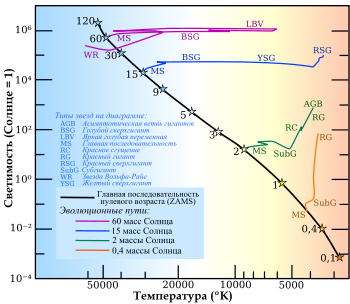
The most common red giants are stars located on the Hertzsprung-Russell diagram near the end of the so-called branch of red giants (in English terminology: RGB , red giant branch ), but continuing the process of hydrogen merging into helium in the shell surrounding the degenerate helium core. Other red giants: red condensation stars (marked as RC in the figure, from the English red clump ) in the cold half of the horizontal branch , in the nuclei of which helium-4 merges into carbon-12 through a triple alpha reaction ; and stars of the asymptotic branch of giants (marked as AGB in the figure), in which thermonuclear combustion of helium occurs in the outer shell of a degenerate carbon-oxygen nucleus (sometimes with hydrogen burning in the outer shell of the nucleus) [2] .
Observed Characteristics
The red giants include stars of spectral classes K and M of luminosity class III, that is, with an absolute magnitude 
The spectra of red giants are characterized by the presence of molecular absorption bands, since some molecules are stable in their relatively cold photosphere. The maximum radiation is in the red and infrared regions of the spectrum .
Origin and structure
"Young" and "old"
Stars in the process of their evolution can reach late spectral classes and high luminosities at two stages of their development: at the stage of star formation and late stages of evolution.
The stage at which young stars are observed as red giants depends on their mass - this stage lasts from ~ 10 3 years for massive stars with masses M ≈ 10 M ☉ and up to ~ 10 8 years for low-mass stars with M ≈ 0.5 M ☉ . At this time, the star radiates due to gravitational energy released during compression. As it contracts, the surface temperature of such stars increases, but due to a decrease in the size and area of the radiating surface, the luminosity decreases. Ultimately, in their cores, the reaction of thermonuclear fusion of helium from hydrogen begins ( proton-proton cycle , and for massive stars also the CNO cycle ), and the young star enters the main sequence .
In the late stages of the evolution of stars after the burning of hydrogen in their bowels and the formation of a “passive” (not participating in thermonuclear reactions) helium nucleus, the stars leave the main sequence and move to the region of red giants and supergiants of the Hertzsprung-Russell diagram : this stage lasts ~ 10% of time of the "active" life of stars, that is, the stages of their evolution, during which nucleosynthesis reactions take place in the stellar interior. Main sequence stars with masses M <10 M ☉ turn first into red giants, and then into red supergiants; stars with M > 10 M ☉ - directly into red supergiants. Before moving to the stage of the red giant, the star goes through an intermediate stage - the stage of the subgiant. A subgiant is a star in the core of which thermonuclear reactions involving hydrogen have already ceased, but the burning of helium has not yet begun, since the helium core is not sufficiently heated.
In modern astrophysics, the term red giants refers, as a rule, to such evolved stars that have descended from the main sequence; young stars that have not reached the main sequence are collectively called protostars or according to a specific type, for example, stars of the T Taurus type.
The structure of red giants, instabilities in their shells and their loss of mass
Both the "young" and the "old" red giants have similar observable characteristics, explained by the similarity of their internal structure - they all have a hot dense core and a very sparse and extended shell ( eng. Envelope ). The presence of an extended and relatively cold shell leads to an intense stellar wind : mass loss during this outflow of matter reaches 10 −6 –10 −5 M ☉ per year. Intensive stellar wind is facilitated by several factors:
- The high luminosity of the red giants in combination with the huge extent of their atmospheres (radii of 10 2 –10 3 R ☉ ) leads to the fact that at the boundaries of their photospheres the radiation pressure on the gas and dust components of their shells becomes comparable with the forces of gravity, which causes the removal of matter .
- The ionization of the regions of the shells lying below the photosphere makes them substantially opaque to electromagnetic radiation , which leads to the convection mechanism of energy transfer. Solar activity is of a similar nature; in the case of red giants, the power of convective flows should significantly exceed solar.
- In extended stellar shells, instabilities can develop, leading to strong oscillatory processes, accompanied by a change in the thermal regime of the star. In the photo of the Red Rectangle nebula, density waves of matter ejected by a star are clearly visible, which may be the consequences of such fluctuations. The periodic oscillations of the shells in many cases take on a scale that is noticeable from great distances: many “old” red giants are pulsating variables (see below), some “young red giants” of the T Taurus type are also variables.
Convective mechanisms can lead to the release of nucleosynthesis products into the atmosphere of the star from internal nuclear sources, which is the reason for the observed anomalies in the chemical composition of red giants, in particular, an increased carbon content.
The average density of red giants can be a million times lower than the density of water (for comparison, the average density of the Sun is approximately equal to the density of water, 1 g / cm 3 ). In this case, the ratio of the average density to the density of the core can be 1:10 8 (for the Sun about 1:50). About 10% of the mass of the red giant is accounted for by its very small core, in which (or in the outer layer of which) thermonuclear reactions occur; the rest of the mass of the star falls on a very long shell, which transfers the energy released in the nucleus to the surface.
On the surface of the red giants, the acceleration of gravity is very small. So, if a star with a mass equal to the mass of the Sun turns into a red giant and increases its radius to the size of the Earth’s orbit ( 1 AU ), then the acceleration of gravity on its surface will be equal to the centripetal orbital acceleration of the Earth, i.e. 0.6 cm / s 2 , or 0.0006 g ; for comparison, the acceleration of gravity on the surface of the Sun is equal to 27.8 g . Low surface gravity and high luminosity of the star contribute to the loss of matter from its shell.
Nuclear energy sources and their connection with the structure of red giants
In the process of evolution of main sequence stars, hydrogen “burns out” —nucleosynthesis with the formation of helium in the pp- cycle and (for massive stars) in the CNO-cycle . Such a burnup leads to the accumulation of helium in the central parts of the star, which at relatively low temperatures and pressures cannot yet enter into thermonuclear reactions. The cessation of energy release in the star’s core leads to compression and, consequently, to an increase in the temperature and density of the nucleus. An increase in temperature and density in the stellar core leads to conditions in which a new source of thermonuclear energy is activated: the burning out of helium (a triple helium reaction or a triple alpha process ), characteristic of red giants and supergiants.
At temperatures of the order of 10 8 K, the kinetic energy of helium nuclei becomes high enough to overcome the Coulomb barrier between nuclei: two helium nuclei ( alpha particles ) can merge to form the extremely unstable beryllium isotope 8 Be:
- 4 He + 4 He = 8 Be.
Most of 8 Be, having a half-life of only 6.7 × 10 −17 seconds, again decays into two alpha particles, but when 8 Be collides with a high-energy alpha particle, a stable 12 C carbon nucleus can form:
- 8 Be + 4 He = 12 C + 7.3 MeV .
Despite the very low equilibrium Be 8 concentration (for example, at a temperature of ~ 10 8 K, the concentration ratio of 8 Be / 4 He is ~ 10 −10 ), the rate of the triple helium reaction is sufficient to achieve a new hydrostatic equilibrium in the star’s hot core. The temperature dependence of energy release in the triple helium reaction is extremely high: for example, for the temperature range T ≈ 1–2⋅10 8 K, the energy release
where Y is the partial concentration of helium in the nucleus (in the case under consideration, when hydrogen is almost "burnt out", it is close to unity).
The onset of the triple helium reaction in the degenerate nuclei of low-mass (mass up to ~ 2.25 M ☉ ) red giants is explosive in nature, which leads to a sharp, but very short-term ( ~ 10 4–10 5 years ) increase in their luminosity - helium flash .
However, it should be noted that the triple helium reaction is characterized by a significantly lower energy release than the CNO cycle : in terms of unit mass, the energy release during helium “burning” is more than 10 times lower than when hydrogen is “burning”. As helium burns out and the energy source in the core is exhausted, more complex nucleosynthesis reactions are possible, however, firstly, such reactions require ever higher temperatures and, secondly, the energy release per unit mass in such reactions decreases as the mass numbers increase reactive nuclei.
An additional factor, apparently affecting the evolution of the red giant nuclei, is the combination of the high temperature sensitivity of the triple helium reaction (and the synthesis of heavier nuclei) with the neutrino cooling mechanism: at high temperatures and pressures, photons can be scattered by electrons with the formation of neutrino- antineutrino pairs that freely carry energy from the nucleus: the star is transparent to them. The rate of such bulk neutrino cooling, in contrast to the classical surface photon cooling, is not limited by the processes of energy transfer from the bowels of the star to its photosphere . As a result of the nucleosynthesis reaction in the star’s core, a new equilibrium is achieved, characterized by the same core temperature: an isothermal core is formed .
The final stages of the evolution of the red giants
| Weight | Nuclear reactions | Processes during evolution | The remainder |
|---|---|---|---|
| 0.1-0.5 | Hydrogen layer source | A degenerate helium core is formed, the shell is scattered | He is a white dwarf with a mass of up to 0.5 solar |
| 0.5-8 | Double layer source | A degenerate C O nucleus with a mass of up to 1.2 M разу is formed ; at the stage of the asymptotic branch of giants , the shell is released with the formation of a planetary nebula observed for ~ 10 4 years | С О - white dwarf weighing 0.5-1.2 solar, planetary nebula |
| 8-12 | Double layered source, then carbon “ignition” in the bowels |
|
|
| 12-30 | Degeneration in the nucleus does not occur and nucleosynthesis proceeds until the formation of iron peak elements (Fe, Co, Ni) | A nucleus with a mass of 1.5–2 solar collapses into a neutron star , the collapse is observed as a flare of a type II supernova (in the presence of an extended hydrogen shell) or Ib / s ( collapse of the core of the Wolf – Rayet star ), a dropped shell is observed for ~ 10 4 years as a supernova remnant | Neutron star |
| > 30 | Processes are unclear | Processes are unclear | A black hole with a mass of 3 solar? |
The sun as a red giant
Currently, the Sun is a middle-aged star, and the age of the Sun is estimated at approximately 4.57 billion years. The sun will remain in the main sequence for another 5 billion years, gradually increasing its brightness by 10% every billion years, after which the hydrogen in the core will be exhausted.
After that, the temperature and density in the solar core will increase so much that the burning of helium will begin, and helium will begin to turn into carbon. The size of the Sun will increase at least 200 times, that is, almost to the modern Earth’s orbit (0.93 AU ) [3] [4] [5] Mercury and Venus , despite the strong loss of mass of the Sun by the time of the transition to the red stage giant, they will be absorbed by them and completely evaporate. The Earth’s orbit will be (according to the most probable scenario) a little farther than the outer shells of the Sun and will not be directly affected by the expansion, but due to the tidal effect it will gradually (over several tens to a hundred million years) approach the star and eventually it will be absorbed by it . But even if they do not share their fate (due to the gradual loss of mass by the Sun as a result of radiation and the Solar wind will move to a higher orbit), it will be warmed up so much that there will be no chance of saving life [6] [7] . Oceans, on the other hand, will evaporate long before the Sun enters the red giant stage, approximately 1.1 billion years later [8] , both due to a gradual increase in the brightness of the Sun and because of the dissipation of the atmosphere .
At the stage of the red giant, the Sun will be approximately 100 million years old, after which it will turn into a planetary nebula with a white dwarf in the center; the planetary nebula will scatter in the interstellar medium for several millennia, and the white dwarf will cool down for many billions to 100 quintillion years.
Red Giants - Variable Stars
- Mirids (radially pulsating long-period variables of the World -Omicron Cet type ) are giants of the spectral class M with a period from 80 to more than 1000 days and brightness variations from 2.5 m to 11 m , emission lines are present in the spectra .
- SR - semiregular pulsating variable giants of spectral class M with a period from 20 days to several years and brightness variations of ~ 3 m (example: Z Ursa Major ).
- SRc - semiregular pulsating variable supergiants of spectral class M (examples: μ Cephei , Betelgeuse , α Hercules ).
- Lb - irregular slow pulsating variable giants of the spectral class K, M, C, S (examples: CO Cyg ).
- Lc are irregular slow pulsating variable supergiants of spectral class M with brightness variations of ~ 1 m (examples: TZ Cas ).
See also
- Asymptotic branch of giants
- Red thickening
- Horizontal branch
- White dwarf
- Degenerate gas
- Helium flash
- Main sequence
- Supernova
- Carbon detonation
Notes
- ↑ Commonly used expression. It is not directly related to age, but determines only a place in a number of spectral classes .
- ↑ Zeilik, Michael A. Introductory Astronomy & Astrophysics. - 4th Ed. - Saunders College Publishing, 1998. - P. 321–322. - ISBN 0-03-006228-4 .
- ↑ Red Giants . HyperPhysics (hosted by the Department of Physics and Astronomy of Georgia State University ). Date of treatment December 29, 2006. Archived February 5, 2012.
- ↑ Strobel, Nick Stages 5-7 . Lives and Deaths of Stars (June 2, 2004). Date of treatment December 29, 2006. Archived February 5, 2012.
- ↑ The fading: red giants and white dwarfs . Date of treatment December 29, 2006. Archived February 5, 2012.
- ↑ Ward & Brownlee, 2003 , p. 142
- ↑ Fishbaugh et al., 2007 , p. 114
- ↑ Leonid Popov. A distant star illuminated plans to save the Earth from the death of the Sun . Membrana.ru. Date of treatment March 5, 2013. Archived March 9, 2013.
Literature
- Shklovsky I. S. Stars: their birth, life and death . M .: Nauka, 1984.
- Red giants and supergiants / Jungelson L. R. // Space Physics: A Small Encyclopedia / Editorial: R. A. Sunyaev (Ch. Ed.) And others - 2nd ed. - M .: Soviet Encyclopedia , 1986. - S. 331-332. - 783 s. - 70,000 copies.
- Postnov K.A. Evolutionary Astrophysics .
- Fishbaugh, Kathryn E .; Des Marais, David J .; Korablev, Oleg & Raulin, François (2007), Geology and habitability of terrestrial planets , vol. 24, Space Sciences Series of Issi, Springer, ISBN 0-387-74287-5
- Ward, Peter Douglas (2006), Out of thin air: dinosaurs, birds, and Earth's ancient atmosphere , National Academies Press, ISBN 0-309-10061-5
- Ward, Peter Douglas & Brownlee, Donald (2003), The life and death of planet Earth: how the new science of astrobiology charts the ultimate fate of our world , Macmillan, ISBN 0-8050-7512-7