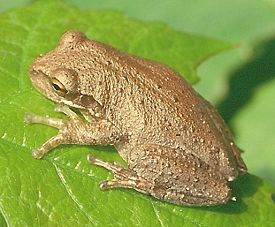
The total length of representatives of this genus ranges from 3 to 14.5 cm. A feature of these frogs is the presence of a continuous ossification of the skull, forming a kind of helmet. Big expressive eyes are raised high. Despite the loose body, these are quite elegant amphibians. On the fingers there are rounded suckers, the interdigital membrane is well developed. The color is greenish, brown, or yellowish, usually with spots or fuzzy stripes.
They live in tropical forests , sparse forests, areas with abundant vegetation. Active at night. They feed on various invertebrates .
These are oviparous amphibians.
Distributed in the Greater Antilles and Bahamas , one species was imported to the south of Florida .
As of November 2018, 8 species are included in the genus [2] :
- Osteopilus crucialis (Harlan, 1826) - Jamaican tree frog
- Osteopilus dominicensis (Tschudi, 1838) - Dominican tree frog
- Osteopilus marianae (Dunn, 1926) - Caribbean tree frog
- Osteopilus ocellatus (Linnaeus, 1758) - West Indus Tree Frog
- Osteopilus pulchrilineatus (Cope, 1870) - Hispanic tree frog
- Osteopilus septentrionalis (Duméril & Bibron, 1841) - Cuban tree frog
- Osteopilus vastus (Cope, 1871) - Giant tree frog
- Osteopilus wilderi (Dunn, 1925) - Antilles tree frog