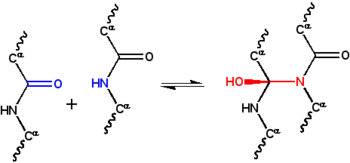
The cyclone hypothesis is the first structural model for the formation of globular proteins . Dorothy Wrinch was developed in the late 1930s based on the assumption that two peptide groups in proteins can be joined using the cyclol formation reaction [1] .
The cyclol hypothesis was based on three assumptions. Firstly, that peptide groups can be formed by a cyclic reaction, these bonds are covalent analogues of hydrogen bonds . Similar reactions were observed about the formation of ergopeptides and other compounds. Secondly, under certain conditions, amino acids spontaneously form the maximum possible number of cyclic bonds, which leads to the formation of cyclic molecules and cyclolic layers. However, these molecules and layers are not observed. Finally, the hypothesis suggests that globular proteins have a tertiary structure corresponding to regular polyhedra and semi-regular polyhedra formed from cyclolic layers without free edges. Similar structures are also not observed.
Notes
- ↑ Tiselius, A . The Chemistry of Proteins and Amino Acids (English) // Annual Review of Biochemistry : journal. - 1939. - Vol. 8 . - P. 155-184 . - DOI : 10.1146 / annurev.bi.08.070139.001103 .