Steven Simpson Hillage ( born Stephen Simpson Hillage ; born August 2, 1951 , , Greater London , England ) is a British rock musician and guitarist. Since the late 60s, he took part in a variety of experimental projects, and is mainly associated with the Canterbury scene . In addition to solo activities, he was also a member of the famous groups Gong and System 7 .
| Steve hillidge Steve hillage | |
|---|---|
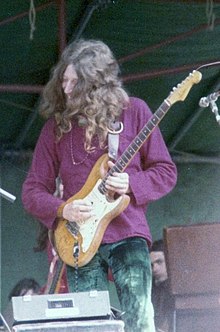 | |
| basic information | |
| Full name | Stephen Simpson Hillidge |
| Date of Birth | August 2, 1951 (68 years old) |
| Place of Birth | Chingford , Greater London , England |
| A country |  United Kingdom United Kingdom |
| Professions | Musician , Producer |
| Years of activity | 1971 - to this day |
| Instruments | |
| Genres | Progressive Rock , Electronics |
| Collectives | Uriel , Khan , Gong , System 7 , Hawkwind |
| Labels | Deram , decca |
| www.a-wave.com/system7/ | |
Content
- 1 Early years
- 2 Khan
- 3 gong
- 4 Solo career in the 70s
- 5 1980-1990 years
- 6 Modernity
- 7 Discography
- 7.1 Uriel
- 7.2 Khan
- 7.3 gong
- 7.4 Solo work
- 7.5 System 7
- 8 References
The early years
Steve Hillidge was born on August 2, 1951 in the London area of Chingford . While still at school, he became addicted to music and became a member of the Uriel blues-rock band, in which Dave Stewart , Mont Campbell and Clive Brooks played in addition to him. The team broke up in 1968 and some of its members subsequently formed the group Egg . However, former associates reunited in 1969 to record Arzachel's album. In the future, the paths of school friends also crossed, in particular Hillidge took part in the recording of the 1974 Civil Surface disc Egg.
In 1969, Hillidge became a student at the University of Kent , located in the city of Canterbury . There he meets the musicians of the local bands Caravan and Spyrogyra , and on occasion takes part in their performances. In between, Steve wrote his own songs, and by the end of 1970, material had accumulated on the whole album. Friends from Caravan brought Hillidge together with their manager Terry King , who, after listening to the demos of the young guitarist (Steve was also helped by his former comrades from Egg), ended up signing a contract with him.
Khan
In early 1971, Hillidge formed a Khan team with Nick Greenwood (ex- Crazy World Of Arthur Brown ). At the initial stage, as a drummer, Pip Pyle (in the future drummer Gong and Hatfield and the North ) was invited to the group, however, in the future he was replaced by Eric Pichy (ex- Dr K's Blues Band ), and Dick Henningham took the place of the keyboard player. Both of the latter were already familiar with Greenwood, having taken part in the work on his solo album Cold Cuts (despite the fact that the album was recorded in the 1970s , they managed to release it only two years later).
Having devoted most of the 71st tour (including accompanying Caravan ), in November 1971, Khan musicians began recording their debut disc. By this time, the group managed to leave Henningham and Hillidge was forced to urgently seek a replacement for him. In the end, Steve opted for his old friend Dave Stewart . After the release of the first Space Shanty album (May 1972 ), Canadian Val Val Stevens (a former member of the Toronto soul rock band Grant Smith & The Power ) took over the keyboard on a regular basis. He made his debut on a short tour of Europe, which included a performance at the Montreux festival, which was filmed by television. In June of that year, the group went on a regular tour, this time again as an escort group for Caravan.
Soon, the creative disagreement between Hillidge and Greenwood led to the departure of the latter from the team. Steve decided to renew the composition of Khan in order to slightly change the musical direction of the group. Of the previous members, only Pichy was left, Stuart (who had been unemployed after the breakup of Egg ) was called up, and a new bass player, Nigel Griggs (later a member of Split Enz ) came. The ensemble’s repertoire was supplemented with new compositions by Hillidge and Stuart , including the song “I Love Its Holy Mystery”, which served as the basis for the future epic composition “Solar Musick Suite”. Neither the band manager Terry King nor the Decca label showed interest in the new Khan music, which forced Hillidge to announce the dissolution of the band in October 1972 .
Gong
However, Hillidge did not remain without work, however, and very soon joined the Kevin Ayers Decadence concert band. He took an active part in recording the same Ayers album of 1973, Bananamour (Steve's guitar solo in “Shouting In A Bucket Blues” became especially memorable), and went on tour with Kevin in Britain and France. During this tour, Hillidge met the Gong musicians, and was so impressed with their work that he decided to stay in France and join the group. In January of 73, he took part in sessions for the new Gong Flying Teapot album - the first part of the planned trilogy "Radio Gnome", and soon became a regular guitarist of the team. Thus, the classic composition of Gong was formed, which in addition to Steve included: David Allen , Jilly Smith , Didier Mahlerb , Tim Blake , Mike Howlett and Pierre Merlin . It was these musicians who recorded the subsequent magnificent albums Angels Egg and You , after which, in 1975 , they went their separate ways.
Solo career in the 70s
After the founder and leader of the Allen team left Gong in April 1975, it was Hillidge who took the lead in the group. However, very soon the burden of leadership began to weigh Steve, and by the end of that year he decided to leave the team and focus on solo work. The optimism was given to the guitarist by the success of his recently released solo album Fish Rising , recorded during his stay in Gong with the help of his members. To work on the next L album, Hilage attracted musicians from the band Todd Randgren Utopia , and after his release, Steve formed a touring team that actively performed throughout 1976 and earned recognition from critics and listeners. In the second half of the 70s, Hillidge strengthened its reputation as one of the best guitarists and performers of progressive rock and fusion , becoming a prominent figure in the music market in the period preceding the appearance of punk and the “new wave” . Motivation Radio ( 1977 ) showed Steve moving away from the usual long-lasting instrumental towards shorter things, however, the next work by Green ( 1978 ), produced by Pink Floyd drummer Nick Mason , was a return to the traditional three-dimensional form.
The albums of the second half of the 70s , created by Hillidge in collaboration with his longtime girlfriend Mikett Girodi , combined the most sophisticated techniques, epic ballads and intricate passages in the spirit of electro-fusion . Poetic motifs on the theme of “electric gypsies” created Hillidge the image of one of the last hippies , and this played a cruel joke with the musician when punk started. However, Stephen was not at a loss and enthusiastically responded to a new musical phenomenon, seeing in him a huge source of energy and freedom. The compositions “Getting Tune” and “Don't Dither Do It” from Hillidge's subsequent Open album ( 1979 ) were clearly inspired by punk rock. During this period, the guitarist spent a lot of time in the London area of the Ladybrook Grove (it was here that the British underground was born at the time), where he worked together with Nick Turner, a member of the Hawkwind band.
1980-1990s
Over the next decade, Hillidge has been actively producing various young musicians, including It Bites , Simple Minds , Cock Robin, and Robin Hitchcock . After a break in the 1990s, Steve again began to promote talented performers, in particular by providing significant assistance to the Charlatans team, which released their debut album in 1995 .
After listening to the cover version of their 1979 album Rainbow Dome Musick by the British electronic band The Orb , the impressed Hillidge decided to reconnect his creative forces with his girlfriend Girodi, and in the early 1990s they founded their own project of dance music in the style of ambient System 7 . Soon the group took one of the leading places in the midst of the London dance underground.
Since the mid-1990s, Hillidge has regularly collaborated with Rashid Taha, playing guitar parts for his songs and simultaneously producing his albums.
He was the producer of an interesting project “1, 2, 3 Soleils”, which was based on Arabic music of paradise . The participants in the show were famous Algerian performers Rai Fowdel , Rashid Taha , Sheb Khaled and Latifa (many songs of which were arranged by Hillidge personally).
Modernity
In November 2006, Steve unexpectedly returned to the Gong group. The guitarist, accompanied by Girodi, took part in a concert of his former team in Amsterdam . In particular, he performed compositions from the album Fish Rising , a new material from the current Hillidge project System 7, as well as a joint performance by former members of Gong. The highlight of the event was the “Glissando Orchestra”, when for more than an hour about a dozen guitarists, including Hillidge and David Allen, played one long, undulating note.
In January 2007, four Hillage solo albums ( Fish Rising , L , Motivation Radio and Rainbow Dome Musick ) were re-released in CD format. Moreover, each disc, with the exception of the latter, contained previously unreleased compositions. In February, other albums ( Green , Live Herald , Open and For To Next / And Not Or ) were released on CDs.
“Light In The Sky” - a composition from Steve’s album Motivation Radio ( 1977 ) was used as the theme for the popular Channel 4 The Friday Night Project .
Discography
Uriel
- ( 1969 ) Arzachel
Khan
- ( 1972 ) Space Shanty
Gong
- ( 1973 ) Flying Teapot
- ( 1973 ) Angel's Egg
- ( 1974 ) You
Solo work
- ( 1975 ) Fish Rising
- ( 1976 ) L
- ( 1977 ) Motivation Radio
- ( 1978 ) Green
- ( 1979 ) Live Herald
- ( 1979 ) Rainbow Dome Musick
- ( 1979 ) Open
- ( 1983 ) For To Next / And Not Or
- ( 1994 ) BBC Radio 1 Live
- ( 2003 ) Light in the Sky
- ( 2004 ) Live at Deeply Vale Festival 1978
System 7
- ( 1991 ) System 7
- ( 1993 ) 777
- ( 1994 ) Point 3 Fire / Water
- ( 1996 ) Power of Seven
- ( 1997 ) Golden Section
- ( 2001 ) Seventh Wave
- ( 2004 ) Encantado