Ribonuclease (RNase, English Ribonuclease, RNase ) - enzymes - nucleases that catalyze the degradation of RNA . Ribonucleases are classified into endoribonuclease and exoribonuclease. Ribonucleases include some subclasses KF 2.7 and KF 3.1.
Functions
Ribonucleases of various classes are found in all living organisms. This indicates the fact that RNA cleavage is an ancient and very important process. Ribonuclease play an important role in the maturation of RNA molecules of all types, and especially mRNA and non-coding RNA . The RNA degradation system is also the first stage of protection against RNA-containing viruses, as well as more subtle cellular immunity systems, for example, RNA interference .
Some endoribonucleases recognize and cut specific nucleotide sequences of single-stranded RNAs; restriction enzymes , nucleases that cut double-stranded DNA, have similar properties.
Ribonuclease play a key role in many biological processes, for example, during angiogenesis , and also make it impossible for self-pollination in some flowering plants.
Classification
The main types of endoribonuclease
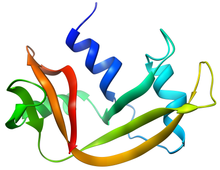
- RNase A ( EC 3.1.27.5 ) - is widely used in biochemical laboratories. For example, bovine pancreatic ribonuclease A ( PDB 2AAS ) is one of the most widely used enzymes in laboratory practice. Specific to single-stranded RNA, cuts the 3'-end of unpaired cytidyl and uridyl nucleotides, leaving the 3'-phosphorylated product as 2 ', 3'-cyclic monophosphate.
- RNase H ( EC 3.1.26.4 ) - cleaves RNA, which is in the form of heteroduplex RNA / DNA. Under the action of ribonuclease H, single-stranded DNA is formed. Ribonuclease H is a non-specific endonuclease and catalyzes the cleavage of RNA by the hydrolysis mechanism in the presence of a bound divalent metal ion. As a result of the activity of ribonuclease H, a 5'-phosphorylated product is formed.
- RNase I cuts the 3'-end of single-stranded RNA, across all nucleotide-nucleotide bonds, leaving at the 5'-end a hydroxyl group and phosphate at the 3'-end, through the transition state in the form of 2 ', 3'-cyclic monophosphate.
- RNase III ( EC 3.1.26.3 ) is a ribonuclease that cuts out 16S and 23S ribosomal RNAs from the transcription product of the polycistronic operon of ribosomal RNA in prokaryotes. RNase III cleaves double-stranded RNAs, cuts pre- miRNAs at specific sites, forming shorter miRNAs, and thus takes part in the regulation of the mRNA lifespan.
- RNase L is an interferon-induced nuclease that, after induction, cleaves all RNA in the cell.
- RNase P ( EC 3.1.26.5 ) - is a ribozyme - an RNA molecule with catalytic properties, takes part in the metabolism of transport RNA [1] .
- RNase PhyM is specific for single-stranded RNA; it cuts the 3'-end of unpaired adenyl and uridyl nucleotides.
- RNase T1 ( EC 3.1.27.3 ) - specific for single-stranded RNA, cuts the 3'-end of unpaired guanyl nucleotides.
- RNase T2 ( EC 3.1.27.1 ) - specific for single-stranded RNA, cuts the 3'-end along all nitrogenous bases, but mainly on adenyl.
- RNase U2 ( EC 3.1.27.4 ) - specific for single-stranded RNA, cuts at the 3'-end of unpaired adenyl bases.
- RNase V1 ( EC 3.1.27.8 ) - sequence-non-specific for double-stranded RNA, cuts any paired nucleotides.
- RNase V ( CF 3.1.27.8 )
The main types of exoribonuclease
- Polynucleotide phosphorylase ( EC 2.7.7.8 ) has both exonuclease and nucleotide transferase activity.
- RNase PH ( EC 2.7.7.56 ) has both exonuclease and nucleotide transferase activity.
- RNase II cleaves single-stranded RNA in the 3'-5 'direction.
- RNase R is a close homologue of RNase II, however, unlike RNase II, it cleaves RNA with secondary structures without the participation of auxiliary factors.
- RNase D ( EC 3.1.13.5 ) cleaves pre-tRNA in the 3'-5 'direction.
- RNase T is the main enzyme for the maturation of stable RNAs in the 3'-5 'direction.
- Oligoribonuclease ( EC 3.1.13.3 ) cleaves short oligonucleotides to mononucleotides.
- Exoribonuclease I ( EC 3.1.11.1 ) cleaves single-stranded RNAs in the direction from the 5 ′ to the 3 ′ end, found only in eukaryotes.
- Exoribonuclease II ( EC 3.1.13.1 ) is a close homologue of exoribonuclease I.
Links
Notes
- ↑ J. Holzmann, P. Frank, E. Löffler, K. Bennett, C. Gerner & W. Rossmanith. RNase P without RNA: Identification and functional reconstitution of the human mitochondrial tRNA processing enzyme (English) // Cell : journal. - Cell Press , 2008. - No. 135 . - P. 462-474 . - DOI : 10.1016 / j.cell.2008.09.01.013 .
Literature
- D'Alessio G and Riordan JF, eds. (1997) Ribonucleases: Structures and Functions , Academic Press.
- Gerdes K, Christensen SK and Lobner-Olesen A (2005). "Prokaryotic toxin-antitoxin stress response loci." Nat. Rev. Microbiol. (3): 371-382.