Sergo-Ivanovo is a village in the Smolensk region of Russia , in the Gagarinsky district . It is located in the north-eastern part of the region 16 km south-west of Gagarin , 7 km north of the M1 Belarus highway. Railway station Sergo-Ivanovskaya on the line Moscow - Minsk . The population is 538 inhabitants ( 2007 ). The administrative center of the Sergo-Ivanovo rural settlement.
| Village | |
| Sergo-Ivanovo | |
|---|---|
 | |
| A country |  Russia Russia |
| Subject of the federation | Smolensk region |
| Municipal District | Gagarinsky |
| Rural settlement | Sergo-Ivanovo |
| Chapter | Pavlov Alexander Sergeevich |
| History and Geography | |
| Founded | 1870 year |
| First mention | 1904 year |
| Area | 1.1 km² |
| Center height | 228 m |
| Climate type | moderately continental |
| Timezone | UTC + 3 |
| Density | 489.09 people / km² |
| Digital identifiers | |
| Telephone code | +7 48135 |
| Postcode | 215050 |
| OKATO Code | 662088721 |
| OKTMO Code | |
| sergoivanovo.ru | |

Content
- 1 Name
- 2 History
- 3 Economics
- 4 Culture
- 5 Post Office
- 6 Health
- 7 Educational institutions
- 8 Attractions
- 9 links
Title
Sergo-Ivanovskoye received its name in honor of a nobleman, public figure, rural owner, provincial representative of the nobility and president of the Smolensk Society of Agriculture Sergey Sergeyevich Ivanov (years of life have not been established) who in the 19th century conducted experiments on growing various fodder crops near the village of Tyosovo, Sychevsky District (mainly corn)
History
The history of Sergo-Ivanovsky begins in 1870, and the village owes its foundation to the railway line that opened that very year, connecting Smolensk with the ancient Russian capital. Sergo-Ivanovskoe appeared as a small station between Vyazma and Kubinka, and was part of the Baskakovsky volost of the Sychevsky district of Smolensk province. The station was one of the points of sale of forest materials: according to the beginning of the 20th century, up to 10 thousand poods were sent from here annually. The population of Sergo-Ivanovsky was composed mainly of workers serving the railway. In the surrounding villages were engaged in agriculture. Since the peasants did not have their own land, they were forced to rent land from the landowner S.I. Povalishin, whose estate was located in Vasilievsky. For rent, peasants paid money or cultivated landowners' land, which was the main reason for their distress. By the beginning of the 20th century, dissatisfaction with the current state of affairs escalated to the fact that in April 1907, under the guise of celebrating Easter, rallies were held at the station demanding the overthrow of the autocracy, the elimination of the feudal-serf system and the establishment of a democratic republic. About five hundred people attended the rallies, including from neighboring Vyazemsky and Gzhatsky counties. Agitators were natives of these places, who worked in factories in Moscow, as well as local residents, among whom stood out the peasant of the village of Armenievo Kuzma Parfyonov. From the urgent report from Captain Klepfer to the head of the Smolensk branch of the Moscow-Riga gendarme department, we learn that police units are needed to stop the riots at the station, and and. about. the district police officer Barantsev in his report “most humblely” asks the Smolensk governor Nikolai Iosifovich Sukovkin to send guards to guard the post office. As a result of the riot, the four main demonstrators were detained and rewritten, and Kuzma Parfyonov was searched and 39 anti-government brochures were found. While the question of his expulsion of "as a harmful agitator" to the remote provinces of the Russian Empire was being decided, Parfyonov managed to escape to Saratov. On November 1, 1917, Soviet power was established in Sergo-Ivanovsky. In February 1918, the formation of the first village councils, the creation of communist cells, and the poor in the Bolshevik Party began. And in 1919, famine came: there was not enough bread, salt, fuel and matches.
War…
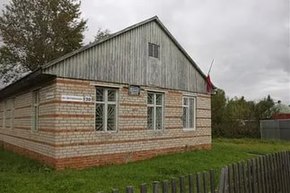
In the fall of 1941, Sergo-Ivanovo, like the whole Smolensk region, was occupied. Nina Gaidukova, who at that time was only 11 years old, recalled: “Our family (my father is a railwayman) was given the opportunity to evacuate on a trolley towards Gzhatsk, but when we reached the Vasilisino station, we were informed that there was no further road: the railways the paths are blown up. I had to go back on foot, because the roads bombed mercilessly. When the Germans entered the village, they drove residents out of their houses, and if they left them to live, then in the kitchen. People were forced to look after horses, heat baths, and clean shoes. My father was taken out for execution several times, calling the Russian commissar for his long hair and mustache. And in every shorn man, the Nazis saw a soldier and a partisan. ” Sergo-Ivanovskaya station was a convenient place for the location of German troops. From here to Tsarevo-Zaimishche there was a narrow gauge railway along which military cargo was transported. There were also ammunition depots, a stable and a prisoner of war camp. Soviet air strikes were carried out against the accumulations of German troops. Long-range bomber pilot, Hero of the Soviet Union Vasily Grechishkin recalled: “On January 18, 1942, I bombed the Sergo-Ivanovskaya station. <...> Six wagons, a steam locomotive, up to two dozen vehicles with manpower were destroyed, and input and output arrows were destroyed. The station was disabled for several hours. ” Sergo-Ivanovskaya was also marked on the map of partisan glory: a detachment of partisans named after Dzerzhinsky, commanded by Lieutenant Mikhail Fedorovich Lopatin, came here. The partisans undermined the railway lines, thereby delaying the advance of German troops to Moscow. In 1942, Lopatin was captured at Sergo-Ivanovskaya, but he managed to escape. People experienced many hardships during the one and a half years that Sergo-Ivanovskaya was in occupation: they lived in bathhouses, stables, dugouts. Boys and old men were taken to a prisoner of war camp. People were dying of the cold, youth were being stolen to work in Germany. Sergo-Ivanovskaya was liberated by the troops of the Western and Kalinin fronts two days later than Gzhatsk - March 8, 1943. The very next day, a resident of the station, Yekaterina Morozova, bandaged wounded soldiers in the building of a veterinary clinic, located on the site of the current village administration.
Economics
Until the early 1990s, Sergo-Ivanovskoe was one of the most prosperous villages in the Smolensk region due to the brick factory, as well as thanks to the cowsheds located in the neighboring villages of Mamonovo and Baskakovo.
Culture
- Sergo-Ivanovo Rural Library
- Library at MBOU "Sergo-Ivanovo Basic School"
- Country Club
Post Office
Health
- Sergo-Ivanovo FAP
Schools
Attractions
Monument to the crashed Soviet plane of the Second World War.
Monument "War to the Liberator" open 03/10/2017