The dwarf hippo [1] , or the Liberian dwarf hippo [1] , the dwarf hippo ( Latin Hexaprotodon liberiensis or Choeropsis liberiensis ) is a herbivorous mammal from the hippo family. It lives in Liberia , Sierra Leone and Cote d'Ivoire . The only other species in this family is the common hippopotamus (hippo, Hippopotamus amphibius ). Like an ordinary hippopotamus, a dwarf hippo leads a semi-aquatic lifestyle, however, unlike ordinary hippos, which form compact herds protecting their territories, dwarf hippos live alone and are not inclined to protect their territory.
| Pygmy hippo |
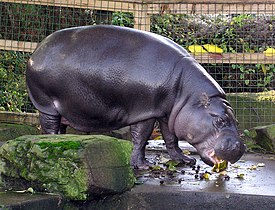
Dwarf Hippopotamus at the Bristol Zoo |
| Scientific classification |
|---|
| No rank : | Bilateral symmetrical |
| Gender: | Dwarf Hippos ( Hexaprotodon Falconer & Cautley , 1836 ) |
|
| International scientific name |
|---|
Hexaprotodon liberiensis
( Morton , 1849 ) |
| Synonyms |
|---|
Choeropsis liberiensis (Morton, 1849) |
| Area |
|---|
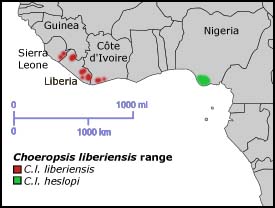 The modern range of the dwarf hippo |
| Security status |
|---|
Endangered speciesIUCN 3.1 Endangered : 10032 |
|
The local name of the animal is mwe- mwe or nigbwe .
Content
These animals were discovered by German zoologist Hans Schomburg in 1911. Samuel Morton originally included the pygmy hippopotamus in the genus Hippopotamus , but then created a separate genus for him, Choeropsis (the name of the species is Choeropsis liberiensis ). In 1977, Corindon established a relationship between dwarf hippos and the genus of extinct hippos Hexaprotodon , and the species became known as Hexaprotodon liberiensis [2] . In 2005 , Jean Renault Boisserier "returned" the dwarf hippo in a separate genus [3] .
The closest relatives of the dwarf hippo became extinct in the historical era:
- Hexaprotodon madagascariensis - The Madagascar pygmy hippo is one of three or four extinct species of Madagascar hippo. The last of these species died out about a thousand years ago.
- Hexaprotodon liberiensis heslopi - Nigerian pygmy hippopotamus - a subspecies of the pygmy hippopotamus that inhabited an isolated population in the Niger Delta . Exterminated at the beginning of the XX century .
The body structure of dwarf hippos resembles ordinary hippos, but the overall appearance is less heavy. The legs and neck are relatively longer, and the head is relatively smaller. In contrast to the ordinary hippo, which is characterized by a strictly horizontal spine , the dwarf line of the back is inclined forward. The eyes and nostrils protrude beyond the skull not so clearly as in the ordinary hippo. The toes are spread apart more strongly, and the membranes between them are less pronounced. In the mouth of dwarf hippos, not two pairs of incisors, but one.
Adult animals reach 75–83 cm in height at the shoulders, 150–177 cm in length; they weigh 180–275 kg (an order of magnitude less than ordinary hippos, whose mass sometimes exceeds 3500 kg). The color of the skin, as thick as that of an ordinary hippopotamus, is brown or greenish-black, somewhat lighter on the stomach. The sweat of a dwarf hippopotamus is pink, but does not contain blood particles.
Typical habitat
landscape .
Sierra leone Dwarf hippos spend more time on land than ordinary hippos, but also depend on the presence of water bodies. Their skin requires regular baths. During the day, hippos lay down in the water or coastal thickets, at night they go out to the forest for feeding. In case of danger, they, even being near a reservoir, do not throw themselves into the water, but run away to the nearest forest thicket. The complete set of natural enemies of dwarf hippos is unknown, but the main predators living in the neighborhood that can attack an adult animal of this size are leopards and Nile crocodiles . Young animals are vulnerable to a wider range of predators, including golden cats , African civet and hieroglyphic pythons [4] .
The lifestyle of the dwarf hippo resembles that of tapir : animals live alone, rarely - in pairs. Researchers have determined that about 2 square meters per male. km area, per female - four times less [5] . When meeting, dwarf hippos do not show aggression towards each other and do not try to defend their territory.
Reproduction of dwarf hippos in the wild has not yet been studied. In captivity, animals reach puberty at the age of three to five years. The estrus cycle in females takes an average of 35.5 days, estrus itself - from 1 to 2 days. In zoos, males and females form stable monogamous pairs; conceptions and childbirth in captivity were carried out at all times of the year. The gestation period is 190–210 days, usually one cub is born, rarely two. Cubs are born not under water, as in ordinary hippos, but on land. Newborns weigh 4.5–6.2 kg; lactation lasts 6-8 months. During feeding, when the female goes ashore for food, the cubs always remain in the water.
Dwarf hippos breed well in zoos, and are at risk in their homeland: according to 1993 IUCN estimates, the natural population of dwarf hippos did not exceed 3000 individuals, and the current population is no more than a thousand [4] . The main reasons for the disappearance of the dwarf hippo was deforestation and uncontrolled slaughter. Civil wars in the habitats of the species made its research and protection impossible.
- ↑ 1 2 Sokolov V.E. The Bilingual Dictionary of Animal Names. Mammals Latin, Russian, English, German, French. / edited by Acad. V. E. Sokolova. - M .: Rus. lang., 1984. - S. 125. - 10,000 copies.
- ↑ The taxonomy and nomenclature of the Hippopotamidae (Mammalia, Artiodactyla) and a description of two new fossil species. Proceedings of the Koninklijke Nederlandse Akademie van Wetenschappen 80 (2): 61-88.
- ↑ Boisserie, Jean-Renaud; Fabrice Lihoreau and Michel Brunet (February 2005). The position of Hippopotamidae within Cetartiodactyla. Proceedings of the National Academy of Sciences 102 (5): 1537-1541
- ↑ 1 2 Choeropsis liberiensis (Pygmy Hippopotamus) (neopr.) . www.iucnredlist.org. Date of treatment January 11, 2017.
- ↑ Eltringham, S. Keith. The hippos. ISBN 0-85661-131-X .