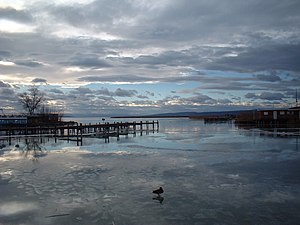
Neusiedler See [1] [2] (in the territory of Austria; German: Neusiedler See ) / Фёрё [3] (in the territory of Hungary; Hungarian. Fertő-tó ) - the fourth largest lake in Central Europe (after Balaton , Geneva and Bodensky ), the westernmost flat brackish lake in Europe, a popular holiday destination, a biosphere reserve . The lake and its environs are included in the UNESCO World Heritage List .
| Lake | |
| Neusiedler-See / Fertö | |
|---|---|
| him. Neusiedler See , Hungary. Fertő-tó | |
 Space shot of a lake | |
| Morphometry | |
| Absolute height | 115 m |
| Dimensions | 36 × 6-12 km |
| Square | 315 km² |
| Deepest | 1.8 m |
| Average depth | 1m |
| Pool | |
| Pool area | 1120 km² |
| Location | |
| Country |
|
| Regions | Burgenland , Gyor-Moson-Sopron |


Content
Geography
Neusiedler See is located on the border of Austria and Hungary , about 77% (240 of 315 km²) of the lake area belongs to the Austrian federal state of Burgenland , the southern tip of the lake - to the Hungarian copper plate Gyor-Moson-Sopron . To the south and southeast of the lake are the territories of national parks : the Austrian Neusiedlersee-Zewinkel and the Hungarian Fertö-Hanschag .
The area of the lake is about 315 km², while the depth is on average about one meter. The lake has an irregular shape, stretched from north to south. The coastline is rugged, with several deep bays. There are several large islands and many small islands and shallows on the lake. The length of the lake from north to south is 36 kilometers, the width varies from 6 to 12 kilometers. Height above sea level - 115 meters, catchment area - about 1120 km². Neusiedler See is extremely shallow, with an average depth of about a meter, and the largest - 1.8 meters.
The age of the lake is approximately 20 thousand years: it arose at the end of the ice age , as a result of fluctuations in the earth's crust.
Hydrography
Several streams flow into the lake, the largest of which is Vulka. The lake belongs to the basin of the Slaves and the Danube , it had a drain in its southeastern end. Currently, the flow of the lake is regulated in order to maintain a constant water level.
The water in Lake Neusiedler See is slightly salted, the water level is subject to great fluctuations. Several times in history, the lake completely dried out (the last time in 1866, when it was possible to cross it along the bottom without wetting a shoe). In 1956, a joint Austro-Hungarian commission was established to control the water level, its responsibility is to regulate the flow from the lake to maintain a given level. Despite this, fluctuations cannot be completely avoided. So in 1965, after heavy rains, the lake level rose by 35 cm, in 2003 the water dropped by almost 30 cm.
Flora and Fauna
The surface of the lake was heavily overgrown with reeds , through which passages for boats were cut in places.
The lake is home to 15 species of fish (the most common are loaches , pikeperch , pike and common carp ). The waters of the lake are rich in different species of invertebrates, and various species of rare insects live in the thickets of reeds.
On Lake Neusiedler See, under natural conditions, more than 300 species of nesting and migratory birds can be observed, among which there are many species of herons (including great white heron ), as well as spoonbills , wild geese , grebes , elkweeds , reeds and many others.
During seasonal migrations, snipe , bean geese and hare stop here. Among the rare species of birds, it is worth noting the red-breasted goose , white-tailed eagle and the moon .
Shores
A training path has been laid along the lake in the territory of the national park, from which bird watchers and park visitors can observe the biosphere of the reserve.
Along the western shore of the lake runs a hilly ridge composed of limestones . The hills are covered with forests and are very picturesque; a large number of rare species of plants grow on them.
Salt steppes stretch to the southeast of the lake.
Tourism
The lake attracts a large number of tourists and nature lovers. On the banks of a large number of beaches. Limited licensed fishing allowed. At Neusiedler See, they engage in sailing and windsurfing , but the shallow depth of the lake at times creates problems for athletes. For the same reason, passenger and cargo shipping are poorly developed on the lake.
Notes
| UNESCO World Heritage Site , Object No. 772 Russian • English • fr. |
- ↑ Austria // Atlas of the World / comp. and preparation. to the ed. PKO "Cartography" in 2009; ch. ed. G.V. Pozdnyak . - M .: PKO "Cartography": Onyx, 2010. - S. 63. - ISBN 978-5-85120-295-7 (Cartography). - ISBN 978-5-488-02609-4 (Onyx).
- ↑ Neusiedler-Ze // Dictionary of geographical names of foreign countries / ed. ed. A.M. Komkov . - 3rd ed., Revised. and add. - M .: Nedra , 1986.- S. 256.
- ↑ Neusiedler-Ze // Dictionary of geographical names of foreign countries / ed. ed. A.M. Komkov . - 3rd ed., Revised. and add. - M .: Nedra , 1986.- S. 391.