Mikhail Leontievich Mil ( November 9 (22), 1909 , Irkutsk - January 31, 1970 , Moscow ) - Soviet helicopter designer and scientist, Doctor of Technical Sciences ( 1945 ), Hero of Socialist Labor ( 1966 ), Lenin Prize laureate ( 1958 ) and the USSR State Prize ( 1968 ).
| Mikhail Leontyevich Miles | ||||||||||
|---|---|---|---|---|---|---|---|---|---|---|
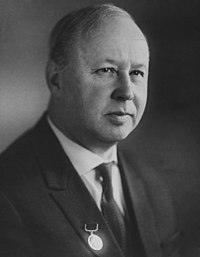 | ||||||||||
| Date of Birth | ||||||||||
| Place of Birth | Irkutsk Russian empire | |||||||||
| Date of death | ||||||||||
| A place of death | ||||||||||
| A country | ||||||||||
| Scientific field | ||||||||||
| Place of work | ||||||||||
| Alma mater | Don Polytechnic Institute | |||||||||
| Academic degree | Doctor of Technical Sciences | |||||||||
| Academic rank | Professor | |||||||||
| Known as | aircraft designer | |||||||||
| Awards and prizes |
| |||||||||
| Signature |  | |||||||||


Content
- 1 Biography and activities
- 1.1 The early years
- 1.2 First Steps in Aviation
- 1.3 Military tasks
- 1.4 To the creation of a helicopter
- 1.5 General Designer
- 2 memory
- 3 Awards
- 4 Bibliography
- 5 notes
- 6 Literature
- 7 References
Biography and Activities
Early years
Born in 1909 , in the same year Igor Sikorsky created his first helicopter [2] .
Childhood and youth passed in Irkutsk ; father, Leonty Samoilovich Mil, was a railway employee; mother, Maria Efimovna, as a dentist. Grandfather, Samuel Mil, was a Jewish cantonist , after 25 years of service in the Navy, a donkey in Siberia. The family was still the eldest daughter Catherine and brother Jacob.
From childhood, Mikhail perfectly drew, was fond of music, easily studied foreign languages. He could become an artist or musician, but became a design scientist. Perhaps this choice was explained by the fact that the 20s of the 20th century was a time when everyone in the USSR was fond of aviation.
First Steps in Aviation
At the age of twelve he made a model airplane , which won a competition in Tomsk . In 1925 he entered the Siberian Technological Institute . In the student glider section, he built a lightweight single-seat glider and made his first flight on it. However, while studying in the second year, a student was expelled from the institute for denouncing “for non-proletarian origin” [3] . After working for a year in Novosibirsk, in the tanning laboratory, as a representative of the proletariat, he immediately entered the 3rd year at the Faculty of Mechanics [4] of the Don Polytechnic Institute in Novocherkassk , where he had an aviation specialty.
At this university he had the opportunity to experimentally verify his calculations in the theory of aeronautics, using one of the two wind tunnels that were then available in the Soviet Union. Lectures on aerodynamics were given by a young professor V.I. Levkov , who subsequently created the world's first hovercraft . In 1929, student Miles learns about a new aircraft - a gyroplane , which in 1919 was designed by the Spaniard Juan de la Sierva, and began to study the theory of his flight. He wrote a letter to N. I. Kamov , head of the gyroplane department at TsAGI, and received an invitation, as part of his summer practice, to participate in the creation of the first domestic gyroplane KASKR-1.
At the end of the institute in 1931 he was sent to the Taganrog Aircraft Plant. However, with the recommendation of N. I. Kamov, he was able to convince the commission that it would bring more benefit to the state by doing gyroplanes in TsAGI . Here he participated in the development of gyros A-7 , A-12 and A-15 . A year later, he became the head of the aerodynamics team of the TsAGI special constructions department. During this period, the first scientific publication of M. L. Mil appeared: “On the Take-Off of the Autogyro” in the journal “Technique of the Air Fleet” for 1934, No. 5.
While receiving a very small salary at TsAGI, the young designer worked as an editor and teacher of the German language [4] .
In 1932-1936 Mikhail Leontyevich led the team of aerodynamics and experimental calculations of the TsAGI Special Designs Department, developing the fundamental principles of aerodynamics of rotorcraft, including the general rotor theory applicable for various cases of flow around it.
In 1936-1939 He worked as an engineer in an experimental design bureau for rotorcraft.
March 21, 1939 it was decided to build a factory for the production of gyroplanes, where Miles became deputy director, Nikolai Kamov .
Military Tasks
During the years of World War II , in 1941-1943, Miles worked in evacuation in the village of Bilimbay , in the Middle Urals, which actually became the aviation capital of the USSR. The best aircraft designers worked here - S. A. Lavochkin , N. I. Kamov .
During the evacuation, Mil was instructed to destroy the archive of the department of special constructions so that he would not get to the enemy. But this archive contained the result of many years of work, and Miles did not dare to destroy it. Moreover, he managed to get the documents out of the laboratory and took them with him. Subsequently, the saved documents came in handy when designing helicopters [3] .
In a difficult front-line situation of 1941-1942, a detachment of 5 gyroplanes was deployed to the front, making 20 sorties. The detachment also included Mikhail Mil. In combat conditions near Moscow, it was planned to use gyroplanes as spotters for artillery fire, however, the devices were suitable only for rear use. An episode is known that testifies to Mile's decisiveness in critical circumstances: when, after a quick breakthrough of the Germans, he had to threaten with a weapon in order to prevent panic among the people entrusted to him and to ensure the dismantling and evacuation of gyroplanes to the rear. [four]
He also worked on improving the design of aircraft, solving the problem of saving an aircraft loaded with ammunition, which, when it lost speed, immediately fell into a tailspin, which it was practically unable to get out of, as the pilot simply lacked physical strength. Miles developed a device that could solve this problem. The device was tested by pilot E. A. Lebedinsky at a front-line airfield. The tests of the device were excellent, its serial production was established. For several months, Miles was at airfields, personally installed the device on airplanes and explained to pilots the principle of its operation.
In 1942, M. L. Mil, together with S. A. Paskhin, developed the original design of an anti-tank gun to fire at tanks and bunkers with RS-82 missiles. It was not possible to bring it to the series, and Miles during the tests almost received serious injuries from a red-hot jet. He was saved from severe burns by someone wearing a short fur coat.
For work on improving combat aircraft Miles in 1945 received the Order of the Patriotic War.
To create a helicopter
In 1943, Miles defended his thesis "Criteria for controllability and maneuverability of an airplane"; in 1945 - doctoral: “Dynamics of a rotor with hinged blades and its application to the problems of stability and controllability of a gyroplane and helicopter”.
Miles set out to create an aircraft that could fly into the air with screws. He persistently wrote to I.V. Stalin , convincing him of the need to begin work on the creation of helical aircraft. As a result, the head of state gave the green light to the organization in Moscow of a helicopter construction design bureau headed by Mil.
In December 1947, it was created on the basis of the plant number 383 MAP. The first GM-1 machine (Helicopter Mil-1), created at the Design Bureau, was lifted into the air on September 20, 1948 at the Zakharkovo airfield by test pilot M.K. Baikalov.
The first tests of two prototypes ended in tragedy. In the first case, when determining the ceiling of the car at an altitude of 5200 m, lubrication froze in the control system, but the pilot managed to leave the car. When landing, Baikalov injured his leg and was suspended from flying, which on the second copy of the car was continued by his comrade Mark Gallay .
Back in operation, Baikalov made 13 demonstration flights on the Mi-1. The fourteenth departure turned out to be fatal: after driving the car from the test aerodrome to the customer (Air Research Institute), a disaster occurred at the landing point: the tail rotor shaft broke off due to a shell in the welding. The flight altitude was insufficient for a parachute jump, and pilot M. Baikalov died. For Mile, this was a shock.
The cause of the tragedy was determined quite quickly: in the future, the propeller shaft of the tail transmission of the Mi-1 helicopters began to be made from the chiseled trunks of artillery guns. There were plenty of them after the war, and there were no more such disasters with the Mi-1. The head designer defined the ceiling of the machine at 3,000 m; a non-freezing grade of grease was selected for the transmission. Testing the third machine was to decide the fate of the design bureau and the designer himself. They were volunteered by the famous pilot V.V. Vinnitsky, to which M. Gallay and G. Tinyakov joined. The machine was successfully tested; on its base in 1949 the first Soviet Mi-1 helicopter was created. Subsequently, 27 absolute world records were set on it.
In early 1950, a decree was issued on the creation of an experimental series of 15 GM-1 helicopters under the designation Mi-1 .
General Designer
In 1964, Miles became the general designer of an experienced design bureau. His team created the Mi-2 , Mi-4 , Mi-6 , Mi-8 , Mi-10 , Mi-12 , Mi-24 and other helicopters . 60 official world records were set on the machines developed in the design bureau. Together with his students, Mikhail Leontyevich developed the theory of a modern helicopter.
In 1958, Miles was awarded the Lenin Prize , in 1968 - the USSR State Prize , in 1966 he was awarded the title Hero of Socialist Labor .
Miles published the scientific work "Helicopters" (books 1-2, M., 1966-1967; co-authored).
The Mi-2 and Mi-4 helicopters created by Mil Design Bureau became a legend, and the Mi-8 became the most massive 2-engine helicopter in the world. The landing Mi-6 is the first helicopter with two engines and a gas turbine power plant with a carrying capacity of 12 tons, the Mi-10 is the largest transport helicopter (flying crane). The twin-screw giant Mi-12 raised a record weight of 40 tons and received the nickname "elephant". He made the first successful flight during the life of the designer, set many world records for lifting capacity, which until now have not been repeated by anyone.
The triumph of the designer’s work was the display of his unique cars at the 1965 air show in Paris. The son of the founder of helicopter engineering Igor Sikorsky , Sergei, admitted that in the field of heavy helicopters Miles not only caught up with the United States, but went far ahead in a number of parameters [2] .
Mi helicopters are operated in more than 100 countries of the world.
M.L. Mil died on January 31, 1970 from a stroke, not having lived to see the start of operation and the triumph of the first Soviet attack helicopter Mi-24. Produced in more than 3,500 copies, the machine took part in dozens of conflicts and was in service with many countries. The famous "Crocodile" is considered the most belligerent helicopter in the world [4] .
Designer Miles is buried in the Yudinsky cemetery , near the railway platform Perkhushkovo . After the death of the designer, his painting “Daffodils. The Corner of the Cabinet ”became the emblem of the exhibition“ Scientists Draw ”in 1981: Miles spent his whole life fond of painting, and a whole staff of artists worked in his design bureau, illustrating for potential customers the combat or economic use of the designed machines.
Memory
In Ulan-Ude, the street is named after Mil.
- The name of Mil is the Moscow Helicopter Plant .
- In Moscow, the name of the designer named a street in the Zhulebino area. In 2009, at the intersection of Aircraft Designer Mil Street and Zhulebinsky Boulevard , a bust of Mil was installed.
- In Kazan, the name of the designer named the street in the Aircraft Building District .
- Moscow secondary school No. 1738 is named after Mil.
- In 2009, a postal block of Russian stamps was issued in honor of Mil.
- A memorial plaque was installed on the building of the Faculty of Technological Machines and Robots of the SRSTU (NPI) ( Novocherkassk ): “The helicopter designer Mi, Hero of Socialist Labor, Lenin and State Prize Laureate, Doctor of Technical Sciences Mikhail Leontyevich studied and studied at the NPI in 1931. 1909-1970 ” [5] .
- In 2009, in Irkutsk, in honor of the 100th anniversary of the birth of M. L. Mil, a memorial plaque was erected on the house number 5 on Karl Liebknecht Street at the initiative of the poet G. Gaida . It is proposed to name the street on which he was born and grew up [6] .
- In Minsk (Republic of Belarus), the name of the designer is the street in the Novaya Borovaya microdistrict (ZhK Sosnovy quarter) [1]
Rewards
- By a decree of the Presidium of the Supreme Soviet of the USSR of July 22, 1966, for outstanding services in the development of Soviet aviation, Mikhail Leontyevich was awarded the title Hero of Socialist Labor with the award of the Order of Lenin and the Gold Hammer and Sickle Medal .
- Three Orders of Lenin (07/12/1957; 07/22/1966; 11/21/1969)
- Order of the Patriotic War, 2nd degree (09.16.1945)
- Order of the Red Banner of Labor (11/21/1959)
- Order of the Red Star (11/06/1944)
- medals
Bibliography
- Rotor aerodynamics with hinged blades during curvilinear movement. - M.: Center. aero-hydrodynamics. Institute of them. prof. N.E. Zhukovsky, 1940.
- Helicopters: Calculation and design [3 books] / M. L. Mil, A. V. Nekrasov, A. S. Braverman and others; Ed. Dr. tech. Sciences M. L. Mil. - M.: Mechanical Engineering, 1966-1967.
Notes
- ↑ 1 2 Miles Mikhail Leontyevich // Great Soviet Encyclopedia : [in 30 vol.] / Ed. A. M. Prokhorov - 3rd ed. - M .: Soviet Encyclopedia , 1969.
- ↑ 1 2 Michael Miles. Strength test / TV channel "Russia - Culture" . tvkultura.ru. Date of appeal September 16, 2017.
- ↑ 1 2 Engineers of Russia // Mil Mikhail Leontyevich . rus-eng.org. Date of appeal September 16, 2017.
- ↑ 1 2 3 4 Mikhail Mil - artist and constructor . warspot.ru. Date of appeal September 16, 2017.
- ↑ Memorial boards of Novocherkassk
- ↑ Sukharevskaya L. “Mikhail Mil is a conqueror of heaven” / Baikal News newspaper 11/05/09
Literature
- Miles N.M., Miles E.M. Unknown Miles. - M .: Eksmo, 2011 .-- 256 p. - ISBN 978-5-699-46871-3 .
- Samsonova I.V. Mikhail Leontyevich Mil (1909-1970) // Moscow Journal. - 2013. - No. 2 . - S. 16-27 .
- Guy D.I. Helicopters are called MI. - M .: Moscow Worker, 1973. - 136 p.
- Bysenkov I. From gyroplane to helicopter — mile // Bratishka: Monthly magazine of special forces. - M .: Vityaz-Bratishka LLC, 2009. - No. 11 . - S. 32-35 .
- Mil N. M., Mil E. M. How to create a helicopter that people need: From the creat. heritage genera. Designer M.L. Mile. - M .: Mechanical Engineering, 1999 .-- 166 p. - ISBN 5-217-02967-6 .
- Miles N. M., Miles E. M. Michael Miles. Life is from two halves. - Kazan: Helicopter, 2006 .-- 239 p. - ISBN 5-901821-06-8 .
Links
- Miles, Mikhail Leontyevich . Site " Heroes of the country ".
- Mikhail Leontyevich Miles
- I. Karpenko. In the middle of the Siberian land
- Internet exhibition dedicated to the 100th anniversary of the birth of M. L. Mil
- "Creator of formidable power"
- Burial of Mikhail Mikhail Leontyevich Mil at the Yudinsky cemetery