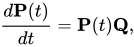
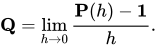
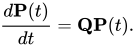
Kolmogorov - Chapman equation for a one-parameter family of continuous linear operators {\ displaystyle \ mathbf {P} (t), \; t> 0}  in a topological vector space expresses a semigroup property :
- {\ displaystyle \ mathbf {P} (t + s) = \ mathbf {P} (t) \ mathbf {P} (s).}

Most often, this term is used in the theory of homogeneous Markov random processes , where {\ displaystyle \ mathbf {P} (t), \; t \ geq 0}  - an operator that transforms the probability distribution at the initial moment of time into the probability distribution at the moment of time {\ displaystyle t}
  ( {\ displaystyle \ mathbf {P} (0) = \ mathbf {1}}
  )
)
For inhomogeneous processes, two-parameter families of operators are considered {\ displaystyle \ mathbf {P} (t, h), \; h> t> 0}  transforming the probability distribution at time {\ displaystyle t> 0}
  in the probability distribution at time {\ displaystyle h> t> 0.}
  For them, the Kolmogorov – Chapman equation has the form
- {\ displaystyle \ mathbf {P} (t, s) = \ mathbf {P} (t, h) \ mathbf {P} (h, s), \; s> h> t> 0.}

For discrete time systems, the parameters {\ displaystyle t, h, s}  take natural values .
We consider homogeneous Markov random processes in {\ displaystyle \ mathbb {R} ^ {n},} for which the transition probability operator {\ displaystyle \ mathbf {P} (t)} defined by transition density {\ displaystyle p (t, x, y)} : probability of transition from area {\ displaystyle U} to the area {\ displaystyle W} during {\ displaystyle t} there is {\ displaystyle \ int \ limits _ {U} dx \, \ int \ limits _ {V} dy \, p (t, x, y)} . The Kolmogorov – Chapman equation for densities has the form:
- {\ displaystyle p (t + s, x, y) = \ int \ limits _ {\ mathbb {R} ^ {n}} p (t, x, z) p (s, z, y) \, dz. }
At {\ displaystyle t> 0, \, t \ to 0} transition density {\ displaystyle p (t, x, y)} tends to a δ-function (in the sense of the weak limit of generalized functions ): {\ displaystyle \ lim _ {t \ to 0} p (t, x, y) = \ delta (xy)} . It means that {\ displaystyle \ lim _ {t \ to 0} \ mathbf {P} (t) = \ mathbf {1}.} Suppose there is a limit (also a generalized function)
- {\ displaystyle q (x, y) = \ lim _ {h \ to 0} {\ frac {p (h, x, y) - \ delta (xy)} {h}}.}
Then the operator {\ displaystyle \ mathbf {Q}} acts on functions {\ displaystyle f (x)} defined on {\ displaystyle \ mathbb {R} ^ {n},} as {\ displaystyle (\ mathbf {Q} f) (x) = \ int \ limits _ {\ mathbb {R} ^ {n}} q (x, y) f (y) \, dy,} and the direct Kolmogorov equation takes the form
- {\ displaystyle {\ frac {\ partial p (t, x, y)} {\ partial t}} = \ int \ limits _ {\ mathbb {R} ^ {n}} p (t, x, z) q (z, y) \, dz,}
and the inverse Kolmogorov equation
- {\ displaystyle {\ frac {\ partial p (t, x, y)} {\ partial t}} = \ int \ limits _ {\ mathbb {R} ^ {n}} q (x, z) p (t , z, y) \, dz.}
Let the operator {\ displaystyle \ mathbf {Q}} - second-order differential operator with continuous coefficients:
- {\ displaystyle (\ mathbf {Q} f) = {\ frac {1} {2}} \ sum _ {i, j} a ^ {ij} (x) {\ frac {\ partial ^ {2} f} {\ partial x ^ {i} \ partial x ^ {j}}} + \ sum _ {j} b ^ {j} (x) {\ frac {\ partial f} {\ partial x ^ {j}}} .}
(it means that {\ displaystyle q (x, y)} there is a linear combination of the first and second derivatives {\ displaystyle \ delta (xy)} with continuous coefficients). Matrix {\ displaystyle a ^ {ij}} symmetrical. Let it be positive definite at each point ( diffusion ). The direct Kolmogorov equation has the form
- {\ displaystyle {\ frac {\ partial p (t, x, y)} {\ partial t}} = {\ frac {1} {2}} \ sum _ {i, j} {\ frac {\ partial ^ {2}} {\ partial y ^ {i} \ partial y ^ {j}}} (a ^ {ij} (y) p (t, x, y)) - \ sum _ {j} {\ frac { \ partial} {\ partial y ^ {j}}} (b ^ {j} (y) p (t, x, y)).}
This equation is called the Fokker-Planck equation . Vector {\ displaystyle b ^ {j}} in the physical literature is called the drift vector, and the matrix {\ displaystyle a ^ {ij}} - diffusion tensor The inverse Kolmogorov equation in this case
- {\ displaystyle {\ frac {\ partial p (t, x, y)} {\ partial t}} = {\ frac {1} {2}} \ sum _ {i, j} a ^ {ij} (x ) {\ frac {\ partial ^ {2}} {\ partial x ^ {i} \ partial x ^ {j}}} p (t, x, y) + \ sum _ {j} b ^ {j} ( x) {\ frac {\ partial} {\ partial x ^ {j}}} p (t, x, y).}