The battle of Wilhelmstal is a battle that took place on June 24, 1762 during the Seven Years' War between the 57 thousandth Allied Army (England, Prussia and their allies) under the command of Ferdinand, Prince of Braunschweig and the 72 thousandth French Army, led by Marshals Subiz and d'Estra . During the battle, the Allied army defeated the French. This brilliant victory allowed the Allied army to wrest the initiative from the French in the campaign of 1762, which ends the year of the Seven Years War . The battle was named after the hunting castle of the Hessian landgraph Wilhelmstal in the vicinity of Kalden , which fell into the combat zone. Currently, the castle houses a battle museum, and in the castle park there is a mass grave of French soldiers who fell in battle, and a small monument erected in our time.
| Battle of Wilhelmstal | |||
|---|---|---|---|
| Main Conflict: Seven Years War | |||
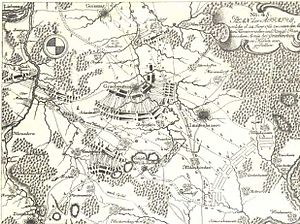 The scheme of the battle of Wilhelmstal | |||
| date | June 24, 1762 | ||
| A place | Kassel neighborhood | ||
| Total | Victory of the Union Army | ||
| Opponents | |||
| |||
| Commanders | |||
| |||
| Forces of the parties | |||
| |||
| Losses | |||
| |||


Content
Initial Situation
The conclusion of peace, and then of an alliance treaty with Russia, saved Prussia , which at the beginning of 1762 was on the verge of defeat in the war. The opposite was the situation for the army of Prussia's allies, who fought with the French and their Saxon allies in northwestern Germany, in Hesse . The British government has repeatedly made clear at the time described that it is no longer interested in this war, considering the main goals of Great Britain in it already achieved. The commander of the Allied Army, Prince of Braunschweig, had to reckon with the real threat that the British units that were part of the army would be recalled by London . This made him rush, while he still had enough troops to withstand the French: the campaign of 1762 was to begin with the Allied offensive.
On the eve of battle
From June 18 to 21, the Allied Army advanced to a position on the left bank of Dimel. The French, in response, having crossed the Weser , go towards Kassel and on June 23 they camp on the opposite bank of Dimel in the vicinity of Grebenstein, Burgufeln, Maymbressen and Kalden.
The French camp rested on the flanks of forests. Rough terrain stretched between the forests, replete with low hills with gentle slopes, intersected by the Esse River, a small tributary of the Dimel. Roads, as such, were absent, only trails led through the terrain, during rains, due to clay soil, they were almost impassable. The corps of Lieutenant General Marquis de Castries (8-10 thousand people) occupied a somewhat advanced position, located behind the village of Karlsdorf. The corps of General Stanville, headquartered in Grebenstein, was slightly extended in front of the left flank.
The Allied camp was located on the opposite bank of Dimel, a tributary of the Weser, 15-20 steps wide, almost drying up in the summer, during the flood of a widespread and flooding neighborhood. The shores of Dimel are high and steep and thus represent the advantages of the defenders.
Obviously, for this reason, the French, having made reconnaissance on June 23 and making sure that the forces of the Prince of Braunschweig are significantly inferior to their own, came to the conclusion that the Union Army intends to defend itself. The Allied offensive undertaken at night took the command of the French army by surprise. It was, therefore, punished for being careless: the French camped too far from Dimel, so that they could not only prevent the crossing, but also discover it; their camp was not adequately fortified, especially on the flanks in contact with the forest; they did not bother to clear the forest of detachments of enemy light troops and left in his hands the fortress of Sababurg, threatening their right flank. It seems that the French marshals have relied too much on their numerical superiority: the idea that the enemy, inferior to them in strength, can leave a well-fortified position and entrust the fate of the entire campaign to the vicissitudes of military luck, simply did not occur to them.
The mistakes of the French did not hide from the Prince of Braunschweig and were taken into account when drawing up the disposition of the battle. According to the disposition, the irregular cavalry of Lieutenant General Luckner was sent to bypass the right, and the English cavalry of Lord Granby was sent to the left flank of the enemy. The center and the right flank of the allies had to attack the French positions from the front, the left flank (Lieutenant General von Spörken) - go to the flank of the right wing, while the cavalry, after completing the detour, attack both flanks of the French from the rear.
On the eve of June 21, the prince’s troops seized the castle of Sababurg, which gave the prince the opportunity to occupy the forest on the right wing of the French with the help of the huntsmen of Luckner, and light English infantry units were always in the forest on the left flank.
Battle Progress
At one o’clock on the night of June 24, the Union Army began crossing the Dimel in 7 columns, leaving all its luggage and wagons in the camp. The crossing took place on a stretch of 3.5 Prussian miles (about 30 kilometers), therefore, building an army in battle formation at night was a rather difficult logistics task.
At 4 a.m., the columns were supposed to stand, completing the construction, in the areas indicated by him, which was done without delay. The offensive has begun. Silence and calm reigned in the enemy camp, as if the enemy was tens of kilometers from the French.
General Spörken, who led the 6th and 7th columns, acting against the right flank of the enemy, the first, walking along the edge of the forest, at 7 am went to the place where he was found by de Castries posts and fired upon. The shelling prompted him to start the battle first, without waiting for the appearance of the Luckner cavalry, in the interaction with which he was supposed to attack.
The de Castries soldiers bravely defended themselves, only a strike by Luckner's cavalry from the rear and the simultaneous appearance of the 4th and 5th attacking columns in front of the front of their position led them to retreat in full order to Grebenstein.
In the camp of the French, raised to their feet by the cannonade on the right flank, at that moment there was complete confusion: the French marshals did not know what they decided: to fight or to retreat. Finally, when columns of the Allies arose in front of the camp itself, and in the rear, on the left flank of the French, at Wilhelmsthal, the British cavalry appeared, a decision was made about a general retreat.
Because of the threat in the rear, this retreat was very dangerous. Therefore, Stanville with his corps (French grenadiers, Swiss mercenaries), additionally reinforced by cavalry taken from the right flank, was to cover the withdrawal of the army from the British. In this direction, at Wilhelmstahl, the hottest fights broke out. Stanville managed not only to repel several attacks of the English cavalry, but twice, with counterattacks, forcing her to seek infantry support. The French captured 7 guns, 5 of which were soon recaptured.
A fierce battle continued until the approaching units of the main Allied forces took Stanville's corps in ticks, encircling it on all sides. It was almost completely destroyed, the French soldiers were killed or captured, however, they were able to fulfill the task assigned to them, covering the withdrawal of the main forces of the French army to Kassel.
Battle Results
Allied losses amounted to 486 people killed, wounded and missing, of which, the share of the English Lord Lord Granby accounted for 439 people.
The claimed losses of the French amounted to 800-900 people killed and wounded and 1,600 captured.
These figures are not true: the surviving Prussian report speaks of 3,546 prisoners. The losses of the French army killed and wounded were, according to Prussian estimates, to exceed 1,500 people. The avenue of the museum in Wilhelmstal claims that 4,000 French soldiers who died in battle were buried in a mass grave in the park.
The main result of the victory was that the French were, from the very beginning of the campaign, imposed the role of the defending side. From Wilhelmstal to the end of the war, the initiative belongs to the Allied Army. In moral terms, a glorious victory at the very beginning of the campaign helped to strengthen the fighting spirit of the army.
Traditions
A book published in 1998 by Niemeyer publishing house The Sagas and Traditions of North Hesse tells us that the French, as they were fleeing, seemed to have buried the treasury of the army in the ground, fearing that it would fall into the hands of the enemy. All that they could remember in the bustle was that from the place where they buried the treasure, one could see 7 church spiers. Having returned a few years later, they could not find the hidden money, so the area around has changed a lot over the years. Until now, generations of treasure hunters have been unsuccessfully searching for the missing treasure.
Literature
Geschichte des siebenjährigen Krieges in einer Reihe von Vorlesungen, mit Benutzung authentischer Quellen, bearbeitet von den Offizieren des großen Generalstabs, Sechster Theil: Der Feldzug von 1762 und der Schluß des Krieges 1763 zheber zhemeberlum Gerweis Geumt zheme der Schluß des Krieges 1763 , SS. 55-93
Iba, Eberhard Michael (hrsg.): Sagen und Geschichten aus Nordhessen. Von Weser, Diemel und Fulda, CW Niemeyer, 1998
Links
- Description of the battle and additional illustrations at www.britishbattles.com [1]