A contravariant vector is usually called the set (column) of coordinates of a vector in a normal basis (that is, its contravariant coordinates ) or a 1-form in the same basis, which, however, is not natural for it. A contravariant vector in differential geometry and related physical concepts is a vector of tangent space .
- This definition is consistent with the definition of the contravariant valence tensor 1 (see. Tensor ), which is the contravariant vector (tangent space vector) as a special case of the tensor.
Basic Information
It is customary to write contravariant coordinates with a superscript, and also in a matrix notation as a column vector (in contrast to a record with a subscript and a row vector for covariant coordinates and, accordingly, a “ covariant vector ”).
A sample of a contravariant vector is a displacement vector recorded as a set of coordinate increments: 
Any set of numbers that transforms with any change of coordinates is the same as
It should be noted that if a non-degenerate metric tensor is defined, then the “covariant vector” and “contravariant vector” are simply different representations (entries in the form of a set of numbers) of the same geometric object - an ordinary vector or 1-form . That is, the same vector can be written as covariant (i.e., a set of covariant coordinates) and contravariant (i.e., a set of contravariant coordinates). The same can be said about 1-form. Converting one view to another is just a convolution with a metric :


(here and below we mean the summation over a repeating index, according to Einstein’s rule).
Substantially, vectors and 1-forms are distinguished only by which of the representations is natural for them. So, for 1-forms, decomposition along a dual basis is natural, for example, for a gradient, since their natural convolution (scalar product) with an ordinary vector (for example, displacement) is carried out without the participation of the metric, simply by summing the multiplied components. For ordinary vectors, such as dx i , expansion in the main basis is natural, since they are convoluted with other ordinary vectors, such as a displacement vector in spatial coordinates, with the participation of the metric. For example, a scalar 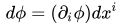

If we are talking about ordinary physical space, a simple sign of covariance-contravariance of a vector is how its natural representation is convolved with a set of coordinates of spatial displacement being a sample of a contravariant vector. Those that coagulate with by means of simple summation, without the participation of the metric, it is a covariant vector (1-form), while with the participation of the metric it is a contravariant vector. If space and coordinates are so abstract and wonderful that there is no way to distinguish between the main and dual basis, except by arbitrary conditional choice, then the meaningful difference between covariant and contravariant vectors disappears, or becomes also purely conditional.
The question of whether it is precisely the idea in which we see the object that is natural for him is already touched on a little higher. The contravariant representation is natural for an ordinary vector, while for a 1-form it is covariant.
- Note: all these terms are usually used in tensor algebra; it is understood that on the space in which the described objects exist (or on the manifold in the tangent space of which they exist) there is a metric (at least pseudo-Riemannian).
Literature
- Landau L.D. , Lifshits E.M. Field Theory. - 7th edition, revised. - M .: Nauka , 1988 .-- 512 p. - (“ Theoretical Physics ”, Volume II). - ISBN 5-02-014420-7 .
See also
- Isomorphism between tangent and tangent space
- Covariance and contravariance
- Covariant vector