Garlic-trees [1] [2] ( lat. Pelobates ) - a genus of tailless amphibians , allocated in the eponymous [1] monotypic family (Pelobatidae).
| Garlic |
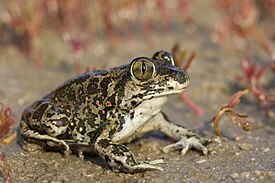
Syrian Garlic Maker |
| Scientific classification |
|---|
| No rank : | Bilateral symmetrical |
| Squad: | Tailless Amphibians |
| Family: | Garlic ( Pelobatidae Bonaparte , 1850 ) |
|
| International scientific name |
|---|
Pelobates Wagler , 1830 |
| Synonyms |
|---|
- Cultripes Müller, 1832
- Didocus Cope, 1866
- Pseudopelobates Pasteur, 1958
|
| Area |
|---|

|
|
Content
The total length of representatives of this genus reaches 9 cm. The muzzle is rounded in front. The eyes are large with a vertical ("cat") pupil. On the heels there are special cornified calluses, with them they can dig a hole for themselves in just a few minutes. Because of this, they do not settle in places with solid soil. Callous corns on males' fingers are not expressed, but on their shoulders they have a large oval gland. There are no resonators . Often garlic ladies smell sharply of garlic , which is where their name comes from.
The color is brown, gray or brown with dark spots or dots.
Inhabit wooded and steppe places. Prefer to travel by land. They feed on invertebrates , in particular insects .
Amplexus of the Iberian Garlic The male, during mating, grabs the female by the body in front of the hips. The masonry is presented in the form of a long thick cord with eggs randomly arranged in several rows.
Tadpoles reach very large sizes - up to 22 cm. The gill opening is located on the left side of the body and is directed back and up. The anus is located on the midline of the body. The oral disk is oval in shape, almost entirely surrounded by papillae (except for a notch from above). The horny beak (jaw) is large, black. The denticles are located chaotically outside, 4–9 rows above and below the beak, in the form of a series of short, intermittent, as well as long continuous lines. The upper fin of the tail is high, the end of the tail is pointed.
They live in Europe , the countries of the Middle East to the western regions of Kazakhstan and in northwest Africa .
As of October 2018, 5 species are included in the genus [3] :
- Pelobates cultripes (Cuvier, 1829) - Iberian garlic shed , or western garlic shed
- Pelobates fuscus (Laurenti, 1768) - Common garlic , or thick-headed grassy
- Pelobates syriacus Boettger, 1889 - Syrian Garlic Maker
- Pelobates varaldii Pasteur & Bons, 1959 - Moroccan Garlic Maker [1]
- Pelobates vespertinus (Pallas, 1771)
- ↑ 1 2 3 Ananyeva N. B. , Borkin L. Ya. , Darevsky I.S. , Orlov N.L. The pagan language dictionary of animal names. Amphibians and reptiles. Latin, Russian, English, German, French. / edited by Acad. V. E. Sokolova . - M .: Rus. Yaz., 1988 .-- S. 106-108. - 10,500 copies. - ISBN 5-200-00232-X .
- ↑ Kuzmin S. L. Amphibians of the former USSR. - M.: Partnership of scientific publications of KMK, 2012. - 2nd ed. - S. 117 .-- 370 p. - ISBN 978-5-87317-871-1
- ↑ Frost DR Pelobates . Amphibian Species of the World, an Online Reference. American Museum of Natural History, New York, USA
- Wagler, 1830. Natürliches System der Amphibien: mit vorangehender Classification der Säugethiere und Vögel: ein Beitrag zur vergleichenden Zoologie ' '. München p. 1-354.
- Akimushkin I.I. Gerlyanki, midwives, and garlic-houses // Animal World: Birds. Fish, amphibians and reptiles. - 3rd ed. - M .: Thought, 1995 .-- S. 386. - 25,000 copies. - ISBN 5-244-00803-X .
- Laurie J. Vitt, Janalee P. Caldwell: Herpetology: An Introductory Biology of Amphibians and Reptiles . 2013, Elsevier Ltd, ISBN 978-0123869197 , S. 479.
- Zweifel, Richard G. (1998). in Cogger, HG & Zweifel, RG: Encyclopedia of Reptiles and Amphibians . San Diego: Academic Press, 88. ISBN 0-12-178560-2 .
