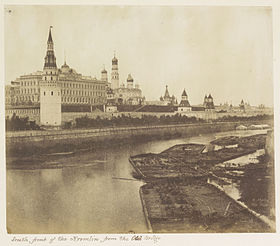
Kalotipiya ( dr. Greek καλός “beautiful” and τύπος “imprint”) is an early photographic process based on the use of paper saturated with iodine silver . Technology has become the first negative-positive process in history to replicate positives from the original negative image on paper. The patent for this photographic process was obtained by its inventor William Henry Fox Talbot on February 8, 1841 [2] [3] [4] . Kalotypy is also called talbotypia by the name of the inventor of the process.
Technology Description
Talbot began his first experiments on creating photograms in 1834 using paper coated with silver nitrate , the photosensitivity of which has been known since the 18th century [5] . Later, it replaces nitrate with silver chloride , which also darkens in proportion to the resulting exposure [6] . At the same time, the “photogenic pattern” of objects laid out on paper appeared directly under the influence of light, requiring long exposures of several hours. The technology has been known since 1802 after its invention by Humphrey Davy and Thomas Wedgwood , but Talbot first learned to fix a picture that had previously darkened under the further influence of light. He proposed to process the image in a solution of sea salt , which removed the remnants of the photosensitive halide . Later, the scientist discovered a higher efficiency as a fixative of potassium iodide [7] .


Shooting with a regular pinhole camera , unlike contact photograms, produced underexposed negatives due to the low photosensitivity of the process. Talbot built a makeshift miniature camera with a square frame window one inch (25 mm) wide. The higher luminous efficiency of the device, which the inventor’s wife called “a mousetrap,” allowed photography on August 20, 1835 [5] [8] . The first picture was the image of a lattice window in the room of the Leccock Abbey, which belonged to the family of the scientist [9] [10] [11] . The next few years, Talbot was busy with other experiments, abandoning experiments with light painting. The development of technology was continued by him shortly after the report of Francois Arago at the French Academy of Sciences on daguerreotype and the creation of a commission to evaluate the invention [12] . Already on January 31, Talbot tried to get ahead of Louis Daguerre by presenting a detailed description of his experiments to the Royal Society of London [13] . In Russia they became known about them three months earlier than about daguerreotype, thanks to a report by Joseph Hamel made at the St. Petersburg Academy of Sciences on May 24, 1839 [14] .
However, in comparison with daguerreotype, the Talbot process had extremely low photosensitivity and was suitable mainly for obtaining photograms and copying drawings. A breakthrough occurred during further research, when the scientist discovered the chemical manifestation of an invisible latent image [8] . As a result, the shutter speed in the pinhole camera was reduced from half an hour to one or two minutes in the bright sun, being equal in this parameter to French technology. The new process was called calotypy, and its description was published in 1841 [15] [16] . Ippolit Bayar tried to challenge Talbot's priority, in 1839 he received the first shots on paper coated with iodine silver [17] . However, this process was not widespread, eventually yielding to daguerreotype and calotypy. Talbot's technology consisted of several stages: first, a sheet of high-quality writing paper was subjected to processing, onto which a solution of nitric acid , and then silver iodide was applied with a brush. This was followed by sensitization with “galloargentonitrate” (silver gallonitrate), consisting of a mixture of silver nitrate with gallic and acetic acids [18] .
The value of the obtained photosensitivity significantly exceeded the same indicator of Daguerre plates, requiring shorter shutter speeds. After exposure of the sheet in the pinhole camera, the weak latent image was intensified by repeated treatment with galloargentonitrate, becoming visible [19] [2] . The process ended with fixing in a solution of potassium bromide , instead of which in 1843 Talbot began to use the hyposulfite recommended by John Herschel as a fixer [8] [13] . The spread of calotypy was hindered by patents, which Talbot defended every improvement in his process, strictly suppressing attempts to use the technology without the permission of the inventor [18] [16] . The process became an alternative to the French in only a few places: in their homeland and in Frankfurt am Main , Germany , where Talbot's student E. Tanner worked [20] . In 1847, calotypy penetrated into France, where they appreciated its convenience for field shooting [21] . The process was most widely spread in the 1840-1850s [22] .
Compared to dagerotype, the advantage of calotypy was the ability to replicate positive images using contact printing from a translucent negative [23] . Modern gallery owners call this technology of making positives a salt photo printing [24] . The image on salt prints is direct, not mirror, as on daguerreotypes available in a single copy. The paper substrate of calotypes made it possible to publish photo albums in small editions, which was impossible for daguerreotype. Talbot was also the first to develop a method for increasing negatives and their optical printing using a camera of a special design - the prototype of a photographic enlarger [18] . The “solar microscope” was also based on the same principle, which makes it possible to make four-hundred-fold increases in the smallest objects by the method of calotypy [7] . They tried to mask the fiber structure of negatives using dry waxed paper as a substrate, for which a regular sheet was impregnated with molten beeswax [25] . However, the negative-positive process became widespread only after the invention of the wet collodion process , in which the photosensitive layer was poured onto a glass base. Sometimes Talbot is mistakenly called the inventor of the manifestation, which was actually first discovered back in the 1820s by Nieps and then successfully used by Daguerre. Talbot's merit consists in creating the concept of a two-stage method for obtaining an image that allows replicating photographs and still prevails in analog photography [26] [16] .
See also
- Album Seal
- Adamson, Robert
- Hill, David Octavius
- Claude, Antoine
- Lewis Carroll and Photography
Notes
- ↑ PHOTO. World History, 2014 , p. 45.
- ↑ 1 2 The New History of Photography, 2008 , p. 61.
- ↑ 100 years of photography, 1938 , p. 59.
- ↑ PHOTO. World History, 2014 , p. 20.
- ↑ 1 2 Lectures on the history of photography, 2014 , p. 23.
- ↑ Essays on the History of Photography, 1987 , p. 20.
- ↑ 1 2 The New History of Photography, 2008 , p. 27.
- ↑ 1 2 3 Photoshop, 1998 , p. 69.
- ↑ Identification, storage and preservation of photographic prints made using various techniques, 2013 , p. 15.
- ↑ Quick reference to amateur photographer, 1985 , p. eight.
- ↑ The most famous exhibits of the Metropolitan Museum of Art . A wealth of art . Trendymen. Date of treatment February 29, 2016.
- ↑ A New History of Photography, 2008 , p. 24.
- ↑ 1 2 100 years of photography, 1938 , p. 58.
- ↑ Creative Photography, 1986 , p. ten.
- ↑ A New History of Photography, 2008 , p. thirty.
- ↑ 1 2 3 Lectures on the history of photography, 2014 , p. 24.
- ↑ A New History of Photography, 2008 , p. 28.
- ↑ 1 2 3 100 years of photography, 1938 , p. 60.
- ↑ Essays on the History of Photography, 1987 , p. 22.
- ↑ A New History of Photography, 2008 , p. 49.
- ↑ Lectures on the history of photography, 2014 , p. 31.
- ↑ Identification, storage and preservation of photographic prints made using various techniques, 2013 , p. 14.
- ↑ Chemistry and Life, 1966 , p. 45.
- ↑ PHOTO. World History, 2014 , p. 556.
- ↑ A New History of Photography, 2008 , p. 71.
- ↑ Foto & video, 2009 , p. 87.
Literature
- Alexey Alekseev. Wet collodion process. Eternal collodion (Russian) // “Foto & video”: journal. - 2009. - No. 2 . - S. 86-93 .
- E.A. Iophis . The photo. Close and far (Rus.) // " Chemistry and life ": journal. - 1966. - No. 3 . - S. 45-49 . - ISSN 0130-5972 .
- Vladimir Levashov . Lecture 1. Background and discovery of the medium // Lectures on the history of photography / Galina Yelshevskaya. - 2nd ed .. - M .: "Trimedia Content", 2014. - S. 11-28. - 464 p. - ISBN 978-5-903788-63-7 .
- A.V. Maksimova, K.A. Misyura-Aladova, Yu. A. Bogdanova. Identification, storage and preservation of photo prints made in various techniques / E. A. Vasilieva. - SPb. : “State Museum and Exhibition Center ROSPHOTO”, 2013. - 47 p.
- Sergey Morozov. Part I // Creative photography / A. Fomin. - 2nd ed .. - M .: "Planet", 1986. - S. 8-24. - 415 p. - 25,000 copies.
- N. D. Panfilov, A. A. Fomin. II. The world's first pictures // A quick reference to amateur photographer. - M .: "Art", 1985. - S. 8-13. - 367 p. - 100,000 copies.
- Maxim Tomilin. Fox Talbot and the two-stage photographic process (Russian) // "Photo Store": magazine. - 1998. - No. 12 . - S. 68-70 . - ISSN 1029-609-3 .
- Michelle Frizzo. A new history of photography = Nouvelle Histoire de la Photographie / A. G. Naslednikov, A. V. Shestakov. - SPb. : Machina, 2008 .-- 337 p. - ISBN 978-5-90141-066-0 .
- K.V. Chibisov . Essays on the history of photography / N. N. Zherdetskaya. - M .: "Art", 1987. - S. 15-23. - 255 p. - 50,000 copies.
- 100 years of photography. Daguerre, Nieps, Talbot . - M .: "Goskinoizdat", 1938. - 62 p.
- The birth of photography // PHOTO. World History / Juliet Hacking. - M.,: "Magma", 2014. - S. 18-25. - 576 p. - ISBN 978-5-93428-090-2 .
Links
- The history of photography: Fox Talbot (rus.)
- Calotypia of Fox Talbot . Photo Watch. Date of treatment June 3, 2013. Archived June 3, 2013.
- William Henry Fox Talbot . photoline.com. Date of treatment June 3, 2013. Archived June 3, 2013.