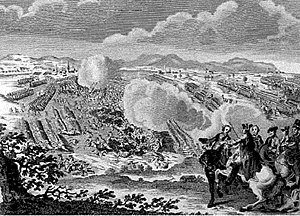
Battle of Minden ( Eng. Battle of Minden , German Schlacht bei Minden , French Bataille de Minden ) - a military clash on August 1, 1759 between the British-Prussian and Franco-Saxon armies during the Seven Years War .
| The Battle of Minden | |||
|---|---|---|---|
| Main Conflict: Seven Years War | |||
 The Battle of Minden | |||
| date | August 1, 1759 | ||
| A place | Minden in Northern Germany | ||
| Total | The victory of the British and Prussians | ||
| Opponents | |||
| |||
| Commanders | |||
| |||
| Forces of the parties | |||
| |||
| Losses | |||
| |||
In the battle between the 41,000-strong allied army of the British, Prussians and their allies under the command of Ferdinand, the Prince of Braunschweig and the 61,000-strong army of the French and Saxons, the Marquis de Contad, which took place on August 1, 1759, north-west of Minden , French troops were defeated that foiled the French plans for the invasion of Hanover . Two striking episodes of this battle - the attack of 6 battalions of the British infantry against the French cavalry and the refusal of the commander of the British cavalry, Lord George Sackville, to comply with the order, as a result of which the French escaped from complete defeat, and Lord Sackville appeared before a military court - entered the annals of the history of the British army still celebrating Minden Day . For Prussia, the victory of the Allied army at Minden had both positive and negative consequences: on the one hand, it provided the Prussians with a reliable rear in the west, on the other, the British, who defeated the French in Canada next month in the battle in the Abraham Valley and took Quebec , considered from that moment the main goals of the war were achieved and, as a result, drastically reduced the financial assistance of Prussia, which Frederick , who suffered at the same time a crushing defeat at Kunersdorf , was in dire need.

Background
In May 1759, the French army in Germany totaled 107 thousand people together with the allies (Saxons, Württemberg). She was opposed by the 57,000th Allied Army under the command of Ferdinand, Prince of Braunschweig. The backbone of the army was Hanoverian and Hessian troops; further - 6 battalions and 14 squadrons, a total of approximately 8.5 - 9 thousand British who joined the army at the end of 1758; a small Prussian detachment, mainly cavalry, despite the fact that many officers of the army and its commander were in Prussian service and, finally, detachments set up by smaller allies. In the summer, the French army with two interacting columns (the main army under the command of Marshal Louis Georges Contad and the 18 thousandth corps de Broglie) goes on the offensive, moving to Hanover. Using the numerical advantage, while avoiding battles, the French are slowly but surely moving forward. The skillful maneuvers and demonstrations of the Prince of Braunschweig are not able to prevent the fall of Minden, taken by de Broglie on July 10, and the surrender of Munster on July 22. The capture of Minden means that the French are open to the very heart of Hanover. Being by nature an adherent of radical decisions, the Prince of Braunschweig from this moment has focused all his efforts on imposing a general battle on the enemy. He sends his nephew, the Crown Prince of Braunschweig, later also a prominent Prussian military leader, to the rear of Marshal Contadu with the 10,000th corps: his nephew must cut the main supply line of the French army. He himself, with his army, takes a position with Minden, referring to the French. This time, the intentions of the commander of the Allied army coincide with the intentions of the French command: Paris also requires Marshal Contad to give battle. For a crescent, the opponents are facing each other, preparing for a decisive battle.
Side forces and disposition
The area on the left bank of the Weser , which became the scene of subsequent events, was limited in the north by the Esperbach River, which flows into the Weser at Petershagen, in the south - by the mountain range, the Harz spur, low and not wide and, nevertheless, representing because of the steep, almost sheer the slopes are a serious obstacle: only two roads leading through or bypassing the mountain range were accessible for troop convoys — the road from Minden to Bielefeld, which ran north-south along the Weser through the so-called Porta Westfalika, and the road to Lubbeck, leading I was in the south-west. Parallel to the ridge, at a certain distance to the north, flows the tributary of the Weser Bastau, which flows into the Weser within the city fortifications of Minden. This tributary, significant only because it can be crossed only by bridges, was at some distance from Minden surrounded on both banks by two-kilometer impassable peat bogs. These swamps made the position of the French army, which stood at Minden, almost impregnable: while the left flank of Marshal Contad was reliably protected by them, the right flank rested on the Weser, the Bastau River flowed in front of the front, and mountains were in the rear. Minden was occupied by a strong garrison; de Broglie with his own forces stood opposite Minden, on the right bank of the Weser. A small (3 thousand people) corps stood south of Minden, near Gofeld, covering the army’s luggage sent to Rem on the right bank of the Weser.
In another scenario, the advantages of the defensive position occupied by the main French army turned out to be serious flaws: the enemy could easily cut the main supply routes of the army, which was done by the Prince of Brunswick, and the limited space did not allow the army to be deployed in combat order without leaving the position. For a general battle, the army had to advance forward, beyond Bastau, to the plain of Minden. This plain, which became a battlefield, was crossed by numerous paths and trails, villages and hamlets, copses, gardens and ponds, which represented obstacles to the movement of troops. In the days leading up to the battle, the Prince of Braunschweig ordered his generals to carefully examine the area on which they were to act.
The main Allied army was located northwest of Minden behind the village of Nordhammern, the left flank was the corps of General Wangenheim (18 cavalry squadrons, 8 infantry battalions, 5 grenadier battalions), which was behind the village of Todtenhausen on the banks of the Weser, was slightly advanced. According to various estimates, the union army at the time of the battle numbered from 31 to 41 thousand soldiers, most authors converge on 36-38 thousand, the French had more than 50 thousand people, estimates range from 46 to 61 thousand.
On the night of August 1, both armies set in motion: the French crossed Bastau along 19 pontoon bridges and began to unfold in battle formation. De Broglie crosses with his own forces to the other side of the Weser and joins the troops of Contad, passing through Minden. At 3 a.m., the Prince of Brunswick receives a report on the crossing of the enemy; his army, on the eve, since the preparations of the French did not go unnoticed, put on alert, comes forward.
The left flank of the French was the infantry of the main army, in the center was the entire cavalry, the right flank consisted of the corps of de Beaulieu. While Contad restrained the main forces of the allies, de Beaulieu began the battle, overturning the corps of Wangenheim. After completing this task, he had to turn left and, connecting with the first echelon of the left flank, attack the left wing of the main forces of the Allied army. The cavalry (63 squadron), located in the center, should, according to circumstances, come to the aid of one or another flank. The disposition of Contad was quite reasonable given the passivity of the enemy. However, the Prince of Braunschweig did not think, idly by, to wait in Northhammern for him to be broken, but he was determined to attack, which the French plan did not provide for. The placement of the French cavalry in the center caused an unusual course of the battle, thanks to which it occupied a special place in the history of the Seven Years War.
Battle Progress
At 6 o’clock in the morning, the Allied army was ready for battle: on the far right flank there were English (14 squadrons) and Hanover (10 squadrons) cavalry under the command of Lord Sackville, adjoined by infantry, combined in 4 columns, 6 and 8 battalions each, each in two echelons, between the Wangenheim corps on the left flank and the infantry on the right flank there were 15 more squadrons of mixed, mainly Prussian cavalry. At that time, only the Corps de Beaulieu completed the construction with the French, the generals of Marshal Contade built and rebuilt their units, as if forgetting that the enemy was in front of them, until 8 in the morning, the French soldiers demonstrated poor training.
De Beaulieu began the battle by shelling the positions of Wangenheim. He advanced his infantry forward, where it suffered senseless losses from enemy fire, but did not go on the offensive, as envisaged by the Contade disposition, because of fear for its left flank, limiting itself to forcing the forces of Wangenheim for the entire duration of the battle. In parallel, Ferdinand of Braunschweig gave the order to clear the village in front of the front of his army from the front line of the enemy, which was usually done before the attack. The duke’s order has not yet been fulfilled, when suddenly 6 battalions of the English infantry, standing in the first echelon of one of the columns, went in close formation to 63 squadrons of the French cavalry, after a while 2 Hanover battalions of the second echelon joined them, then 3 more battalions from other columns . The attack began without an order, according to other sources, the British commander misunderstood the commander’s order transmitted in French, in case of an attack, give a signal of a drum battle, and immediately went on the attack under the drum. These 11 battalions, suffering terrible losses from the fire of French artillery, as in a parade, moved forward, chasing in front of themselves everything that they encountered on their way. Letting the enemy cavalry at close range, they met her in a friendly volley, the front rows behind the erupted riders closed and those French cavalrymen who managed to break through the ranks were destroyed by the back rows in close combat, while the convoy continued its irrepressible march. Demonstrating bulldog resistance, the British and the Hannover infantry who joined them walked like a skating rink through the French cavalry, smashing it cleanly, including a reserve of selected parts of carabinieri and gendarmes staffed with the color of the French noble youth. The French cavalry completely dropped out of the battle and this ended the first phase of the battle.
In alarm for the fate of the brave English infantry, Ferdinand of Braunschweig sends an order to Lord Sackville to go in support of her. He, however, pretends that he did not understand the order and did not budge. Repeated orders also do not impress the commander of the British cavalry. Finally, for 6 times (!) Times, the commander sends an order to Sackville's deputy, Lord Granby. However, Sackville forbids Granby to execute the order and sets off to personally speak with Ferdinand. As a result of the explanation, he, however, somewhat moves his squadrons to the left, but nevertheless does not enter the battle. Sackville's behavior in the battle of Minden was explained differently by contemporaries: some believed that Sackville acted out of personal motives, in spite of the commander; a British military court denounced the lord for cowardice in the face of the enemy.
In the second phase of the battle, batteries on the flanks of the Contade army were captured or crushed and the infantry covering them was defeated. Here the cavalry of the left flank of the allies distinguished themselves, the enemy had Saxon battalions of Prince Xaver, who had shown courageous resistance. By 10 o’clock the battle ended in a convincing victory for the Allied army: the frustrated ranks of the French fled to the pontoon bridges across Bastau. Corps de Beaulieu, the only uninjured in the entire French army, in perfect order withdrew to Minden and took up new positions in the vicinity of the city, covering the withdrawal of the main forces. Lord Sackville pushed his cavalry forward a little, just so that his people could see the backs of the fleeing French, however, did not take part in the pursuit, which was one of the reasons that allowed the enemy to avoid complete defeat.
Battle Results
The claimed French losses amounted to more than 7000 people killed, wounded or taken prisoner (444 officers, among them 5 generals and 6642 soldiers), 26 heavy and about a dozen light guns, 7 banners, 10 standards. The winners lost 151 officers and 2,460 privates, of which 78 officers and 1,297 privates were battle heroes, 6 English infantry battalions ( Napier, Stewart, Welsh Fusilier, Kingsley, Brudenell, Home ).
Having covered Contade's retreat, de Broglie crossed the same day to the other side of the Weser, leaving a garrison of 300 soldiers in Minden, which capitulated the next morning. The Contade army was locked up in its old camp, where it suffered casualties from the ongoing shelling of the allies that installed their batteries on the banks of Bastau. The situation of the French was rather deplorable: on the same day when the battle of Minden took place, the Crown Prince of Braunschweig broke the small detachment of the Duke de Brissac in the battle of Gofeld and locked, thus, finally the road to Bielefeld, the only way to retreat in the south-west direction. On the night of August 2–3, taking advantage of the heavy fog, the French were able to build two pontoon bridges over the Weser and, unnoticed by the enemy, cross over to the other side. Pursued on the heels by the cavalry of the allies, the French retreated behind Kassel, leaving the city, which soon capitulated to the mercy of fate, and could stop and gain a foothold only on the Marburg-Giessen line. For all the remaining years of the war, they were no longer able to advance as far as in July 1759. The immediate danger to Hanover no longer arose and the British, who won in 1759 a series of decisive victories over the French overseas, thanks to which this year went down in history as the " Glorious Year ", began to gradually lose interest in the war in Germany. Prussia’s help, which she urgently needed at that time, was reduced.
Lord Sackville was removed at the suggestion of Ferdinand of Braunschweig from the post of commander of the British cavalry and appeared at home before a military court. The court found him completely guilty and sentenced to appeal and expulsion from the army. His name was struck off the lists of the British Army, a court verdict stating that he “was unable to serve His Royal Majesty in any military post” was read out in every British regiment. After such a harsh sentence, one could expect the lord’s military career to be over forever, however, it didn’t turn out that way: using family ties, Lord Sackville, under the name of Lord Germain, went into politics, rising to the post of Secretary of State for American Affairs in 1775. In this capacity, he took part in the development of the strategy of the British army against the rebellious colonies in the War of Independence, and he is attributed the bulk of the blame for the defeat of Great Britain in this war.
Minden Day
6 British regiments bear the name Minden on their banners as Battle Honor . The artillery brigade and the military band of the British Army are also named after this name. On August 1, the British Army celebrates Minden Day . On this day, soldier caps are decorated with roses in the colors of the regiments to which the soldiers belong: according to legend, on August 1, 1759, in pursuit of the enemy, the British had to go through the rose garden on the way, and each one plucked a rose and decorated her cocked hat . On this subject - "Rose of Minden" - was subsequently written by the popular British military march.
From the Memoirs of the French Participant in the Battle of Minden
После того, как в сражении при Миндене английский корпус рассеял многими вовремя данными залпами находившуюся перед ним линию кавалерии, корпус жандармерии и корпус карабинеров получили приказ атаковать его. Они пошли ещё на значительном расстоянии от противника галопом и en muraille , то есть без интервалов по сторонам между эскадронами. За счёт смыкания рядов возникла давка первоначально в середине, затем на флангах, в особенности, на правом. Огонь пехоты начался в центре её линии, когда мы были от неё на расстоянии не более 15 шагов, и, поскольку огонь был продолжительным, от центра к флангам, лошади предпринимали отчаянные усилия свернуть вправо или влево, с тем, чтобы убежать. Вес, вызванный мощным давлением, был чудовищным, всадники, потерявшие всякую власть над своими конями, наталкивались друг на друга и сваливались в огромные кучи, так, что от силы восемь или десять человек из каждого эскадрона остались верхом, так сказать, управителями своих лошадей, которыми и были в момент унесены вдаль. Некоторые прорвали вражеский строй без того, чтобы привести его в беспорядок, для этого их было слишком мало. От огня погибло немного людей, но много было контуженных, много оторванных и поломанных конечностей, многие были задавлены в свалке или погибли под конскими копытами.
Memory
В честь сражения был назван британский корабль HMS Minden (спущен на воду в 1810 году).
Literature
- Groehler, Olaf: Die Kriege Friedrichs II., Brandenburgisches Verlagshaus, Berlin 1990
- Geschichte des siebenjährigen Krieges in einer Reihe von Vorlesungen, mit Benutzung authentischer Quellen, bearbeitet von den Offizieren des großen Generalstabs, Dritter Theil: Der Feldzug von 1759, als Manuscript zum Gebrauche der Armee abgedruckt, Berlin 1828
- C. von Decker, Oberst und Brigadier der Ersten Artillerie Brigade ir .: Die Schlachten und Hauptgefechte des siebenjährigen Krieges. Mit vorherrschender Bezugnahme auf den Gebrauch der Artillerie, in Verbindung mit den beiden andern Hauptwaffen der Armee, Druck und Verlag von Ernst Siegfried Mittler, Berlin, Posen und Bromberg 1837
Links
- Подробное описание сражения (нем.)
- Богато иллюстрированное описание сражения (англ.) .