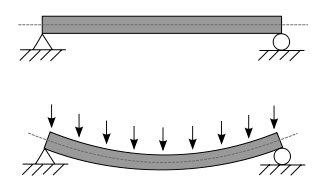
The beam is a linear element of the supporting structures, resting on both ends (unlike the console ) and working mainly on bending . Various sections are made (T-beam, I-beam, box beam, beam and others).
In practice, as a rule, a horizontally located beam takes up a vertical transverse weight load, but in some cases it is necessary to take into account the influence of probable horizontal transverse forces (for example, a wind load or when taking into account a possible earthquake ). A loaded beam, in turn, acts on the supports, which can be columns , suspensions , walls or other beams (crossbars). Then the load is transferred further and as a result, in most cases, it is perceived by the structural elements working on compression , as supports . Separately, we can distinguish the case of the truss in which the rods rest on a horizontal beam.
The strength properties of a beam depend on several of its characteristics:
- the area and shape of its cross section;
- beam length;
- beam material;
- method of securing it.
In modern buildings, steel , reinforced concrete or wooden beams are usually used. One of the most common types of steel beam cross-sections is the I-beam . I-beams are used in the construction of building frames and bridges. Also used are T-beams , channels , beams with a hollow profile (in particular, pipes ), beams with an angular section profile.
Steel beam can be rolled or welded .
See also
 Play media file
- Cronbalk - supporting structure or structural element.
- Rand beam - a beam resting on separate foundations and absorbing the load from the wall located above it.
- The Virendel beam is a horizontal structural component.
- Continuous beam - statically indefinable beam with additional supports in the span.
Literature
- Beam (beam) // Military Encyclopedia : [in 18 vol.] / Ed. V.F. Novitsky [et al.]. - SPb. ; [ M. ]: Type. t-va I. D. Sytin , 1911-1915.