Postojnska Jama [1] ( Slovenian. Postojnska jama ) is a system of karst caves 24,340 m long on the Karst plateau [2] , located near the town of Postojna in Slovenia in the region of Notranska Kráška . The longest cave system in Slovenia and one of the most visited places in this country by tourists, equipped with electric lighting and a railway since the 19th century.
| Postojnska Yam | |
|---|---|
| Slovene. Postojnska jama | |
 Stalagmite "White Diamond" - a symbol of the cave | |
| Location | |
| A country |
|

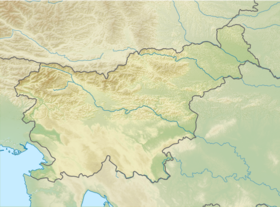


This limestone plateau in Slovenia gave the name to the very term “karst” - a set of processes and phenomena of water dissolution of rocks and the formation of voids in them, as well as peculiar landforms that occur in areas composed of rocks that are relatively easily soluble in water, for example, gypsum , limestone, marble, dolomite and rock salt. [3]
The cave was formed by the waters of the Pivka River , which flows through the cave for 800 m. Inside, the temperature is kept at around 10 ° C all year round. 5.3 km of the cave is open to the public - this is the longest open cave space for tourists to visit in the world.
Content
History
The cave was first described in the XVII century by Baron Janez Vaykard Valvazorom . New territory of the cave was accidentally discovered by a simple minister named Luca Chech in 1818, who participated in the preparation of the cave for the first visit of the first Emperor of Austria, Franz II . [3]
In 1819, the cave was open to the public and Chech became one of the six guides. Its priority in discovering new territories of the cave was not recognized for a long time and only after almost a quarter of a century justice was restored. (B. Gotman 10/01/17) Electric lighting of the cave was carried out in 1884, even earlier than in Laibach , the capital of Krajina , on the orders of Emperor Franz Joseph , who visited the cave twice. To receive the Habsburgs , a magnificent Predyam Palace was built in front of the cave entrance (now given to a restaurant).
During the First World War, a whole military unit of the Italian army passed through the cave to the rear of the Austrians with the help of engineers [4] . Access to the farthest halls of the cave (or rather, to the 500-meter Lepa pit or the Beautiful Cave in Russian) was facilitated by the construction in 1916 by Russian prisoners of war, the so-called. Russian bridge [4] .
In 1872, the world's first cave railway was laid, the trolleys of which were initially pushed by guides , and at the beginning of the 20th century a gas locomotive was installed. After 1945, the locomotive was replaced by an electric one. In so-called. the concert hall inside the cave has long held musical events (eg, in 1930 the La Scala theater gave two concerts here [5] ).
During the Second World War, Slovenian partisans blew up strategic fuel reserves for the Luftwaffe stored in the cave (B. Gotman 01.10.17), as a result of which some halls of the cave are still covered with black soot [6] .
Fauna
One of the symbols of the cave is the “ human fish ” - an amphibian up to 20 cm long, living underground. In one of the halls of the cave there is an aquarium where you can see these animals - the only vertebrates in Europe that spend their whole life underground.
In total, 150 species of animals were found in the cave, among which there are many endemic species [7] . Luka Chech also discovered a previously unknown beetle in the cave, which was mistakenly named not by the name of the discoverer, but by the name of the museum curator. (B. Gotman 10/01/17) There is a vivarium near the cave, where the entire cave fauna is represented.
Notes
| External video files | |
|---|---|
| Drive through the cave by underground railway. | |
- ↑ Geographic Encyclopedic Dictionary: Geographic Names / Ed. A.F. Treshnikov . - 2nd ed., Ext. - M .: Soviet Encyclopedia , 1989. - S. 382. - 210 000 copies. - ISBN 5-85270-057-6 .
- ↑ B. Gotman 10/01/17
- ↑ 1 2 B. Gotman 10/01/17
- ↑ 1 2 V.N.Dublyansky. 1. Caves and caves • 1.3. Birth - "classical" speleology // Entertaining speleology . - Ural LTD, 2000 .-- 526 p. - ISBN 5-8029-0053-9 .
- ↑ Aspects of the History of Slovene Karst (1545–2008) - Trevor R. Shaw - Google Books
- ↑ Predjamski Grad (historical castle, Slovenia) - Encyclopedia Britannica (unavailable link) . Date of treatment April 19, 2019. Archived April 17, 2010.
- ↑ Vivarium Proteus "Postojna Cave
Links
- Postojnska Yama - article from the Great Soviet Encyclopedia .
- Official site