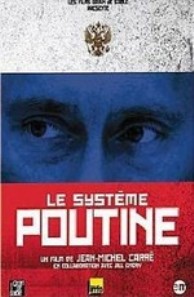
“The Putin System” ( French “Le Système Poutine” , English “The Putin System” ) - a documentary by Jean Michel Carré and Jill Emery about the President of Russia V.V. Putin , his biography , career and his foreign and domestic policy .
| Putin system | |
|---|---|
| Le système poutine | |
 | |
| Genre | Documentary |
| Producer | Jean Michelle Carré Jill emery |
| Producer | Jean Michelle Carré Jill emery |
| Composer | Benui Jarlan Mark tomasi |
| Film company | Les films grain de sable |
| Duration | 1 hour 38 min |
| A country | France Germany Lithuania |
| Tongue | English |
| Year | 2007 |
| IMDb | ID 1183380 |
Content
Movie Story
“The Putin System” is a documentary film by cult French director Jean-Michel Carré and journalist Jill Emery. The film "Putin's System" was the most scandalous at the Amsterdam Documentary Film Festival, but won many awards. The film is about Vladimir Putin and his rise to power in Russia. The filmmakers explain that they had 200 hours of material - 200 hours of interviews with different people, including Putin’s school friends. But they had to abandon these episodes in order to tell not about the person, but about the system. The filmmakers wanted to interview Putin himself, but neither the president, nor people from his entourage agreed to meet with the crew.
For the film, the opinions of political scientists and direct participants in the events were collected, including: Nina Khrushcheva , Grigory Yavlinsky , Oleg Kalugin , Vladimir Bukovsky , Lyudmila Narusova , Boris Berezovsky , Yuri Samodurov , Yuri Felshtinsky , Sergey Dorenko , Vladimir Milov , Garry Kasparov , Vladimir Ryzhkov , Zbigniew Brzezinski and others
Story
The film begins with a description of Putin’s childhood and his love of intelligence . After much effort, during his fourth year at the Faculty of Law at St. Petersburg State University, his successes and aspirations were noticed by the KGB , he was accepted into this service. Putin moved up the professional ladder, faithfully and implicitly doing all the work, including hunting for dissidents in Leningrad . Putin was sent to the GDR , where he acquired new connections. After returning to his homeland, at the request of Sobchak, he joined his election campaign. In August 1991, due to the failure of the KGB , during the August coup, he withdrew from its composition, but retained ties with the people working there. Putin sided with the reformers. After the film goes on the story of work in St. Petersburg , where he received a lot of experience. There, to improve the standard of living, he used the old ties with Germany. Despite the defeat of Sobchak in the 1996 mayoral elections, Putin was able to move up the career ladder, becoming first deputy head of the presidential administration of Yeltsin, then director of the FSB , then prime minister and, finally, in 1999, Boris Yeltsin's successor to the presidency . Shortly before that, explosions of residential buildings took place in Russian cities, which still cause debate over the involvement of the government and the FSB in them. Fearing the wrath of the Russians, and also using the fact of the invasion of militants in Dagestan , Putin took advantage of the nationalism of the majority of Russians towards the Chechens and convincing everyone that the bombings were a provocation by the militants, he introduced federal troops to Chechnya . Using campaigning and television channels owned by the oligarchs , the prime minister was able to turn himself into a national hero, as well as convince the people of the correctness of his actions in Chechnya . In the 2000 election, Putin was elected president of Russia.
The new president promised to return to Russia the status of a global superpower. To achieve this goal, he eliminated his competitors and oligarchs , who helped Putin come to power. The vertical of power in domestic politics has intensified, the Putin regime is already beginning to resemble a mixture of Yeltsin’s democracy and Soviet dictatorship. In foreign policy, features of imperialism have appeared. Putin tried to make foreign states partially dependent on the energy complex of Russia, and the former Soviet republics - completely. Putin’s democracy scheme did not tolerate any criticism and was aimed at reducing civil liberties . In 2004, Putin was re-elected president. After that, according to the authors of the film, Russia finally turned into an open authoritarian state, freedom of the press was reduced, and now the president himself appoints governors in the regions of Russia. The course of imperialist politics continued, especially in relation to Ukraine , where pro-Russian Ukrainian politician Viktor Yanukovych was defeated by pro-Western Yushchenko in the 2004 presidential election . However, Putin, manipulating the cessation of gas supplies, forced Yushchenko to appoint Viktor Yanukovych as Prime Minister of Ukraine. The President of the Russian Federation was able to easily solve the problem with Chechnya in a peculiar way, bringing pro-Putin militants to power in Chechnya, and thereby created the opinion among the people that the war in Chechnya was stopped. Further, an attack on the gallery of Marat Gelman by opponents of Putin, mainly the National Bolsheviks, was shown. The film also talks about the murders of potential Putin rivals, such as journalist Anna Politkovskaya , who was ready to publish new material on Chechnya, Ramzan Kadyrov and his bandits. Former FSB officer Alexander Litvinenko , who vehemently pointed out the involvement of the president (then prime minister) in the bombings of apartment buildings in 1999, tried to figure out the Politkovskaya murder, but he was poisoned with polonium , as a result of which he died. According to the authors, the president, as well as his favorite intelligence agencies and special services, could have been involved in these killings. The film ends with an assessment of Putin's performance until 2007.
Film Demonstration
The decision of the Latvian LTV channel to air the film "Putin's System" on the eve of the elections to the State Duma of Russia turned into a political scandal in Latvia. According to the chairman of the National Council of Radio and Television of Latvia, Russia could regard the demonstration of this film the day before the election as interference in its internal affairs, since political campaigning is prohibited in Russia itself on the eve of the election. “We need a stable relationship with Russia,” he said. [1] As a result of the scandal, the head of LTV, Janis Holsteinis, resigned. Before that, he stated that "postponing the film was an idiotic mistake." [2]
The film was shown in Russia at the Sakharov Center on November 23, 2007 [3] .
Notes
- ↑ Kommersant-News - A film about Putin banned in Latvia . Date of treatment December 10, 2007. Archived December 10, 2007.
- ↑ Victim of the “Putin System” . Kommersant No. 226 (3802) (December 7, 2007). Date of treatment August 14, 2010. Archived March 3, 2012.
- ↑ Screening of the documentary The Putin System. November 23, 2007. Museum and Public Center named after Andrei Sakharov. Other events. Museum and public value ...