The Iveron Icon of the Most Holy Theotokos , or the Gatekeeper , or the Gatekeeper ( Greek Πορταΐτισσα - Portaitissa ) is the Orthodox icon of the Virgin Mary with the Baby , revered as a miraculous [1] , belongs to the iconographic type Hodegetria . The original is in the Iversky monastery on Mount Athos , in Greece . Since the time of her miraculous appearance, she never left the Holy Mountain.
| Iveron Icon of the Mother of God | |
|---|---|
| Παναγία Πορταΐτισσα | |
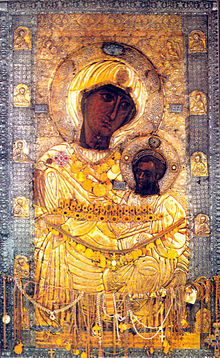 icon from the Iversky monastery | |
| Iconographic Type | Hodegetria |
| Location | Athos , Greece |
| Celebration date | February 12 ( February 25 ); Tuesday of the Bright Week ; October 13 ( October 26 ) |
Modern scholars date the Iveron icon as follows: Professor of the University of Athens, Panagiotis Vokotopoulos ( Greek Παναγιώτης Βοκοτόπουλος ) - the first half of the XI century [2] , professor of art history at the University of Innsbruck Thomas Steppan ( German Thomas Steppan ) - the beginning of the XII century [3] ; Academician Nikodim Kondakov - XII century [4] [5] .
Content
Tales of finding the icon
The surviving Greek legends are no older than the 16th century, Slavic legends are recorded in writing no earlier than the 15th century. There are various versions of the origin of the icon, which in content are fundamentally different from each other.
According to one version, in the 9th century, during the reign of Emperor Theophilus, in order to save the icon from the iconoclasts, the image was lowered into the sea by a woman who lived near the city of Nicaea . Two centuries later, the monks of the Georgian Iversky monastery on Mount Athos saw an icon in the sea supported by a pillar of fire. The Monk Gabriel Svyatorets, having received an order from the Virgin in a dream, walked on water and brought the icon to the catholicon , but in the morning it was discovered above the gates of the monastery. Tradition reports that this happened several times, therefore the icon was left at the gate and called the Gatekeeper , or Gatekeeper , and on behalf of the monastery - Iversky Monastery - it received the name Iverskaya . Initially, the icon was outside, in a kyoto, directly above the entrance, but later a special small temple was built inside the monastery, to the left of the gate, in which it is today.
In the XVI century, the icon was decorated with a hammered silver setting of the work of Georgian masters [6] . The salary leaves open only the faces of the Virgin and the Infant.
Celebration Days
- on Tuesday of the Bright Week (passing celebration) - finding the prototype in the sea at Mount Athos;
- February 12 (February 25 ) - transfer of the list of the Iveron Icon to the monastery on Valdai in 1656;
- October 13 (October 26 ) - a ceremonial meeting and the transfer in 1648 to Moscow of the list of icons sent to Tsar Alexei Mikhailovich from Athos;
- April 23 ( May 6 ) - the second acquisition of the oldest Moscow image (list) of the icon in 2012, when it was transferred by the Historical Museum of the Russian Orthodox Church (now the list is in the Novodevichy Convent ) [7] ;
- some calendars also additionally indicate March 31 ( April 13 ), perhaps this is due to the rolling date of Tuesday of the Bright Week : according to legend, the first appearance of the icon in the sea to the monks of the Athos Monastery occurred on Tuesday of the Bright Week, which falls on March 31, that year other unverified data - on April 27;
Iverskaya Chapel in Moscow
In 1669, a copy of the list of the Iveron Icon brought from Athos was placed at the triumphal Neglinensky ( Resurrection ) gates of Kitay Gorod. A small wooden canopy was made for the icon, later a chapel was erected in its place [8] . In 1791, the chapel was rebuilt by the architect Matvey Kazakov [9] . After the ruin of 1812, it was rebuilt as a monument to the victory over Napoleon [8] .
In 1929 the chapel was dismantled, and in 1931 the Resurrection Gate was demolished. In 1994-1995, the chapel and the gate were restored (the author of the project was the architect O. I. Zhurin).
Upon the restoration of the Iversky Chapel in 1995 from the Iversky Monastery on Mount Athos, a new copy of the miraculous icon of Our Lady of the Goalkeeper was stored there. Every day, every two hours, from eight in the morning until eight in the evening, prayers are held in the chapel with the reading of the akathist to the Blessed Virgin Mary . All Moscow clergy serve one at a time. This new image has already become famous for many miracles [10] .
Montreal Iveron Icon
The Montreal Iveron Icon is a list of the Iveron Icon of the Mother of God, written in 1981 on Athos by the Greek monk Chrysostom. According to numerous testimonies, the icon continuously streamed for 15 years. In 1997, her keeper Joseph Munoz was killed and the icon disappeared without a trace.
See also
- Iversky Monastery (Athos)
- Iversky Church
Notes
- ↑ Iveron Icon of the Mother of God . Orthodox church calendar . Date of treatment June 19, 2018.
- ↑ Vokotopoulos PL Note sur l'icône de la Vierge Portaitissa // Zograf. - Beograd, 1996 .-- Vol. 25. - P. 28; idem. ῾Η εἰκόνα τῆς Παναγίας Πορταΐτισσας τῆς ῾Ιερᾶς Μονῆς ᾿Ιβήρων // ῞Αγιον ῎Ορος. Θεσσαλονίκη, 2001. - Τ. 1: Θύση-Λατρεία-Τέχνη. - Σ. 83-88.
- ↑ Steppan T. Überlegungen zur Ikone der Panhagia Portaitissa im Kloster Iwiron am Berg Athos // Sinnbild und Abbild: Zur Funktion des Bildes. - Innsbruck, 1994. - Bd. 1 .-- S. 23–49
- ↑ Kondakov N.P. Monuments of Christian art on Mount Athos . - SPb., 1902. (reprint M., 2004). - S. 166-167. Tab. Xvii, 2.
- ↑ Kondakov N.P. Iconography of the Mother of God . - T. 2. - S. 216.
- ↑ Mount Athos. Images of the Holy Land / project idea: V. Semenov, hieromonk Justin Simonopetrit; ed. A. Lidov. - M .: Indrik, 2011 .-- S. 70.
- ↑ Transfer of the oldest in Russia list of the Iveron Icon of the Mother of God of the Russian Orthodox Church . Patriarchy.Ru (May 6, 2012). Date of treatment June 19, 2018.
- ↑ 1 2 Mokeev G. Ya. Prikremlevsky memorial of Holy Russia . Russian resurrection . Date of treatment June 19, 2018.
- ↑ Belyaev L.A. Iverskaya Chapel // Orthodox Encyclopedia . - M .: Church Scientific Center "Orthodox Encyclopedia" , 2009. - T. XXI. - S. 22-23. - 752 s. - 39,000 copies. - ISBN 978-5-89572-038-7 .
- ↑ Volkova, 2018 .
Literature
- Tolstaya T.V., Turilov A.A., E.P.A., Guseva E.K., E.P.I. The Iveron Icon of the Mother of God // Orthodox Encyclopedia . - M .: Church Scientific Center "Orthodox Encyclopedia" , 2009. - T. XXI. - S. 8-22. - 752 s. - 39,000 copies. - ISBN 978-5-89572-038-7 .
- Original acts relating to the Iveron icon of the Mother of God, brought to Russia in 1648, M. 1879.
- Talberg N.D. Spacious month of the words of the Saints in the Russian Land shone. What needs what icons should be worshiped. - Reprint reproduction of the publication. - SPb. : Vera, 1997 .-- S. 298-299, 313-314, 473.
- Timoshina L. A. The Case of the Arrival of the Monks of Mount Athos Iversky Monastery in 1647 in Moscow // Kapterevsky Readings 8. - M. , 2010. - P. 42-64 .
- Chentsova V.G. Icon of the Iveron Mother of God. Essays on the history of relations between the Greek Church and Russia in the middle of the 17th century. according to the documents of the RGADA. - M. , 2010.
Links
- Volkova M. Moscow Goalkeeper . Orthodoxy.ru . Sretensky Theological Seminary of the Russian Orthodox Church (10.26.2018). Date of appeal October 26, 2018.
- Mount Athos Icons: Iverskaya (Goalkeeper, Portaitissa) , Holy Mountain
- Lebedeva E. Chapel of the Iveron Icon of the Mother of God . Orthodoxy. Ru, 10.26.2004.
- The story of the Iveron Icon of the Mother of God