Beans ( Latin Phaséolus ) is a typical genus of plants of the legume family ( Fabaceae ), combining about 97 [3] species in the warmer regions of both hemispheres. They are bred because of fruits and seeds - and some species also because of flowers (called "Turkish beans" [4] [5] ).
| Beans | |||||||||||||||||||||||||
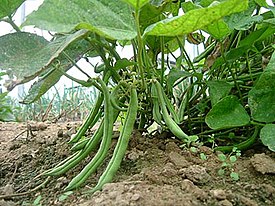 Common Beans ( Phaseolus vulgaris ) | |||||||||||||||||||||||||
| Scientific classification | |||||||||||||||||||||||||
|---|---|---|---|---|---|---|---|---|---|---|---|---|---|---|---|---|---|---|---|---|---|---|---|---|---|
| |||||||||||||||||||||||||
| International scientific name | |||||||||||||||||||||||||
Phaseolus L. , 1753 | |||||||||||||||||||||||||
| Synonyms | |||||||||||||||||||||||||
| |||||||||||||||||||||||||
| Type view | |||||||||||||||||||||||||
Phaseolus vulgaris L. [2] | |||||||||||||||||||||||||
Of the cultivated species, the first place is occupied by common beans ( Phaseolus vulgaris ) with many varieties and varieties, some of which are curly, others are bush. The native land of this species is Latin America .
Another type of bean, Phaseolus coccineus , with red flowers, is often bred as an ornamental plant.
Some species, colloquially called "beans", belong to other genera of legumes , for example, to the genus Vigna ( Vigna ). A popular food plant, ordinary, horse or Russian beans ( Vicia faba ) belong to the genus Vika, or Peas .
Content
Botanical Description
Herbaceous plants, often annuals, mostly curly, with cirrus leaves. The root system is pivotal.
Leaflets 3, very rarely 1. Both the whole leaf and each leaflet is provided with stipules.
Flowers in axillary brushes. Receptacle with a cupped disc. The wings of the moth corolla are more or less spliced with a boat, the long tip of which, as well as the stamens and column are spirally twisted.
Hanging bean , 5-28 centimeters long, bicuspid, between seeds with incomplete sponge septa. Seeds are rich in legumin and starch .
History
Archaeologists have found bean seeds in Peru and Mexico, which indicate that it was cultivated for 5,000 years BC.
After the expedition of Christopher Columbus in the 15th century, beans began to be bred in Europe, Africa and Asia.
Aztec use
In the work “ General History of the Affairs of New Spain ” (1547-1577), Bernardino de Sahagun , based on Aztec information about the properties of plants, provided various information about beans, in particular, about its variety:
|
Views
Some types:
- Phaseolus acutifolius - Holly beans , or Tepari
- Phaseolus amblyosepalus
- Phaseolus angustissimus
- Phaseolus anisotrichos
- Phaseolus augustii
- Phaseolus brevicalyx
- Phaseolus chacoensis
- Phaseolus cibellii
- Phaseolus coccineus - Multiflorous Beans
- Phaseolus filiformis
- Phaseolus galactoides
- Phaseolus glabellus
- Phaseolus grayanus
- Phaseolus latidenticulatus
- Phaseolus leucanthus
- Phaseolus lunatus - Moon beans , or Lima beans
- Phaseolus massaiensis
- Phaseolus micranthus
- Phaseolus microcarpus
- Phaseolus nelsonii
- Phaseolus oaxacanus
- Phaseolus pachyrrhizoides
- Phaseolus parvulus
- Phaseolus pedicellatus
- Phaseolus plagiocylix
- Phaseolus pluriflorus
- Phaseolus polymorphus
- Phaseolus polystachios
- Phaseolus polytylus
- Phaseolus ritensis
- Phaseolus sonorensis
- Phaseolus tuerckheimii
- Phaseolus vulcanicus
- Phaseolus vulgaris L. typus [2] - Common Beans
- Phaseolus wrightii
- Phaseolus xanthotrichus
Nutritional Value
|
| ||||||||||||||||||||||||||||||||||||||||||||||||||||||||
Bean seeds and green beans (fruits) of green beans (commonly used incorrectly called pods) are used as food. In sugar and vegetable varieties, the whole bean is consumed whole, including the leaves and seeds. Most species are poisonous in their raw form.
Before cooking, it is recommended to soak the beans in water (8-10 hours). This is advisable for two reasons:
- the soaking process softens the beans and returns moisture to them, which reduces the cooking time;
- when soaked in water, oligosaccharides (sugars that are not digested in the human body) dissolve, causing gas formation and complicating the digestion process.
Pests
The main pest of bean seeds is bean kernels .
Notes
- ↑ For the conventionality of indicating the class of dicotyledons as a superior taxon for the plant group described in this article, see the APG Systems section of the Dicotyledonous article .
- ↑ 1 2 Information on the Phaseolus genus in the Index Nominum Genericorum database of the International Plant Taxonomy Association (IAPT) .
- ↑ Species of Phaseolus according to The Plant List (English) (lat.) (Retrieved October 5, 2016)
- ↑ Beans // Explanatory Dictionary of the Living Great Russian Language : in 4 volumes / auth. V.I. Dahl . - 2nd ed. - SPb. : Printing house of M.O. Wolf , 1880-1882.
- ↑ Turkish Beans // Brockhaus and Efron Encyclopedic Dictionary : 86 tons (82 tons and 4 extra). - SPb. , 1890-1907.
- ↑ Sahagun, 2013 , p. 207.
Literature
- Bernardino de Sahagun , Kuprienko S.A. General story of the affairs of New Spain. Books X-XI: The knowledge of asteks in medicine and botany / Ed. and per. S.A. Kuprienko .. - K .: Vidavets Kuprіnko S.A., 2013 .-- 218 p. - (Mesoamerica. Sources. History. Man). - ISBN 978-617-7085-07-1 .
- The theoretical foundations of selection "Gene pool and selection of leguminous crops" / Ed. B. S. Kurlovich and S. I. Repiev. - St. Petersburg., 1995 .-- 430 p.