 architectural monument
| Sight | |
| Assumption Cathedral | |
|---|---|
 | |
| A country |  Ukraine Ukraine |
| City | Kharkov |
| Denomination | Orthodoxy |
| Diocese | Hankovskaya |
| Type of building | Cathedral |
| Architectural style | baroque (temple), classicism (bell tower) [1] |
| Established | 1657 year |
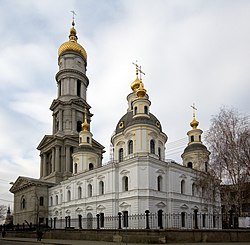
The Cathedral of the Assumption of the Blessed Virgin Mary (the Assumption Cathedral ) is one of the oldest Orthodox churches in Kharkov [2] . The fifth of the twelve official symbols of the city [3] .
Built in 1685-1687. Since the 17th century, it was rebuilt several times. In 1924 it was closed, in 1929 it was partially disassembled. From the 1920s to the beginning of the 1940s, it served as the building of the city radio station, in the postwar years - as the premises for the workshops of the sewing and dyeing enterprise [4] [5] . In the 1950-1980s, he underwent a comprehensive restoration [6] [7] . Since 1986 - the House of Organ and Chamber Music of the Kharkov Regional Philharmonic Society [1] . Since 1990 - the current church of the Ukrainian Orthodox Church (Moscow Patriarchate) [5] .
Located in the city center on the University Hill on the banks of the Lopan River. The quarter occupied by the cathedral is limited to Universitetskaya street , Kvitki-Osnovyanenko street and Soborny lane .
The cathedral bell tower (89.5 m) is the tenth tallest stone building in Kharkov and the second tallest bell tower in Ukraine .
History
XVII century
In 1656, from the very beginning of the restructuring of the walls of the Kharkov fortress, most of its territory was allocated for dense development by the courtyards of citizens. In the northern part of the quarter (where the Yunost movie theater and the Stare mikto restaurant are currently located), a place was allocated for the construction of the main city church - the future Assumption Church, the rest of the territory was reserved for the city square for holding meetings of the “community”, fairs and festivities [8] .
The first mention of the Assumption Cathedral in written sources is found in the 1658 report of the governor Ofrosimov, sent to Moscow [2] [9] :
And in Kharkov, sovereign, your tsar’s pilgrimage, the Cathedral Church of the Assumption of the Blessed Virgin Mary of the Red and New Years was built, and the Lord, the sovereign, the military people brought to that cathedral church in the past in 1657 under the Warrior Selifontov.
According to him, a wooden temple was built in 1657, and the forest for the church was transported by the Cossacks at Silifontov, the first Kharkiv governor. The built temple was single-throne, with an area of about 16 square fathoms (about 70 m²). At first, there were not even wooden icons in the temple, but paper ones were used instead. Also, many liturgical books required for full worship were missing [2] [9] .
The Cathedral Church of the Assumption of the Blessed Virgin Mary had dimensions “between the corners of 4 fathoms” (about 8.5 m), was “cold”, had no rich decoration and liturgical books. Instead of traditional icons, paper icons of Lithuanian manufacture were used [10] .
Even during the construction, in 1657, two Kharkov priests Yeremey and Vasily, as well as Deacon Joseph, visited Moscow with the aim of receiving money and church items for the construction of the Assumption Church, and submitted a petition to Tsar Alexei Mikhailovich with this petition. Also in subsequent years petitions were sent to the king for help to the temple. The king gave instructions several times to assist the petitioners and transfer to the Assumption Cathedral a number of liturgical books and icons. The text of one of the decrees [2] [9] :
On August 716, August 6, according to the sovereign, the Tsar and Grand Duke Alexei Mikhailovich ... to the decree of the district governor Theodore Mikhailovich Rtishchev and Grigory Mikhailovich Anichkov and the deacon David Deryabin and Ignatius Matviev and Andrei Selin. The great sovereign tsar ... indicated to send out from the order of the Grand Palace a new city in Kharkov in the Cathedral Church of the Assumption The Most Holy Theotokos books of the gospel, apostle, psalter with liturgies, general general, six-day old cathedral churches with the name of Ivan. And according to the tsar’s tsar ... by decree of the okolnichny Theodore Mikhailovich Rtishchev and Grigory Mikhailovich Anichkov and deacon David, Ignatius and André to institute about this according to this great sovereign decree.
During earthworks in the following centuries, human remains were discovered, which gave reason to assume the presence of a church cemetery at the temple [2] [9] . Around the churchyard was built a wooden fence, within which the cemetery was located. Apparently, already in the 1780s this cemetery was abolished, and later on its territory was built up: the northern part was occupied by the guest house, and the southern part by the buildings of Kharkov University [11] .
By the 1680s, Kharkov continued to grow. Podil was built up in the bend of the Kharkov river; to the east and south of the fortress, overseas settlements appeared. The construction of new wooden churches began: Blagoveshchensk, Trinity, Nikolaev and others. Many of the churches started by the construction in size and architectural forms exceeded the first city cathedral - the Assumption Cathedral Church [12] . By this time, the temple had already fallen into disrepair, and in 1685–1687 inside the fortress, 25-30 fathoms (50-60 m) north of the old wooden one, a new stone cathedral was built under the leadership of Colonel Avdiy Grigoryevich - a cross-shaped church with five the domes. The consecration of the temple was carried out by the Belgorod Metropolitan Avramy in 1688 [13] . At the location of the throne of the old wooden church until the beginning of the XVIII century there was a wooden chapel. A stand-alone stone bell tower was also built, but the date of its construction is not known. Two storerooms and a cellar were rented on its lower floor [2] [9] [11] .
In 1685, on the site of the current Assumption Cathedral, through the efforts of the Kharkov punished colonel Avdiy Grigoryevich, who made the bulk of the sum, and parishioners, as well as at the expense of the treasury, the construction of the first stone cathedral church in Kharkov began [12] .
In 1687, the cathedral was largely completed. Like most cathedral churches in Ukraine, it had a cruciform plan shape and was crowned with five chapters - central and side, located on the sides of the world. The roof and the heads of the cathedral were covered with oak shingle . The idea of a temple of this type is given by the cathedral in Izium , erected in 1685, probably by the same construction artel. A feature of the Kharkov Assumption Cathedral was a free-standing stone hipped bell tower. In addition to its direct purpose, the bell tower was also used for household purposes - in the lower tier two “comoros” and a cellar were arranged, which were leased to merchants to store goods [14] .
The Assumption Cathedral was the first stone building in Kharkov. The second stone building was the Intercession Church with a bell tower, erected in 1689.
18th century
March 3 [1] (according to other sources, May 3 [15] or July 8 [11] ) in 1733, the strongest fire in the history of Kharkov broke out on the territory of the fortress, destroying 300 yards with all buildings and all trading shops in the city. Nicholas Church perished in the fire, standing at the intersection of the current streets of Korolenko and Pushkinskaya. An oak shingle roof burned down near the Assumption Cathedral, the domes in the church and on the bell tower, everything inside burned out, only stone walls remained. But already in 1734, thanks to the efforts of Archpriest Grigory Alexandrov, the church was restored, the domes were built and gilded crosses were installed, and the roof was covered with white “English” tin [2] [9] [11] .
In accordance with the options under review for redevelopment of Kharkov, which became the main city (center) of the Sloboda-Ukrainian province in 1765, the old, dilapidated Assumption Cathedral, built in the spirit of the church architecture of Sloboda Ukraine, ceased to correspond to its functions and did not meet the architectural tastes of Catherine Russia . In addition, in 1770, dangerous cracks were discovered in the walls of the cathedral. It became clear that even major repairs would not help here, so in 1771 a decision was made to build a new cathedral. For the dismantling of the old temple, the efforts of the cathedral archpriest M. Shvansky and the church warden F. Grekov collected 937 rubles.
With the blessing of Samuel Mislavsky, on May 14, 1771, a new stone church was laid out according to the plan of Moscow, the largest in Zamoskvorechye , the Church of the Holy Martyr Clement, the Pope , built in 1762-1770 on Pyatnitskaya Street - square in shape with five domes and five thrones [11] [ 13] . Its architects, presumably, were A. Yevlashev and D. Ukhtomsky. The architectural feature of this Moscow church was the absence of semicircular absids on the eastern facade. An earlier analogue of the Moscow church was the Church of the Transfiguration Life Guards Regiment in St. Petersburg, designed by M. Zemtsov and P. Trezzini in 1743-1754 [16] . In accordance with the prices of that time, various construction works were paid: for the dismantling of the iconostasis and its transfer to the bell tower - 20 kopecks .; for the dismantling of heads, roofs, floors, windows and doors by carpenters - 57 rubles. 60 cop .; for dismantling the walls and storing bricks to the Tula landowner A. Dobrynin under the contract - 300 rubles .; Y. Vyrodov for the supply of lime from the Belgorod plant (about 210 l) - 35 kopecks. for a quarter; F. Grekov for the manufacture of bricks, at the price of 3 rubles. 50 kopecks for a thousand. Unskilled laborers received 10 kopecks. in a day. A log cabin was bought from K. Garbar, who lost his plot on Lysaya Gora for 40 rubles. Iron materials were supplied by merchants A. Lashin and A. Tambovtsev from Belgorod, S. Chernikin from Yelets and Ya. Mizerny from Kharkov. The digging pit under the foundation of the new cathedral with the removal of land was estimated at 17 rubles. 55 kopecks Huge granite stones were specially laid in four corners of the building, specially delivered to Kharkov on 24 bulls from Bakhmut (now Artyomovsk). The remaining brick from the dismantling of the old temple in the amount of 276,700 pieces was laid in the foundation. For masonry walls, a master mason F. Medvedev from the Goncharskaya Sloboda Tula was hired with a payment of 1 rub. 30 kopecks for every thousand bricks. Forging and locksmithing performed Barinov from Tula "for 25 rubles a year, but for traveling from Tula to Kharkov 3 p. 50 kopecks on church grubs. " Carpentry and carpentry contracted to perform I. Galenko "with comrades" from Kharkov [17] .
The construction of the new Assumption Cathedral was carried out on the voluntary donations of believers - not only Kharkov, but also many other cities of the Belgorod diocese, to which Kharkov belonged [18] .
Three petitioners were also actively collecting donations - “traitors” Gavrilo Lepka, Kondrat Sagodenko and David Shapoval, who raised funds for the Belgorod diocese . David Shapoval put a lot of work, from 1770 to 1780 he collected alms in the amount of 18 thousand rubles - a significant amount at that time [2] [9] . Leaving a large farm and family, for ten years he walked around cities and villages, "collecting good-will alms" [18] .
The construction was led by Archpriest Mikhail Shvansky and church warden Lieutenant Fedor Anastasevich Grekov [13] . In 1777, the Assumption Cathedral was built "in draft" - walls, roofs, domes and chapters were erected. It was planned to establish five thrones in honor of the Saints in the cathedral [18] .
In the spring of 1778, the iconostasis was hastily installed in the northern aisle; On April 25, the throne was consecrated in the name of the miraculous Kazan Icon of the Mother of God [11] [18] . In 1779, with the completion of the plastering work, the southern chapel was consecrated - also in the name of the Kazan Icon of the Mother of God [18] .
In 1780, all construction work in the Assumption Cathedral was not yet completed. In connection with the transformation of the Sloboda-Ukrainian province into Kharkiv governorate that took place in the same year and the upcoming celebrations in honor of Catherine II, the northern chapel of the Assumption Cathedral was renamed in the name of St. Catherine the Great Martyr [18] . On September 27, 1780, in the presence of Field Marshal Count Pyotr Aleksandrovich Rumyantsev-Zadunaysky, who arrived in Kharkov to open Kharkov governorship, Bishop Haggai consecrated the main - the Assumption throne of the cathedral [13] [18] .
On June 8, 1783, the exterior and interior decoration of the church was completely completed, including the throne of the Holy Apostles Peter and Paul , in whose name the southern chapel in the choirs was consecrated. In the same year, the main iconostasis of the cathedral was installed [11] . Thus, the construction of the Assumption Cathedral lasted about 12 years (1771-1783) [18] .
The new Assumption Cathedral has surpassed the former in its area. In terms of plan, it has a shape close to a square with sides of 27.5 × 25 m. By its type, the building belongs to the cross-domed churches. The central main nave - the axial, the widest part of the church, separated by massive pylons from the north and south side galleries - is oriented according to the Orthodox church canon from west to east. The main nave crosses the transept - the middle gallery, stretching from north to south. Above their crosshairs there is a large light drum with eight windows, covered by a hemispherical dome with a head. Above the corner parts of the building are four small deaf drums with heads, not communicating with the interior of the temple. The main light drum, round in plan, is located exactly in the center of the cathedral and rests on four powerful pylons with beveled internal corners. According to the tradition established in church architecture, the base of the light drum is based on a square formed by pylons with the help of supporting arches connecting the main supports - pylons. The remaining open corners are filled with triangular curved arches resembling wind-filled sails. The implemented design is highly reliable, provides uniform load distribution from the head and dome through the drum, sails and supporting arches to the pylons and foundations [19] .
The construction of the Assumption Cathedral in Kharkov took place at a time when the artsy architectural style of Baroque did not meet the new tastes, new ideas of citizenship and enlightenment, which, with the coming to power of Catherine, gradually refracted in the next new Baroque style - classicism, when the Baroque style had not yet expired themselves, especially in the provinces, and the techniques of classicism have not yet become widespread. This was manifested in the nature of the external architectural decoration of the cathedral, in the spirit of the transition period: in the absence of lush decor, in a more restrained and strict design of the facades [20] .
The geometrically accurate composition of the cathedral is based on the contrast of the static two-light main volume, covered with shingle, and tiered domed domes with gilded “book gold” chapters and crosses. All facades of the building are solved the same way, in accordance with the viewing conditions of the temple, located in the center of the square. The main vertical axis of each facade is emphasized by its central part, highlighted by a protrusion- salite on three windows. The entire facade is built "on five axes" - five openings. The walls are cut through by two tiers of window openings, separated vertically by a wide belt framed by curtain rods. Altogether, 79 windows were glazed in the cathedral, glazed with "arkly shklarnymi inserts." The piers and corners of the lower tier are decorated with a boardwalk - horizontal horizontal rows of masonry, and the upper tier - single and double pilasters. The architectural details used triangular and arched sandriks above the windows, the so-called "eared" platbands, panels, rosettes, paired cherub heads, locar with volutes on the roof of the central dome [21] .
The lower arches of the temple were first covered with shingle, subsequently replacing it with metal. The domes were covered with iron, painted with oil paint, and the chapters were covered with gilded metal.
The interior of the cathedral was still dominated by the Baroque style, representing the exact opposite of the external architectural style. This was most clearly manifested in the design of the main iconostasis, which closes the central nave. According to Archpriest T. Butkevich, who served as a keyman in the Assumption Cathedral in the 1880s, the cathedral iconostasis was made according to the drawings of Bartolomeo Francesco Rastrelli , which "... makes a great honor to the aesthetic taste of the cathedral church publishers ... and is currently the subject of admiration for all people who know how appreciate true art ” [22] .
The main iconostasis of the cathedral, which was a world-class work of art and destroyed during the Civil War, was made by contractor Smirnov. The material for the iconostasis was two linden huts in the village of Dergachi, donated by their owner Krasnokutskaya. The cathedral iconostasis was carried out for about five years. The tree turned out to be of excellent quality and completely dry, therefore, not a single crack or the slightest curvature appeared in the iconostasis. The iconostasis was three-tiered, with columns of the Ionic style and graceful framing of icons, curved in the direction of the apse in the plan, had a stepped, spatially developed composition, culminating in an icon in a medallion framed by picturesque decorative elements of the floral style. on top of the pilasters at the second and third levels, at the corners of the protruding parts of the tiers, decorations in the form of four ancient Greek urns were installed. Three doorways were symmetrically located in the lower tier, among which stood out the central Royal Gates, made in the form of a carved lattice with five oval medallion icons. In style and design, the iconostasis of the Assumption Cathedral is close to the iconostasis of the Akhtyr Pokrovsky Cathedral , which in ancient times was also considered the work of Rastrelli [23] [2] [9] .
The temple courtyard was initially fenced with a wooden fence built in 1779. Subsequently, in 1791, a stone fence was built in its place, having located eight stone shops in its eastern part (from the side of the present Kvitka-Osnovyanenko street), which gave the cathedral a large annual income [11] .
XIX century
On November 12, 1818 and February 13, 1819, meetings of parishioners and citizens of Kharkov were held, at which, at the proposal of Archpriest Andrei Prokopovich [24] , a proposal was discussed to erect a new very high bell tower in honor of Alexander I and the victory of the Russian army over Napoleon I in the Patriotic War of 1812 . It was decided to call the bell tower Aleksandrovskaya, and its design was entrusted to the professor of architecture of Kharkov Imperial University Evgeny Vasiliev [11] [13] .
On the right is the Assumption Cathedral . XIX century .
According to urban legend , when considering the initial draft, the mayor of Lomakin was very outraged by the fact that the designed bell tower would be higher than the Moscow bell tower of Ivan the Great , 81 meters high.The architect, who did not want to reduce the height of the building, went to the trick and promised to remake the project for the next meeting. For the next review, Vasiliev presented the same project, only with the heights of each floor, without a total height. In words, he assured those present that the bell tower would not exceed the bell tower of Ivan the Great. Thus, on May 8, 1820, the plan and facade of the bell tower were approved [11] . In fact, the Nobility Assembly could not approve or not approve the draft, it simply did not have the right to do so. All statements were conducted exclusively in St. Petersburg. And the signatures, including the then mayor of Lomakin, which really are on the architect’s project, only say that Vasiliev acquainted the members of the commission for the construction of the bell tower with the project [25] .
Many donations were collected for the construction, the old bell tower was dismantled, and already on August 2, 1821, the Reverend Paul laid the new one, but the construction work was carried out slowly and intermittently. The construction of the bell tower lasted from 1821 to 1826, after which it was suspended for the settlement of the foundation and rest of the entire structure [26] . According to the project, it was planned to arrange a warm temple in it, and on November 5, 1833, the main throne was consecrated in honor of the Epiphany , and on November 12 of that year, the bishop Innokenty Alexandrov consecrated the chapel in honor of the Holy Great Martyr Paraskeva [13] . In 1837, work was continued, but already under the direction of architect A. Ton, the project, with minor modifications, was mainly completed in the early 1840s [1] .
On October 1, 1841, with a large crowd of people, Archbishop Smaragd made a procession from Pokrovsky Cathedral to Uspensky, a moleben and sprinkling of the cross were held, after which he was erected by the Moscow master Lukin over the dome of the bell tower [13] . The gilded cross had a height of 7 arshins (about 5 m) [1] [11] , and according to some sources it weighed 25 pounds (more than 400 kg) [1] , according to others - about 30 pounds (about 490 kg) [11] . The cross was made of oak wood, studded with iron strips, over which is lined with gilded copper sheets. A ball was laid out with the same gilded copper on which a cross was mounted and a small chapter located between the main dome and the ball. All these works cost 20 thousand rubles in bank notes [11] .
Completely construction work was completed only in 1844 [1] . The builders tried to make the building as strong as possible, as a result, the foundation of the built bell tower was buried in solid ground by 14 arshins (about 10 m), and the thickness of the foundation walls was 9 arshins (more than 6 m) [11] . The height from the basement to the end of the stone building was 32 fathoms (over 68 m) [11] , and to the top of the cross above the dome is 42 fathoms (about 89.5 m) [13] . During its construction, 3.5 million bricks and 4 thousand pounds (about 65.5 tons) of connected iron were used [13] . The total construction costs amounted to 110 thousand rubles in silver [13] or more than 400 thousand rubles in bank notes [11] . 12 bells were installed on the bell tower [1] , and at first small ones were used [24] . The smallest of them weighed only 8 kg [1] , the largest - 201 pounds 32 pounds (more than 3 tons) [24] .
On November 4, 1846, at the request of the Reverend Innocent, by the decision of the Holy Synod, the Assumption Cathedral received the status of a cathedral, and the Intercession Cathedral, formerly a cathedral, became just a monastery church [24] . Considering that the bell tower of the cathedral was built “in memory of the deliverance of the fatherland from invasions of the outsiders in 1812”, the Synod considered it permissible to inscribe on the bell tower the inscription: “To God the Savior for the deliverance of the fatherland from the invasion of Gaul and with them twenty languages” [11] .
On May 3, 1855, the Kharkov City Society decided to buy and install tower clocks on the bell tower for city funds, and to repair the clockworks for their repair and winding at the expense of the city. And in the summer of 1862 the clock was installed [11] . They were French-made by the Parisian company Borel [1] . In September 1863, the former largest 200-pound bell was replaced by the Ryzhov brothers donated to the cathedral and the much larger bell, weighing 1,003 pounds (over 16.1 tons), cast at their factory. Its lifting and installation on the first tier of the bell tower was carried out with a large crowd of people [11] .
Soon, a chapel was consecrated to the bell tower, consecrated in honor of St. Nicholas . In 1886, an iconostasis was built in it, placing a fence in the form of a bronze lattice in front of it. Eminent Ambrose in 1889, at the expense of the clergy and donations of parishioners of the Kharkov diocese, was cast a silver bell weighing 18 pounds (about 300 kg). And this so-called “royal bell” was hanged in a newly built chapel. On the bell among the ornaments is a monogram with the initials of the emperor, surrounded on three sides by a garland with relief images of the names of imperial children [11] .
XX — XXI centuries
In 1924, an antenna of the first Ukrainian broadcasting radio station was installed on the bell tower. The day of its first broadcast, November 16th, became a professional holiday for radio and communications workers. The studio was located nearby, and so that the bell ring did not interfere with broadcasts, the cathedral was closed in the same year. Later, the transmitter was installed inside the cathedral, while destroying valuable murals . The radio station worked until 1941 [4] .
During the second half of the 1920s, all values were taken out of the cathedral, including the wooden iconostasis of the 18th century, assembled according to the drawings of Bartolomeo Francesco Rastrelli , dismantled and transported to the warehouse of the Kharkov Art Museum , where it burned down during the Great Patriotic War . В 1929 году были снесены все пять куполов Успенского собора, сняты колокола с колокольни [5] . Внутри храма построили перекрытие, разбив объём здания на два этажа. Также подверглись разрушению декоративные элементы фасада [7] .
Во время Великой Отечественной войны собору удалось избежать разрушения, хотя вокруг него было уничтожено много зданий: все здания спуска Халтурина , а также бывшее здание Присутственных мест (в советское время — Дом Красной армии), предположительно построенное по проекту Джакомо Антонио Доменико Кваренги . Также от бомбардировок пострадал один из старых корпусов Харьковского университета [7] . В послевоенное время в здании собора функционировали швейный и красильный цеха [5] .
В конце 1950-х годов в соборе провели ремонтные работы по проекту архитектора В. Коржа сотрудничавшего с искусствоведом Р. Кутеповой. Так, была перекрыта крыша здания собора, оштукатурены и окрашены стены фасада [7] . В 1959 году в ходе частичной реставрации собора был перекрыт и позолочён купол Александровской колокольни [6] . Также произвели замену лестницы на новую металлическую, содержащую 280 ступеней [7] . В колокольне были установлены новые часы с диаметром циферблата 3,7 м и длиной минутной стрелки более 1,5 м [6] .
Колокольня Успенского собора высотой 89,5 м на протяжении более полутора веков была высочайшим каменным зданием в городе (если не считать металлические вышки), и только в 2006 году были построены более высокие строения в Харькове — два 25-этажных жилых дома высотой 91 (110 с антенной) [27] и 95 м [28] .
На протяжении 1970-х — начала 1980-х годов проводилась комплексная реставрация собора и колокольни с целью восстановления к аутентичному виду храма второй половины XVIII века. Так, в 1973 году начали производиться исследовательские и проектные работы Украинским специальным научно-производственным управлением, продолжавшиеся до 1982 года. Параллельно шли строительные работы: укрепление фундаментов и стен. После этого заново возвели пять куполов, покрыли их медью, позолотили и установили кресты. Проведена реставрация фасада: разобраны поздние пристройки, восстановлены карнизы, наличники окон, утраченные архитектурные элементы. Также проведена реставрация интерьеров [7] . В 1975 году на колокольню, находящуюся на реставрации и окружённую лесами, налетел ураган, в результате чего погнулся шпиль и сдвинулся купол [29] . Реставрационные работы продолжались около 12 лет; общие затраты составили 1,8 млн рублей [7] .
1 декабря 1986 года в помещении храма был открыт Дом органной и камерной музыки [1] , рассчитанный на 472 места. В алтарной части собора был установлен орган производства чехословацкой фирмы Rieger-Kloss , содержащий 3 мануала и 3554 звуковые трубы [7] .
Первое богослужение в отреставрированном соборе состоялось 2 ноября 1990 года, которое провёл митрополит Харьковский и Богодуховский Никодим. Устав Свято-Успенского сбора был утверждён 4 марта 1992 года, после чего на основании договора с Харьковской филармонией в соборе проводили нерегулярные богослужения. За каждое богослужение Харьковская епархия производила оплату [5] .
Во исполнение Указа Президента Украины «О мероприятиях по возвращению религиозным организациям культового имущества» от 4 марта 1992 года и распоряжения Кабинета Министров Украины «О перспективном плане неотложных мер по окончательному преодолению негативных последствий политики бывшего Союза ССР относительно религии и восстановлению нарушенных прав церквей и религиозных организаций», 29 октября 2004 года глава Харьковской областной государственной администрации Евгений Кушнарёв подписал распоряжение № 136 о передаче до 16 ноября 2004 года в ведение Украинской православной церкви (Московского патриархата) зала в колокольне и до 1 января 2006 года — всего комплекса Успенского собора. Распоряжение было оспорено в суде по инициативе депутата областного совета Дениса Шевчука, который обосновал свою позицию тем, что орган Харьковской филармонии находится в коммунальной собственности и имеет значительную стоимость (по оценкам депутата — несколько миллионов долларов), поэтому именно только жители Харькова вправе решить, как поступить с органом [30] [31] [32] [33] [34] . Распоряжение от 29 октября 2004 года было приостановлено решением суда.
21 ноября 2006 года был восстановлен крест на колокольне собора [25] .
В 2009 году глава Харьковской областной государственной администрации Арсен Аваков подписал новое решение о передаче Успенского собора в ведение Харьковской и Богодуховской епархии УПЦ (МП). До 2010 года в Соборе параллельно по согласованному графику проходили концерты органной музыки и церковные службы [35] . В начале 2009 года был подписан контракт на строительство нового органа Alexander Schuke (4 мануала, 72 регистра) [36] [37] в новом строящемся филармоническом комплексе [38] , где разместился новый органный зал Харьковской филармонии [39] [40] . После открытия нового филармонического комплекса планируется полный переход Успенского собора в ведение епархии [35] .
Храм
Architecture
Собор представляет собой памятник позднего ( екатерининского ) барокко . По своему архитектурному облику и внутреннему устройству харьковский Успенский собор близок к созданной в начале XVII века церкви Климента Папы Римского в Москве (1769). Однако считать его «копией» собора Святого Климента нельзя в силу значительных отличий в плане, силуэте и декоре (замена колонн на пилястры, уменьшение барабанов малых куполов, различная пластика главок и т. п.)
Имущество
В дореволюционный период собору принадлежал ряд объектов недвижимости в городе и ближнем пригороде. Из описей соборного имущества 1724 и 1769 годов следует, что горожанами и чиновниками для содержания собора активно жертвовались земельные участки, дома и торговые лавки. Также у собора была во владении мельница, расположенная ниже Дергачей по течению Лопани, и 19 рабочих. В 1730 году собору был отдан во владение сенокос при впадении реки Лозовой в Лопань. Большинство имущества было продано уже к середине XIX века, кроме нескольких лавок и соборного дома в начале Московской улицы [13] .
О соборном доме известно с XVIII века, когда он был ещё одноэтажным деревянным строением. Построенный в квартале от собора, на углу Николаевской площади и Московской улицы, он предназначался для проживания соборного причта . По причине ветхости здание было снесено в 1837 году. Некоторое время на его месте находились торговые лавки, а на протяжении 1845—1849 годов был выстроен новый каменный четырёхэтажный дом с магазинами на первом этаже и квартирами на верхних [24] .
Приход
Первоначальные границы прихода Успенского собора неизвестны. Наиболее старая из сохранившихся переписей относится к 1724 году и перечисляет улицы, относившиеся к собору, но из-за того, что в середине XVIII века в Харькове ещё не было официально закреплённых названий улиц, их трудно однозначно идентифицировать. Так, например, перечислялись такие улицы как: «улица пана полковника в замку», где находился «двор его милости пана полковника харьковского Григория Семёновича Квитки» и «двор князя Кропоткина»; «улица зовемая сотницкая»; «в пригородку улица Врида», где был «дворец сотника Угольчанского»; «улица Максима Писаря»; «улица смежная с николаевским приходом»; «улица над ярком» и др. Самые ранние сведения о количестве прихожан собора датируются 1728 годом. В течение XVIII—XIX веков происходило уменьшение численности прихожан за счёт передачи части дворов другим церквям. Так, дворы северной части соборного прихода в 1801 году были переданы новообразованному приходу Мироносицкой церкви [5] . В 1810 году мироносицкому приходу были переданы ещё 30 дворов [41] . Также сокращение населения обуславливалось развитием центра Харькова, переездом жителей в другие районы и строительством новых торговых и промышленных зданий на месте частных жилых домов. Определённое влияние оказывали и эпидемии чумы (1738, 1772), брюшного тифа (1787, 1821, 1833, 1848), холеры (1830, 1847, 1848, 1853, 1866, 1871), высокая детская смертность от оспы , скарлатины , кори и дифтерии [5] .
| 1728 | 1748 | 1780 | 1791 | 1801 | 1811 | 1820 | 1830 | 1840 | 1850 | 1860 | 1870 | 1880 | 1893 | |
|---|---|---|---|---|---|---|---|---|---|---|---|---|---|---|
| мужчин | 325 | 751 | 1226 | 1218 | 711 | 781 | 573 | 635 | 580 | 482 | 444 | 319 | 333 | 362 |
| женщин | 329 | 724 | 1322 | 1189 | 763 | 903 | 761 | 707 | 603 | 522 | 464 | 337 | 331 | 384 |
| Total | 654 | 1475 | 2548 | 2407 | 1474 | 1684 | 1334 | 1342 | 1183 | 1004 | 908 | 656 | 664 | 746 |
Национальный состав прихожан изменялся со временем. Согласно официальным документам XVII века прихожане собора были черкасами, казаками, «людьми малороссийской породы». Вот некоторые фамилии этого периода: Пужня, Чернолих, Литовченко, Пропадыус, Шарпыло, Жигаренко, Кучерявный, Мизерный, Довгопляс, Пономаренко, Скрыннык, Келеберда, Шкарупа, Вареник и др. В начале XVIII века в списках соборных прихожан появляются русские фамилии: Яковлев, Баранов, Володин. В течение XVIII века количество русских фамилий значительно увеличивается [5] .
При храме в XVII—XVIII веках действовало братство соборной харьковской церкви Успения Пресвятой Богородицы, занимавшееся просветительской и благотворительной деятельностью. Братство осуществляло свою деятельность за счёт пожертвований «братчиков», являвшихся прихожанами собора. Ими содержались две приходские школы, «странноприимный дом», а также «шпиталь» для нищих и бедных больных, вместимостью более 50 коек. Кроме этого братство финансировало похороны нищих, помогало бедным прихожанам, оказывало содействие в выдаче замуж сирот-девиц… [5]
Священники
- Любицкий, Стефан Петрович (1837 — 1 октября 1911) — протоиерей, настоятель Харьковского кафедрального Успенского собора. 35 лет состоял священником при церкви Харьковской тюрьмы. За 14 лет до смерти стал настоятелем Харьковского кафедрального собора и членом консистории. Белое духовенство.
Успенский собор в искусстве
- Успенский собор упоминается в романе Игоря Болгарина и Георгия Северского « Адъютант его превосходительства » (1968) [42] , лёгшем в основу одноимённого фильма (1969).
- В 2004 году к 350-летию Харькова « Укрпочтой » была выпущена почтовая марка с изображением колокольни Успенского собора.
- В 2004 году к 350-летию Харькова Национальным банком Украины была выпущена юбилейная монета номиналом 5 гривен с изображением на аверсе колокольни Успенского собора.
Колокольня Успенского собора на юбилейной марке «Укрпочты» (2004)
Колокольня Успенского собора на юбилейной монете НБУ (2004)
Notes
- ↑ 1 2 3 4 5 6 7 8 9 10 11 Лейбфрейд, А. Ю. Харьков. От крепости до столицы : Заметки о старом городе / А. Ю. Лейбфрейд, Ю. Ю. Полякова. — Харьков : Фолио, 2004. — 335 с. — ISBN 966-03-0276-2 .
- ↑ 1 2 3 4 5 6 7 8 9 Редин Е. К. Материалы к изучению церковных древностей Украины : Церкви города Харькова. — Харьков : типография «Печатное дело», 1905.
- ↑ Перечень объектов, относящихся к городской символике (утверждён решением Исполнительного комитета Харьковского городского совета № 384 от 12 апреля 2000):
- Беседка в Сквере Победы « Стеклянная струя » (ул. Сумская, 34)
- Благовещенский собор (ул. Карла Маркса, 1)
- Общий вид Площади Конституции
- Здание Горсовета (пл. Конституции, 7)
- Успенский собор (ул. Квитки-Основьяненко, 2)
- Общий вид Площади Свободы
- Госпром (пл. Свободы, 5)
- Памятник Тарасу Шевченко (ул. Сумская, 35)
- Железнодорожный вокзал Харьков-Пассажирский (Привокзальная пл.)
- Покровский собор (ул. Университетская, 8)
- Киноконцертный зал « Украина » (ул. Сумская, 35)
- Здание Харьковского театра оперы и балета (ул. Сумская, 25)
- ↑ 1 2 16 листопада — день українського радіо (ноябрь 2005). Date of treatment March 27, 2015.
- ↑ 1 2 3 4 5 6 7 8 9 10 Буткевич, Т. И. Историко-статистическое описание Харьковского Кафедрального Успенского собора. — Харьков : ХЧМГУ, 2006. — 368 с. — ISBN 966-8246-52-7 .
- ↑ 1 2 3 Дяченко, И. Улицы и площади Харькова : Очерк. — 4-е изд. — Харьков : Прапор, 1977. — 272 с.
- ↑ 1 2 3 4 5 6 7 8 Новгородов, В. Е. Золотой венец старого Харькова : Успенский собор — памятник архитектуры XVIII века. — Харьков : Прапор, 1990. — 48 с. — ISBN 5-7766-0206-8 .
- ↑ Новгородов, 1990 , с. 7.
- ↑ 1 2 3 4 5 6 7 8 Багалей, Д. История города Харькова за 250 лет существования (с 1655 года) / Д. Багалей, Д. Миллер. — Харьков : Типография М. Зильберберг и Сыновья, 1905. — Т. I.
- ↑ Новгородов, 1990 , с. 7, 8.
- ↑ 1 2 3 4 5 6 7 8 9 10 11 12 13 14 15 16 17 18 19 20 Гусев, А. Н. Харьков : Его прошлое и настоящее. — Харьков : Типография Адольфа Дарре, 1902.
- ↑ 1 2 Новгородов, 1990 , с. 9.
- ↑ 1 2 3 4 5 6 7 8 9 10 11 Филарет (Гумилевский, Д. Г.). Историко-статистическое описание Харьковской епархии. Отделения I, II. — М. : Типография В. Готье, 1852 (Отделение I), 1857 (Отделение II).
- ↑ Новгородов, 1990 , с. 9-10.
- ↑ Новгородов, 1990 , с. 10-11.
- ↑ Новгородов, 1990 , с. 13-14.
- ↑ Новгородов, 1990 , с. 11, 14—15.
- ↑ 1 2 3 4 5 6 7 8 Новгородов, 1990 , с. sixteen.
- ↑ Новгородов, 1990 , с. 17—18.
- ↑ Новгородов, 1990 , с. 20-21.
- ↑ Новгородов, 1990 , с. 18-19.
- ↑ Новгородов, 1990 , с. 21.
- ↑ Новгородов, 1990 , с. 22.
- ↑ 1 2 3 4 5 Багалей, Д. История города Харькова за 250 лет существования (с 1655 года) / Д. Багалей, Д. Миллер. — Харьков : Типография М. Зильберберг и Сыновья, 1912. — Т. II.
- ↑ 1 2 Дикань, Филипп. История главного храма Харькова . MediaPost on-line. Date of treatment March 27, 2015.
- ↑ История строительства Успенского собора в Харькове . Форт-Пост (7 июня 2018). Date of treatment June 7, 2018.
- ↑ Олимп . SkyScraperPage.com. Date of treatment March 27, 2015.
- ↑ Пионер . SkyScraperPage.com. Date of treatment March 27, 2015.
- ↑ Человек и стихия : журнал. — Л. : Гидрометеоиздат, 1976.
- ↑ Утром служба — вечером музыка? (16 февраля 2005). Date of treatment March 27, 2015.
- ↑ Свято-Успенский Собор в Харькове хотят вновь забрать у Церкви . Стояние за истину (17 февраля 2005). Date of treatment March 27, 2015.
- ↑ Кому будет принадлежать Успенский собор — решит местный референдум? (обновлено) . MediaPort (19 февраля 2005). Date of treatment March 27, 2015.
- ↑ Силаева, Анна. Не корысти ради… . MediaPost (февраль 2005). Date of treatment March 27, 2015.
- ↑ Глебова, Анна. Аваков выполнил завещание Евгения Кушнарёва . Городской Дозор (10 апреля 2009). Date of treatment March 27, 2015.
- ↑ 1 2 Органный зал Успенского собора будет работать до марта 2010 года . Арсен Аваков. Персональный сайт (14 апреля 2009). Дата обращения 11 ноября 2012. Архивировано 20 ноября 2012 года.
- ↑ Орган, как символ возрождения . Главное (27 ноября 2008). Дата обращения 11 ноября 2012. Архивировано 3 марта 2012 года.
- ↑ Лучший в Украине орган (недоступная ссылка) . Главное (6 декабря 2008). Дата обращения 11 ноября 2012. Архивировано 3 марта 2012 года.
- ↑ Харьковская филармония долгостроем не будет. Арсен Аваков . Арсен Аваков. Персональный сайт (8 апреля 2009). Дата обращения 11 ноября 2012. Архивировано 20 ноября 2012 года.
- ↑ Телепрограмма «Акценты» с Арсеном Аваковым . Арсен Аваков. Персональный сайт (11 апреля 2009). Дата обращения 11 ноября 2012. Архивировано 3 марта 2012 года.
- ↑ Новый орган в Харьковской филармонии заиграет осенью следующего года, обещают в облгосадминистрации . информационное агентство «МедиаПорт» (8 апреля 2009). Дата обращения 11 ноября 2012. Архивировано 3 марта 2012 года.
- ↑ Протоиерей Николай Лобарский. Харьковская Крестовоздвиженская (Мироносицкая) церковь 1783—1908 гг. — Харьков : Райдер, 2007. — ISBN 978-966-8246-72-2 .
- ↑ Беляев, К. А. Харьков в зеркале мировой литературы / К. А. Беляев, А. П. Краснящих. — Харьков : Фолио, 2007. — ISBN 978-966-03-3779-4 .
Literature
- Новгородов, В. Е. Золотой венец старого Харькова. — Х. : Прапор, 1990. — 41 с.
Links
- Успенский собор . Харьковская епархия. Дата обращения 27 марта 2015.
- Александровская колокольня Успенского собора, Украина, Харьков . Московская школа церковных звонарей Ильи Дроздихина (5 июля 2012). Дата обращения 27 марта 2015.
- Дом органной и камерной музыки (Органный зал Харькова) . Харківська філармонія. Дата обращения 27 марта 2015.