The battle of Moines ( it. Schlacht von Moys ) - the battle of the initial stage of the Seven Years War took place on September 7, 1757 in Saxony , at Moys (now the village of Uyazd ( Polish. Ujazd ) in Poland), not far from Görlitz , between the 13 thousandth building of the Prussian general Winterfeld and the corps of the Austrian general, Count Nadashdi , in whom Prussian troops were defeated, General Friedrich II , a close adviser to Frederick II , was twice as powerful as a mortal wound.
| Battle at moise | |||
|---|---|---|---|
| Main conflict: Seven Years War | |||
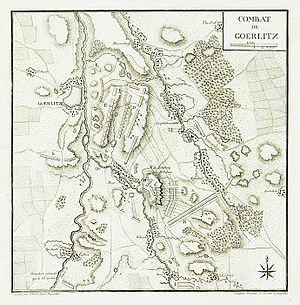 Moise Battle Chart | |||
| date | September 7, 1757 | ||
| A place | Mois Village in Saxony, now Uazd in Poland | ||
| Total | Austrian victory | ||
| Opponents | |||
| |||
| Commanders | |||
| |||
| Forces of the parties | |||
| |||
| Losses | |||
| |||


Content
On the eve of battle
Unsuccessful, with great losses, the retreat of the army of Prussian Prince Augustus Wilhelm from Bohemia in the summer of 1757, was the result of a quarrel between Frederick and his brother, as a result of Augustus William left the army and returned to Berlin . In his place was appointed Duke of Bevernsk , who, as an adviser, was given the favorite and confidant of Frederick, Lieutenant General Winterfeld, who had a separate corps, according to different sources, from 10 to 13 thousand people. The Duke of Bevern himself was about 22,000 soldiers. The army of the duke should cover the path to Silesia.
On August 31, the Duke of Bevern, contrary to the advice of Winterfeld, took up a position with Görlitz. Winterfeld follows him and, having crossed the Neisse , sets up a camp on the opposite bank, near the village of Moines, about 10 km from the Duke’s camp. The connection between the two camps is carried out over the bridge over Neuss.
It is believed that the plan to defeat the corps of Winterfeld is associated with the visit of the Austrian Chancellor, Count Kaunitz , at the field camp of the Austrian army: the commander-in-chief, the Prince of Lorraine and Earl Down, wanted to “shine before the authorities”, marking the visit with military success. In accordance with the plan of the Austrian command, the main army of the Austrians advanced to Bernstadt , in order to tie the forces of the Duke of Beverna. The operation itself was entrusted to General Nadashdi, who was stationed at Seidenberg (now Zaviduv , Poland), whose corps was reinforced by 42 grenadier companies under the command of Duke Arenberg . According to Austrian data, Nadashdi commanded 16 thousand soldiers of the regular troops and 4 thousand frontiers in this operation, Prussian sources call other, probably exaggerated, figures. Nadashdi artillery consisted of 24 heavy guns. With these forces, Nadashdi set out on September 4 on a campaign against the Görlitz.
A hussar regiment and two battalions of grenadiers were located on the left flank of the corps of Winterfeld, in the center were the Cuirassier and dragoon regiments, 4 infantry regiments, the grenadiers regiment in the first echelon and 2 dragoon regiments in the second, the right flank was located on Yekelberg hill (also known as Holzberg) adjoining close to the village of Moys, and consisted of two battalions of grenadiers and a hussar regiment of Tsiten. From the center of the position of the right flank were removed at 3000 steps (approximately 2.5 km).
The Austrians approached Mois in the early morning of September 9th in two columns under the command of generals Esterhazy and Weed. According to the stories, this morning there was a thick fog. First of all, Nadashdi occupied Galgenberg Hill, located opposite to Yekelberg, and installed his heavy artillery there.
Not expecting an attack, Winterfeld was absent from the camp at this time, being in Goerlitz, on the opposite bank of the Neuss.
Battle Course
The battle began shelling Yekelberg, at 11 o'clock border guards went into the first attack on the hill, which the Prussians managed to repel. The second attack, where the border guards were reinforced by grenadiers, was a success, the ranks of Yekelberg’s defenders were crushed, and the Austrians broke into Prussian camp “on the backs” of fleeing Prussian soldiers, where a desperate melee broke out between the tents. At the same time, on the extreme left flank of the Prussian position, the Austrian hussars, attacking in close combat, in the manner of heavy cavalry, completely exterminated the Prussian infantry regiment of the Treskov, their trophies made up, among other things, two banners and the captured Major Dessau, aide-adjutant Prus. General Winterfeld, who appeared on the battlefield at this time, makes efforts to recapture Jekelsberg, without risking to use the units covering the message with Goerlitz. As a result, all attempts, in view of the overwhelming numerical superiority of the enemy, turn out to be doomed to failure. In the midst of the battle of the general, a bullet catches in the back under the right shoulder and stuck in the chest. The Prussian grenadiers in their arms are carried away by the wounded commander to Goerlitz, where he, in full consciousness, dictates orders to his generals and a farewell letter to the king - a scene repeatedly reproduced later in patriotic Prussian writings. The wound of the general finally demoralizes the soldiers. A short time later, everyone who can, having abandoned artillery, are saved in Goerlitz. The Austrians do not pursue the runners, satisfied with the occupation of the Prussian camp.
Anyone who reads the descriptions of the case at Moise inevitably raises the question: where was the duke of Bevern at that time? Separated from the battlefield by several kilometers, he could not, of course, be unaware of the battle taking place. Why did he not support Winterfeld? Historians answer this question as follows: General Winterfeld as a person, an approximate king, was surrounded by envious and ill-wishers, one of whom was the Duke of Beverna, who had nothing against the royal pet well got from the Austrians.
After the battle
The body of Winterfeld, originally buried at Lübben , was soon transferred to the Polkwitz estate belonging to him and reburied there. On the way, the coffin of the general must proceed through the territory occupied by the Austrian troops. The prince of Lorraine not only allowed the passage of the funeral procession, but also, in those blissful times, the knightly gestures were still valued, ordered an honorary escort of Austrian cavalry.
Frederick learned about the death of Winterfeld on September 17th and experienced it hard, as a great personal loss. According to the memoirist's testimony, the king's eyes were moistened when, already at the end of his life, the conversation in his presence accidentally touched the battle of Moise.
The death of General Winterfeld remained the main event connected with the case of Moises, first of all, of course, for the Germans, since the name of the general, to whom monuments were made in Prussia , is inextricably linked with the cult of Frederick in pre-war Germany. The battle itself absolutely did not change anything in the disposition of forces then. The Duke of Bevern, to whom the task of containing a numerically superior enemy force (the Austrians in total had about 90 thousand soldiers against the duke’s thirty-thousand army) was clearly not on the shoulder, continued after Moys to retreat as he did before. This retreat led him, eventually, under the walls of Breslau .
Literature
- Hans Karl v. Winterfeld und der Tag von Moys. - Görlitz: Verlag Heinze & Co., 1857.
Links
Harald Skala: Das Treffen bei Moys (Ujazd / PL) und der Tod GL Karl v. Winterfeldt am 7. 09. 1757 on [1]