Abkhaz-Adyghe languages (West Caucasian languages) is one of the groups of Caucasian languages that is part of the North Caucasian superfamily . Includes Adyghe and Abkhaz-Abazin branches and Ubykh language . The latter, genetically closer to the first branch, experienced a significant influence of the second, and as a whole occupies an intermediate position between both.
| Abkhaz-Adyghe languages | |
|---|---|
| Taxon | family |
| Status | universally recognized |
| Area | North Caucasus , Abkhazia , Turkey , Jordan , Syria , Germany , Israel |
| Number of carriers | 3 million |
| Classification | |
| Category | Languages of Eurasia |
| North Caucasian superfamily (hypothesis) | |
| Composition | |
 | |
| Language group codes | |
| ISO 639-2 | - |
| ISO 639-5 | - |
Adyghe languages
(Adyghe, Kabardino-Circassian) Abkhazian language Ubykh language
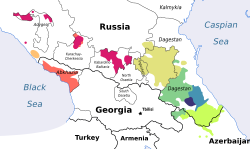
Abkhaz-Adyghe languages are otherwise called North-West Caucasian , in the place of their initial and main distribution - the North-West Caucasus .
Distributed in Russia (in the North Caucasus ), in Abkhazia and among the Middle East diaspora (mainly in Turkey , Syria , Jordan ). The total number of speakers of the Abkhaz-Adyghe languages is approx. 3 million people, including 764,660 people in Russia . (2002 census).
Content
Related Language Hypotheses
The most popular point of view is the relationship between the Abkhaz-Adyghe languages and the Nakh-Dagestan languages, with which they together form the North Caucasian superfamily . According to an alternative point of view, kinship with the Nakh-Dagestan languages is acquired due to their close proximity and is limited mainly to vocabulary, while there are significant differences at the level of morphology and phonetics.
Hutt Kinship Hypothesis [1]
Vyacheslav Vsevolodovich Ivanov showed that the Hutt language is related to the West Caucasian languages, namely the Abkhaz, Adyghe and Ubykh languages. " This hypothesis was first expressed (circa 1920) by the Swiss orientalist Emil Forrer. Now we can consider the" hypothesis as a whole proved necessary to clarify a large number of details in the future , "wrote Vyacheslav Vsevolodovich. Additional evidence - the culture of the Hutt burials resembles Maikop culture .
- A little great version
In the latest works of A. S. Kasyan, 2009-2010, arguments are made in favor of the opinion that according to glottochronological analysis, the Proto-Abkhaz-Adyghe and Hattian languages existed at the same time, and they should be attributed to different branches of the Sino-Caucasian macro-family , the collapse of which occurs in the middle of the 11th millennium BC. e. As a result of this disintegration, two large branches were formed: the proto-language of Sino-Tibeto-On-Dene and the proto-language of North-Caucasian-Basque and Yenisei-Burushaski. Then the collapse of the second branch of the North-Caucasian-Basque and Yenisei-Burushaski occurred in the second half of the 9th millennium BC. e. Kasyan brings the Hattian language precisely with the proto-language Yenisei-Burushaski. The North Caucasian-Basque branch breaks up in the first half of the 7th millennium BC. e. to the Basque and North Caucasian branch. The collapse of the North Caucasian proto-language into the Proto-West Caucasus and Proto-East Caucasus occurred around 3800 BC. e. In turn, the collapse of the Proto-West Caucasian language into the Abkhaz-Abaza, Ubykh and Adyghe branches occurred around 640 BC. e. .. Further, in turn, the disintegration of the single Abkhaz-Abazin language into Abkhaz and Abazin occurred around 1080 AD e., and the collapse of the Adyghe language into Western (Adygean) and Eastern (Kabardian) dialects refers to 960 AD. e. Thus, as mentioned above, in the same period with the Hutt language (2nd millennium BC. E.), there was a separate Proto-West Caucasian language that gave rise to all Abkhaz-Adyghe languages.
The hypothesis of kinship with the Mitanni language [2]
Anchabadze Yu. D. in his Review of: Caucasian Ethnographic Collection VII // Soviet Ethnography, No. 6, 1982., which cited an article by Professor A. K. Gleie “On the Prehistory of the North Caucasian Languages” (published in 1907), finds convincing the following conclusions of A. K. Gleie that:
- tribes, related to the Abkhaz-Circassian, in ancient times lived to the south, until Mesopotamia itself. To prove this, he turns to the Mitanni language and compares it lexically and grammatically with the Abkhaz-Circassian.
- Mitanni language occupies a middle place between the Abkhaz-Adyghe and Nakh-Dagestan languages .
The hypothesis of the existence of the Sino-Caucasian macro-family of languages
The author of the hypothesis is S. A. Starostin . This hypothetical macrofamily unites several language families and isolated languages of Eurasia and North America. The hypothesis is not yet universally accepted , but is popular among linguists - supporters of deep comparative studies . In particular, this macro-family includes: the Basque language , the Yenisei languages (a small language family in Siberia, of which only the Ket language is live), on-den languages (the language family of the Indians in North America), the Abkhaz-Adyghe languages with which Starostin brings together Hutt language , Nakh-Dagestan languages , with which Starostin brings together Hurrit-Urartian languages , Burushaski (an isolated language in Pakistan), Sino-Tibetan languages .
Classification
Adyghe branch
The Adyghe (Circassian) group includes two closely related languages, which are sometimes considered adverbs of a single Adyghe language. In particular, the self-names of both languages are the same - Adyghe (Bze).
- Adyghe language ( adygabze ) - is now spoken in the northern and eastern regions of the Republic of Adygea and some mountain valleys along the Black Sea ( Shapsug dialect ). Up to 90% of the western Circassians were involved in Caucasian mujajirism , and now they make up almost 80% of the Turkish Circassians. However, the language was better preserved on the ancestral lands of the Caucasus, and language statistics look as follows: 129,419 native speakers in the Russian Federation (2002).
- The Kabardino-Circassian language ( Adygebze ) is one of the official languages of Kabardino-Balkaria and Karachay-Cherkessia . In Russia they speak it: Kabardins and Circassians , a total of 587 547 people. The structure of the latter includes the remains of Besleeneites , whose dialect occupies an intermediate position between the Adyghe and Kabardino-Circassian languages. A lot of Kabardians live in the diaspora.
In the Diaspora, the Adyghe and Kabardino-Circassian are considered the same language, called the Circassian language.
Abkhaz-Abazin branch
Abkhaz-Abazin languages are also quite close to each other and include the following languages:
- The Abkhaz language (aԥsua byzshǝa, aԥsshǝa) is the official language of the Republic of Abkhazia (Apsny), a partially recognized state where more than 90 thousand people speak it. However, if in 1989 they made up only 17.8% of the population of Abkhazia, then after the Georgian-Abkhaz war (1992-93) , in 1995 - more than half. In the Caucasus, carriers of only two dialects (Abzhui and Bzyp) remained, carriers of others (Sadz and Ahchips) were deported to the Ottoman Empire.
- The Abazin language (Abaza Byzshva) is the official language of Karachay-Cherkessia , where it is spoken in the north of the republic. Three auls speak the Ashkhar dialect, another ten speak Tapant. Before the Caucasian war, Abaza populated many parts of modern Karachay-Cherkessia, as well as the southern part of the Mostovsky district of the Krasnodar Territory. In total, 38,247 people speak it in Russia.
Genetically, the Abkhaz-Abaza languages are close enough to be considered as adverbs of one language. At the same time, the Ashkhar dialect of the Abaza is closer to the Abkhaz than the Tapant dialect. Conventionally, this is depicted in the diagram above.
Ubykh branch
The fate of the last Abkhaz-Adyghe language - Ubykh (at ° axə) turned out to be more sad. The Ubykhs lived along the Black Sea coast between the Sadzs and Shapsugs , where Sochi is now located. Being active participants in the Caucasian war, they were completely evicted after the defeat of the highlanders. In the Ottoman Empire, they settled with the Circassians and subsequently switched to their language: the last native speaker of the Ubykh language Tevfik Esench died in the village of Hajiosman (on the shores of the Sea of Marmara in Turkey) on October 7, 1992 . However, the Ubykhs themselves are still alive, and in Turkey there are about 10,000 people. There is a movement for the restoration of the language and even for the development of its literary form. Ubykhsky is considered one of the record holders for sound diversity: according to experts, it has up to 80 consonant phonemes.
History
Adyghe-Abkhazian languages are natively distributed in the Western and Central Caucasus, on both sides of the Main Caucasian Range. Little is known about their life in ancient times. The most probable ancestors of the Adyghe-Abkhaz were the Meots , common in ancient times in the northwestern Caucasus. After the crushing campaigns of the Huns and Tetraxite Goths, the Meot tribes were driven back to the mountainous regions of the Trans-Kuban region, and the Meot name itself completely disappeared. He was replaced by the tribes of Zikhs, Kasogs ( Kashak ) and Abazgs - the names of large local tribes. It is possible that Tauris , a tribe living in Crimea during the era of Greek colonization, also belonged to the Abkhaz-Adyghe peoples.
Another blow across the North Caucasus was the devastating invasions of the Tatar-Mongols in the 13th century and the hordes of Tamerlane in the 14th centuries, after which Adyghe tribes took refuge in inaccessible mountain valleys. The ancestors of the Abkhazians, Abazins, Ubykhs, and Black Sea Adygs lived on the other side of the Caucasus Range along the Black Sea coast . But there was little space in the mountains, and as soon as it became calmer around, part of the Circassians moved to the east (c. XIII - XIV centuries), laying the foundation for the Kabardian ethnic group . Abaza groups began to migrate to the liberated lands from the south, due to the Caucasian ridge - first tapanta (which means “plain inhabitants”), and then Ashkaraua (“highlanders”), which occupied part of the territory of modern Karachay-Cherkessia . Later, already in the XVIII century, part of the Kabardians returned and settled in the north of modern Karachay-Cherkessia, received the name of “fugitive” Kabardians. Already in Soviet times, the ethnonym “ Circassians ” was assigned to them, before that it denoted all Circassians in general.
In the second half of the 19th century, all Abkhaz-Adyghe peoples to one extent or another survived another great disaster - the so-called. Muhajirism, or forcible resettlement of a significant part of them within the Ottoman Empire . As a result, in the Caucasus, there were almost or almost no Natukhaevites, Khatukaevites, Egerukaevs, Mamhehs, Makhoshevites, Abadzekhs (1 aul left), Shapsugs , Sadzs , Ubykhs , Beslenevites (4 auls), mountain (Pskhu, Dal, Zebeld) and Gum Abkhazians . The mountainous strip of the northwestern Caucasus was completely depopulated and subsequently inhabited by immigrants from other regions of Russia and the Ottoman Empire ( Armenians , Greeks ), and the empty regions of Abkhazia also by mehrels , Svans, and Georgians .
However, the new homeland was not very welcoming: thousands of Muhajirs, often located in deserted places, died of starvation and disease. The fate of the native language was even less prosperous. Direct and indirect methods, the Turkish government supplanted any minority languages, and only in the most recent time, seeking to comply with European standards, Turkey went on some concessions. However, even now, none of the Abkhaz-Adyghe languages has an official status in Turkey, is not taught at school, and in fact has no written language. Official statistics show a little more than 100 thousand speakers (speaking the language) of the Adyghe language (where it is considered as one language) and 12 thousand speak Abkhaz, while there are about a million ethnic Adygs and Abkhaz-Abaza, and the number of people , one way or another being the descendants of muhajirs, reaches several million.
Grammatical characteristic
In typological terms, the Abkhaz-Adyghe languages are quite close to each other. The most striking features of their grammar are the following:
- extremely poor vocalism with very rich consonantism . In the Adyghe languages, three basic vowel phonemes / a, ə, ɨ / (а, э, s) are represented, and in the Ubykh, Abkhaz, and Abaza, only two - / a, ɨ / (а, s). At the same time, in live pronunciation, each of these phonemes has several pronunciation allophones (variants) depending on the surrounding consonants, which is partially transmitted spelling .
- The number of consonants varies from 45 in Kabardian to 80 in Ubykh. Such a huge number is explained by the fact that in these languages there are several additional articulations added to the main set of consonants. So, in Ubykh there are “only” 44 basic consonants, many of which can be pharyngealized, palatalized (“softened”) and labialized (“rounded up”). As a result, we get a set of 80 phonemes. In addition to the abruptive (pӀ, tӀ, kӀ, tӀ), lateral (Ӏ, k), uvular (x, k, k) and pharyngeal (k, x) consonants, rare sounds like Abkhaz-Adyghe are common in the Caucasus alveo-palatal (“lisping”) (шъ, щӀ, жъ) and abruptive spirants (фӀ, шӀ, щӀ). For such a large number of consonants, of course, there are not enough letters of the Russian alphabet (which these languages use). Different languages solve this problem in different ways: the Abkhazian went along the path of using additional letters by modifying existing ones and adding new ones, and the rest - more common for the Caucasus - by using special additional characters b, b, Ӏ , y. For correspondence between letters and phonemes for consonants in Abkhaz-Adyghe languages, see the article on graphics of Abkhaz-Adyghe languages .
- In morphology, the Abkhaz-Adyghe languages are distinguished by rich verbal inflection, or polysynthetism . A large number of prefixes and suffixes with a certain meaning and a fixed place can be attached to one verb root, as a result of which a whole sentence can be transmitted in one word. Using consonant verbal affixes for a subject , object, and indirect object, direction, place, version (if the action is performed for someone), coercion, negation, transition, time, and some other meanings can be expressed. For example, in the Adyghe language such words are possible as p-f-e-s-tygy “him-for. You-him-I-gave”, u-kyy-s-f-e-play “you-for. Me “I looked at him”, sy-b-de-kӀo-n-ep “I am for you. I will not marry.” in the Abaza d-i-ba-ztIxIva "although-he-he-and-saw"; abh. and-sy-s-i-ly-rit "for me-she-made-him-write."
- Syntactically, the Abkhaz-Adyghe languages refer to the languages of the ergative system : cf. Adyghe. “Ar is hedgehog” “He is waiting for him” (nominate. Construction) - “Ash ar esche” “He is leading him” (ergat. Construction). The functions of subordinate clauses are performed by verb forms that include adverbial affixes in the meanings of “where”, “when”, “where”, “why”, “where”; Wed abh. "D-ah-gylaz" "where he stood", "d-ah-ne-nez" "where he came." The basic word order : “ subject + complement + predicate ”. Word order is especially important in abh. and Abazin., where there is no category of case .
Writing
Until the beginning of the XIX century, none of the Abkhaz-Adyghe languages had a written language. But according to some reports, researchers of the Maykop culture came to the conclusion that the Abkhaz-Adyghe group, later lost, had the oldest written language. After joining Russia, numerous but scattered attempts are made to develop and apply writing for individual Abkhaz-Adyghe languages based on the Cyrillic alphabet and Arabic script . After the establishment of Soviet power for the Adyghe languages, Arabic-based alphabets were centrally introduced. In 1923, Kabardian, and in 1926-1927. - Abkhazian, Adyghe and Abaza are translated into Latin, which was used until 1936-1938. After that, the Abkhaz alphabet was transferred to the Georgian basis (until 1954), and the remaining three - to the Cyrillic alphabet, which exists to this day. For more details see the article on the graphics of the Abkhaz-Adyghe languages .
Folklore
In the absence of written language in the Abkhaz-Adyghe languages, there was a rich oral folklore , which occupied a most important place in the life of these peoples. In each of them there were different types of professional singers and performers of folk art, writers. So, among the Circassians such people were called dzheguako (dzheugakue). Among other genres of folklore, the central place was occupied by the epic Nartov , which is also characteristic of other peoples of the North Caucasus. For example, here is an excerpt from a text dedicated to one of the Narts - Sosruko.
Sosrukue di kan,
Sosrukue di Nehu,
Zi mehuue dyuzhafe
Afer zi jane kueshӀ,
Digger zi py пe shygu ...
Transfer:
Sosruko is our favorite
Sosruko is our light.
Whose shield is golden-yellow,
Whose clothing is chain mail,
Over whose head is the sun ...
Research History
The study of Abkhaz-Adyghe languages begins with the first half. XIX century ( L. Ya. Liulier, I. Gracilevsky, Shora Nogmov , later L. G. Lopatinsky, Kazi Atazhukin); a significant contribution to the study of the Abkhaz-Adyghe languages was made by N. S. Trubetskoy , D. A. Ashhamaf , N. F. Yakovlev , G. V. Rogava, K. V. Lomtatidze , Z. I. Kerasheva and others.
See also
- Swadesh Lists for Abkhaz-Adyghe Languages
Notes
Bibliography
- Balkarov B. Kh. Introduction to Abkhaz-Adyg linguistics. Nalchik, 1970.
- Kassian A. Hattic as a Sino-Caucasian language // Ugarit-Forschungen. Internationales Jahrbuch für die Altertumskunde Syrien-Palästinas. Bd 41, 2009—2010. P.309-447
- Rogava G.V. Abkhaz-Adyghe languages // Languages of the peoples of the USSR. T. 4.M., 1967.
- Chirikba V.A. Abkhaz-Adyghe languages // Languages of the Russian Federation and Neighboring States. Encyclopedia. In three volumes. T. 1. AI. Moscow: Nauka, 1998, p. 18-24.
- Shagirov A.K. Abkhaz-Adyghe languages // Languages of the world. Caucasian languages. M., 1999.
- Chirikba VA Common West Caucasian. The reconstruction of its phonological system and parts of its lexicon and morphology. Leiden, 1996.
- Gabunia Z. M. Russian linguistic science in the formation and development of Caucasian linguistics, Vladikavkaz, 2011. - 518 p.
- Gabunia Z. M. Small languages in the third millennium and the processes of globalization / in collaboration with R. Guzman Tirado / - Vladikavkaz, 2010.
- Gabunia Z. M. Minority languages in the modern world. Caucasian languages / in collaboration with R. Guzman Tirado / - M: Russian Academy of Sciences, 2002.
Links
- Maykop Inscription Study
- Tower of Babel: A project of an etymological database , initiated by S. A. Starostin , includes an etymological database of Abkhaz-Adyghe languages.
- Atlas of Caucasian languages with a register of languages (English) .
- Map of the Caucasus Languages (compiled by the CIA) (English)
- Website of the Abkhazian language "Amrachuaga"
- Section "Adyghe-Abkhazian languages" on the site of Dzheguako (inaccessible link)
- “On the Kabardino-Circassian language”