

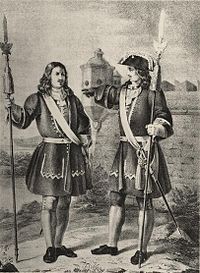

Ground Forces - the formation ( type of armed forces (AF)) of many states of the world, along with the Navy (forces) and the Air Force (fleet) .
Short name - CB .
In some countries, they can be called ground forces , the army (for example, the US Army [3] ). In Germany, this type of military is called Heer .
In the military affairs of Russia in the Soviet period in the 1920s, the phrase “ Earth troops ” was also used [4] .
Traditionally they consist of infantry, cavalry, artillery, motorized and mechanized units, units, formations and associations. They may also have their own aviation units called the Ground Forces Aviation or Army Aviation and Air Defense Forces.
Ground forces are the most numerous type of armed forces of any state, and it is they that bear the main burden in any armed conflict ( war ).
Content
Weapon
The following types of weapons were part of the Ground Forces:
- Infantry ( infantry ), modern varieties of motorized rifle troops (Russia), ( motorized infantry troops (Germany)) - the main means of delivery of manpower to the place of tasks, automotive and special equipment.
- Dragoons (walking service)
- Cavalry (cavalry)
- Reitars
- Hussars
- Dragoons (equestrian service)
- Tank troops (forces) ( armored forces , mobile forces , mechanized forces , armored forces )
- Missile Forces and Artillery
- Ground (military) air defense
- Army aviation ( front-line , tactical, district , military )
- Airborne troops (airborne troops (forces) (Kazakhstan), highly mobile airborne troops (Ukraine), quick reaction forces (troops), special forces (forces) (Special Forces) (USA)), a modern kind of infantry, intended for landing air behind enemy lines or for quick deployment in geographically remote areas - the main means of delivery of manpower - aircraft (can be part of the Air Force or an independent force in the Armed Forces (Russia)
- Army fleet
Russian Ground Forces
Ground Forces (SV) - a type of Armed Forces of the Russian Federation, designed to cover the State border , repel attacks by the aggressor , hold on to occupied territory, defeat troop groups and seize enemy territory.
Ground Forces Day is a professional holiday of the military and civil servants of the Russian ground forces. This day is celebrated in Russia annually, October 1 .
Imperial period
- Army of Peter I
Soviet period
The organization of the armed forces of the workers is the Workers 'and Peasants' Red Army of the USSR .
The workers 'and peasants' red army is divided into land , sea and air forces .The composition of the Workers 'and Peasants' Red Army also includes special forces : troops of the United State Political Administration and escort troops .
- Article 2., Section I., Law of the USSR “On Compulsory Military Service”, Approved by the CEC of the USSR Union, Council of People's Commissars of the USSR, August 13, 1930, No. 42 / 253b
USSR Ground Forces
In 1946, the Red Army (RKKA) was renamed the Soviet Army (SA), and the ground forces of the Red Army into the Ground Forces of the Armed Forces of the USSR (NE USSR AF, NE USSR).
Ground Forces - a type of the Armed Forces of the USSR, designed to conduct hostilities mainly on land, the most numerous and diverse in armament and methods of warfare. According to its combat capabilities, it is capable of independently or in cooperation with other types of armed forces to launch an offensive in order to defeat enemy troop groups and seize its territory, deliver fire attacks to great depths, repel the enemy’s invasion, its large air and sea landing forces , and firmly hold occupied territories and areas and borders. In its composition, the SVs have various types of troops, special troops and special services ( special services ). Organizationally, SWs consist of units , units , formations, and associations .
The military units were divided into military branches (motorized rifle troops, tank troops, airborne troops, missile troops and artillery , military air defense troops (military branches), army aviation, and also units and subunits of special troops (engineering, communications, radio engineering, chemical, technical support, protection of the rear - not to be confused with special purpose units (SP)) .In addition, there were parts and establishments of the rear in the NE.
He headed the SV of the USSR Commander-in-Chief , who was the Deputy Minister of Defense of the USSR . He was subordinated to the General Staff and Directorate of the USSR.
Headquarters - Moscow .
The banner of the ground forces was used during military parades on Red Square in Moscow on May 9 and November 7. A flag with the emblem of the USSR and an ornament on the flag fields was used in the company of the guard of honor to designate the USSR Armed Forces.
- Commanders-in-Chief who were Deputy Minister of Defense of the USSR (year)
- 1946 —1946 - G.K. Zhukov , Marshal of the Soviet Union
- 1946 —1950 - I. S. Konev , Marshal of the Soviet Union
- 1955 —1956 - I. S. Konev , Marshal of the Soviet Union
- 1956-1957 - R. Ya. Malinovsky , Marshal of the Soviet Union
- 1957 —1960 - A. A. Grechko , Marshal of the Soviet Union
- 1960 —1964 - V. I. Chuykov , Marshal of the Soviet Union
- 1967-1980 - I. G. Pavlovsky , Army General
- 1980 —1985 - V.I. Petrov , Marshal of the Soviet Union
- 1985 — 1989 — E.F. Ivanovsky , Army General
- 1989-1991 - V.I. Varennikov , Army General
- 1991 - 1992 - V. M. Semenov , Army General
The SV Armed Forces of the USSR were divided according to the territorial principle into military districts (groups of troops), military garrisons :
- Moscow Military District (OLMVO)
- Leningrad Military District ( LenVO )
- Baltic Military District ( PribVO )
- Belarusian Military District ( BelVO )
- Kiev Military District ( KKVO )
- Carpathian Military District ( PrikVO )
- Odessa Military District
- North Caucasus Military District ( KSKVO )
- Transcaucasian Military District ( ZakVO )
- Volga Military District ( PRIVO )
- Central Asian Military District ( SAVO )
- Turkestan Military District ( KTurkVO )
- Ural Military District ( UrVO )
- Siberian Military District ( Siberian Military District )
- Trans-Baikal Military District ( ZabVO )
- Far Eastern Military District (KDVO)
- Northern Group of Forces ( SGV )
- Central Group of Forces ( TsGV )
- Group of Soviet Forces in Germany ( GSVG ), later - Western Group of Forces ( ZGV )
- Southern Group of Forces
Modern Period
Combat Purpose and Opportunity
Ground forces - the largest in terms of combat composition of the Armed Forces of the Russian Federation . They are intended for the defeat of enemy force groupings, the capture and retention of its territories, regions and borders, the reflection of enemy intrusions and its large airborne assault forces .
Structure and Leadership
The Commander-in-Chief of the Ground Forces (since 2014 ) is Colonel General Oleg Leonidovich Salyukov .
The following types of troops, special forces and services are included in the Ground Forces:
- Motorized rifle troops ;
- Tank troops ;
- Missile forces and artillery ;
- Air Defense Forces ;
- Intelligence units and military units ;
- Engineer troops ;
- Troops of radiation, chemical and biological defense ;
- Communications troops ;
- other.
Organizationally, ground forces consist of platoons , companies , battalions , regiments , brigades and divisions , which are then subordinate to the command of the army, corps or directly to the district. In 2017, the Ground Forces of the Russian Federation comprise 12 combined armies and 1 army corps with a total number of about 280,000 people [5] .
China Ground Forces
The ground forces of the PRC are the most numerous type of armed forces. Together with strategic missile forces, the air force and the naval forces, they make up the People's Liberation Army of China ( PLA ).
US Ground Forces
The U.S. Army is a land force ( army ) designed to conduct combat operations on land, while the army is organizationally separated from the Navy and the Air Force , the Marine Corps , the transport corps , the National Guard, the Coast Guard, and the military police . It is part of the US Armed Forces , and is a species.
See also
- Warfare
- Military establishment
- Type of Armed Forces
- Type of army
- Special Forces
- Special service
Notes
- ↑ Fig. 186. // Historical description of clothing and weapons of the Russian troops, with drawings, compiled according to the highest command : in 30 tons, in 60 books. / Ed. A.V. Viskovatova . - T. 2.
- ↑ Fig. 166. // Historical description of clothing and weapons of the Russian troops, with drawings, compiled according to the highest command : in 30 tons, in 60 books. / Ed. A.V. Viskovatova . - T. 2.
- ↑ American Army - the biggest myth of the XX century
- ↑ Resolution of the USSR Revolutionary Military Council "On the results of the tactical training of the Red Army based on the experience of maneuvers of the 1927-28 academic year and the training goals for 1928-29"
- ↑ The Military Balance 2018 .-- P. 193.
Literature
- Resolution of the USSR Revolutionary Military Union "On the results of the tactical training of the Red Army based on the experience of maneuvers of the 1927-28 academic year and the training objectives for 1928-29"
- Military Encyclopedic Dictionary (VES), Moscow (M), Military Publishing House (VI), 1984, pp .;