"Novik" - Russian "small" armored cruiser , II-nd - "corvette" rank , according to the English classification corresponded to a cruiser of the 2nd class. The first in the world is a “25-nodal” multi-purpose cruiser (close reconnaissance scout, “armored destroyer leader”, counter-destroyer, destroyer “hunter”), capable of independently searching, selecting a target and attacking it, a high-performance staging of minefields in open sea, and also suitable for replacing obsolete gunboats) - the predecessor of the cruiser scout subclass. He distinguished himself in the Russo-Japanese War of 1904-1905 . It got its name in memory of the Novik corvette.
| Novik → Suzuya | |
|---|---|
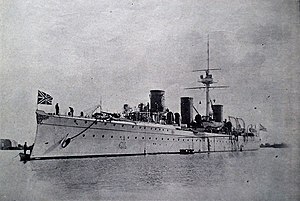 Cruiser II rank Novik | |
| Service | |
 Russian empire Russian empire | |
| Named after | Corvette Novik |
| Class and type of vessel | Armored cruiser |
| Organization |  Russian imperial fleet Russian imperial fleet |
| Manufacturer |  "F. Shihau ", Danzig "F. Shihau ", Danzig |
| Construction started | February 29, 1900 |
| Launched | August 2, 1900 |
| Commissioned | 1901 year |
| Withdrawn from the fleet | flooded by the crew in 1904 |
| Service | |
 Japan empire Japan empire | |
| Named after | |
| Class and type of vessel | Armored cruiser |
| Organization |  Japan Japanese Imperial Navy Japan Japanese Imperial Navy |
| Manufacturer | |
| Construction started | July 16, 1906 raised and sent for restoration |
| Commissioned | July 11, 1908 |
| Status | disassembled for metal in 1913 |
| Main characteristics | |
| Displacement | 3080 t |
| Length | 109.86 m |
| Width | 12.20 m |
| Draft | 5.03 m (recess) |
| Engines | 3 vertical triple expansion machines, 12 Schulz-Tornicroft boilers |
| Power | 17 000 liters with. (12.5 Mw ) |
| Mover | 3 screws |
| Speed | 25 knots (46.3 km / h ) |
| Sailing range | 3,500 miles at 10 knots; (2370 miles (12 knots) - economic course - 8 days; 660 miles (25 knots) - 1 day) |
| Crew | 12 officers 316 conductors and lower ranks |
| Armament | |
| Artillery | 6 × 120 mm Kane guns (45 calibers), 6 × 47 mm Hotchkiss (43 caliber), 2 × 37 mm 23-caliber Hotchkiss guns, 64-mm assault gun Baranovsky (19 calibers), 2 × 7.62 mm Maxim three-line machine guns |
| Mine torpedo armament | 5 × 1 × 381 mm mine (torpedo) vehicles |
Since 1906, after lifting and restoring repairs, it was part of the Japanese fleet under the name Suzuya. The tactical and technical task (TTZ) for the design of a unique experimental small cruiser was developed by the Russian Maritime Technical Committee (MTK), in the framework of the shipbuilding program of 1898, "... for the needs of the Far East" , taking into account the effective combat use of the "small" cruisers " Elsvik type ”in the Sino-Japanese War of 1894-1895 , the general trends of the subsequent development of small cruisers, the features of the Far Eastern Theater, and under the influence of the Russian national idea (concept) that arose against this background -“ universal ezbronnogo vessel ", first substantiated in 1895, Admiral S. O. Makarov . The victory in the preliminary competitive design, the subsequent design and construction of this cruiser, which generally meets the extremely contradictory requirements of the Russian Admiralty, was a significant achievement of the German cruising industry. According to the revised working drawings of the Novik cruiser, two of the same small cruisers of the Pearl type ( Pearl and Emerald ) were built at the Nevsky Plant . Despite the rather ambiguous attitude towards the Novik project, at the world level, the concept of developing the “small cruiser” subclass revived after the Russo-Japanese war, and was practically embodied by the leading naval powers until the outbreak of World War I, as subclasses: “ cruiser scout ”and“ small light cruiser ” [1] .
Design Assignment
At the Russian Main Naval Headquarters (GMH), an operational-tactical task (OTZ) for designing a "small" cruiser for the Pacific Theater began to take shape in 1895, immediately after the aggravation of relations with Japan. Prior to this, since 1882, the concept of a “small” cruiser for the Russian Navy was rejected, because during this period, Russian cruising was developing in the direction of counteracting the latest “medium” and “large” cruisers of a likely enemy - England. The British Admiralty did not fundamentally order "small" cruisers for its Navy, taking into account their organic shortcomings: a small fuel supply to ensure an acceptable cruising range, unsatisfactory seaworthiness and the instability of the "artillery platform" with strong excitement. Against this background, the British company Armstrong began large-scale export construction of "small" Elswick type cruisers on orders from the Navy of developing countries. These ships were the embodiment of the latest achievements of world naval technology and weapons. The British specialists, with maximum benefit for themselves, used the unique opportunity to test these cruisers in the real combat conditions of the Pacific Theater, during the Sino-Japanese War of 1894-1895. Relatively inexpensive, but well-armed "small" cruisers fully complied with the conditions of the limited Pacific Theater, where they actually formed the basis of the "combat core" of the fleets of China and Japan and were effectively used as multipurpose ships.
After the aggravation of Russian-Japanese relations, the Japanese Navy had an absolute numerical superiority in the "small" reconnaissance cruisers and destroyers. The Japanese "Big Shipbuilding Program for 1895-1902" , in addition to large warships, provided for placing orders in England and the USA for the construction of new "small" cruisers, and technical modernization of the old "Elswick-type" cruisers with the installation of the latest Armstrong artillery weapons ". The Russian “medium” cruisers of the Svetlana and Diana types, designed as part of the shipbuilding program of 1895, could well oppose the “small” cruisers of the likely enemy, but were much more expensive and therefore not numerous.
In May 1895, at a meeting of flagships in Chifu , Vice Admiral S.O. Makarov first stated and justified the concept of a “universal armored vessel” (in fact, the development of the concept of ships of the British firm Armstrong, put forward by J. Rendell, the designer of another in 1883, for the Chilean Navy, the small cruiser Esmeralda (displacement - 2800 tons, armament: 2 × 1-254 mm, 6 × 1-152 mm), but with reference to the Far Eastern Theater. This cruiser became the ancestor of the exported cruisers "elsvikskogo type", in 1894 passed the Modernization the firm "Armstrong", was bought by Japan, and in February 1895 - became a member of the Japanese Navy under the name "Izumi" This cruiser Admiral Makarov described as:. "... the perfect fighting machine ..." ... According to S. O. Makarova - “universal armored vessel” - “small” cruiser, with a displacement of up to 3000 tons, speed of 20 knots, armament: 2 × 1-203 mm, 4 × 1-152 mm; 12 × 1-75 mm guns, in conditions of financial constraints, is most suitable for serial construction instead of squadron battleships, "large" and "medium" cruisers, in order to speed both baking balance of forces in the Far East theater. At the same time, he strongly opposed the increase in speed to the detriment of artillery, referring to the opinion of the General of the Marine Artillery Corps, F. V. Pestich, who maintained that "one should not catch up with the enemy in order to be defeated by him . " Also, in his opinion, high speed is not so important for long-range reconnaissance, since the situation changes too quickly, and the obtained data, in any case, will be somewhat outdated and inaccurate (before the appearance of radio transmitters), and destroyers are enough for close reconnaissance. According to S.O. Makarov, armored cruiser formations will be able to successfully resist not only destroyers and cruisers, but using superiority in speed and maneuverability and enemy squadron battleships ... and, if necessary, withstand a single battle with an armadillo. According to a number of naval historians, the concept of an “armless vessel” to some extent influenced the formation of tactical and technical requirements for the design of “small” (II rank) and “medium” (I rank) armored cruisers of the “Corvette” rank in the framework of the “shipbuilding program of 1897” , regarding the implementation of the correlation of levels of ensuring structural unsinkability and armor protection (principle: “unsinkability, not impenetrability”). However, in terms of the composition of the armament, the influence of the “armless vessel” concept is virtually absent here.
From November 1895 to December 1897, at meetings on strengthening the Russian naval forces in the Pacific Ocean, in particular, the question was discussed: ... do small reconnaissance cruisers with a displacement of 2000 ÷ 3,000 tons be needed at the squadron? ... This question arose due to the fact that small cruisers are inferior to medium cruisers in speed, seaworthiness, cruising range, weapons, but due to the lower displacement for their design and construction required relatively less money. This condition was considered in favor of small cruisers, taking into account financial constraints and operational and tactical features of the Far Eastern Theater. In addition, it was assumed that small cruisers would be able to replace obsolete seagoing gunboats at the Pacific Theater and counteract the superior enemy destroyers.
From December 12 to 18, 1897, some participants in the meetings wrote in writing their thoughts on the forces needed in the Pacific ... In particular:
- Vice-Admiral I.M. Dikov believed that in the squadron there should be one reconnaissance cruiser per squadron; each ship of rank I and II should be given a destroyer. He considered the cruiser’s main quality to be the speed for which all other elements should be sacrificed, for the high-speed ship “can and must evade any battle during reconnaissance, taking care not of minor victories and military distinction of personnel, but of the execution of the assignment given to it” .
- This statement, contrary to the concept of a “universal armored vessel”, nevertheless, it subsequently formed the basis for the development of OTP for the design of a small cruiser for the Pacific Theater.
- Vice-Admiral E.I. Alekseev , based on the experience of commanding a squadron in the Pacific Ocean, believed that the number of cruisers with the main forces should be increased: ... there should be as many armored cruisers as eight squadron battleships, eight cruisers with a displacement of 5000 ÷ 6000 ton, four cruisers reconnaissance displacement of 3000 ÷ 3500 tons and the four - less than 1500 tons ... Tasks prior cruisers small displacement it put the following: "to serve at the squadron forzeylyami, scouts, messengers cruisers for transmitting sensitive and spe GOVERNMENTAL orders separately from an Operating troops or ships of the fleet. " The smallest of the ships indicated by them were also intended for surveying, reconnaissance off the coast and at the ports.
- Vice-Admiral N. I. Skrydlov believed that it would be most expedient to build, in addition to the existing ones, one squadron battleship of the Peresvet type and three of the Majestic type (with a displacement of 15,000 tons). In this case, the main forces of the squadron turned out to be three the same "triples" (types: " Poltava ", "Relight" and "Majestic"). Each of the large ships would be accompanied by a reconnaissance cruiser with a displacement of 3,000 ÷ 4,000 tons. Due to a clear lack of time, the Vice Admiral proposed three large battleships and five cruisers to order abroad.
- According to Vice Admiral N.I. Skrydlov, reconnaissance cruisers with a displacement of 3,000 ÷ 4,000 tons should accompany the main forces of the squadron (each squadron battleship, which, according to Skrydlov, should have at least 9 units in the Pacific Theater). In accordance with this, additional functions of the “armored counter-carrier” were assigned to the “small” cruiser ...
On December 27, 1897, during the final meeting, chaired by Admiral General (in the presence of vice admirals: P.P. Tyrtov , Director of the Maritime Ministry, N.I. Kaznakov , V.P. Verkhovsky , I.M. Dikov , S P. Tyrtov , S.O. Makarov, F.K. Avelan and E.I. Alekseev), during lengthy discussions, when a decision was made on the quantitative and qualitative composition of the ship at the Pacific Theater, Admiral General, who had no doubt about the need rank I cruisers, raised the question of the feasibility of building instead of 10 small reconnaissance e of one or two squadrons of battleships ... However, the meeting strongly disagreed with him, due to the fact that, among other things, cruisers with a displacement of 2000 ÷ 2500 tons were supposed to replace obsolete gunboats in the Pacific squadron (“ Koreets ”, “ Manjur "," Thundering "and others).
During March 1898, the Marine Technical Committee (MTK) developed a program - tactical technical task (TTZ), for the design of a cruiser of rank II, in which the main tactical and technical elements were determined: displacement - not more than 3000 tons (with a normal coal reserve - 360 t), the total volume of coal pits should provide a cruising range of 5000 miles at an economic speed of 10 knots; the highest speed - 25 knots; weapon composition: 6 × 1-120 mm; 6 × 1-47-mm guns and one assault gun Baranovsky; mine armament - six vehicles with 12 torpedoes, 25 min barriers and 30 anchors to them; armored deck - "possible thickness" . The document was approved by the ITC Chairman Vice Admiral I. M. Dikov and the chief inspectors: shipbuilding - N. E. Kuteinikov, artillery - Major General A. S. Krotkov, mine - Rear Admiral K. S. Osteletsky, mechanical - N. G. Nozikov. In parallel, a program was also developed to design a cruiser of the same displacement but at a speed of 30 knots ...
The tactical-technical task (TTZ) approved by the Imperial Russian Admiralty for designing a type of high-speed small cruiser was very tough and contradictory, taking into account restrictions on the displacement and the main dimensions of the ship: ... The purpose is cruising service in the open ocean ... The main requirement is speed, not less than 25 knots ... Armament and booking - if possible, taking into account the best seaworthiness ... The maximum possible range ... Good conditions for the habitability of the crew and ...
On April 1, 1898, the MTK program entered the General Directorate of Shipbuilding and Supplies (GUKiS).
The terms of the TTZ, for the conclusion of a contract for design and construction, were familiarized with the most famous companies: German, English, Italian, French, American and Danish. The Imperial Russian Admiralty established as the main paragraph of the contract: “The speed of at least 25 knots. Armament and armor are the greatest possible, with the least difficulty for navigating the open sea at all times. The ship was intended for cruising in the ocean and should have all the marine qualities. At the same time, a large radius of action and a good crew room were set as an indispensable condition ... "
Design
In the competition for the right to conclude a contract for the design and construction of a small high-speed reconnaissance cruiser, the following firms joined: German companies: Howaldtswerke (Kiel), F. Shihau "and" Krupp "; English: London and Glasgow Engineering & Iron Shipbuilding Company and Laird; Italian - Ansaldo; French - Chantier de la Gironde Society (Bordeaux); the Danish company Burmeister og Vine, as well as the Nevsky Shipyard with the technical assistance of English firms.
- The first company to answer the competition announced by MTK was the German company Hovaldtswerke from Kiel. Her attorney F. Goh, on April 10, 1898, received at the GUKiS requirements for the “25-knot” cruiser, and a day later for the “30-knot” cruisers ... Already on April 28 there was an answer that in the first case the cruiser would be 103, 63 m, width 12.8 m, draft 4.88 m. The project involved the installation of two vertical triple expansion machines with a capacity of 9000 hp. each and the Tornicroft water tube boilers. A calculation was attached, from which it followed that in order to reach the ship 30 knots, a machine of 25,000 hp was needed, the mass of which would be at least 1900 ÷ 2000 tons, and for a given displacement of 3000 tons, only 1000 remained on the hull, artillery and fuel t ... I. M. Dikov found these calculated arguments convincing and, transmitting the documents for consideration to the shipbuilding department, accompanied them with a resolution: “I believe that the 25-node move is sufficient. It is hardly possible to demand more . ” In general, the information sent was arranged by the MTK, with the exception of data on the need to create in the boilers a high-forced draft necessary to achieve full speed ... Taking into account this comment by the MTK, the German company revised the project, and in early June 1898 submitted to St. Petersburg drawings: longitudinal and cross sections, the location of coal pits, engine rooms and boiler rooms, mid-frame, as well as the description of the ship. At the same time, the designers did not meet the agreed displacement, increasing it to 3202 tons. The cruiser had armor protection with an armored deck 20 mm thick with 40-50 mm bevels in the area of cars and boilers. June 13, 1898 in the MTK was presented a model of the ship. In an effort to receive an order, the company developed the option of replacing Tornicroft boilers with Belleville system boilers preferred by the Russian Ministry of the Sea, in which the cruiser length increased by 9 m, displacement - by 100 tons, but the full speed was provided with very moderate forced draft in the boilers.
- In June 1898, the project of the Italian company Ansaldo was submitted to the MTK for consideration. The original version was supposed to use two cars with six cylinders each, in the second - with four cylinders. In both cases, 14 Yarrow boilers were supposed to ensure the development of a total capacity of 16,500 hp. Толщина броневой палубы находилась в пределах от 20 до 50 мм, боевая рубка с толщиной стенок 125 мм.
- 7 июля 1898 года, английская фирма: «Лондон энд Глазго инжениеринг энд айрон шипбилдинг компани» представила спецификации и чертежи… Однако кроме заявленной цены (225 тыс. фунтов стерлингов) иных данных обнаружить не удалось, поэтому 16 июля 1898 года, документы были возвращены, вероятно, за явным несоответствием проекта требованиям Морского министерства.
- Проект Невского судостроительного завода был разработан при технической помощи англичан, включал: корпусную часть выполнил инженер Э. Рид, механическую часть — разработки фирмы «Модсли, Филд энд сан». Крейсер должен был иметь длину 117 м и ширину 12,2 м, то есть отличался необычайно большим, для того времени, отношением длины к ширине — 9,6. Проектное водоизмещение составляло 3200 тонн, бронезащита в горизонтальной части палубы и в оконечностях — 30 мм, на скатах у машин и котлов — 80 мм. Пар для двух машин обеспечили 16 котлов Ярроу, скорость и артиллерийское вооружение соответствовали заданию, минное — уменьшено до четырех аппаратов.
Представили свои чертежи так же и германские фирмы — «Ф. Шихау» и «Крупп».
3 июля 1898 года, на заседании МТК, все проекты были рассмотрены и оценены на неофициальной конкурсной основе… В итоге, лучшим был признан вариант «Шихау» со скоростью 25 уз (имелся еще и 28-узловой, но эта скорость достигалась за счет ослабления вооружения и бронирования).
- Примечательно, что проект поступивший от датской фирмы «Бурмейстер ог Вайн» был рассмотрен и принят вне конкурса, поскольку заказ корабля по нему (будущего крейсера « Боярин ») был предрешен на высочайшем уровне.
В январе—феврале 1899 года, в Морское министерство поступили еще три проекта 3000-тонных разведчиков. Первый из них, английской фирмы «Лэрд», отличался несколько уменьшенным бронированием и минным вооружением (три аппарата), но зато должен был нести восемь 120-мм орудий. Общество «Шантье де ла Жиронд» из Бордо прислало сразу два варианта — один при водоизмещении 3000 т поддерживал бы 21-узловую скорость в течение 10 часов, другой при 3520 т — 25 уз в продолжение двух часов. Отличительной особенностью являлось наличие продольной переборки между бортом и главными механизмами. Чертежи были рассмотрены МТК больше из познавательного интереса, фирмам же сообщили, что новые заказы за границей более не планируются.
Постройка
5 августа 1898 года, начальник ГУКиС вице-адмирал В. П. Верховский и представлявший в России интересы фирмы «Ф. Шихау» Р. А. Цизе подписали контракт на постройку крейсера. Корабль должен был быть готов к испытаниям через 25 месяцев (впоследствии срок сдачи перенесли на 5 декабря 1900 года). В документе подробно оговаривались характеристики корабля, устанавливались традиционные в таких случаях штрафы, в том числе за недобор скорости. При ходе менее 23 узлов, или осадке, более чем на 15 см превышающей контрактную, русское Морское министерство получало право отказаться от заказа и получить обратно деньги. Строительство должно было вестись Данцингским отделением фирмы «Шихау», на верфи в Данциге , изготовление механизмов — филиалом фирмы в Эльбинге .
Экипаж был сформирован еще до начала постройки корабля. Старшим судовым механиком крейсера, был назначен молодой выпускник Технического училища Морского ведомства — К. Р. Тирнштейн . В ноябре 1898 года, наблюдающим за постройкой крейсера «Новик» и постройкой четырёх 350-тонных миноносцев, заказанных той же фирме, был назначен — капитан 2-го ранга Пётр Фёдорович Гаврилов. 6 декабря 1898 года, П. Ф. Гаврилов прибыл в Эльбинг для наблюдения за постройкой. В рапортах, П. Ф. Гаврилов неоднократно характеризовал К. Р. Тирштейна как чрезвычайно добросовестного и на редкость исполнительного.
- П. Ф. Гаврилов — знающий офицер, имел трехлетний стаж службы в должности старшего офицера крейсера II ранга "Африка (1892—1895 гг.), двухлетний стаж в должности командира миноносца «Взрыв» (1895—1896 гг.), трехлетний стаж работы в должности помощника главного инспектора минного дела (1896—1898 гг). 6 января 1899 года, П. Ф. Гаврилов, вместе с представителями дипломатического корпуса и капитанами 1-го ранга Н. К. Рейценштейном и А. Ф. Стемманом — командирами заказанных в германии крейсеров I ранга, соответственно «Аскольд» и «Богатырь», был представлен Вильгельму II . Германский Император с интересом побеседовал с офицерами, расспросил про корабли. В разговоре с П. Ф. Гавриловым он одобрительно отозвался о котлах Торникрофта, которые должны были установить на «Новик».
Длительное согласование чертежей между германскими проектировщиками и русским МТК, а также задержки поставок со стороны сталелитейных заводов, явились причинами задержки начала стапельных работ примерно на год. Только в декабре 1899 года, начались регулярные стапельные работы, которые впоследствии продвигались весьма интенсивно.
29 февраля 1900 года, состоялась официальная закладка крейсера «Новик». На момент закладки, корпус был доведён до броневой палубы, масса установленного металла составляла до 600 т. Командир корабля был в восторге от « … поразительной точности пригонки частей набора… Можно смело сказать, что до сих пор на стапель не было принесено ни одного золотника лишнего металла, зубило отсутствует, все отверстия точно совпадают ». По его расчетам выходило, что крейсер может быть спущен на воду уже в конце мая — всего через полгода после начала интенсивной постройки! Фирма очень спешила, рассчитывая, что на торжественном спуске будут присутствовать русский и германский императоры, официальная встреча которых планировалась в мае — июне 1900 года, в Данциге. Однако, встреча была отложена и, директор верфи уведомил о том, что намного удобнее продолжать монтажные работы на стапеле.
18 апреля 1900 года, старшим офицером крейсера «Новик» был назначен лейтенант Ф. Н. Иванов (до этого, командовал миноносцем № 120).
2 августа 1900 года, в 13-00, состоялся торжественный спуск крейсера на воду. На церемонии присутствовали: генерал-губернатор и командующий войсками Западной Пруссии, представители русского посольства в Германии, командиры строившихся на немецких верфях крейсеров I ранга «Аскольд» и «Богатырь», соответственно — Н. К. Рейценштейн и А. Ф. Стемман, бывший морской министр Франции адмирал Лакруа. Русский посол граф Н. Д. Остен-Сакен приехать не смог, поэтому прислал в дар кораблю икону в позолоченной ризе, с дарственной надписью. Фирма преподнесла сюрприз, до последнего момента державшийся в секрете, — за свой счет привела в Данциг из Пиллау только что законченный постройкой, но еще не прошедший испытания и не переданный русскому флоту миноносец — «Дельфин» (с 1902 года — « Бесстрашный »). Необычно суровая для Данцига зима значительно затормозила дальнейшую достройку корабля.
Tests
2 мая 1901 года, крейсер «Новик» впервые вышел в море, на заводскую пробу.
12 мая 1901 года, практически завершённый постройкой крейсер, неофициально посетил кайзер Вильгельм II. Поднявшись на борт, он познакомился со всеми офицерами, побеседовал с членом МТК — флагманским инженером-механиком Ф. Я. Поречкиным . Интересуясь новым типом крейсера, император одобрил удобства размещения и высказался о том, что артиллерия вероятно слишком сильна по размерам корабля. 14 мая, на память офицерам о своём визите, Вильгельм прислал свой портрет с дарственной надписью. 30 августа, во время манёвров германского флота, в Данциге, русский император — Николай II , на борту яхты « Штандарт » беседовал с П. Ф. Гавриловым на предмет особенностей нового крейсера.
Стремясь ускорить сдачу крейсера, завод не стал проводить прогрессивных испытаний механизмов, при условиях постепенного наращивания мощности и скорости. В результате, во время первого же выхода, крейсер разогнали до 24 узлов. Как позднее писал П. Ф. Гаврилов: «допущенное заводом при первых же ходах форсирование машин было главной причиной затянувшихся испытаний и ряда различных аварий» .
15 мая 1901 года, крейсер вышел из Данцига и 18 мая 1901 года прибыл в Кронштадт. С мая по середину сентября крейсер семь раз выходил в море, из которых четыре были прерваны из-за поломок машин и винтов. Летом были обнаружены раковины на валах машин.
23 сентября 1901 года, в ходе приёмо-сдаточных пробегов крейсера, германские специалисты решили весьма серьезную проблему: было замечено « значительное движение корпуса в горизонтальной плоскости около середины длины судна, то есть в районе помещений бортовых машин ». Для устранения этого явления, завод изменил параметры винтов, перебрал механизмы, уравнял число оборотов средней и бортовых машин (первоначально они давали по 155÷160 и 170÷175 об/мин — соответственно, а впоследствии — 160÷165 об/мин). Несколько испытательных выходов подтвердили правильность принятого решения.
Устраняя неисправности — упустили время, сильные осенние ветры помешали провести испытания на мерной миле. Крейсер пришлось оставить на заводе на зимовку, во время которой были произведены замены валов, на которых, летом 1901 года были обнаружены раковины.
В январе 1902 года, германский журнал: «Die Flotte» опубликовал статью в которой сообщалось: "Построенный по заказу русского правительства на Шихаусской верфи крейсер «Новик», который на своих последних испытательных пробегах развил скорость хода в 26 уз, недавно был окончательно принят на службу Императорского Российского флота. Над проектом этого совершенно нового типа военного судна задумывались самые крупные английские, французские и американские фирмы. Из всех стран Россия, однако же, получила уклончивые ответы, так как высокие задачи, которым должно было удовлетворить это своеобразное судно, не могли быть разрешены удовлетворительным образом ни одной из запрошенных фирм. В конце концов, русское правительство решило передать заказ фирме «Шихау».
23 апреля 1902 года — спустя без малого год после первого выхода в море, на крейсере «Новик» были завершены официальные испытания на полный ход.
According to the test results, the Novik cruiser fully met all the difficult conditions of the contract. According to a review published in a German magazine: “... is a successful type of military vessel, the speed of which has not yet been achieved with these dimensions ...”; "... is a masterpiece of German shipbuilding ..." .
Technical Description
The description of the hull’s construction, published in the “Report on the Maritime Department in 1897-1900”, is very figurative: “The type of cruiser II rank“ Novik ”is a huge destroyer of 3000 tons with a 25-knot move. The lower part of the cruiser is a cigar-like structure, slightly flattened in the vertical direction, covered by an armored deck from above, and from the bottom consisting of a double bottom, gradually converging with the outer skin and approximately halfway from the keel to the waterline, which goes into the system of coal side pits, bottom and top armored deck. Above the flattened underwater "cigar" is a superstructure, for the most part above-water, forming one interdeck space . "
The length of the hull between the perpendiculars was 106, the maximum width was 12.2 m (excluding the thickness of the skin), and the height from the keel to the upper deck was 7.7 m. The main material was mild Siemens open-hearth steel. The spacing was 610 mm.
At the time of testing, the normal displacement with all the reserves stipulated by the contract (including 360 tons of coal) was only 2720 tons, that is, almost 300 tons less than the projected one: this result was the result of maximum lightening of the hull and machines.
Brief data on the load of the cruiser "Novik" company "F. Shihau ”reported to the Ministry of Marine only in January 1906. Missing information about the armor in the German data was probably included in the body mass.
If we assume that the Novik’s armor weighed as much as the Emeralds and Pearls (345 tons) that were built according to his design at the Nevsky Plant, then the mass of the hull should be 875 tons — only 32% of the displacement.
The materials of Vice Admiral S.O. Makarov contain slightly different data, but it is difficult to compare them because of the different way of grouping.
According to them, the supply corps accounted for 42.3, the armor - 10.43, the artillery with ammunition - 4.73, mine weapons - 3.36, the mechanisms, boilers and the water supply to them - 26.7% from the displacement. It also contains information that the Novik armored deck had a mass of 294 tons. If this information is correct, then the hull accounted for 34% of the displacement. The austerity of all load articles led to the replacement of the linoleum liner (6-7 mm thick), usual for Russian navy ships, with a wooden coating of the upper deck.
The mass load of the Novik rank II cruiser
| Name of load | Mass, t | % of the nominal displacement |
|---|---|---|
| Body | 1219,858 | 44.86 |
| Various equipment | 97,786 | 3.60 |
| Cars and boilers | 790,417 | 29.07 |
| Artillery | 83,301 | 3.06 |
| Ammunition | 67,760 | 2.49 |
| Coal | 360,000 | 13.24 |
| Team with things | 49,500 | 1.82 |
| Six-week provisions | 38,500 | 1.42 |
| Fresh water for eight days | 12,000 | 0.44 |
| Total normal displacement | 2719,125 | 100.00 |
The maximum lightness of all structures was evidenced by the fact that already in the winter of 1901-1902, it was necessary to replace the ladders in the boiler room, which could not stand even a year of operation. During the inspection of 1903, the unusual narrowness of the ramps, all the entrances and exits, made an unpleasant impression on visitors.
The unsinkability of the ship was ensured by: 17 watertight bulkheads below and nine above the armored deck, a double bottom in the engine and boiler rooms area (from 40 to 137 ships; dividing the hold by longitudinal bulkheads into a large number of compartments; MTK further developed the company's initial proposals, requiring the completion the heights of the transverse bulkheads passing under the smoke exits of the boilers to the next (upper) deck.In addition, the plant had to additionally produce curvilinearly towering bulkheads that provide waterproof Flue be output.
The cruiser was controlled from the battle or steering (running) cabin, or from the bridge. All three control points are equipped with compasses, mechanical steering wheels, electric steering systems, engine telegraphs, and ringing devices in the engine room.
The initial project did not include the installation of a wheelhouse (as on the Askold cruiser). It was only supposed to install a wave breaker shield, preventing flooding of the deck in stormy weather. The drawings presented in the MTK did not even have a bridge, despite the fact that its construction was stipulated in the contract. This caused difficulties. The company, weighed down by the multiple coordination of drawings, designed this design according to its own understanding. However, by the spring of 1901, when it was installed: smokestacks of pipes, davits, boats, rowing ships, it turned out that the bridge was too low, its wings were short, so the feed of the cruiser and its sides were out of sight of the skippers. After a number of objections, the company admitted the mistake and replaced the bridge with a new one that fully met the requirements of P.F. Gavrilov.
The main protection of the cruiser was provided by the armored deck, located on the main length of the hull 0.6 m above the waterline. In the bow of the hull of the armored deck, not reaching a ram of 29.5 m, it began to descend smoothly, resting on the stem at a depth of 2.1 m. In the stern, the reduction of the armored deck began 25.5 m to the stern and reached a recess of 0.6 m . In its horizontal part, the deck consisted of two layers of plates with a total thickness of 30 mm (10 + 20). On bevels abutting the sides of the vessel 1.25 m below the waterline, the total thickness reached 50 mm (15 + 35). Over the cylinders of the main vehicles protruding above the armored deck, a 70-mm glacis was arranged. Additional protection was provided by coal pits located above the armored deck, throughout the engine and boiler rooms.
The stability of control of the cruiser in combat conditions was provided by the conning tower, formed by 30-mm nickel steel armored plates and connecting the conning tower to the armored deck with a pipe of the same thickness to transmit commands.
The ship’s power plant included: three vertical four-cylinder (two low and one medium and high pressure cylinders) triple expansion machines and 12 Shihau boilers, which were actually modifications of the Tornicroft boilers, their total heating surface was 4500 m2, working pressure - 18 atm. The cruiser had two engine rooms - a bow with onboard vehicles and a stern with an average machine and six boiler rooms, two boilers in each. The boiler rooms combined into pairs located across the hull, each of which had its own chimney. The location of the branches is echelon: first, two boiler rooms, then a machine room, one boiler room, and finally another machine room. This explains the unequal distance between the pipes.
The propellers of the side shafts initially differed slightly from the average: the former had a diameter of 4 m and the latter 3.9 m. After the accident, on May 11, 1901, when the spool of the medium-pressure cylinder of the left machine broke during the tests, new, slightly smaller diameters were installed screws - 3.9 and 3.76 m, respectively. Strong vibration of the case forced, in October 1901, to change the screws again. In the final version, the lateral three-bladed propellers had a diameter of 3.9 m and a pitch of 5.34 m, and the average four-bladed propeller had 3.56 and 5.25 m.
Booking
- Armor: Deck - 50 mm (75 mm maximum), deckhouse - 28 mm
Service
On May 18, 1902, after completion of the acceptance tests, Novik arrived in Kronstadt.
September 14, 1902 the cruiser under the command of the captain of the 2nd rank P.F. Gavrilov left Kronstadt heading for the Russian Far East .
In December 1902, the captain of the 2nd rank N.O. Essen , who had previously formed the squadron in Kronstadt, and then in Reval and Libava, was appointed commander of the newest light-weight destroyer Novik.
On December 6, 1902, while staying in Piraeus (Greece), the captain of the 2nd rank N.O. Essen took command of the Novik. April 2, 1903 the cruiser Novik arrived in Port Arthur, and was included in the Russian squadron of the Pacific Ocean, commanded by Vice Admiral O. V. Stark .
From the very first day of the Russo-Japanese War , Novik took an active part in the hostilities.
On the night of January 27, 1904, immediately after the attack of the Japanese destroyers on the Russian squadron, the commander of the cruiser was ordered to pursue the enemy. The commander of the cruiser Novik, Captain of the 2nd rank N.O. Essen, was the first to build the ship for battle and went to sea, but did not catch the enemy. While the couples were raising on Novik, the Japanese destroyers managed to leave.
On the morning of January 27, 1904, the entire Russian squadron went out to meet the Japanese fleet. N.O. Essen brought Novik to intelligence. While Russian ships, intact by Japanese torpedoes, were just leaving the raid, Novik fired a torpedo at the Yakumo cruiser and made a daring attempt to get close to the enemy squadron. The commander of the "Novika" decided, after a night shock, to achieve success - he twice tried to attack the flagship battleship of Admiral Togo, trying to get closer to the distance of a torpedo shot. When trying to attack again, Novik got hit by a 12-inch (305 mm) shell in the stern (according to other sources - as a result of an 8-inch (203 mm) shell hit at the waterline), he was forced to withdraw from the attack, and returned to the base. At the Port Arthur raid, the damaged Novik was greeted with shouts of “Hurray!”
After ten days of intensive repair, the ship was put into operation. The following days were filled with vigorous military activity. "Novik" participated in battles with the Japanese squadron, supported destroyers, carried out reconnaissance, its crew showed high skill, heroism, showing an example of fulfilling a duty.
On the Novik, the squadron commander admiral S. O. Makarov kept his flag, while reaching the rescue of the destroyer Survivable, surrounded by Japanese ships. However, the launch at sea took place two hours after the start of the battle and noticeably after its completion, when the sinking Russian destroyer was already captured by the Japanese and was drowning, so the attempt was unsuccessful [2] .
The cruiser repeatedly covered the exits to the sea of destroyers and gunboats, fired at the coast occupied by the enemy.
The active actions of Novik, amid the first setbacks, were noted by the command. For the battle on January 27, 1904 near Port Arthur, N.O. Essen was awarded the Golden Saber with the inscription "For Courage" , and 12 members of the Novik crew received St. George's Crosses .
March 16, 1904, by order of the vice-admiral S.O. Makarov, commander of the squadron, captain of the 2nd rank N.O. Essen was appointed commander of the squadron battleship Sevastopol . S.O. Makarov saw in N.O. Essen of his soul mate, in an effort to " take the sea into your own hands!" "And insisted on his appointment as commander of the battleship" Sevastopol ", despite the fact that seniority was the turn of Captain 1st Rank R. N. Viren , who had the support of the Admiralty. March 18, 1904, the captain of the 2nd rank M.F. von Schulz took command of the cruiser Novik. According to him, N.O. Essen was not delighted with the appointment to a powerful but clumsy battleship. Having got used to the maneuverability of the high-speed cruiser, Essen felt "out of place" on the battleship. N.O. Essen, impudent, impulsive nature, left Novik with regret. On March 1, 1904, N.O. Essen wrote to his wife: “Yesterday I received an armadillo and handed over the Novik to Schulz. The team shouted “Hurray!” In my honor, cordially escorted me… I’m used to “Novik”, I prefer cruising service, and this increase doesn’t please ” ... [3]
July 28 ( August 10 ), 1904 , during the battle in the Yellow Sea , the cruiser Novik received 3 surface holes (2 killed, 1 wounded) broke into the port of Qingdao . Then, rounding Japan from the east, he came to the port of Korsakov on Sakhalin Island to replenish coal reserves.
August 7 ( 20 ), 1904 , not having time to replenish coal reserves (to take the bunker), the cruiser was forced to take the battle with the Japanese cruiser Tsushima . During the 70-minute battle, the cruiser received 3 hits below and 2 above the waterline, as well as more than 10 in the superstructure (2 killed, 17 wounded). In turn, Novik inflicted one underwater hole, as a result of which there was a significant roll at Tsushima, and he was forced to leave the battle to repair the damage. M.F. von Schulz, having received radio interception data on the approach of the Japanese armored cruiser Chitose , ordered the cruiser to be sunk. The cruiser lay on the ground at 23 hours and 30 minutes at the Korsakovsky post. On August 8, the newly arrived Chitose fired at the already flooded hull of the Russian cruiser, firing about 100 rounds at the Novik units and the city protruding from the water. Later, part of the Novika crew was evacuated to Vladivostok.
Based on the Portsmouth Peace Treaty, the southern part of Sakhalin Island was surrendered to Japan.
July 16, 1906 "Novik" was raised by the Japanese. The cruiser was reconstructed with the installation of new boilers and weapons.
July 11, 1908 the cruiser became part of the Japanese fleet under the name "Suzuya."
In 1913 it was excluded from the lists of the fleet and dismantled for metal.
Project Evaluation
The construction in Germany and the completion of tests in Russia of the first (experimental) high-speed small cruiser reconnaissance "Novik", satisfying the extremely contradictory tactical and technical requirements of the Russian Admiralty, was a significant technical achievement of the German shipbuilding company "Schihau", and a landmark event in the world history of development " small "cruisers" corvette "rank. The main requirement of the customer - high speed - 25 knots (but not to the detriment of security, armament, cruising range and habitability conditions) with relatively small dimensions and displacement - was realized due to the unusually large relative lengthening of the hull, as much as possible to lighten the structure (in damage to strength), the use of an unusually powerful, but lightweight, compact and economical steam-piston propulsion system.
Before the Russo-Japanese War, the attitude to the project of the cruiser Novik was very controversial, both from foreign and Russian naval specialists. Upon completion of the construction of the cruiser, the German Emperor - Kaiser Wilhelm II was convinced that the Russians unreasonably increased the design capacity of the weapons. One of the authoritative German experts, in contrast to the enthusiastic article of the German magazine: “Die Flotte” , called the cruiser built for Russia “Car Case”, implying unreasonably high relative power and, accordingly, weight parameters of the propulsion system for a cruiser of this class.
Admiral S. O. Makarov, in the dissenting opinion about the shipbuilding program for 1903-1923, defined his attitude towards the Novik project: - It will not be a small gain if ships of 3,000 tons of Novik type are replaced by armored vessels of the same displacement, suitable for reconnaissance and battle . "
- From the point of view of S. O. Makarov, in the Novik project the effectiveness of weapons was sacrificed at an unjustifiably high speed. The absence of artillery mounts of an intermediate caliber of 203 mm limited the combat capabilities of the cruiser at long distances, when medium-caliber artillery became ineffective.
In February 1904, S.O. Makarov, in a letter to the managing director of the Ministry of the Sea, F.K. Avelan proposed that the cruisers “Emerald” and “Pearl”, which were being built at the Nevsky Shipyard, be remodeled, bringing their characteristics closer to the “armless” the ship. " According to the calculations of the ship engineer P.F. Veshkurtsov, in the case of dismantling the middle machine and part of the boilers, a gain of 270 tons was ensured, due to which it was proposed to strengthen mine-artillery armament with the installation: 1 × 203 mm, 5 × 1-152 mm and 10 × 1-75 mm guns; four mine vehicles; reinforce the housing; in the vacant engine room, it was recommended to install two auxiliary engines of 100 liters. with. "For cruising at low speed." At the same time, the design speed was supposed to decrease by 2.7 knots and reach 22.3 knots (in the calculation it was not taken into account that the design speed of these ships was not 25, but 24 knots). But there was no time left for the implementation of such reconstruction, if it were deemed expedient, since these ships barely had time to prepare for inclusion in the 2nd squadron of the Pacific Ocean. The only consequence of the letter of S. O. Makarov was the installation on the cruisers "Emerald" and "Pearl" - mine vehicles (three on each), not provided for by the initial draft.
По мнению Н. Л. Кладо, крейсера малого водоизмещения оправдывают себя лишь в качестве бронепалубных, …" совершенно не приспособлен для боя и пригоден лишь для посылок, обладает очень слабой мореходностью и в свежую погоду он не может воспользоваться своей большой скоростью, и любой броненосный крейсер оставит его далеко позади ". Район действия малого крейсера очень мал. Например бронепалубный крейсер «Новик» водоизмещением 2836 тонн, на котором отдано под машину 26,7 % от его водоизмещения, чтобы достичь скорости в 25 узлов, может при своём запасе угля (17,9 % от его водоизмещения) пройти всего только 660 миль и через сутки уже угля у него не будет, а экономическим ходом (12 узлов) он может пройти расстояние всего 2370 миль в продолжении 8 суток. Сравнивая малый бронепалубный крейсер «Новик» со средним — броненосным (фактически бронепалубным) крейсером I ранга «Богатырь» (так же германской постройки), Кладо пишет: « Между тем броненосный (впрочем бронированный очень слабо) крейсер „Богатырь“ (водоизмещение 6972 тонны), при относительном весе машины 20,15 % от его веса, отданных под машину, имеет скорость в 23 узла, каковой при меньшем сравнительном запасе угля (16,6 %) от его водоизмещения, может пройти 1680 миль; притом его не остановит такая погода, при которой „Новик“ уже будет бездействовать „. Оценивая боевые качества корабля по соотношению показателей: скорость/броня/ артиллерия/дальность, Кладо Н. Л. делает вывод о том, что: …“ Чем корабль больше, тем большее количество наступательных и оборонительных средств может он в себя вместить, тем он мореходнее и тем устойчивее платформа и, тем с меньшими относительными затратами веса может ему быть сообщена сила тяги винтов, защита, скорость и район действий » [4] .
- Накануне русско-японской войны, в Николаевской Морской академии, были разработаны правила (методика) для сравнения боевой эффективности кораблей различных классов, с учётом их разнородных элементов: артиллерии, бронезащиты, скорости хода и всех их особенностей, путём вычисления (определения) так называемых «боевых коэффициентов кораблей». Н. Л. Кладо усовершенствовал эти правила, устранив самый главный недостаток методики — трудность сопоставления таких разнородных элементов как «сила» корабля и его «скорость», возникающая при сравнении броненосных кораблей, от которых требуется главным образом «сила», с бронепалубными крейсерами и миноносцами — одно из главнейших качеств которых — скорость. Н. Л. Кладо применил сравнение посредством боевых коэффициентов для частей эскадр, состоящих из однородных кораблей, к которым предъявляются одинаковые требования. [5] В частности, были определены сравнительные значения боевых коэффициентов для «малых» и «средних» крейсеров корветского ранга. Так, для крейсеров II ранга: «Новик», «Жемчуг» и «Изумруд», значение боевого коэффициента составило — 3,2; «Боярин» — 2,7. Для японских «малых» крейсеров 2-го класса, водоизмещением менее 4000 тонн: «Идзуми» — 1,0; тип «Нанива» — 2,4; «Сума» — 2,9; «Акаси» — 2,9; «Чийода» — 2,7 [6] .
После русско-японской войны, проект «Новик» явился родоначальником возникновения и развития из подкласса малых крейсеров «корветского» ранга — нового подкласса: малых быстроходных крейсеров-разведчиков, которые во флотах ряда ведущих морских держав обозначались термином: «крейсер-скаут». Развитию «малого» крейсера, аналогичного проекту «Новик», способствовал научно-технический прогресс в области военно-морской техники и главным образом повсеместное применение паротурбинных двигателей.
Русские бронепалубные крейсера II ранга типа «Новик», несмотря на отдельные недостатки, хорошо зарекомендовали себя в ходе русско-японской войны. Поэтому после русско-японской войны в Англии и Германии были заложены большие серии быстроходных крейсеров малого водоизмещения, предназначенных для боевых действий в составе эскадр и флотов [7] .
В России, с августа 1907 года, по заданию Морского Генерального Штаба (МГШ), для проверки возможности создания быстроходного крейсера малого водоизмещения с паротурбинной двигательной установкой, предназначенного для: « Разведочная службы при эскадре броненосцев или совместные действия с отрядом миноносцев », был привлечён Балтийский завод [8] .
В соответствии с тактико-техническим заданием (ТТЗ) на проектирование, предсерийный экспериментальный крейсер «Новик» фактически явился опередившим своё время, единственным в мире, «стопроцентовым» — «бронированным лидером миноносцев» (в то время класс эсминец ещё не был официально принят), поскольку, выполняя предусмотренные ТТЗ функции контр-миноносца, был вполне способен выполнять все функции, впервые определённые для английских «лидеров флотилий», в начале Первой мировой войны .
In Culture
Прорыв крейсера «Новик» описан в романе В. Пикуля «Каторга», а также в романе А. Степанова « Порт-Артур ».
Notes
- ↑ Цветков И. Ф. Гвардейский крейсер «Красный Кавказ». Ленинград. Судостроение. 1990 г. стр. 142
- ↑ НП ИнфоРост. ГПИБ | Описание военных действий на море в 37-38 гг. Мейдзи (в 1904-1905 гг.). - СПб., 1909-1910. . elib.shpl.ru. Дата обращения 6 июня 2018.
- ↑ Б. Шалагин. Собиратель Балтфлота. Журнал «Морской Сборник» № 12. 1990 г.
- ↑ Кладо Н. Л. Современная морская война. С-Петербург. 1905 г. стр. 83, 98÷99
- ↑ Кладо Н. Л. Современная морская война. С-Петербург. 1905 г., стр. 442
- ↑ Кладо Н. Л. Современная морская война. С-Петербург. 1905 г. Приложения: стр. 24÷33
- ↑ Цветков И. Ф. Гвардейский крейсер «Красный Кавказ». Ленинград. Судостроение. 1990 г., стр. 19
- ↑ Цветков И. Ф. Гвардейский крейсер «Красный Кавказ». Ленинград. Судостроение. 1990 г., стр. 51