Coulomb blockade - blocking the passage of electrons through a quantum dot connected between two tunnel contacts , due to the repulsion of electrons in the contacts from the electron at the point, as well as an additional Coulomb potential barrier, which creates an electron that sits on the point. Just as the field of nuclear forces during alpha decay [1] prevents the alpha particle from escaping , the Coulomb barrier prevents the electron from escaping from the point, as well as the entry of new electrons to it. Experimentally, the Coulomb blockade is manifested as a peak-like dependence of the point conductivity on the point potential, i.e., on the voltage at the additional electrode (gate).
This phenomenon is observed when the Coulomb energy e² / 2C (caused by even one electron with a charge e; C is the capacity of a point) of a quantum dot is noticeably larger than the temperature and the distance between the levels of the quantum dot.
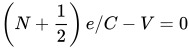
This phenomenon can be understood as follows. Let the potential of the point be set to V using an additional electrode, and N additional electrons will be on the point. Let C be the capacity of a point. Then, to plant an additional electron on a point, you need to do work
![{\ displaystyle {\ frac {(N + 1) ^ {2} e ^ {2}} {2C}} - {\ frac {N ^ {2} e ^ {2}} {2C}} - eV + \ delta \ epsilon = e \ left [\ left (N + {\ frac {1} {2}} \ right) e / CV \ right] + \ delta \ epsilon,}](https://wikimedia.org/api/rest_v1/media/math/render/svg/220c42ad91cb0c2d10b2ba191a21caa0820911d8)
Where - additional energy due to the difference in the Fermi level of electrons at the point and in the contacts. With a certain selection of the gate voltage and the relative positions of the Fermi levels of the contacts and the points, the relation , , that is, the potential barrier for the transition of an electron from a contact to a point disappears. This is observed as a peak in the conductivity of the point. Due to the final temperature of the point, the Fermi level in the contacts is slightly blurred, this makes the width of the peaks of the Coulomb blockade finite. That is, usually the peak width in units of eV is of the order of the point temperature in units .



See also
- Single electron transistor
Notes
- ↑ Goldin L. L., Novikova G. I. Quantum Physics. Introductory course. - M: Institute for Computer Research, 2005