Operation Bolo [1] ( eng. Operation Bolo ) - US Air Force operation during the Vietnam War , aimed at eliminating the threat from the North Vietnamese MiG-21 fighters. During the operation, U.S. aviation conducted one of its most successful air battles in the entire war.
| Operation Bolo | |||
|---|---|---|---|
| Main Conflict: Vietnam War | |||
 F-4C Phantom II 8th Tactical Fighter Air Wing Static Exposure at Pacific Museum | |||
| date | January 2, 1967 | ||
| A place | North Vietnam | ||
| Total | American Air Force Victory | ||
| Opponents | |||
| |||
| Commanders | |||
| |||
| Forces of the parties | |||
| |||
| Losses | |||
| |||


Content
Background
Starting in March 1965, US aircraft carried out regular bombing of the Democratic Republic of Vietnam as part of the Rolling Thunder campaign. During the first year, the basis of the air defense system of the DRV was barreled artillery and machine guns, while anti-aircraft missile systems and interceptor fighters played a fairly small role. However, the constant support from the USSR made it possible to strengthen the country's air defense and air forces. Since mid- 1966, the actions of North Vietnamese aviation, which received modern MiG-21 fighters , were activated. At the end of the year, the DRV Air Force command began practicing the interception of American aircraft at distant approaches to targets, which made it possible to inflict tangible casualties on the F-105 Thunderchief strike.
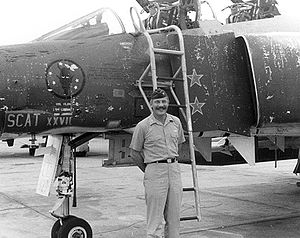
In the fall of 1966, Colonel Robin Olds , ace of World War II (12 air victories) became the new commander of the 8th tactical fighter wing of the US Air Force at Ubon Air Base ( Thailand ). He was worried about the increase in casualties in aerial combat and concluded that it was necessary to strike at enemy aircraft. Until this time, the fight against the DRV Air Force was considered a secondary task because of their low activity. It was impossible to destroy MiGs on earth because the ban on bombing Vietnamese airfields continued: the top political leadership of the United States was afraid that strikes on airfields would lead to casualties among Soviet military personnel and to a sharp escalation of the war, right up to direct intervention by the USSR. There was only one way out: to engage enemy aircraft in air combat on conditions favorable to the American side.
The operation was codenamed Bolo. Its essence was that F-4 Phantom II fighters had to imitate the behavior of the F-105 strike group, which represented an easier target for MiGs. The simulation included the use of standard flight routes to the target, maintaining the characteristic speed and altitude, the use of Phantom crews to use the terminology of Thunderchiff pilots during radio communications. Thus, MiGs had to fall into the trap, attacking fighters ready for battle instead of sufficiently vulnerable attack aircraft. By this time, North Vietnam had only one MiG-21 fighter regiment (921st), based at the Fuk Yen airfield in the Hanoi area.
Conduct
The operation was scheduled for January 1, 1967 , but was postponed for a day due to bad weather. On January 2, a decision was made to carry out the operation, despite heavy cloud cover. The main task was assigned to 28 F-4C aircraft from the 8th wing, personally headed by Olds: they were supposed to imitate the F-105 strike group over Fook Yen. The same number of Phantoms from the 366th tactical fighter wing ( Danang , South Vietnam ) had the task of blocking other airfields from the coast and intercepting North Vietnamese MiGs while trying to escape to China [2] . To ensure the operation involved “ wild caresses ” of F-105, early warning radar aircraft EC-121 , electronic warfare aircraft EB-66 , fighter cover aircraft F-104 . The boldness of the operation also consisted in the fact that not a single pilot of the 8th wing had the experience of real air combat before that moment: the Vietnamese MiGs simply avoided fighting the F-4, preferring to hunt for the F-105 safe for themselves.
The American plan worked. The MiG-21 was raised to intercept the enemy, and the Phantom pilots, using numerical superiority and a surprise factor , entered into a maneuverable air battle with them, in which only 12 F-4 managed to take part. According to American data, 7 enemy planes were shot down reliably and 2 presumably, there were no own losses. Vietnamese data confirm the loss of 6 MiG-21s (one of which was incurred as a result of fuel consumption by an airplane) and 1 pilot, and also acknowledge the fact that Americans have no losses [3] . For the 921st regiment, it was a hard, but not the last blow: on January 6, the US Air Force set up a new trap and shot down two more MiG-21s.
Vietnamese version of the battle
According to Vietnamese sources, on January 2, 1967, only two MiG-21PFL units entered the battle. The first link in the composition: Wu Ngok Dinh, Nguyen Duk Tuan, Nguyen Dan Kin and Bui Duk Nho took to the air at 13:56 Hanoi time. Having broken through layered clouds, the planes came under enemy attack and were shot down, all four pilots managed to escape using catapults. After the loss of the first four MiGs, the second link consisting of Nguyen Ngok Do, Dan Ngok Nya, Dong Van De and Nguyen Van Kok took to the air. This time, the Vietnamese pilots were more attentive and, noticing an enemy attack, performed a missile defense . As a result, only one plane was shot down, and its pilot Nguyen Ngok Do successfully ejected. The three surviving MiGs landed at the Noi-Bai air base. Total losses per day amounted to 5 MiG-21PFL: 1812, 1908, 1909, 2106, 2206. [4] [5]
Summary
Having lost half the MiG-21 available in a few days, the DRV Air Force command was forced to reconsider the tactics of using fighter aircraft. The personnel of the 921st regiment was demoralized by what happened. In general, it took at least two months to make up for the losses: until the spring of 1967, the 921st regiment remained unworkable, the activity of North Vietnamese aviation almost stopped. The air battle of January 2, 1967 was one of the largest in the entire war. According to official American data, the same major successes were later achieved only twice: in May 1967 and in May 1972 . The only consolation for the Vietnamese was the salvation of all the pilots shot down that day.
Victories
Listed below are all seven crews that were officially counted for one victory in battle on January 2, 1967.
| # | Pilot | Weapons operator | Weapon |
|---|---|---|---|
| one | 1st Lieutenant Ralph Vetterhan | 1st Lieutenant Jerry Sharp | AIM-7 |
| 2 | Captain Walter Radeker III | 1st Lieutenant James Murray III | AIM-9 |
| 3 | Colonel Robin Olds | 1st Lieutenant Charles Clifton | AIM-9 |
| four | Captain Everett Raspberry Jr. | 1st Lieutenant Robert Western | AIM-9 |
| five | Major Philippe Combise | 1st Lieutenant Lee Dutton | AIM-7 |
| 6 | captain john stone | 1st Lieutenant Clifton Dannegan Jr. | AIM-7 |
| 7 | 1st Lieutenant Lawrence Glynn Jr. | 1st Lieutenant Lawrence Carey | AIM-7 |
Confirmed by the Vietnamese side losses:
| # | Pilot | Regiment | Description |
|---|---|---|---|
| one | Wu Ngok Dinh | 921st IAP | Shot down, the pilot successfully ejected |
| 2 | Nguyen Duc Thuan | 921st IAP | Shot down, the pilot successfully ejected |
| 3 | Nguyen Dang Qin | 921st IAP | Shot down, the pilot successfully ejected |
| four | Bui Duk Nude | 921st IAP | Shot down, the pilot successfully ejected |
| five | Nguyen Ngok Do | 921st IAP | Shot down, the pilot successfully ejected |
Notes
- ↑ Bolo is a type of machete .
- ↑ American pilots were forbidden to invade China's airspace.
- ↑ Diego Zampini. Robin Olds: Mastermind of Operation Bolo
- ↑ Lịch sử dẫn đường Không quân (1959-2004)
- ↑ Lịch sử Trung đoàn không quân 921
Links
- Victories and Losses // Combat Application of the MiG-21 in Vietnam (translation of the book: Istvan Toperczer. Mig-21 Units of the Vietnam War)
- Diego Zampini. Robin Olds: Mastermind of Operation Bolo
- d / f "Air battle over Vietnam" from the series "Air aces of war" ( National Geographic Channel )