Squirrels or amphisbens ( lat. Amphisbaenia - from other Greek. Αμφίς - "from both sides" and βάινο - "I go") - a group of scaly reptiles , until recent molecular studies were considered a separate suborder along with lizards and snakes. Amphisbens are now assigned to the same scaly group as real lizards ( Lacertidae ) and teiids ( Teiidae ). [1] The group consists of 184 species [2] (as of January 2014), grouped into 23 genera, included in 6 families identified to date [3] .
| Two-way | |||||||||||||||||||||||||||||||
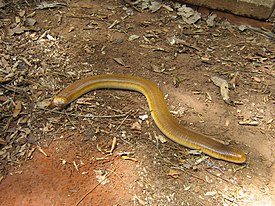 Amphisbaena alba | |||||||||||||||||||||||||||||||
| Scientific classification | |||||||||||||||||||||||||||||||
|---|---|---|---|---|---|---|---|---|---|---|---|---|---|---|---|---|---|---|---|---|---|---|---|---|---|---|---|---|---|---|---|
| |||||||||||||||||||||||||||||||
| International scientific name | |||||||||||||||||||||||||||||||
Amphisbaenia Gray , 1844 | |||||||||||||||||||||||||||||||
| Families | |||||||||||||||||||||||||||||||
| |||||||||||||||||||||||||||||||
| Area | |||||||||||||||||||||||||||||||
 Spread | |||||||||||||||||||||||||||||||
Sizes range from 72 centimeters for Amphisbaena alba Linnaeus, 1758 to 9-12 centimeters for Chirindia rondoense (Loveridge, 1941) . Bipartites are found in South America , Mexico , Africa, and West Asia . One species also penetrate southern Europe and the southeastern United States .
The most numerous genus of Amphisbaena itself includes over 100 species.
Content
Appearance and structure
The body is vermiform, cylindrically elongated, covered with a solid horny film, encircled by narrow transverse rings that intersect with more or less obvious longitudinal grooves. Each ring is divided into regular rectangles or squares, in appearance somewhat resembling scales. The bipartite is distinguished by strong ossification of a skull that is variable in shape, devoid of cranial arches and columnar bones characteristic of lizards.
A few pleurodont or, less commonly, acrodont teeth are located only in the front of the jaw and vary in shape and size. The embryonic egg tooth does not disappear with age, but, increasing in size, remains for life.
Unlike most snakes and legless lizards that have a single right lung , two-legged developed one left.
Large horny shields cover only the flattened head of the bipedal, which also acts as an organ for digging. In accordance with this purpose, in some species the head is keeled elongated or stupidly rounded at the end, in others it is spade-like flattened in a vertical or horizontal plane, or it is pointed like an iron. In the latter case, the front end of the muzzle is located at the level of the abdomen or, to one degree or another, is turned up. Special studies have shown that a similar head shape in combination with specialized neck muscles is an ideal burrowing device designed for the different density of the soil on which the dweller lives .
Most species lack external extremities; only a few representatives of the North American genus Bipes retain short front legs with toes reduced to some extent. The back half of the body of most dyadoks smoothly passes into a short, more or less stupidly rounded tail , which looks very much like the head end. This similarity is also underlined by the fact that in case of danger, many dvukhhodki sharply pull their tail up, distracting the attention of the predator from a fixed, easily vulnerable head. Due to this, the indigenous people of some countries call the two-legged two-headed snakes. Some burrowing snakes and worms are also called double-headed snakes for the same reason. In some species, the tail is capable of twisting and has considerable tenacity.
Movement
Numerous transverse rings encircling the body of two-walkers throughout, give them an amazing resemblance to a large earthworm , even more intensified when the animal moves. At the same time, distinct waves run through the entire body of the dvukhka from front to back, formed by the rapid movements of successively approaching and diverging trunk rings. It seems that the body of the animal is lengthening, then shrinking in length, like the way it happens in a crawling worm. However, in reality, the forward movement of the two-wheeler comes from the fact that traveling waves, encountering the slightest roughness of the substrate , in total create forces pushing the animal in the opposite direction.
The possibility of this type of movement, unknown in other vertebrates, is explained by the fact that, unlike lizards and snakes, the skin of two-legged animals loosely adheres to the body, forming a movable skin sac that can be folded along the lines of the rings surrounding the body. In a similar unusual way, the animal is able to move forward and backward equally easily, which explains the name "amphisbene" itself, which comes from two Greek words literally translated as "moving in both directions." It is also clear that the other name of these reptiles, “two-walkers,” is widely spread in the literature.
This feature plays an important role in the movement of bipedal boats in the narrow underground passages laid by them, where they are deprived of the opportunity to turn around. On the surface of the soil, amphisbens can also move in the usual serpentine way, bending the body to the sides, and some of them are able to wave the body in a vertical plane, like fairy-tale dragons .
Lifestyle
Like many other burrowing reptiles, the eyes of two-steps are hidden under the skin through which they are visible in the form of small dark spots. The animal is therefore capable of only distinguishing light from darkness and, possibly, distinguishing only the general outlines of objects. But they have highly developed organs of smell , touch and taste , as well as a special chemical feeling that helps them often detect prey - various soil invertebrates - even behind a small layer of soil.
High specialization in the underground way of life has led to the fact that dvuhhodki rarely appear on the surface, spending most of their life underground or in the nests of ants and termites , which they mainly feed on. It is noteworthy that even the ferocious stray ants, who devour everything in their path, are tolerant of the two-walkers living in them. South American Indians consider amfisben ant queens who administer the anthill.
Reproduction
Most species lay round eggs coated with a thin, sometimes translucent, shell. In the masonry 2-6 pieces. Clutches are done in anthills or in burrows; cases of finding eggs in the same burrow together with the female laying them down are known. This suggests a concern for the offspring. Several ovoviviparous species, Loveridgea ionidesii and Monopeltis capensis, have been identified .
See also
Legless amphibians
Notes
- ↑ Pyron RA, Burbrink FT, Wiens JJ A. phylogeny and revised classification of Squamata, including 4161 species of lizards and snakes // BMC evolutionary biology. - 2013. - No. T. 13 No. 1 . - S. 93 .
- ↑ The Reptile Database: Amphisbaenia
- ↑ The Reptile Database: Higher Taxa in Extant Reptiles - Amphisbaenia
Literature
- Gilyarov M.S. , Baev A.A. , Vinberg G.G., Zavarzin G.A. et al. Biological Encyclopedic Dictionary. - M .: Soviet Encyclopedia, 1986.- S. 24.
- Kudryavtsev S.V., Frolov V.E., Korolev A.V. Terrarium and its inhabitants. - M .: Forest industry, 1991. - P. 87—89. - ISBN 5-7120-018-2.