Ganesha , or Ganapati ( Skt. गणेश ; Gaṇeśa IAST ; pronunciation ) - in Hinduism, the god of wisdom and prosperity. One of the most famous and revered gods of the Hindu pantheon .
| at the birth of Vinayak, then acquired the name of Ganesha, Ganapati | |
|---|---|
| Skt. गणेश | |
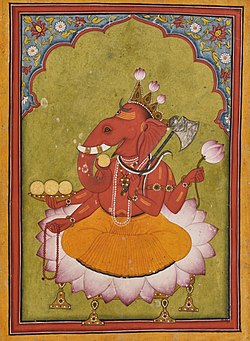 Ganesha, Berlin Museum | |
| god of wisdom and prosperity | |
| Mythology | |
| Name interpretation | Lord of the Ghana |
| Latin spelling | Gaṇeśa IAST |
| Floor | male |
| Occupation | the lord of the Ghana (army-retinue of Shiva), in his retinue there are also lies - sorcerers, diviners and sorcerers |
| Father | Shiva |
| Mother | Parvati |
| Brother | Skanda |
| Sister | Ashokasundari |
| Spouse | Siddha or Buddhi |
| Children | |
| Character traits | A full man with an elephant head and one tusk, the number of hands is from 2 to 32 |
| Related concepts | intelligence, reason, success, prosperity |
| Attributes | In Bengal, tied with a banana tree |
| Wahana | rat |
| Mantra | Ganesha sahasranama |
| Origin | see probable origin |
| Mentions | Rigveda , Atharva Veda , Ganapati Upanishad , Ganesha Purana , Mudgala Purana , Ganesha Sahasranama |
Often before his name is added the respectful prefix Sri- . One popular way to worship Ganesha is to chant the Ganesha-sahasranama ( Skt. गणेश सहस्रनाम , “the thousand names of Ganesha”), each symbolizing a separate aspect of God, and Ganapati-sukta .
Content
Family
The son of Shiva and Parvati . At the same time, the Puranic myths contradict each other, describing the birth of Ganesha. In some cases, it is said that Ganesha was created by Shiva, in others - it was created by Parvati, in the third - jointly by Shiva and Parvati. Variants are known in which Ganesha appeared to the world in an incomprehensible way and was discovered by Shiva and Parvati, who adopted him.
Brother Ganesha - Skanda ( Kartikeya , Murugan ). In the northern part of India, it is generally accepted that the eldest of the brothers is Skanda. In the southern part, the birth championship is attributed to Ganesha. Skanda was revered as an important warlike deity from the 5th century BC. e. according to the VI century AD e. Mass worship of Ganesha began after the sunset of the cult of Skanda.
The opinions of myths also differ regarding the marital status of Ganesha. Some myths attribute Ganesha to the brahmacharyas who could not marry. This opinion is widespread in the south of India and, in part, in its northern part.
According to another version, Ganesha is associated with such ideas as Buddhi (intellect, mind), Siddhi (success) and Riddhi (prosperity). Sometimes these ideas (concepts) were personified in the deities of the same name, which were recognized by the wives of Ganesha.
Another option claims that the wife of Ganesha was the goddess of culture and arts of Saraswati or the goddess of luck and prosperity Lakshmi .
A version circulated in Bengal connects Ganesha with the banana tree of Cala Bo .
Images
Depicted as a complete man with an elephant head and one tusk, sitting on his wahana - a rat or a mouse [1] [2] [3] (according to other versions, a shrew [4] or even a dog [5] ). The number of hands varies from two to thirty-two, depending on the appearance.
Probable Origin
The earliest references to Ganapati are found in two hymns of the Rigveda - 2.23.1 and 10.112.9. The first sukta consists of 19 verses (ricks) written in the size of a jagati (except for 15 and 19, which are written in trishtubh). The Sukta glorifies the deities Brahmanaspati and Brihaspati , who are usually regarded as the names of one deity, but such authoritative commentators as Yaska, Shaunaka and Sayana clearly distinguish. In general, there may be little doubt that the now-known Ganapati grew out of Brihaspati - Brahmanaspati of this sukta (Gartsamanda-sukta), but the idea is undoubtedly Vedic :
gaṇānāṃ tvā gaṇāpatiṃ havāmahe kaviṃ kavīnāmupamaśravastamam।
jyeṣṭharājaṃ brahmaṇāṃ brahmaṇaspata ā naḥ śṛṇvannūtibhiḥ sida sādanam।
We call you, O Ganapati Ghana (leader of the heavenly forces)!
Oh, Brahmanaspati of brahmanas (leader of brahmanas), Poet among poets (in the highest sense - as a creator among creators)!
In riches exceeding all known, the most sparkling among creatures!
Listen to our prayers, come with your blessing and sit down!
Commentators give many details specifying the leader of the heavenly armies to known aspects - in particular Indra and Agni , which are often revered in the Vedas , as well as Rudra ( Taittiriya-samhita and Vajasaneya-samhita describe Ganapati as Rudra). It is curious that in the same place, as well as in the Shatapatha Brahman , Agni is described as the giver of everything, having a big belly.
Ganapati is interestingly served in the later Atharva Veda . Some deities who were not regarded as important and influential in the Rig Veda began to play a much more significant role in the Atharva Veda. Mother Earth - Prithvi becomes one of the central aspects, and Brahmanaspati (Brihaspati) appears here as the associated Vachaspati - the patron of sacred speech. He is the first born among the gods, associated with him is the number 21 (5 Mahabhuts , 5 Tanmatra, 10 Indriyas and Karmendriyas and Prana as a life force). This group of 21 is called Ghana or the Gates, and Vachaspati is called Ganapati or Vratapati .
He and Mahad Yaksha (the great mystical light), existing in the center of the world, and all the gods as branches of this central tree of the world.
Vachaspati also appears as the leader of the Yakshasas. And these Yakshasas are not at all those demons with whom a later interpretation of mythology tries to present them. Yaksha is a wonderful, exceptional, powerful and worshipable spirit. In his retinue there are also lies - sorcerers, soothsayers and sorcerers, consuming psychotropic drugs and leading a lifestyle that is at variance with the laws. All this wonderful brethren subsequently migrated to the retinue of Ganapati as the son of the god Shiva. And actually, only from the Ganapati Upanishad do descriptions of the elephant-faced appearance of Ganapati appear.
Ganesha Holiday
Every year in India, a festival dedicated to Ganesha is held - Ganesha-chaturthi , or, in other words, the "Ganesha Festival". The celebration begins on the fourth day of the arriving moon of the month of Bhadrapad (it falls between August 19 and September 20) and lasts ten days. Colorful processions with statues ( idols ) of the deity gather thousands of crowds of pilgrims. After offering to Ganesha, these statues are stoked in reservoirs, thus symbolizing the natural cycle of birth and death. [6] [7]
Legends
- According to one legend, the father of Ganesha was deprived of his father by the god Shiva. Ganesha did not let his father, inflamed with a passion for his wife, into the chambers where she was. Then Shiva angrily stripped his head, throwing it so far that no one sent could find her. The goddess was angry and refused to admit Shiva to him until he corrected the situation. To reassure his wife, Shiva sewed the head of a nearby elephant to Ganesha. According to another version, on the birthday of Ganesha they forgot to invite the god Shani (personification of the planet Saturn ), and he, appearing without an invitation, incinerated the baby's head with anger. Then Brahma advised Shiva to sew the baby the head of the very first being that he met. This creature was the elephant of Indra - Ayravat . According to oral Indian myths, Saturn (Shani), being one of the relatives, was invited to honor the newborn son of Shiva: the mother of Ganesha, Parvati , certainly wanted to show the powerful relative a beautiful baby. With a deadly look that he was unable to control, Shani refused the invitation for a long time, but he was still persuaded. The very first glance of Shani on the son of Shiva incinerated his head. According to another version, the head just fell off.
- Regarding the loss of one tusk, there are also several versions of legends. According to one of the legends of Ganesha, fighting the giant Hajamukha , he himself broke his tusk and threw it at the enemy. The tusk had magical powers, and Hajamukha turned into a rat, then becoming a Ganesha mount . Another legend says that one day Shiva was visited by the sage Parasurama (avatar of Vishnu ), but Shiva was sleeping at that time, and Ganesha refused to let him in. Then Parasurama threw his ax into Ganesha and cut off his right tusk. There is also a legend that, recording Mahabharata under the dictation of Vyasa , Ganesha broke his pen and, not wanting to miss a word, broke a tusk and began to write to them.
- Ganesha is also the ruler of the Ghana (the army of Shiva's retinue). There is a legend that Ganesha and Skanda (both are the sons of Shiva) fought for this post, and in the end Shiva decided that he would be the lord of the Ghana, who would run around the Galaxy faster. Skanda immediately took off and began his long journey, and Ganesha walked around his parents in a hurry in a circle, because it was Shiva and Parvati who were the personification of the Galaxy. And after that, Ganesha received the nickname "Ganapati" (the lord of the Ghans).
See also
- Ganapati upanishad
- Ganesha Purana
- Ganesha sahasranama
- Mudgala purana
- Ganesha chaturthi
Notes
- ↑ Dubyansky, 1996 , p. 138.
- ↑ Grinzer, 1991 , p. 265.
- ↑ Dowson J. A Classical Dictionary of Hindu Mythology and Religion, Geography, History and Literature. - London, 1928 .-- S. 107.
- ↑ Ganesh's Shrew, Durbar Square
- ↑ Statue of the dog mooshika at the Rubin Museum
- ↑ Ganesha Chaturthi festival in India
- ↑ Colorful Ganesha Chaturthi festival in India
Literature
- in Russian
- Grinzer P. A. Ganesha // Myths of the World / Ed. S. A. Tokarev . - M .: Soviet Encyclopedia , 1991.- T. 1. - S. 265.
- Glushkova I.P. The common Indian god Ganesha // Hinduism Tree / Otv. ed. I.P. Glushkova. - M .: Publishing company "Eastern Literature" RAS , 1999. - S. 283-312. - 559 p. - (Culture of the peoples of the East). - 2500 copies. - ISBN 5-02-018032-7 .
- Dubyansky A.M. Ganesha (Ganapati) // Hinduism. Jainism. Sikhism / Ed. M.F. Albedil and A.M. Dubyansky . - M .: Republic , 1996 .-- S. 138-139. - 576 p. - ISBN 5-250-02557-9 . Archived on September 18, 2014. Archived September 18, 2014 on Wayback Machine
- in other languages
- Brown, R. (1991), Ganesh: Studies of an Asian God , Albany: State University of New York Press , ISBN 0-7914-0657-1 , < https://books.google.com/books?id=oF -Hqih3pBAC >
- Doniger W. Ganesha // Encyclopædia Britannica , 06/03/2015
- Getty, A. Gaņeśa: A Monograph on the Elephant-Faced God. - 1992 reprint. - Clarendon Press , 1936. - ISBN 81-215-0377-9 .
- Grimes, JA (1995), Ganapati: Song of the Self , SUNY Series in Religious Studies, Albany: State University of New York Press , ISBN 0-7914-2440-5 , < https://books.google.com/books ? id = duOe-jM8kRIC >
- Krishan, Y. (1981–1982), " The Origins of Gaṇeśa IAST ", Artibus Asiae (Artibus Asiae Publishers). - T. 43 (4): 285-301 , DOI 10.2307 / 3249845
- Krishan, Y. (1999), Gaņeśa: Unravelling An Enigma , Delhi: Motilal Banarsidass Publishers , ISBN 81-208-1413-4 , < https://books.google.com/books?id=BKoyRJxj9jUC >