Birch ( lat. Bétula ) - a genus of deciduous trees and shrubs of the Birch family ( Betulaceae ). Birch is widespread in the Northern Hemisphere ; in Russia is one of the most common tree species. The total number of species is about a hundred [3] or slightly more [4] . Many types of birch are widespread and most important forest-forming species, largely determining the appearance and species composition of deciduous and coniferous-deciduous (mixed) forests in temperate and cold parts of Eurasia and North America .
| Birch | |||||||||||||||||||||
|---|---|---|---|---|---|---|---|---|---|---|---|---|---|---|---|---|---|---|---|---|---|
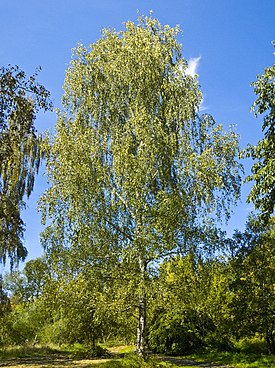 Drooping birch ( Betula pendula ). New Marburg Botanical Garden. Hesse, Germany . Photo 9/22/2007 | |||||||||||||||||||||
| Scientific classification | |||||||||||||||||||||
| |||||||||||||||||||||
| International scientific name | |||||||||||||||||||||
Betula L. , 1753 | |||||||||||||||||||||
| Synonyms | |||||||||||||||||||||
See text | |||||||||||||||||||||
| Type view | |||||||||||||||||||||
Betula alba L. [2] , nom. utique rej. = Betula pubescens Ehrh. - Birch fluffy | |||||||||||||||||||||
| Kinds | |||||||||||||||||||||
| |||||||||||||||||||||
| Area | |||||||||||||||||||||
| |||||||||||||||||||||

Many parts of birch are used in the economy: wood , bark , birch bark (the surface layer of the bark), birch sap . The kidneys and leaves are used in medicine : extracts from the kidneys and leaves as a diuretic, bactericidal, wound healing and antipyretic, and the oil extract from birch buds as a dermatological agent. Some species are used to create shelterbelts, as well as in decorative gardening .
Birch occupies an important place in the culture of the Slavs , Scandinavians , Finno-Ugric and other peoples.
Content
- 1 Name
- 2 Biological Description
- 3 Distribution and environmental status
- 4 Chemical composition
- 5 Economic value and application
- 5.1 Wood
- 5.2 Tar
- 5.3 Birch bark
- 5.4 Birch sap
- 5.5 Medical use
- 6 Taxonomy
- 6.1 Species of the genus "Birch"
- 7 Cultivation
- 7.1 Agricultural technology
- 7.2 Varieties
- 8 In culture and ethnography
- 8.1 Birch in paganism
- 8.1.1 Scandinavians and Finno-Ugric peoples
- 8.1.2 Celts
- 8.1.3 Slavs
- 8.1.4 Turkic peoples
- 8.2 Folk omens
- 8.3 Russian proverbs, sayings, riddles and jokes about birch
- 8.4 In the visual arts
- 8.5 In heraldry
- 8.6 In the culture of Slavic peoples and Russia
- 8.7 In the culture of other nations
- 8.8 In toponyms
- 8.1 Birch in paganism
- 9 notes
- 10 Literature
- 11 Links
Title
The Latin generic name was borrowed from the Gallic language [5] .
The Russian word birch comes from Praslav. * berza , dating back to great-ie. * b h erĝos (compare lit. beržas , Latvian. bērzs , Ossetian bærž , other indian bhurjah , other English beorc , English birch , German Birke , Dutch berk , Norwegian bjørk , Swedish. björk ), from the root * b h erĝ- "glow, whiten."
In Slavic languages : Belor. Byaroza , Ukrainian birch , bulg. birch , serbochor. breza , slovennaya . brė́za , Czech bříza , Polish brzoza , v. puddles. brěza , n. brjaza [6] . Names in other languages: fr. bouleau , yakut. hutsҥ . For more information about the genus names in other languages, see the Betula page of the Wikipedia project .
The word birch is related to the words birch bark ( lat. Ulmus ), birch bark .
Biological Description
Botanical illustration from Köhler's Medizinal-Pflanzen , 1887
Most species of birches are trees up to 30 and even 45 m high, with a trunk girth up to 120-150 cm, some species are shrubs from large to small, up to creeping, barely rising above the ground. All representatives of the genus are monoecious dioecious wind-pollinated (anemophilous) plants [8] .
The root system of birches is powerful, depending on the type and conditions of growth, it is either superficial or, more often, goes obliquely inland. The root root of the seedling dies off very quickly, but the lateral roots develop powerfully and are rich in thin, fibrous roots. Birch grows slowly only in the early years. Then, on the contrary, it begins to grow rapidly, and this ensures its victory over competing grassy vegetation .
The bark of most birches is white, yellowish, pinkish or reddish-brown, in some species gray, brown or even black. The cell cavity of the cork tissue on the trunks is filled with a white resinous substance - betulin , which gives the cortex a white color [9] . The outer part - birch bark - is usually easily peeled off with ribbons. In old trees, the lower part of the trunk is often covered with a dark crust with deep cracks.
Birch leaves are alternate, whole, serrated along the edge, ovate-rhombic or triangular-ovoid, monosymmetric, with a wide wedge-shaped base or almost truncated, smooth, up to 7 cm long and 4 cm wide, turn yellow before falling. Young leaves are sticky. The venation of the leaf blade is perfect cirrus (cirrus): the lateral veins end in the teeth [8] .
The kidneys are alternating, sessile, covered with helically arranged, often sticky scales; lateral kidneys slightly spaced.
Male flowers in complex inflorescences - serykovidny thyres - appear in the summer on tops of elongated shoots, usually 2-3; at first they are erect and green, then gradually turn brown. Their length is 2–4 cm. Male catkins consist of numerous thyroid stalked integumentary scales fused with a central flower stem, expanded to the apex, equipped with two smaller scales from below and containing 3 flowers on the inside. Each flower is also covered with a scaly perianth , in which the fertilization organs, the stamens, are placed. Outside, the entire earring is covered with a moisture-impervious resinous substance. In this form, catkins winter. In the spring, in March - May (depending on the climate ), the stem of the male catkins lengthens, as a result of which the flakes surrounding the flower open, and between them yellow stamens become noticeable, abundantly secrete pollen . At this time, the earrings, which stood straight ahead, first bend over and then completely hang. Female catkins grow on tops of shortened shoots (brachyblasts) developing from the lateral buds of last year's shoots, and therefore always sit on the side of the branch. Along with the blooming of male catkins, leaf buds and female catkins bloom. During flowering, they are always shorter and narrower than masculine, which immediately fall after pollination. Bracts (fruit) scales of female earrings deeply three-lobed; lateral lobes usually shorter than average. Female flowers (that is, only the ovary ) sit three under each bract of scales; in each ovary there are two hanging ovules , one of which dries by pollination, and the second grows, occupying the entire cavity of the ovary. The female fertilized earring lengthens at this time, often a leg grows, and it itself thickens due to an increase in the volume of scales, gradually turning into an oval or oblong-cylindrical "cone". After fruit ripening, which occurs quite soon - depending on the climate, in July - September - the fruit earring (cone) crumbles and only the core remains from it. Flower formula : and [10] .
The fruit is a flattened lenticular nut carrying two dried columns on top and surrounded by a more or less wide thin-skinned membranous wing. Fruits sit three in the axils of three-lobed fruit (bract) scales. Seeds are very light - there are 5,000 seeds per gram. Easily carried by the wind (at a distance of 100 m from the mother plant [8] ), the fruits do not open.
Distribution and ecological status
Many types of birch are widespread and most important forest-forming species, largely determining the appearance and species composition of deciduous and coniferous-deciduous ( mixed ) forests in temperate and cold parts of Eurasia and North America . There are shrubs among birches, the most famous of which is the dwarf birch ( Betula nana ) is common in the tundra of Europe and North America [11] and the mountain tundra of Siberia . It does not reach 1 m in height. In the glacial and postglacial periods, this birch was distributed much further south, now it is found there only in the swamps as a relic .
Most birches are very frost-resistant, do not suffer from spring frosts, tolerate permafrost , penetrate far beyond the Arctic Circle or form the upper border of a forest in the mountains (for example, birch woodlands in the Caucasus ). Birch trees of subtropical regions (Himalayan-Chinese, some Japanese and American river birch ( Betula nigra )) are more demanding for heat [12] . The most southern and thermophilic species of birch on our planet is the alder birch ( Betula alnoides ), which enters the mountainous regions of the monsoon tropics of Southeast Asia [13] [14] .
To the richness of the soil, birch is not demanding. Species of birch grow on sandy and loamy , rich and poor, moist and dry soils. It is found on the moist banks of rivers and seas, in swamps, in marshy tundra , on dry rocky slopes, in sultry dry steppes . So, for example, Birch Radde ( Betula raddeana ) forms forests covering gorges in the mountain-forest belt in the mountains of Dagestan [12] .
Most birches are photophilous, although there are quite shade-tolerant ( Ribbed birch ( Betula costata ), Woolly birch ( Betula lanata ) and Allegany birch ( Betula alleghaniensis )) [12] .
Many types of birch are the pioneers of the settlement of felling, burnt areas , wasteland and outcrops (such is the Betula pendula ): in these places, pure birch plantations (secondary forests) are often grassy, therefore, birch is often referred to as soil-improving species [15] . In the future, the composition of the stand changes: the birch is replaced by spruce , as spruce can exist under a relatively bright birch canopy, and young birches are shaded by spruces and die (see Succession ) [12] .
In the forest-steppe in humid places in saucer-shaped depressions, the birch (often together with aspen and occasionally with willow ) forms small forests called spikes . Splits are characteristic of the forest-steppe of Western Siberia and are found on the Oka-Don plain [16] .
The genus Birch in the collections of the botanical gardens of Russia as a whole is represented by 92 taxa , exclusively in the collections of open ground. The largest collection of the genus is in the Main Botanical Garden of the Russian Academy of Sciences [17] .
According to various sources, the life expectancy of birch is 100-120 years [18] , 150 (300) years [19] , 100-150 years, individual trees survive to 400 years or more [12] .
Among the others living on the birch are the caterpillar of the linden- hawthorn , the birch moth , and the raspberry-froth . The stag beetle - the largest beetle in Europe - lives in birch wood and other deciduous trees. May beetles feed on birch leaves, and in some years, when their numbers are especially high, they can cause serious harm to trees [12] .
Mycorrhiza species of fungi are characteristic of birch groves and forests mixed with birch, many of which live in the community exclusively or mainly with birch. The most common and known of them [20] :
- common boletus and some other species of the genus Obabok - marsh boletus, pink boletus ;
- white birch mushroom - refers to the most valuable edible mushrooms ;
- some milkers (a black lump , a pink wave ), certain types of russula - russula green , russula yellow , russula food .
Damaged trees can be affected by parasitic fungi - for example, a mantle ( Inonotus obliquus ), which is rarely found on other trees. Preparations obtained from chaga - a sterile form of mowed tinder fungus - are used in traditional and official medicine as adaptogens .
Birch trees are also characterized by specific species of fungi - destroyers of dead wood ( saprotrophic ), which play a crucial role in the process of self-cleaning of forests from dead wood, windbreaks, etc. [21] Of these, birch tinder ( Piptoporus betulinus ) and birch lenzites are common in birch groves ( Lenzites betulina ), the first of which is not found on wood of other species, and the second usually prefers birch [22] .
Chemical Composition
Most types of cortex contain triterpenoid betulin , one of the few white organic pigments . Its content in the bark of ribbed birch ( Betula costata ) exceeds 5%, in the birch bark ( Betula pendula ), the content of betulin reaches 14%, and in the bark of Manchurian birch ( Betula mandshurica ) - up to 27%. Of the species growing in Russia, the maximum content of betulin is observed in the bark of fluffy birch ( Betula pubescens ) - up to 44% [23] .
In the buds of birch drooping (as well as fluffy) contains about 3-5% of essential oil , the main components of which are bicyclic sesquiterpenoids . The kidneys also contain resinous substances , alkaloids , ascorbic acid , flavonoids and higher fatty acids [24] .
The leaves contain essential oil, dammaran derivatives, coumarins , tannins and flavonoids [24] .
Economic Significance and Application
- Orthodox birch branches decorate churches and dwellings on the Day of the Holy Trinity [25] .
- Appreciated in decorative gardening for the beauty of the crown and openwork foliage. Sometimes used as a tapeworm in landscape design.
- Leaves give alum yellow dye for wool [26] .
- In beekeeping, birch is important as a dust-bearing plant [27] .
- The birch torch was used in antiquity to illuminate peasant huts - it burns brightly and almost without soot .
- Birch brooms are harvested as livestock feed for the winter.
- Birch gives the best firewood [25] .
Wood
The birch is cut at the age of ripeness of wood - from 40-50 years. Previously, to obtain large good ornamental material, the birch was cut at 60–80 and even sometimes at the age of 100 [12] ; it is suitable for firewood in 40-60 years. Birch is not very suitable for construction, as it soon rots due to the development of the fungus [26] .
Heavy dense birch wood is quite strong, it resists cracking well. The color is white, with a more yellow core. Used for the manufacture of high-quality plywood , skis , small carved toys, butts of firearms . Karelian birch is especially appreciated, which has a very complex texture of wood [12] .
The growths, occasionally formed on the roots, large branches or trunks of birches - cap - in the section have a kind of complex and beautiful pattern. The processed cap has long been used for the manufacture of elegant crafts: caskets , snuff boxes , cigarette cases , decorative furniture parts.
Crash
With dry distillation of birch bark, birch or birch tar is formed [28] .
Birch tar is used in medicine and veterinary medicine, mainly as an anti-inflammatory and antiseptic, it is part of tar soap and various ointments and creams used to treat skin diseases. In leather industry, it is used in the manufacture of yufti [28] . In the old days, they lubricated the hubs of cart wheels to reduce friction .
Birch bark
The upper layer of the birch bark has its own name - birch bark , or birch bark (both spelling and pronunciation are acceptable [29] ).
Due to the presence of resinous substances, birch bark is extremely strong and durable [30] .
Birch bark has long been used in folk crafts for the manufacture of tueski , baskets, boxes, ladles , baskets , other kitchen utensils , simple shoes ( bast shoes ), and served as writing material ( birch bark letter ).
Birch bark is perfectly preserved in river deposits, peat bogs , thanks to which Academician V.L. Yanin discovered in Novgorod a whole treasure of ancient Russian manuscripts.
Many ancient Chinese and Sanskrit texts on birch bark are also known [12] .
In earlier times, birch bark was used for malaria [31] .
The peoples of the North and Far East used birch bark for the manufacture of boats and the construction of dwellings - the plague .
Birch sap
Birch trees accumulate nutrients, including sugar , at the end of the vegetative period. In the spring, with the beginning of sap flow (before the leaves open), these substances begin to rise towards the leaves.
If cuts are made on the trunk at this time, a significant amount of juice will flow out of them (apiary - liquid released from the cut vessels of the wood of the stems or roots of living plants under the influence of root pressure) containing from 0.43 to 1.13% sugar [27 ] . The outflow phenomenon is observed after the first thaws; in the first days, leakage is insignificant, but then gradually increases and, having reached a maximum after some time, begins to decrease gradually, and by the time the buds open, it completely stops. The duration of juice flowing out is several weeks [32] .
Collecting birch sap depletes the tree; moreover, pathogens can penetrate living tissues through wounds on the cortex, the tree can become ill and eventually die. In this regard, after collecting the juice, it is recommended to cover damage to the cortex with var or clay [33] .
Birch sap goes into the preparation of various drinks. A large birch can produce more than one bucket of juice per day. Juice is sometimes canned , acidified with phosphoric acid . One stripped birch sap is used for spring feeding of bees [27] .
Medical use
Birch has traditionally been used for medicinal purposes: infusions from birch buds and leaves as a diuretic , bactericidal, wound healing and antipyretic agent [30] , and an oil extract from birch buds as a dermatological agent.
Methyl salicylate is obtained from the essential oil of cherry birch ( Betula lenta ) (by distillation of the bark and shoots with water vapor ) [24] .
Birch tar is a traditional preservative and disinfectant [30] .
Birch brooms in Russia have traditionally been used for therapeutic and prophylactic purposes in a Russian bath [30] .
It was believed that the smell of birch cures melancholy and helps with the evil eye , and birch sap , collected on special days in March and April, cleanses the blood [34] .
In northern latitudes, birch pollen is sometimes the allergen responsible for seasonal hay fever in people with increased sensitivity [35] .
Taxonomy
Betula L. , 1753, Species Plantarum 2: 982 [36] .
The genus Birch is one of the six modern genera that are part of the Betulaceae family of the order Fagales .
| Department of Flowering , or Angiosperms | ||||||||||||||||
| the order of the bucoliferous | another 58 orders of flowering plants ( APG III ) | |||||||||||||||
| Birch family | seven more families, including Beech , Casuarin and Nut | |||||||||||||||
| clan Birch | five more genera: Hornbeam , Hazel , Alder , Ostriopsis and Khmelegrab | |||||||||||||||
| about a hundred [3] species, including Sagittarius Birch , Fluffy Birch, Ehrman Birch | ||||||||||||||||
Heterotype synonyms [37] :
- Betulaster Spach , 15: 198 (1841).
- Apterocaryon Opiz Lotos. Zeitschrift für Naturwissenschaften 5: 258 (1855).
- Chamaebetula Opiz Lotos. Zeitschrift für Naturwissenschaften 5: 258 (1855).
Species of the genus "Birch"
Representatives of the genus are distinguished by high polymorphism ; different authors look differently at the rank of some taxa that make up the genus. Typically, the number of species is estimated at about one hundred [3] or slightly more than one hundred [4] .
According to The Plant List , the genus has 119 species and hybrids [3] , the most famous of which are:
- Cherry Birch ( Betula lenta ). A view from North America with a shiny reddish-brown or almost black bark.
- Dwarf birch ( Betula nana ). Shrub usually no more than 1 m tall with small rounded leaves; grows in Europe in swamps, in swampy pine forests .
- Low birch, or squat birch ( Betula humilis ). Shrub up to 2 m high with elliptical leaves; grows in Europe along the banks of ponds, in swamps.
- Drooping birch, or warty birch, or dangling birch, or drooping birch ( Betula pendula ). A species widespread in Europe and Siberia ; also found in northern Africa . Bark from snow white to grayish white. The height is usually 10-15 m, sometimes up to 30 m. Young shoots are naked, warty (in contrast to the pubescent birch , in which young shoots are pubescent and without warts).
- Useful birch ( Betula utilis ). View from the Himalayas up to 18 m high with light smooth bark.
- Fluffy birch, or pubescent birch ( Betula pubescens ). In the European part of Russia, it often grows next to a warty birch . How to distinguish these species, see above . It is a nomenclature type .
- Black birch ( Betula nigra ). View from eastern North America . In young trees, the bark is white and smooth, in older ones it is dark, wrinkled. Presumably Ancestral Species [38]
- Erman's birch, or stone birch ( Betula ermanii ). It is found in Kamchatka , Sakhalin , on the shores of the Sea of Okhotsk . It is called stone for extremely hard, dense and heavy wood that sinks in water.
Cultivation
Agricultural Engineering
In Russia, the best growth of birch plantations is observed in the northern and middle regions, on moderately moist, not too dense soils , not poor in humus content. The difference in the mineral composition of soils does not reveal a particularly noticeable effect on the growth of birch, and only on calcareous soils does it grow very rarely. Needing, as a light-loving tree species, in sufficient sunlight, it early thinned out in clean plantings, which adversely affects the soil fertility. Growing in a mixture with conifers and distinguished by rapid growth, the birch soon overtakes them in height and detects a harmful effect on their further growth: its long and thin branches, set in motion by the wind, knock down, “make” the buds of conifers, resulting in trees these breeds become ugly. After felling, the birch successfully resumes both with seeds annually produced in abundance and with shoots from the stump that appears near the root neck even in old 60–70-year-old trees [39] .
When growing birches for decorative purposes, it should be borne in mind that their proximity to many plants is depressing. This happens for the following reasons:
- birch trees usually have faster growth compared to other trees;
- birches dry out the soil;
- upon decomposition of fallen birch foliage, substances are released that are growth inhibitors for some plants.
Young spruces , as well as many types of rose hips , get along well with birch trees in the culture [40] .
Varieties
A rather large number of decorative forms of various species of this genus are known. Some of them [41] :
- Betula nigra 'Heritage' - the variety is distinguished by a pinkish bark, which, exfoliating, twists;
- Betula pendula 'Purpurea' - different purple leaves;
- Betula pendula 'Laciniata' (another name is 'Dalecarlica' ) - differs by drooping branches and deeply dissected leaves;
- Betula pendula 'Tristis' - a tree with a weeping crown;
- Betula pendula 'Yongii' - a tree with a weeping crown;
- Betula platyphylla 'Whitespire' - a tall slender tree with snow-white bark;
- Betula utilis 'Jermyns' is a tall tree with snow-white bark.
In Culture and Ethnography
Birch in Paganism
Pre-Christian symbolism associated with the birch is known among many peoples living in the regions where this plant is distributed; this applies to the Celts , and to the ancient Scandinavians , and to the Slavs . For all these peoples, birch was primarily a symbol of the transition from spring to summer and, in a broader sense, a symbol of death and resurrection [34] .
Scandinavians and Finno-Ugric peoples
Since the time of the tribal system, birch is a cult tree and a national symbol of the majority of Finno-Ugric peoples - Karelian , Vesy , Mansi , Khanty , Perm , Komi-Zyryan , Finns ( Sumy ) and Finns-Tavasts ( em ), as well as a highly respected national a tree among Scandinavians - Swedes and Norwegians [42] .
The eighteenth rune of the German alphabet , the rune of growth and fertility - Berkan - means "birch", "birch branch."
Among the Scandinavians, the birch was a symbol of the goddess Nerta , who was considered the great Mother Earth.
“Birch days” between April 22 and May 1 are still celebrated in Central and Northern Sweden . In this case, the so-called “ May pole ” is usually constructed, that is, a pole with a crossbeam at the top, which is decorated, entwined with young branches of the birch and the first wildflowers, and this object, which actually replaces the natural birch, becomes a gathering center for youth and various outdoor entertainments, recalling precisely this ancient holiday celebrated by a living, growing Sacred Birch.
The Erzya has a ritual holiday called “Tudonn Iltiamoni Chi” (“Birch Festival”).
« Житие Стефана Пермского » сообщает, что близ села Усть-Вымь находилась «прокудливая берёза», которой поклонялись местные жители — зыряне и пермяки . Святитель Стефан Пермский в ходе своей просветительской и проповеднической миссии среди язычников в 1379 году срубил и сжёг эту берёзу. Впоследствии, как сообщает предание, на этом месте была построена первая в крае церковь, а её престол расположился непосредственно на пне срубленной берёзы [43] .
Отличительной чертой погребального ритуала финно-пермян , согласно археологическим данным, является обёртывание умершего в берёсту. Северные русские и старообрядцы укладывают покойника в гроб (домовину) на берёзовые веники без комля .
Согласно древним представлениям манси и хантов, Священная берёза-праматерь, принадлежавшая богине Калтась-эква , была златолистой и росла семью серебряными стволами из одного основания.
М. Энгельгардт в 1781 году отметил у Ардона священную берёзовую рощу осетин . К деревьям никто не прикасался, опасаясь неизбежного несчастья.
В фольклоре балтийских и германских народов сохранились устойчивые употребления, при которых слово берёза выступает в значении чистоты, невинности [44] .
Кельты
Берёза является одним из 22 деревьев, входящих в кельтский гороскоп друидов (24 декабря — 20 января) [45] . В кельтской астрологии Солнце отождествлялось с Берёзой. Кельты хоронили умерших в шапках из берёзовой коры [34] .
Славяне
В славянских поверьях отношение к берёзе было двойственным: согласно одним традициям, дерево и изделия из него, в том числе из берёсты , считались оберегом от нечистой силы; в частности, берёзовые веники , использовавшиеся в бане , рассматривались и как инструменты ритуального очищения [34] . Согласно другим традициям, берёзу считали нечистым деревом, в ветвях которого поселяются черти и русалки , и которое является воплощением душ умерших родственников; берёза также считалась деревом, из которого нечистая сила делает свои инструменты — к примеру, ведьмы , согласно поверьям, летают на берёзовых мётлах [34] .
В старинный русский женский обрядовый праздник — Семи́к , что праздновался в четверг на седьмой неделе после Пасхи , девушки шли в лес «завивать берёзу». Выбрав деревья, девушки завивали их — связывали верхушки двух молодых берёзок, пригибая их к земле [46] . Из веток заплетали венки [47] . При этом пели песни и ходили хороводом вкруг наряженной лентами берёзки, принося её в деревню [48] . При завивании венков девушки кумились, или сестрились : на связанные в виде круга ветви берёз вешали крестик , девушки попарно целовались через этот венок, менялись какими-нибудь вещами (кольцами, платками) и после этого называли себя кумой или сестрой [49] [50] .
Тюркские народы
Считается, что Умай (Умайя), тюркская богиня, олицетворяющая земное естество , спустилась на землю с двумя берёзами [34] .
Народные приметы
- Из берёзы весной течёт много сока — к дождливому лету.
- Осенью листья берёз начнут желтеть с верхушки — весна ранняя, зажелтеют снизу — поздняя [51] .
- Коли берёза наперёд опушается, то жди сухого лета, а коли ольха — мокрого [50] .
- Если на берёзах много серёг — к урожаю гороха (Владимирск. губ.) [52]
- Если весною на берёзе много почек — просо будет обильное (чуваш.) [52]
- Если берёзовая шишка натрое весною — то овёс хорошо родится (Тобольск. губ.) [52]
- Если берёзовые почки распускаются снизу, то хлеба ядрёные (хорошие зерном) родятся (Пермск. губ.) [52]
- Весною на осине и берёзе хорошая мочка — будет хлеб ядрёный (Тобольск. губ.)
- Если листья на берёзе густы и тёмно-зелены (при обилии летней влаги) — к урожаю и рослому хлебу [52]
- Когда на берёзе появится жёлтый лист пятнами с лошадиную голову, пора сеять озимый хлеб (вотяц.) [52]
- Если листочки на берёзе пожелтеют на верхушке, рожь нужно сеять в первый сев; если на середине — в средний, если ближе к корню — в последний сев (вотяц.) [52]
- Когда лопаются серёжки у берёз — время сеять хлеб (чуваш.) [52]
- Если наверху берёзы листья раньше и больше распустились — хлеб нужно сеять раньше; если в середине больше распустились — нужно средне сеять; если внизу больше распустились — сеять позже [52]
- Если берёза расцветёт сверху, то ранний сев лучше, если в середине — средний сев, если снизу — поздний сев (о посеве яровых хлебов) [52]
- Сей овёс, когда берёзовый лист станет распускаться [52]
Русские пословицы, поговорки, загадки и шутки о берёзе
- Стоит дерево, цветом зелено. В этом дереве — четыре угодья: первое — больным на здоровье, второе — людям колодец, третье — от зимы свет, четвёртое — дряхлым пеленанье
- Берёза не угроза: где стоит, там и шумит (Яросл. губ.) [52]
- Бела береста — да дёготь чёрен [52]
- Тонка берёза, да разуму учит [52]
- Для врага и берёза — угроза
- Сок берёзовый с мякотью
- Зелена, а не луг, бела, а не снег, кудрява, а не голова (загадка)
- Влезу на горушку, одеру телушку, сало в рот, а кожу прочь (загадка — берёзовый сок)
В изобразительном искусстве
Аркадий Рылов . Зелёный шум. 1904. Холст , масло . Государственная Третьяковская галерея , Государственный Русский музей
Исаак Левитан . Золотая осень . 1895. Холст, масло. State Tretyakov Gallery
Архип Куинджи . Берёзовая роща . 1879. Холст, масло. State Tretyakov Gallery
Александр Головин . Берёзки. 1908—1911. Бумага, гуашь . State Tretyakov Gallery
Аркадий Рылов . В лесу. 1905. Холст, масло. Кировский областной художественный музей имени В. М. и А. М. Васнецовых
В геральдике
Берёза является распространённым геральдическим символом:
В германской геральдике XII века основное эмблематическое изображение берёзы — это кустообразное дерево с золотой листвой и серебряным (или золотым) стволом. Более позднее изображение берёзы в немецкой и шведской геральдике — зелёное кустообразное дерево с белым (серебряным) стволом, независимо от цвета поля щита. С XVIII века было принято изображение с так называемой «закрытой кроной», с XIX века — стилизованное с 8 ветвями и 7 корнями, 39 листьями с каждой стороны и одним листом на самом верху: 10:11:11:7:1:7:11:11:10. В чешской геральдике изображение целого дерева берёзы практически не встречается, его заменяет изображение треугольного берёзового листа зелёного цвета, натуральной (а не стилизованной) формы. Эта эмблема служит говорящей эмблемой в коммунальной геральдике для обозначения городов (например, города Брезова (Пржезава), получившего городской герб в 1960 году). В русской геральдике эмблема берёзы почти не употребляется, причём у неё нет чёткого эмблематического вида, она изображается в виде дерева с кудреватой кроной зелёного цвета и с неясно очерченным чёрно-серым стволом. Примером может служить герб города Берёзова в Тюменской области: три стоящие рядом на одном уровне берёзки в серебряном поле. Берёзовый лист служит с 60—70-х годов XX века также одной из эмблем защитников окружающей среды в ФРГ и немецкой партии «зелёных» [42] .
«Признаками, отличающими в геральдике берёзу от других деревьев, служат форма листьев (треугольные с острыми зубчиками по краю) и наличие длинных „серёжек“. Все остальные признаки, включая окраску ствола, не являются типологически значимыми» [53] .
В геральдике существует также термин «берёзоволистный»: обозначение линии сечения в виде чередующихся разнонаправленных листьев берёзы и образованных с её помощью делений щита и гербовых фигур [54] .
Берёза присутствует на гербах следующих географических пунктов: Берёзовский городской округ, Дегтярск , посёлок (до 1926 года — город) Берёзово и Берёзовский район (Россия), посёлок Великий Березный (Украина), Брезегард-Пихер , Пирк , Винненден (Германия), Безенбюрен (Швейцария), Březová, Březina (Чехия), коммуны Дага, Гнеста ( швед. Gnesta ) (Швеция), общины Яласъярви , Юука , Тохмаярви (с 1953 по 2004 год), Карттула ( фин. Karttula ) (Финляндия), Ля Фаж-Монтиверну ( фр. La Fage-Montivernoux ) (Франция).
В культуре славянских народов и России
В украинском и чешском календарях именем берёзы назван месяц март .
Березозолом в древнеславянских памятниках письменности обозначался месяц апрель . Слово составилось из берёза и из слова зол , не употреблявшегося самостоятельно, которого корень тот же, что и в словах зел-ёный , зел-енеть и т. д. Таким образом, слово собственно означает зелень берёзы или месяц, в который берёза зеленеет; вот почему чеш. březen обозначает месяц март [55] .
Берёза считается одним из символов России, поэтому во многих случаях её название использовалось для обозначения объектов, связанных с Россией:
- Берёзу воспел Сергей Есенин в одноимённом стихотворении 1913 года [56] .
- В советские годы в РСФСР словом « Берёзка » называли сеть валютных магазинов, появившихся в 1964 году.
- В конце XX века в СССР и России существовал двухцветный камуфляж «берёзка» [57] .
- Известно несколько песен на тему берёзы:
- Песня Владимира Трепетцова «Белая берёза» («Над тихоней речкой рос кудрявый клён…»; 1960) стала фактически народной. Её фрагменты можно слышать во многих кинофильмах (например, « Москва слезам не верит » и « Афоня ») [58] . Песню исполняли многие певцы, в том числе Михаил Гулько : в 1981 году в США вышел его альбом с этой песней [59] .
Белая берёза, я тебя люблю,
Протяни мне ветку нежную свою.
Без любви, без ласки пропадаю я,
Белая берёза, милая моя.— Из песни «Белая берёза» [60]
- Русская народная песня « Во поле берёза стояла ».
- Песня «Берёзовый сок», исполнявшаяся белорусским ансамблем « Песняры » [61] .
- Песня «Русские берёзы», исполнявшаяся В. Зинкевичем (слова Талгата Нигматулина , музыка Е. Ширяева):
Омытые дождём весенним
Меня укрыли лёгкой тенью
Берёзы, русские берёзы,
Вы на судьбу мою похожи.
Я верю в вашу тишину,
Вот подойду и обниму.
За вашу память и мою,
За то, что здесь сейчас стою.
- Песня «Растёт в Волгограде берёзка», исполнявшаяся Людмилой Зыкиной (музыка Г. Ф. Пономаренко , слова В. Агашина).
- С берёзы начался Невский проспект в Санкт-Петербурге . На месте Адмиралтейского сада было посажено четыре ряда берёз, и это положило начало магистрали.
- Название Государственного академического хореографического ансамбля взято от первой постановки Н. С. Надеждиной (1948) русского девичьего хоровода «Берёзка» на музыку русской народной хороводной песни «Во поле берёзонька стояла…»
- Одно из драгоценных пасхальных яиц фирмы Фаберже было изготовлено в 1917 году из карельской берёзы. Оно так и называется — « Берёзовое ».
- В традиционной культуре народов эрзя и мокша большое значение имеет торама — духовой музыкальный инструмент. Тораму делают из ветви берёзы или клёна , которую продольно раскалывают пополам, сердцевину каждой половины выдалбливают, а затем половины обматывают берёстой. При обмотке берёстой одну сторону трубы делают шире, а другую у́же. Внутрь трубы вставляют язык из берёсты.
- В императорской России было построено несколько «берёзовых домиков» — парковых павильонов , обитых снаружи берёзовыми жердями или тонкими брёвнами с неснятой корой: в Гатчине , в Кузьминках , в Петергофе . Такого рода павильоны- сюрпризы были типичны для российских парков второй половины XVIII века, за их намеренно скромным фасадом скрывался роскошный интерьер .
В культуре других народов
- Цыгане оборачивали нательную рубашку вокруг берёзы и по первому звуку, услышанному после этого, предсказывали будущее [34] .
- Берёза, в том числе карельская, чаще всего используется для изготовления рукояти традиционного скандинавского (в основном финского) ножа пуукко .
- Алексей Ермолов в книге «Народная сельскохозяйственная мудрость в пословицах, поговорках и приметах» (издание 1905 года) приводит как интересное поверье у киргизов , да и у других азиатских народов, следующее выражение про берёзу: «Где меж елей вырастет берёза, туда непременно придут русские» [52] .
В топонимах
- Огромное количество географических названий и, в частности, названий населённых пунктов России и других славянских стран, имеют корень «берёза». Это и хорошо знакомые Березники , и безвестные сёла и деревни ( Берёзовка и Берёзка ). В Самарской области есть и «чистая» Берёза , в Брестской области Белоруссии — Берёза ( белор. Бяро́за ), в Трубчевском районе Брянской области — посёлок Белая Берёзка , в Ленинградской области — Берёзовые острова . Населённые пункты под названием Бреза есть в Боснии , Сербии , Словении , Черногории , Словакии , Бржиза — в Чехии .
- Многие финские топонимы восходят к фин. koivu , литовские — к лит. beržas , которые также означают берёза .
- Название города на северо-востоке Венгрии — Ньиредьхаза ( венг. Nyíregyháza ) — происходит от слова Ньиршег, низменного района, в котором расположен город, в свою очередь восходящему к слову берёза ( венг. Nyír ).
- Улан-Бургасы , горный хребет в Бурятии , назван от бур. бургаса (бургааһан) , что значит мелкий березник .
- Образование славянских названий рек, гидронимов , от названий деревьев — явление широко распространённое. Подсчитано, что на первом месте по частоте употребления в речных названиях находится берёза. Самое известное среди таких названий — Березина , правый приток Днепра . Существует гипотеза , что некогда Березина и Днепр ниже её впадения считались одной рекой с общим названием Березина , а известное античное название Днепра Борисфен представляет собой искажённое Березина [62] .
Notes
- ↑ For the conventionality of specifying the class of dicotyledons as a superior taxon for the plant group described in this article, see the APG Systems section of the Dicotyledonous article .
- ↑ Сведения о роде Betula (англ.) в базе данных Index Nominum Genericorum Международной ассоциации по таксономии растений (IAPT) .
- ↑ 1 2 3 4 Виды рода Betula согласно данным The Plant List
- ↑ 1 2 Флора Восточной Европы, т. 11. / Под ред. Н. Н. Цвелёва . М.—СПб: Тов-во научных изданий КМК. 2004. — С. 65.
- ↑ Walde A., Hofmann JB Lateinisches etymologisches Wörterbuch. — Heidelberg: Carl Winter's Universitätsbuchhandlung, 1938. — Bd. 1. — S. 103.
- ↑ Этимологический словарь Фасмера , 1, 154.
- ↑ На основе книги Пономарёв Н. А. Березы СССР : С 1 картой и 56 рисунками в тексте / Наркомлес СССР; ЦНИИ мех. обработки дерева. — М.—Л.: Гос. лес. тех. изд-во, 1933. — С. 7—10.
- ↑ 1 2 3 Лантратова А. С. Деревья и кустарники Карелии: Определитель. — Петрозаводск: Карелия, 1991. — С. 106—107. — ISBN 5-7545-0369-5 .
- ↑ Пробка // Проба — Ременсы. — М. : Советская энциклопедия, 1975. — ( Большая советская энциклопедия : [в 30 т.] / гл. ред. А. М. Прохоров ; 1969—1978, т. 21).
- ↑ Андреева И. И., Родман Л. С. Ботаника. — 3-е, перераб. and add. — М. : Колос, 2005. — С. 407. — 528 с. — ISBN 5-9532-0114-1 .
- ↑ Карта распространения на территории Северной Америки на сайте USDA NRCS
- ↑ 1 2 3 4 5 6 7 8 9 Береза . Лесная энциклопедия .
- ↑ Кузнецов А.Н. СТРУКТУРА И ДИНАМИКА МУССОННЫХ ТРОПИЧЕСКИХ ЛЕСОВ ВЬЕТНАМА // Автореферат диссертации на соискание учёной степени доктора биологических наук. — Москва, 2015.
- ↑ Особенности тропической лесной растительности Кардамоновых гор Камбоджи. А. Н. Кузнецов, С. П. Кузнецова. Бюллетень Московского общества испытателей природы. Отдел биологический. 2012. Т. 117, вып. 5 Сентябрь — Октябрь, с. 39—50.
- ↑ Лантратова А. С. Деревья и кустарники Карелии: Определитель. — Петрозаводск: Карелия, 1991. — ISBN 5-7545-0369-5 .
- ↑ Колки (небольшие леса) // Большая советская энциклопедия : [в 30 т.] / гл. ed. A.M. Prokhorov . - 3rd ed. - M .: Soviet Encyclopedia, 1969-1978. (Проверено 3 мая 2013)
- ↑ Прохоров А. А. и др. Аналитические возможности информационно-аналитической системы по коллекционным фондам ботанических садов // Hortus Botanicus. — 2004. — № 2 . — С. 65—79 . Архивировано 29 июля 2007 года.
- ↑ Береза бородавчатая — Лекарственные растения — Яндекс. Словари (недоступная ссылка) (недоступная ссылка)
- ↑ Высота и продолжительность жизни деревьев
- ↑ Вавриш П. О., Горовой Л. Ф. Грибы в лесу и на столе. — К. : Урожай, 1993. — С. 23. — ISBN 5-337-00728-9 .
- ↑ Грибы: Справочник / Пер. с итал. Ф. Двин. — М. : Астрель, АСТ, 2001. — С. 13. — ISBN 5-17-009961-4 .
- ↑ Лессо Т. Грибы, определитель / пер. from English Л. В. Гарибовой, С. Н. Лекомцевой. — М. : «Астрель», «АСТ», 2003. — С. 212, 227. — ISBN 5-17-020333-0 .
- ↑ Род Берёза в издании Растительные ресурсы России. Т. 1
- ↑ 1 2 3 Энциклопедический словарь лекарственных растений и продуктов животного происхождения / Под ред. Г. П. Яковлева и К. Ф. Блиновой. — 2-е изд., испр. and add. - SPb. : СпецЛит, 2002. — С. 80—81.
- ↑ 1 2 Берёза / А. К. Скворцов // «Банкетная кампания» 1904 — Большой Иргиз. — М. : Большая российская энциклопедия, 2005. — С. 353—355. — ( Большая российская энциклопедия : [в 35 т.] / гл. ред. Ю. С. Осипов ; 2004—2017, т. 3). — ISBN 5-85270-331-1 .
- ↑ 1 2 Береза, дерево // Энциклопедический словарь Брокгауза и Ефрона : в 86 т. (82 т. и 4 доп.). - SPb. , 1890—1907.
- ↑ 1 2 3 Абрикосов Х. Н. и др. Берёза // Словарь-справочник пчеловода / Сост. Н. Ф. Федосов. — М. : Сельхозгиз, 1955. — С. 23. .
- ↑ 1 2 Большая российская энциклопедия : [в 35 т.] / гл. ed. Yu.S. Osipov . - M .: Great Russian Encyclopedia, 2004—2017. [one]
- ↑ Берёста в Толковом словаре русского языка Ушакова (недоступная ссылка) (недоступная ссылка)
- ↑ 1 2 3 4 Берёза / А. К. Скворцов // Большая российская энциклопедия : [в 35 т.] / гл. ed. Yu.S. Osipov . - M .: Great Russian Encyclopedia, 2004—2017. [2]
- ↑ Верещагин В. И., Соболевская К. Я., Якубова А. И. Полезные растения Западной Сибири / АН СССР; Центр. сибирский бот. сад. — Л. : Изд-во АН СССР (Лен. отд.), 1959. — С. 22. — 346 с.
- ↑ Берёза в словаре Животные и растения
- ↑ Марков А. В. Добывание берёзового сока . — М. : КОИЗ, 1943. — С. 19. — 31 с.
- ↑ 1 2 3 4 5 6 7 Энциклопедия символов, знаков, эмблем / Авт.-сост. В. Андреева и др. — М. : Астрель: МИФ: АСТ, 2002. — С. 77—78. — (AD MARGINEM). — 3 000 (доп, тираж) экз. — ISBN 5-17-008096-4 . , ISBN 5-271-02117-3 , ISBN 5-87214-062-2 .
- ↑ Крылов В. Готовимся к весне // Астма и аллергия. — 2006. — № 1.
- ↑ Sp. Pl. 2: 982. 1753
- ↑ World Checklist of Selected Plant Families: Betula L., Sp. Pl.: 982 (1753). Royal Botanic Gardens, Kew
- ↑ Берёза на сайте Энциклопедия декоративных садовых растений.
- ↑ Пономарёв Н. А. Берёзы СССР / Наркомлес СССР; Центр науч.-исс. ин-т мех. обработки дерева. — М.—Л.: Гос. лес. тех. изд-во, 1933. — С. 7—10.
- ↑ Мерзликина М. Тёмные аллеи // Гармония сада : журнал. — Сентябрь 2008. — С. 45—48 .
- ↑ Берёза . Энциклопедия декоративных садовых растений . Дата обращения 5 июня 2016.
- ↑ 1 2 В. Похлёбкин. Словарь международной символики и эмблематики.
- ↑ Рыжова Е. А. Миссионерские предания в Повести о рождении и крещении Стефана Пермского
- ↑ Norman Yu.V. Birch cult and its name among the peoples of Siberia and the Volga region (based on the materials of Turkic and Uralic languages)
- ↑ Horoscope of the Druids Archived on May 11, 2008.
- ↑ Curling of birches . Russian Ethnographic Museum.
- ↑ Trinity wreath . Russian Ethnographic Museum.
- ↑ Trinity (Semitsky) birch . Russian Ethnographic Museum.
- ↑ Cumulation (cross-breeding) . Russian Ethnographic Museum.
- ↑ 1 2 Birch // Explanatory Dictionary of the Living Great Russian Language : in 4 volumes / auth. V.I. Dahl . - 2nd ed. - SPb. : Printing house of M.O. Wolf , 1880-1882.
- ↑ Strizhev A.V. Calendar of Russian nature. - 3rd ed., Revised. - M .: Mosk. worker, 1981. - 224 p., ill.
- ↑ 1 2 3 4 5 6 7 8 9 10 11 12 13 14 15 Ermolov A. S. Folk agronomy. - M .: Russian book, 1996 .-- 512 p. - 10,700 copies. - ISBN 5-268-01278-9 .
- ↑ Dictionary. Heraldry of the Sverdlovsk region. Birch tree
- ↑ Dictionary. Heraldry of the Sverdlovsk region. Birch
- ↑ Berezozol // Brockhaus and Efron Encyclopedic Dictionary : in 86 volumes (82 volumes and 4 additional). - SPb. , 1890-1907.
- ↑ S. Yesenin. Birch tree
- ↑ Summer. Features of individual disguise
- ↑ V. Trepettsov - White Birch (with notes) Archived on December 13, 2007.
- ↑ Mikhail Gulko. Personal drives . Chanson Museum
- ↑ White birch . bards.ru . Date of treatment February 12, 2010.
- ↑ Biryukov, Yu. And my homeland generously gave me birch sap ... // Homeland . - No. 9. - 2006. (Retrieved December 31, 2008)
- ↑ Pospelov E. M. School Toponymic Dictionary / A manual for students of mediums. and Art. age. - M .: Education, 1988. - S. 32. - ISBN 5-09-000824-8 .
Literature
- Sinadsky Yu.V. Birch. Its pests and diseases / Otv. ed. P.I. Lapin; USSR Academy of Sciences; Ch. nerd garden. - M .: Nauka, 1973.- 218 p.
- Korchagina I. A. Family of birch (Betulaceae) // Plant Life : in 6 tons / hl. ed. Al A. Fedorov . - M .: Education , 1980. - V. 5. Part 1: Flowering plants / ed. A. L. Takhtadzhyana . - S. 311-324. - 430 s. - 300,000 copies.
- Danchenko A. M. Population variability of birch / Ed. ed. V. L. Cherepnin; USSR Academy of Sciences, Sib. Department, Institute of Forest and Timber named after V.N.Sukacheva. - Novosibirsk: Science, Sib. Department, 1990 .-- 202 p. - ISBN 5-02-028957-4 .
- Danchenko A. M., Trofimenko N. M. Ecology of seed propagation of birch / Ed. ed. Vorobyov V.N .; Grew up. AN, Sib. Department, Institute of Ecology and Nature. complexes. - Novosibirsk: Science, Sib. ed. firm, 1993. - 182 p. - ISBN 5-288-00236-2 .
- Botany. Encyclopedia "All plants of the world": Per. from English = Botanica / ed. D. Grigoriev et al. - M .: Könemann, 2006 (Russian edition). - S. 142-144. - ISBN 3-8331-1621-8 .
- Ponomarev N.A. Birches of the USSR. - M .: Goslestekhizdat, 1932 .-- 247 p.
- Chernyaeva G.N., Dolgodvorova S.Ya., Bondarenko S.M. Extractive substances of birch / Ed. ed. Chudinov B.S .; USSR Academy of Sciences, Sib. Department, Institute of Forest and Timber named after V.N.Sukacheva . - Krasnoyarsk, 1986.- 122 p.
- Illustrated identifier of plants of the Leningrad region / Ed. A. L. Budantseva and G. P. Yakovleva . - M .: Partnership of scientific publications of KMK, 2006. - S. 167. - 700 copies. - ISBN 5-87317-260-9 .
- Forest Encyclopedia. In 2 t. / Ch. ed. G.I. Vorobiev. Ed. col .: N.A. Anuchin, V.G. Atrokhin, V.N. Vinogradov et al. - M .: Sov. Encyclopedia, 1985 .-- T. 1.
- Animals and plants. Illustrated Encyclopedic Dictionary. - M .: Eksmo, 2007 .-- S. 117-119. - additional, circulation of 5,000 copies. - ISBN 5-699-17445-1 .
- Plant resources of Russia: Wild flowering plants, their component composition and biological activity / Ed. ed. A. L. Budantsev. - St. Petersburg — M.: KMK Scientific Publications Partnership, 2008. - T. 1. Magnoliaceae Families - Juglandaceae, Ulmaceae, Moraceae, Cannabaceae, Urticaceae. - S. 164-176. - 700 copies. - ISBN 978-5-87317-472-0 .
- Birch // Brockhaus and Efron Encyclopedic Dictionary : in 86 volumes (82 volumes and 4 additional). - SPb. , 1891. - T. IIIa.
- Birch (genus of trees) // Bari - Bracelet. - M .: Soviet Encyclopedia, 1970. - ( Great Soviet Encyclopedia : [in 30 vol.] / Ch. Ed. A. M. Prokhorov ; 1969-1978, vol. 3).
Links
- Betula (English) : taxon information on the Tropicos website.
- Birch in the Brief Encyclopedia of Symbols