Sedi - the monetary unit of Ghana , introduced July 19, 1965, issued by the Bank of Ghana. 1 cedi equals 100 pesewa . The ISO code 4217 is GHC. From January 1, 2007 to January 1, 2010 in the All-Russian Classifier of Currencies it was called “Ghanaian Grids”, then simply “Grids”, now “Ghanaian Grids”.
| Ghanaian Cedi (Russian) | |||||
|---|---|---|---|---|---|
Ghana Cedi (English) | |||||
| |||||
| Cheats and symbols | |||||
| ISO 4217 codes | GHS (936) | ||||
| Abbreviations | ₵ • GH ₵ • Ȼ | ||||
| Territory of appeal | |||||
| Issuing country |  Ghana Ghana | ||||
| Derivative and parallel units | |||||
| Fractional | song ( 1 ⁄ 100 ) | ||||
| Coins and banknotes in circulation | |||||
| Coins | 1, 5, 10, 20 and 50 songs 1 cedi | ||||
| Banknotes | 1, 2, 5, 10, 20 and 50 cedi | ||||
| Currency history | |||||
| Predecessor currency | Ghanaian pound | ||||
| Chronicle | Cedi New cedi Cedi (GHC) Sedi (GHS • 07/01/2007 →) | ||||
| Issuance and production of coins and banknotes | |||||
| Issuing center (regulator) | Bank of Ghana | ||||
| www.bog.gov.gh | |||||
 Wikimedia Commons Wikimedia Commons | |||||
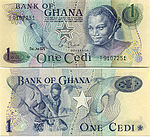
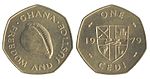
Content
History
In the colonial period, the pound sterling was circulated on the territory of the British colony Gold Coast , and in 1796-1818 silver coins were minted for the Gold Coast - acca . In 1913, the new currency of the British colonies that were part of British West Africa , the West African pound , was introduced.
After independence in 1957, the West African pound continued to be used in circulation. The need for the introduction of its own currency arose in Ghana as a result of the development of the tourism business and the influx of foreign tourists into the country. In 1958, the Ghanaian pound was introduced, replacing the West African pound in a 1: 1 ratio. In 1965, the Ghanaian pound was replaced by cedi in the ratio of 1 pound = 2.4 cedi (1 penny = 1 song).
On February 23, 1967, the “new sedi” was introduced, replacing the sedi in the ratio of 1 new sedi = 1.2 sedi. Despite the change in the name of the currency unit, on the banknotes of the new sample the name of the currency unit was still indicated: “Cedi, Cedis, ₵”.
On February 16, 1972, the "new Cedi" was renamed the "Cedi." Banknotes of a new type were issued, old banknotes of the 1967-1971 sample continued to be used in circulation until March 1973.
In March 1979, banknotes were exchanged for 1979 banknotes. The exchange of amounts up to 5000 cedi was carried out in a ratio of 10: 7, over 5000 cedi - 2: 1 [1] .
On July 1, 2007, in order to combat the effects of inflation , a cedar denomination was made. Old cedars were exchanged for new ones at a ratio of 10,000: 1. Until the end of 2007, old and new-style cedi were in circulation simultaneously.
Coins
| Picture | Denomination | Material | Diameter (mm) | Thickness (mm) | Weight (g) | Hert | Years release |
|---|---|---|---|---|---|---|---|
| 1 song | steel , plaque. copper | 17 | 1.2 | 1.82 | smooth | 2007 | |
| 5 songs | steel, plaque. nickel | 18 | 1.52 | 2,5 | 2007 2012 2016 | ||
| 10 songs | 20.5 | 1.54 | 3.4 | 2007 2016 | |||
| 20 songs | 23.47 | 1.5 | 4.36 | 2007 2016 | |||
| 50 songs | 26.45 | 1.69 | 6.15 | ribbed | 2007 | ||
| 1 cedi | steel plaque .: ring: nickel center: bronze | 27.98 | 1.85 | 7.3 | intermittently ribbed | 2007 |
Banknotes
On the obverse of all banknotes (except for 2 cedi) is a group portrait of Ghana's political figures, which shows E. Ako-Adzhey , J. B. Dankuahi, Kwame Nkrum, E. Obetsbury-Lamptey, W. Ofori-Atta and E. Akuffo -Addo [2] . A banknote of 50 cedi has been printed since 2012 with a hologram in the form of a cocoa fruit.
| 2007 series | ||||||
|---|---|---|---|---|---|---|
| Picture | Denomination (sit down) | Dimensions (mm) | Main colors | Description | Years | |
| Front side | Downside | |||||
| [one] | one | 137 × 65 | red pink | portrait of the , Triumphal Arch in Accra | Akosombo Dam | 2007 2010 2013 2014 2015 |
| [2] | 2 | 139 × 67 | yellow brown | portrait of Kwame Nkrumah | ghana government building | 2010 2013 2014 2015 2017 |
| [3] | five | 141 × 68 | blue blue | portrait of the Big Six, Triumphal Arch in Accra | University of Ghana | 2007 2010 2011 2013 2014 2015 |
| [four] | ten | 145 × 71 | green | Bank of Ghana building | 2007 2010 2011 2013 2014 2015 2017 | |
| [five] | 20 | 149 × 74 | Violet blue | Supreme Court Building | 2007 2010 2011 2013 2014 2015 2017 | |
| [6] [7] | 50 | 153 × 77 | brown | Fort Christiansborg | 2007 2010 2012 2014 2015 2016 2017 | |
Exchange rate regime
Ghana is currently using a floating exchange rate regime . The criterion for the effectiveness of the exchange rate policy ( exchange rate anchor ) are inflation indicators.
| Market rate | ||||||||
|---|---|---|---|---|---|---|---|---|
| ||||||||
Notes
- ↑ Brief history of the Gana currency , Bank of Ghana website
- ↑ http://www.dengi-afriki.ru/ganskiysedi-afrika.php (unavailable link)
Links
- Ghanaian Cedi (inaccessible link) in Russian
- Bank of Ghana website
- Ghanaian Cedi Site