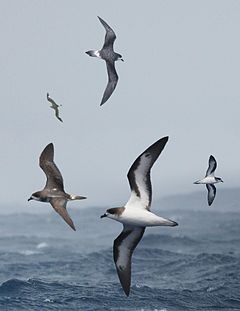
Bermuda typhoon [1] ( lat. Pterodroma cahow ) is one of the few species of petrel-like detachment that does not live in the Pacific Ocean . This nocturnal nesting bird on the earth is the national bird of Bermuda , as well as a symbol of hope for the protection of nature. His dramatic “rediscovery” ( Lazarus Effect ), that is, the discovery of the species after it was considered extinct of the century, inspired documentaries.
| Bermuda typhoon |
|---|
|
|
| No rank : | Bilateral symmetrical |
|
|
Pterodroma cahow
( Nichols & Mowbray , 1916 ) |
|
Endangered speciesIUCN 3.1 Endangered : 22698088 |
|
Originally distributed throughout the archipelago, Bermuda typhoons are slowly breeding birds, but at the same time excellent flyers, and therefore spend their adult lives in open seas. At 5 years old, the bird returns to its former nesting site for reproduction, laying only one egg per season.
The ominous night cries of Bermuda typhoons prevented the first Spanish navigators from establishing settlements on the islands because of their superstitions, since they believed that these islands were inhabited by demons. Instead, pioneers began to breed pigs in coastal areas, thereby launching a rapid attack on the existence of birds. The subsequent colonization of Bermuda by the British led to the emergence of species such as rats, cats and dogs, and the mass extermination of birds by the first colonists reduced their numbers by a factor of ten. Since 1621, birds have been considered exterminated.
17 nests were discovered on the rocky island group of Castle Harbor in 1951 , and David Wingate launched a program to build concrete holes and wooden partitions for nest tunnels in order to keep a slightly larger natural enemy of the white-tailed phaeton away, and to restore the islands adjacent to Nonsach Island, forming on them a future viable basis for the species.
Under the protection of the law, the population began to recover well. The main threat to their future is the lack of a suitable breeding ground. Hurricane Fabian destroyed many nesting holes in 2003. Recently, the larger and more ecologically restored island of Nonsach was re-inhabited by the chicks, their movement was successfully planned, so they will leave their mark on these surroundings. This work is supervised by current Bermuda Conservation Officer Jeremy Madeiros, assisted by Australian petrel specialist Nick Carlisle.
However, the total population of these birds in 2005 was only about 250 individuals.