National People's Congress ( Chinese р 人民 代表 大会 , Pinyin : Quánguó Rénmín Dàibiǎo Dàhuì , pall .: Quango Renmin Daibiao Dahui ) , NPC ( Chinese. - The highest legislative body ( parliament ) of the People’s Republic of China , according to the Constitution of the PRC, is the supreme body of state power of the country. The composition of the NPC includes deputies elected from the provinces, autonomous regions, cities of central subordination and the armed forces.
| National People's Congress | |
|---|---|
| 全国 人民 代表 大会 | |
 | |
| Type of | |
| Type of | unicameral parliament |
| Guide | |
| Chairman of the Standing Committee | Li Zhanshu , CCP from March 17, 2018 |
| Structure | |
| Of members | 2980 |
 | |
| Fractions | Government (2115):
PEFKN and independent (859)
Other:
|
| Elections | |
| Last election | December 2017 - January 2018 |
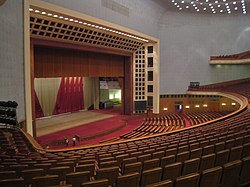
| Conference hall | |
 | |
| House of Assembly | |
| Site | |
| www.npc.gov.cn | |
NPC deputies are elected for a term of 5 years. In extraordinary circumstances that make it impossible to hold elections, the postponement of elections of deputies of the NPC of the next convocation is allowed. Such a decision shall become effective if a majority (at least 2/3 of the votes) of all members of the NPC Standing Committee (NPC SC) accepts this convocation. The term of office of deputies of the NPC of this convocation in this case is extended.
In practice, the NPC automatically approves decisions already taken by the leadership of the Communist Party, which owns the real power in the country.
Content
NPC Functions
The main functions of the NPC are as follows:
- Amending the Constitution of the PRC and monitoring its implementation.
- Adoption of the criminal and civil codes of the PRC.
- Adoption of laws on the state structure and other basic laws and amendments to them.
- Election and removal of the Chairman of the PRC and his deputy.
- Approval and removal of the Prime Minister of the State Council, his deputies and members of the State Council of the PRC , ministers, chairmen of state committees, chief auditor, head of the secretariat of the State Council of the PRC.
- Election and removal of the chairman of the Central Military Council of the PRC and approval of all other members of the Central Military Command.
- Election and removal of the chairman of the Supreme People's Court of China .
- Election and removal of the Prosecutor General of the Supreme People’s Procuracy of the PRC .
- Consideration and approval of the plan for socio-economic development of the PRC and a report on its implementation.
- Consideration and approval of the state budget of the PRC and the report on its implementation.
- Approval of the formation of provinces, autonomous regions and cities of central subordination.
- Approval of the creation of Special Administrative Regions and their regime.
- The solution of issues of war and peace.
- Amendment or cancellation of the decrees of the NPC SC that have expired.
- The implementation of other functions to be performed by the supreme body of state power.
PC NPC
| Portal: Politics |
| China |
| Series Article |
|
The standing body of the NPC is its Standing Committee ( NPC SC ), the responsible and accountable NPC.
The NPC SC acts as the supreme body of state power and operates under the control of the NPC between the sessions of the NPC.
The composition of the NPC SC includes the chairman, his deputies, the head of the secretariat, and members elected from among the deputies of the NPC elected and removed by the NPC. Persons included in the PC of the NPC cannot be in the service of state administrative bodies, courts and prosecutors.
The NPC SC usually meets every 2 months. The work of the NPC SC is led by the chairman of the NPC SC, which convenes the meetings of the NPC SC.
The Chairperson, Vice-Chairpersons and the Head of the Secretariat form the Chairperson’s Council, dealing with the important ongoing work of the NPC SC.
The Chairman of the NPC SC and his deputies cannot hold their posts for more than 2 terms (1 term = 5 years).
The main functions of the NPC PC:
- Adoption of laws and amendments to them (with the exception of laws that should be adopted by the NPC). Partial changes and additions to laws adopted by the NPC.
- Interpretation of the Constitution and laws, control over the implementation of the Constitution.
- The abolition of administrative acts, decrees and orders of the State Council of the PRC, contrary to the Constitution and laws.
- Repeal of local laws and decisions of state authorities of provinces, autonomous regions and cities of central subordination, contrary to the Constitution, laws and administrative acts.
- Exercising control over the work of the State Council, the Central Military District, the Supreme People’s Court and the Supreme People’s Prosecutor’s Office.
- Approval of candidatures of ministers, chairmen of state committees, chief auditor and head of the secretariat of the State Council.
- Approval of the candidacies of the vice-chairmen of the CEA and members of the CEA.
- Appointment and removal of deputy chairmen and judges of the Supreme People’s Court of the People’s Republic of China, members of the judicial board of the Supreme People’s Court of the chairman of the military court.
- Appointment and removal of deputies of the general prosecutor and prosecutors of the Supreme People’s Prosecutor’s Office of the People’s Republic of China, members of the board of the Supreme People’s Prosecutor’s Office and the chief prosecutor of the military prosecutor’s office.
- Approval of appointments and removal of chief prosecutors of public prosecutors of provinces, autonomous regions and cities of central subordination.
- Making decisions on the appointment and recall of authorized representatives in foreign countries.
- Consideration and approval of the necessary partial amendments to the plan of socio-economic development of the PRC and the state budget in the course of their implementation.
- Making decisions on ratification and denunciation of treaties and important agreements concluded with foreign states.
- Establishment of military ranks, diplomatic ranks and other special ranks and ranks.
- The establishment of state awards and their awarding, the introduction of state honorary titles and their awarding.
- Making pardon decisions.
- Making a decision to declare war in the event of an armed attack on the PRC or, if necessary, the fulfillment of international treaty obligations on joint defense against aggression.
- Decision-making on general or partial mobilization in China.
- Decision-making on the introduction of martial law throughout the country or in individual provinces, autonomous regions and cities of central subordination.
- The performance of other functions assigned to him by the NPC.
The NPC SC usually convenes a NPC session once a year. Prior to the session, deputies form delegations in constituencies. Before each session of the NPC, a preparatory meeting is held, during which the bureau and the head of the secretariat of this session are elected, the agenda of the session is adopted. During the work of the NPC session, plenary meetings are held with the participation of all NPC deputies and group discussions. The group is usually made up of delegations from one province, autonomous region, city of central subordination or the armed forces. The Presidium directs the plenary meetings of the session and assigns the duties of the chairman of the meetings to several persons in turn.
Persons who are members of the State Council (State Council) of the People's Republic of China, the Central Military Council (CVS) of the People's Republic of China, the Chairman of the Supreme People’s Court of the People’s Republic of China, the Prosecutor General of the People’s Prosecutor’s Office of the People’s Republic of China attend sessions of the People’s People’s People's Party without the right to vote. With the permission of the presidium of the session, meetings of the NPC session may also be attended by responsible persons of other bodies and organizations.
By the decision of the presidium of the session, bills submitted to the NPC by its deputies, the NPC PC, the special commissions of the NPC, the State Council of the People’s Republic of China, the Central Military Commissariat of the People’s Republic of China, the Supreme People’s Court of the People’s Republic of China, and the Supreme People’s Prosecutor’s Office are sent for group discussions. These bills are also considered by the special commissions of the NPC, which prepare reports on them that are submitted to the podium of the session, where after discussion of the said reports a decision is made on the possibility or impossibility of submitting bills directly to the session for adoption.
Voting by decision of the deputies may be secret or open.
Sessions of the NPC and meetings of the PC of the NPC are held in Beijing , at the Tiananmen Square Public House .
Sessions of the National People's Congress
All-China Assembly of People's Representatives of the First Convocation
- The first session (September 15-28, 1954), the second session (July 5-30, 1955), the third session (June 15-30, 1956), the fourth session (June 20 - July 15, 1957), the fifth session (January 25 - February 11, 1958)
All-China Assembly of People's Representatives of the Second Convocation
- The first session (April 18-28, 1959), the second session (March 29 - April 10, 1960), the third session (March 22 - April 16, 1962), the fourth session (November 17 - December 3, 1963)
All-China Assembly of People's Representatives of the Third Convocation
- First Session (December 21, 1964 - January 4, 1965)
All-China Assembly of People's Representatives of the IV convocation
- First Session (January 13-17, 1975)
All-China Assembly of V Representatives
- The first session (February 26 - March 5, 1978), the second session (June 18 - July 1, 1979), the third session (August 30 - September 10, 1980), the fourth session (November 30 - December 13, 1981 ), fifth session (November 26 - December 10, 1982)
All-China Assembly of People's Representatives of the VI Convocation
- The first session (June 6-21, 1983), the second session (May 15-31, 1984), the third session (March 27 - April 10, 1985), the fourth session (March 25 - April 12, 1986)
All-Chinese Assembly of People's Representatives of the 11th Convocation
- The first session (March 5-18, 2008), the fourth session (March 5-14, 2011), the fifth session (March 8-14, 2012)
Office Languages
Paperwork is conducted in Chinese. At the NPC sessions, translation of written documents and speeches into the following languages of national minorities is provided - Mongolian , Tibetan , Uigur , Kazakh , Korean , and Zhuang [1] .
Representatives of National Minorities in the NPC
The share of deputies - representatives of national minorities - in the NPC changed depending on the convocation. In 1954, 178 deputies (14.5% of the NPC) belonged to national minorities, in 1993 - already 554 deputies (18.6% of the NPC) [2] . Then the number of deputies from national minorities decreased and in 2008 there were only 411 (13.8% of the NPC) [2] .
Chairpersons of the NPC SC
- Liu Shaotsi (1954-1959 gg.), Chairman of the SC NPC 1st convocation;
- Zhu Dae (1959-1976), Chairman of the SC NPC 2nd, 3rd and 4th convocation;
- In July 1976 - March 1978, the position was vacant, the duties were collectively performed by the vice-chairmen (21 people);
- Ye Jianying (1978-1983), Chairman of the SC NPC of the 5th convocation;
- Peng Zhen (1983-1988), Chairman of the NPC SC 6th convocation;
- Wan Li (1988-1993), Chairman of the SC NPC 7th convocation;
- Qiao Shi (1993-1998), Chairman of the NPC SC 8th convocation;
- Li Peng (1998-2003), Chairman of the NPC SC 9th convocation;
- U Bango (2003-2013), Chairman of the SC NPC of the 10th and 11th convocation;
- Zhang Dejiang (2013-2018), Chairman of the NPC SC 12th convocation;
- Li Zhanshu (2018-), Chairman of the NPC SC 13th convocation.
Political Parties
- PEFKN
- PDA
- Kuomintang
- September 3rd Movement
- Hong Kong parties
- Democratic Alliance for Progress -8
- Hong Kong Trade Unions-2
- New Century -1
- New People's Party -1
- Liberal Party -1
- Political Parties Macau
See also
- People's Political Advisory Council of China
Notes
- ↑ Yao Wang. Xinjiang Uygur Autonomous Region and PRC policy in the context of contemporary international security challenges. The dissertation for the degree of candidate of political sciences. - M., 2015. - S. 68. Access mode: http://istina.msu.ru/dissertations/10651593/
- ↑ 1 2 Yao Wang. Xinjiang Uygur Autonomous Region and PRC policy in the context of contemporary international security challenges. The dissertation for the degree of candidate of political sciences. - M., 2015. - S. 67. Access mode: http://istina.msu.ru/dissertations/10651593/