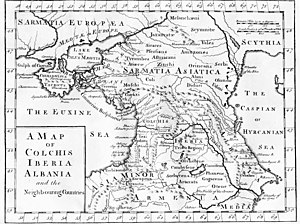
Melanhlena ( Greek Μελαγχλλαινοι ) - the people who lived in Asian Sarmatia . Practiced cannibalism . According to Herodotus (4, 20. 21) they lived north of the royal Scythians along the upper course of the river Don and bordered to the north with large swamps, their name was derived from the dark color of the dress. Later writers believe that this nation also lived in Colchis and in European Sarmatia.
Content
Title
Self melanhlenov unknown. According to Herodotus, they were called so because they wore black clothes ( Greek Μελαγχλαανοι - “black-dressed”) - short black cloaks. In the Greek inscription found in Olbia , the Savdarata people are mentioned , the Iranian word, which coincides in meaning with the Greek melanhlen . This gives grounds to assume that Herodotus leads the original ethnonym translated into Greek [2] .
Localization
Herodotus puts melanhlens in the northern parts of Scythia , extending into the mainland, upward along Borisfen (modern Dnieper) , apparently east of the agafirs , neurovs , and androphages .
Other authors note that melanhlen lived in the territory of the Kharkiv region . For example, in the territory of the Donetsk settlement , located on a triangular cape on the bank of the Udy river near the village of Karachevka. Excavations that were carried out on this site in 1902 by V. A. Gorodtsev , in the late 1920s by A. S. Fedorovsky, in the 1950s by B. A. Shramko, and later by A. G. Dyachenko, identified three cultural main layer:
- bottom layer - no later than V century BC. er , the settlement of the agricultural — pastoral tribes known to Herodotus under the name of melanhlens;
- middle layer - VIII - X centuries n. er the settlement of the early Slavic culture of Romenia , burned by the Pechenegs at the beginning of the X century;
- the upper layer is the fortified settlement of Kievan Rus that emerged in the second half of the 10th century after the defeat of the Khazar Kaganate .
And also in the area of the city of Pesochin , excavations of mounds, roughly identified as mounds of melanhlens, are underway.
On the map, compiled according to Ptolemy 's Geography and printed in London in 1770 , melanhleas are marked in its upper part, east of the Tanais River (modern Don ), that is, in the territory of the Asian Sarmatia of Ptolemy. However, Ptolemy himself had melanhlens in European Sarmatia , whose boundary was the Don River [3] , noting that the velts occupy the ocean coast at the Bay of Veneda, higher than them fall, then the most northern ones are carbony, and east of them are crosses and fats (below these gelons, hippopods and melanhlanes); below them are agathirs (agathirs), then aorses and pagirit; below them are the savars (savra, saubry, sauri) and boruschi up to the Ripean mountains [4] .
Mentions
Procopius of Caesarea wrote: “In the past, there were many Gothic tribes, and many of them now, but the largest and most significant of them were Goths , Vandals , Visigoths and Gepids . Previously, however, they were called savromates and melanhlens. Some called these tribes hetami ”(“ The War against Vandals ”, book 1, 2.2).
History
Melanchlae had their own "kings". The kings of melanhlens participated in the council of the kings of Great Scythia around 512 BC. er in developing a common strategy to combat the army of Darius I. Melanchles, along with a number of other nations, refused to support the Scythians. After the conflict with the Scythians, presumably, they went north, to the Oka River [5] .
Life
Not belonging to the Scythian tribe , the melanhleins were very similar to the Scythians in their way of life and character, that is, they were nomads.
Ethnicity
Ethnicity melanhlenov controversial. Previously, scientists attributed them to the ancestors of the Slavs . But the archaeological excavations of the mounds of melanhlens showed their close relationship in lifestyle and genotype with the Iranian peoples . Almost every grave is used to find a Scythian sword - akinak . Researchers believe that the melanhleen were the more sedentary of the tribes and the first to go over to agriculture. This version is confirmed by excavations of pesochinsky barrows.
In modern traditions, melanhlens are considered either the Balts of the Yukhnov culture [6] , or the Cimmerians [7] , or the ancestors of the Finns [8] .
Notes
- ↑ Ptolemy . Geography (III, 18) Archived on September 21, 2013. . Translated by S. K. Apt . Note: In Geography (III, 18. 41-43), Ptolemy describes the second map of Asia .
- Essays on the history of the peoples of Russia in antiquity and the early Middle Ages: studies. manual for humanity. fact universities / V.Ya. Petrukhin , D.S. Rayevsky . - M .: Sign, 2004. - p. 105. - 415 p. - ISBN 5-7859-0057-2 .
- ↑ Ptolemy . "Geography" (III, 8. 32) Archived September 21, 2013. . Translated by S. K. Apt.
- ↑ Ptolemy . Geography (III, 5. 19–25) Archived on September 21, 2013. . Translated by S. K. Apt. Note: In "Geography" (III, 5. 19-25) Ptolemy talks about the peoples of European Sarmatia .
- ↑ Kolovrat Yu. A. Zmievsky krai in the Scythian-Persian war beginning. VI century. BC er / Yu. A. Kolovrat // History of Zmievsky Krai. - Serpent. - 12/26/2010.
- ↑ PRESLAVIANS AND BALTOSLAVIANS The Polish aspect of the Balto-words of the yansk nutrition // Onomastics Polissya. - K. - 1999, p. 139-146, 150
- ↑ About field, field ... (inaccessible link) . The appeal date is April 6, 2009. Archived October 16, 2007.
- ↑ Niederle L. Slavic antiquities. - p.133
Literature
- Melanchlae // Encyclopedic Dictionary of Brockhaus and Efron : in 86 tons (82 tons and 4 extra). - SPb. , 1890-1907.
- G.V. Vernadsky, M.M. Karpovich . Ancient Russia , 1943.