Jinan ( Chinese р . 济南 , pinyin : Jǐnán ) is a city of sub-provincial significance in China , the seat of the government of Shandong province. Located in the western part of the province, about 400 km south of the country's capital, the city of Beijing . The name means "south of the Jishui River " and is due to the fact that these places were located south of the Jishui River (now the Yellow River flows along the bed of the former Jishui River).
| City of sub-provincial significance | |
| Jinan | |
|---|---|
| 济南 | |
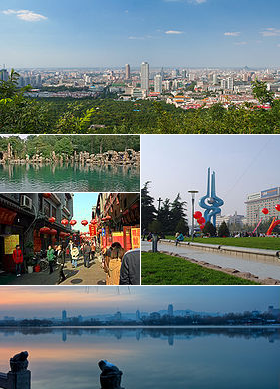 | |
| A country | PRC |
| Enters into | shandong province |
| History and geography | |
| Square | |
| Height | |
| Timezone | |
| Population | |
| Population | |
| Digital identifiers | |
| Telephone code | |
| Zip Codes | |
Geography and climate
Located in the northwestern part of Shandong Province on the Yellow River . The relief of Jinan is a transition zone from the Taishan massif in the south to the valley of the Yellow River - in the north. Karst aquifers in limestone formations descend from south to north and provide access to many artesian springs, both in the city itself and in its environs.
The city is located in the transition zone from a humid subtropical climate to a continental one. Four seasons are clearly expressed in the year. Jinan is characterized by arid spring, hot and rainy summers, cool autumn, arid and cold winters. The average annual temperature is 14.6 ° C; The average annual rainfall is about 670 mm, most of which falls in the summer. The coldest, as well as the driest month is January, with an average temperature of −0.4 ° C and an average rainfall of only 5.7 mm. Snowfalls sometimes occur, but are usually quite insignificant. July is the hottest and most rainy month, with a temperature of 27.5 ° C and a rainfall of 201.3 mm.
In addition to the Yellow River, many small rivers flow through Jinan. The largest of them: Xiaoqing .
Population
As of 2005, the population of the sub-provincial city of Jinan was 5.69 million people. The 2010 census reports a population of 6.81 million. The Chinese (Han) make up 98.3% of the city’s population. The remainder is mainly represented by Hui and Manchu . The population speaks mostly in the Jinan dialect of the North Chinese dialect group. Standardized putonghua is also common.
History
In the era of Wozen and Autumn and the Battle of the Kings, the western part of the territory of the modern city of subprovinational significance Jinan was part of the principality of Lu , and the eastern part of the principality of Qi . In 685 BC er Qi began building a defensive structure known as the Tsiskaya Great Wall in the territory of the modern Changqing district.
When the kingdom of Qin conquered all the other kingdoms , and, having created the first single centralized state in the history of China, divided the country into jin districts, these lands became part of Jibei district (济 济 郡); they were then called Fox (历 下 邑). Under the Han empire, Jinan County (济南 郡) was created, the board of which was located in the modern county of Zhangqiu. Under the Western Jin Empire (4th century), the county government relocated to the territory of the modern district of Licheng. Thanks to the construction of Buddhist cave temples (IV — VII centuries AD.), These places became a major religious center.
Under the Sui Empire, in 583, Jinan County was transformed into Qizhou Province (齐 州), which included 10 counties. Under the Northern Song Empire in 116, the region was raised in status even higher, becoming the Jinan administration (济南). The Jurchens who then seized these places retained the existing management structure.
After the Mongol conquest, when the great Khan Munké died in 1259, and in the 1260s, a civil war broke out among the Mongols between supporters of Khubilai and Arig-Bugi , the Chinese served as Mongols by the Chinese Li Tan, appointed by them as governor of Shandong province, in 1262 he rebelled went over to the side of the Song empire and captured Jinan. Khubilai threw his best commanders against Li Tanya, who defeated the rebel army at Jinan. Li Tan took refuge in Jinan, but after several months of the siege was forced to surrender.
After the overthrow of the Mongol rule and the proclamation of the Ming empire in Jinan, the government of Shandong province moved in 1369. During this period, 15 counties and 4 provinces were subordinate to the Jinan administration.
Under the Qing Empire, in 1724, three out of four areas were removed from subordination to the council and transferred directly to the provincial authorities, becoming “directly controlled”. In 1852, the Yellow River laid its new channel near the northern part of the city. The city was connected to the Great Canal and the internal Chinese waterways, which led to its rapid growth. In 1897, the Qing government transferred Qingdao to Germany. The Germans, despite the resistance of local residents, began to build the Qingdao-Jinan Railway, which was one of the reasons for the rebellion of the Ietuan . In 1904, the road was completed, and in the same year the commercial port was officially established, making the city an important transportation hub. In 1912, in the Jinan area, the Yellow River crossed the Tianjin-Pukou Railway, further increasing the commercial and transport significance of the city.
After the Xinhai Revolution in China, the administrative division was reformed, during which the governing boards were abolished (only counties, regions and provinces remained), and in 1913 the Jinan administration was disbanded. The territory of the modern sub-provincial city of Jinan was divided between the regions of Donglin (东临 道) and Jinan (济南 道). After the Kuomintangs established their power in China as a result of the Northern Expedition , the regions were also abolished, and the counties began to submit to the provincial authorities. In July 1929, the city of Jinan (济南 市) was officially formed. In 1930, it was divided into 10 districts.
During the Sino-Japanese War, the city was occupied by Japanese troops in 1938. Puppet Chinese authorities divided the city into 11 districts. After the capitulation of Japan in 1945, the division of the city into 11 districts was preserved. Then the civil war began , and in September 1948 the city was taken by the Communists. The People's Government established the Special City of Jinan (济南 特别 市). In May 1949, it was transformed into the city of Jinan, consisting of 11 districts. In 1950, they were divided into 6 urban areas and 5 suburban areas, and in 1951 the sixth suburban area was created. In 1954, a change was made in the administrative-territorial division: now there are 5 urban and suburban areas. In 1955, districts were given names instead of numbers.
In 1958, the Special Area of Tai'an (泰安 区 区区) was disbanded, and part of its administrative units was transferred to Jinan jurisdiction, but in 1961 it was re-established. In 1978, the counties of Zhangqiu and Changqing passed under the jurisdiction of Jinan, in 1985 - the Pingyin county, in 1989 - the Tsiyan and Shanhe counties. In 1992, Zhangqiu County was transformed into a city county.
In February 1994, Jinan became a city of sub-provincial significance.
In 2001, Changqing County was transformed into an area of urban subordination.
In 2016, Zhangqiu City County was transformed into an area of urban subordination.
In 2018, Jiyang County was transformed into the area of urban subordination.
In 2019, the city district Laiu was annexed to Jinan; its Gaicheng district retained its name, and the Laicheng district became the Laiu district.
Economy
After the transition of the Huang He to a new channel to the north of the city in 1852 and the creation of a large railway junction, Jinan became a large market for agricultural products from fertile areas of the south of the country to the north. [1] Subsequently, the city also developed as a center for the textile and clothing industry, there were mills, oil mills, factories for the production of paper, cement and matches. In the 1950s, a large metallurgical plant and chemical plants were built near the city. In the 1970s, factories for the production of trucks and construction equipment were also created. In recent years, high-tech industries have been actively developing: the production of household appliances, information and bioengineering technologies. Numerous CNC machine tool factories operate and are under construction.
Transportation
Located at the intersection of two major railways. One of them goes from Beijing to Shanghai, in the direction from north to south, the second - connects Jinan with the port of Qingdao on the Yellow Sea. Other branches connect Jinan with Handan ( Hebei Province), Dezhou , Tai'an , Jining , Zaozhuang , Zibo and others. The main roads passing through the city include godao 104, 220 and 309.
Jinan Yaoqiang International Airport is located approximately 33 km northeast of the city. As of 2010, Jinan Airport is the 24th busiest in China with 6,898,936 passengers. Flights to the following destinations are performed: Chengdu, Hong Kong, Shanghai, Kunming, Seoul, Osaka, Dalian, Taipei, Guangzhou, Urumqi, Harbin, Wuhan, Changsha, etc.
Administrative division
The city of sub-provincial significance Jinan is divided into 10 districts, 2 counties:
| Map | Status | Title | Hieroglyphs | Pinyin | Population (2010 approx.) | Square (km²) | Density population (/ km²) |
|---|---|---|---|---|---|---|---|
Fox Shizhong Huayin Tianqiao Licheng Changqing Zhangqiu Jiyang Layou Gancheng Pingyin Shanhe | |||||||
| Area | Fox | 历 下 区 | Lìxià qū | 542.248 | 100.87 | ||
| Area | Shizhong | 市 中 区 | Shìzhōng qū | 571.251 | 280.33 | ||
| Area | Huayin | 槐荫 区 | Huáiyìn qū | 380.654 | 151.65 | ||
| Area | Tianqiao | 天桥 区 | Tiānqiáo qū | 503.764 | 258.71 | ||
| Area | Licheng | 历 城区 | Lìchéng qū | 921.898 | 1303.88 | ||
| Area | Changqing | 长 清 区 | Chángqīng qū | 560.282 | 1208.54 | ||
| Area | Zhangqiu | 章丘 区 | Zhāngqiū qū | 1.015.129 | 1721.29 | ||
| Area | Jiyang | 济 阳 区 | Jǐyáng qū | 552.406 | 1097.15 | ||
| Area | Layou | 莱芜 区 | Láiwú qū | 1739.61 | |||
| Area | Gancheng | 钢城区 | Gāngchéng qū | 506.42 | |||
| County | Pingyin | 平阴 县 | Píngyīn xiàn | 372.741 | 715.18 | ||
| County | Shanhe | 商河县 | Shānghé xiàn | 620.365 | 1163.19 |
Attractions
Jinan is known in China for its numerous springs, lakes fed by spring water, and willows growing near water. Writer Liu E described the city in his novel Traveling Lao Tsanya (老残游记, written in 1903–04, published in 1907) so “Every family has a source, every home has a willow.” [2] Jinan is also the historical center of the Buddhist culture of these places, with quite a few religious monuments preserved here.
Most sources are located in the center of Jinan and flow into Lake Daminghu (Daming) . The most famous source of baota, mentioned in Chunqiu’s chronicle, and also called “source number one in Celestial”, is the Qing emperor Qianlong . The source is fed with underground water from limestone through three outlet openings. The volume of outgoing water reaches a maximum in spring (up to 1.6 m³ per second). The temperature of the source is constant throughout the year and is 18 ° C. Baotu is surrounded by a park with many ancient historical buildings and pavilions.
To the southwest of the city is the Hill of a thousand Buddhas - a hill with images of Buddhas carved out of the rock, as well as statues of Buddhas from the times of the Thai and Sui dynasties and the Shinguochang temple. Most of the ancient Buddhist structures are in Licheng County. Among them is the Pagoda of the Four Gates, built in 661, which is considered one of the oldest surviving brick pagodas in China. Below the hill on which stands the pagoda, are the remains of the temple Shentun, built in the IV century and destroyed in subsequent wars. In Changqing County, Lingyuan Temple was built during the Qin Dynasty and flourished during the Tang and Song times.
It is also worth noting the Provincial Museum of Shandong Province, which contains a huge number of exhibits from different historical eras.
Education
Universities and colleges
- Shandong University (山东 大学)
- Shandong Normal University (山东 师范大学)
- Tsilu University of Education (齐鲁 师范 学院)
- Shandu Institute of Architecture (山东 建筑 大学)
- Shandong Financial University (山东 财政 学院)
- Shandong University of Chinese Traditional Medicine (山东 中 医药 大学)
- Shandong University of the Arts (山东 艺术 学院)
- Shandong College of Art and Design (山东 工艺 美术 学院)
- Shandong Institute of Physical Education (山东 体育 学院)
- Jinan University (济南 大学)
- Shandong College of Electrical Engineering (山东 电子 职业 技术 学院)
- Jinan Railway Polytechnic Institute (济南 铁道 职业 技术 学院)
Sports
Football
The football club from Jinan " Shandong Luneng " is one of the strongest in China, since 1994 it has been playing in the Super League . 4 times (1999, 2006, 2008, 2010) the team won the Chinese championship, 4 more times won the China Cup (1995, 1999, 2004 and 2006).
Basketball
The local Shandong Lions Basketball Club (until 2003, Shandong Flamin Bulls) performs in the Chinese Basketball Association , but did not achieve such success as the football one. The Lions have never reached the final of the playoffs.
Twin Cities
- Wakayama , Japan ; since January 14, 1983 .
- Coventry , UK ; since October 3, 1983 .
- Yamaguchi , Japan ; since September 20, 1985 .
- Rennes , France ; since 1985 .
- Kefar Sava , Israel ; since 2007 .
- Sacramento , USA ; since May 29, 1985 .
- Regina , Canada ; since August 10, 1987 .
- Port Moresby , Papua New Guinea ; since September 28, 1988 .
- Suwon , South Korea ; since October 27, 1993 .
- Nizhny Novgorod , Russia ; since September 25, 1994 .
- Vantaa , Finland ; since August 27, 2001 .
- Jundalup , Australia ; since September 4, 2004 .
- Augsburg , Germany ; from October 10, 2004 .
- Vitebsk , Belarus ; since April 20, 2006 .
- Kharkov , Ukraine ; since August 23, 2007 .
Notes
- ↑ Jinan. (2008). In Encyclopædia Britannica. Retrieved October 28, 2008, from Encyclopædia Britannica Online
- ↑ In the original simplified hieroglyphs: "家家 泉水 , 户户 垂杨". Traditional characters: “家家 泉水 , 戶戶 垂楊”
Links
- Jinan - information on the territory, population and history of changes in the administrative-territorial division on the site 行政 区划 网(whale.)