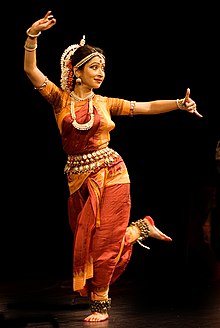
Odyssey is one of eight classical styles of Indian dance . It comes from the East Indian state of Orissa . Based on archaeological evidence, this dance can be considered the oldest of the existing ones. Dated to the 1st century BC e. the bas-reliefs in the cave temples of Udaigiri (near Bhubaneswar ) prove this fact. The active development and restoration of this dance tradition began with the period when India gained independence from British rule. In Odyssey, of great importance, unlike other classical forms of Indian dance, is the Tribhangi pose (lit. triple bend), the square pose of Chauk or Choka (symbolizes Lord Jagannath ), and the independent movement of the head, chest and pelvis. The dance is distinguished by numerous bhangs (racks), including leg movements and a variety of poses captured in Indian sculpture. The main bhangs are bhanga , abhanga , atibhanga and tribhanga .
The ancient treatise " Natyashastra " describes what positions a head, hands, fingers, feet can take during a dance, the main 9 emotions on which the dance is built are listed. Each pose in such a dance carries a semantic load. With the help of gestures, facial expressions, poses, the dancer tells the whole story.
Content
- 1 History and Origin
- 1.1 Mughal Age and British Colonization
- 2 Traditional schools
- 3 References
History and Origin
The first images of the Odyssey dance were found in the Monchapuri cave on the hills of Udaigiri, which were carved in stone in the era of the emperor Kharavel . In the company of the two queens, the emperor enjoys the girl’s dance to the accompaniment of women musicians. Based on this, it can be judged that Odyssey was originally a worldly dance, and only later became an integral part of the temple culture of Orissa. Ritual dances from the Jagannath temple in Puri soon migrated to the Vaishnava , Shaivite and Shakti traditions as well. One of the engravings on the walls says that a devadasi named Karpurshri was a dancer at a Buddhist monastery, just like her mother and grandmother. Temple dancers acquired a special status - the Mahari , thus devoting their lives to serving God .
Numerous images of dancers were discovered during excavations of the Buddhist temple of Ratnagiri ( VI - IX centuries ). Temples of the Tantric tradition, such as the Yogini Temple in Hirapur, are also decorated with sculptures and bas-reliefs depicting poses characteristic of the modern dance of Odyssi. At that time, when the state of Orissa became a major center of worship of Shiva, it is natural that the dance became a form of worship of him, since Shiva himself is considered the greatest dancer. He is also known as Nataraj , which means Lord of the Dance. The Shaivite temples of Bhubaneswar are decorated with countless sculptures depicting Odyssi dance poses. Vaishnava temples, such as the Jagannatha Temple and the Sun Temple in Konarak , also abound in dance scenes carved on the walls, proving the continuity of certain art forms from the Shaivite to Vaishnava tradition.
Mughal Age and British Colonization
In the era of the Mughals , dances serve as entertainment for rulers and courtiers, and the service of the Mahari (temple dancers) falls into decay. The degradation of the classical styles of Indian dance, especially intensified after the ban by the British authorities of temple dances.
Traditional Schools
The Odyssey tradition includes two areas: Mahari and Gotypua :
- Mahari (lit. elected ) - temple dancers, in particular, at the Jagannatha temple in Puri , the first mention of them occurs in the 10th century. The first Mahari performed mainly Nritta ( pure dance ) and Abhinaya (interpretation of poetry). Later, Mahari's dances began to be based purely on the work of The Gitagovind , the poet Jayadeva .
- Gipotua (lit. one boy ) - performed only by boys dressed and decorated as girls-dancers. The boys learned dance from Mahari, and gradually, their work goes beyond the temples, and, unlike Mahari, becomes the property of the general public. The revival of tradition is due to the development of Vaishnavism in medieval Orissa, under King Prataparudra . As followers of Caitanya , Vaisnavas did not approve of women dancing. At this time, Bengali Vaishnava poets create a great many poems in the Oriya language, dedicated to Radha and Krishna, which become the plot for the dances of the gipotua .
Orissa State Crafts - Filigree Silver. The dancers are dressed in silver jewelry and sari made of natural cotton or silk, produced in Orissa by weaving ikat .
Of great importance are the colors of clothes and jewelry worn by dancers, the way of putting on a sari . Different states wear saris in different ways.