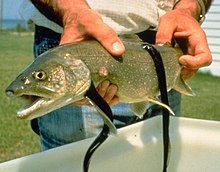
Sea lamprey [1] ( lat. Petromyzon marinus ) - a species of the maxilliformes from the order minceous , the largest representative of the order. It stands out in the monotypic genus of lampreys ( Petromyzon ) [2] . It reaches a length of 120 cm and a mass of 2.3 kg.
| Lamprey |
 |
| Scientific classification |
|---|
| No rank : | Bilateral symmetrical |
| Grade: | Lampreys ( Petromyzontida ) |
| Gender: | Lamprey ( Petromyzon Linnaeus , 1758 ) |
|
| International scientific name |
|---|
Petromyzon marinus Linnaeus , 1758 |
| Security status |
|---|
Least ConcernedIUCN 3.1 Least Concern : 16781 |
|
The Red Book of Russia
the view disappears |
|
Content
A cylindrical body without paired fins. Round mouth funnel with a fringed edge. In front of the body there are 7 gill openings. Unpaired nasal opening on the upper side of the head. Tongue with conical thickening and with teeth. Dorsal fin with gap. The maxillary plate is narrow with two teeth, the mandibular with 7-8 teeth. In the oral funnel there are several circular rows of strong and sharp horn teeth. There is no central groove on the front of the tongue. The color depending on age and habitat is different, often light gray or light green with a black marble pattern.
The oval mouth of the lamprey contains concentric rings of sharp teeth with a bony tongue
Like most lampreys, sea lampreys in adulthood are external parasites of fish. They stick mainly to large fish (such as trout , mackerel , herring , cod , flounder, and others) [3] . Enzymes in the lamprey mouth prevent clotting of the victim’s blood. Victims usually die from blood loss or infection.
Spawns in June - early July in the rivers. At a depth of 40-60 cm in pebble soil, the male builds a nest. It is a flat recess with a diameter of up to 50 cm. After spawning, producers die. The eggs (34-240 thousand, depending on the size of the female; the size of the eggs is about 1 mm) are swept into flat cavities. Larvae are born 10-11 days after spawning. They live in the river for 5-6 years, after metamorphosis young lampreys slide into the sea, the marine period is about 1-2 years [4] .
European coastal waters from the White Sea and Iceland to Gibraltar , the western Mediterranean and the Adriatic . Not found in the Black Sea. Found on the east coast of North America. In Russia, sea lamprey lives in Narva , Neva and Luga - rivers that flow into the Gulf of Finland. It is found in some rivers of the Kaliningrad region.
- ↑ Reshetnikov Yu.S. , Kotlyar A.N. , Russ T.S. , Shatunovsky M.I. The Bilingual Dictionary of Animal Names. Fish. Latin, Russian, English, German, French. / edited by Acad. V. E. Sokolova . - M .: Rus. Yaz., 1989 .-- P. 13 .-- 12,500 copies. - ISBN 5-200-00237-0 .
- ↑ FishBase: List of valid species of the genus Petromyzon
- ↑ Silva, S., Araújo, MJ, Bao, M., Mucientes, G., & Cobo, F. (2014). The haematophagous feeding stage of anadromous populations of sea lamprey Petromyzon marinus: low host selectivity and wide range of habitats. Hydrobiologia, 734 (1), 187-199.
- ↑ Silva, S., Servia, MJ, Vieira-Lanero, R., Barca, S. & Cobo, F. (2013). Life cycle of the sea lamprey Petromyzon marinus: duration of and growth in the marine life stage. Aquat. Biol, 18: 59-62