Soldatov’s catfish [1] ( Latin: Silurus soldatovi ) is a species of large, scaleless ray-finned fish of the catfish family (Siluridae). It is named after the Russian ichthyologist Vladimir Konstantinovich Soldatov, who in 1907-1913. worked as part of a scientific expedition in the floodplain of the Amur River , studying the biology of migratory salmon and sturgeon fish [2] .
| Som Soldatova |
|---|
 |
|
| No rank : | Bilateral symmetrical |
|
|
Silurus soldatovi Nikolsky & Soin , 1948 |
|
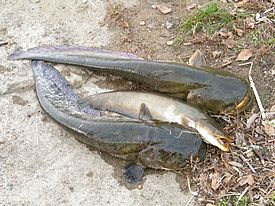
Two catfish of the Soldatov caught in the
Amur , between them - the
Amur catfishFreshwater fish, reaches a length of 4 m and a weight of 40 kg [3] . The basis of the diet is fish: crucian carp , carp , skate , Amur pike and others, sometimes swallows waterfowl. Goes hunting mainly at night. In the fall, he leaves for deeper parts of the reservoirs, where he leads a sedentary lifestyle. Does not eat in winter. Lives over 30 years.
The size and color of the body are similar to those of the European catfish . The back and sides of the catfish are brownish-gray, with dark, blurry stains. The abdomen is in most cases light.
It occurs in the Amur River Basin, in the Ussuri River and Lake Khanka .
Matures in the fourth year of life, spawns in coastal thickets from mid-June to July. Caviar is laid on the vegetation, where Soldatov’s catfish builds something like a nest.
The Red Book of Russia
the population is declining |
|
Due to the declining number of catfish since 1981, the fishing of these fish in the Russian part of the Amur has been banned [4] . Som Soldatov is listed in the Red Book of Russia [5] . In 2014, the Moscow Mint issued in the Red Book series a commemorative coin with a face value of 2 rubles with an image of a catfish Soldatov with a total circulation of 5000 copies.

