The Caspian lamprey , or Volga lamprey [1] ( lat. Caspiomyzon wagneri ) is the only species of migratory freshwater jawless lamprey family. There are two forms of Caspian lamprey. The small variety has a length of up to 31 centimeters. The larger one reaches a length of 55 centimeters and a weight of up to 200 grams.
| Caspian lamprey |
| Scientific classification |
|---|
| No rank : | Bilateral symmetrical |
| Grade: | Lampreys ( Petromyzontida ) |
| Gender: | Caspian Lampreys ( Caspiomyzon Berg , 1906 ) |
|
| International scientific name |
|---|
Caspiomyzon wagneri ( Kessler , 1870 ) |
| Security status |
|---|
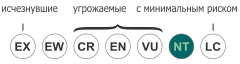
Close to vulnerableIUCN 3.1 Near Threatened : 135706 |
|
The Red Book of Russia
the population is declining |
|
Content
Like all lampreys, it has a round mouth and boneless skeleton. The body resembles a worm. 2 dorsal fins. The skin is devoid of scales and covered with mucus . The funnel-shaped sucker-mouth, horny, blunt teeth: 1 tooth on the maxillary plate and 5 teeth on the mandibular. There are blunt teeth on the suction cup and tongue. The body is painted in an even gray color [2] .
Passing view. To spawn, lampreys rise up the rivers (Volga, Kura, less often Terek and Ural). The move begins in late September and lasts until mid-December. After winter rest (food ceases at the beginning of migration), spawning continues from March to May. Females spawn in nests — deepening pebble or sandy bottoms on shallows with a strong current. Males equip nests. Lamprey has a fertility of 32.6 thousand eggs in the Volga, and 24 thousand in the Kura. Caviar bottom, sticky. In the Volga, spawning takes place in late May and early June at a temperature of 16. Spawning occurs at a time. Spawning lampreys die. The larvae of young lampreys - sandworms - live on sandbanks, usually burrowing in the sand. Hatching occurs after 9-11 days. After three or four years, the ambulances undergo metamorphosis , become adults and go to the Caspian Sea . In Kura, lampreys spawn at the age of 5-6 years [2] .
Adult lamprey is attached to Caspian trout during its course into the rivers. Algae are found in the stomachs. Probably feeds on detritus . During the migration, food stops. Activity increases at night [2] .
Endemic to the Caspian Sea basin , it leads a conservative lifestyle. On a river bed moves along the coast or along the rod.
It is found in the rivers Ural , Terek , Kura , Araks , small rivers of the coast of Azerbaijan and Iran .
Previously, it entered the Volga and its tributaries. After the Volgograd dam was built, it does not go above it, only a few individuals were found in the Volgograd and Saratov reservoirs.
- ↑ Reshetnikov Yu.S. , Kotlyar A.N. , Russ T.S. , Shatunovsky M.I. The Bilingual Dictionary of Animal Names. Fish. Latin, Russian, English, German, French. / edited by Acad. V. E. Sokolova . - M .: Rus. Yaz., 1989 .-- P. 12 .-- 12,500 copies. - ISBN 5-200-00237-0 .
- ↑ 1 2 3 Commercial fish of Russia. In two volumes / Ed. O.F. Gritsenko, A.N. Kotlyar and B.N. Kotenev. - M .: VNIRO publishing house, 2006. - T. 2. - P. 13-14. - 624 p. - ISBN 5-85382-229-2 .