Black Forest - a forest in the Znamensky and Alexandria regions of the Kirovograd region of Ukraine. It is a hornbeam - oak forest located on the watershed of the Ingulets and Tyasmin rivers. The total forest area is 18,353 hectares, of which 3,500 hectares is a state reserve . On the territory of the forest there is the southernmost sphagnum bog in Ukraine, covering an area of about 2 hectares, and Lake Berestuvatoye (called the Black Lake by local residents).
| Black forest | |
|---|---|
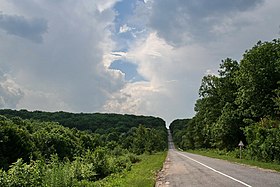 Road passing through the Black Forest | |
| Specifications | |
| Square | 35 km² |
| Location | |
| A country |
|
| Region | Kirovograd region |



The territory of the Black Forest is part of the Chernolesky landscape reserve of national importance, created in 1975 . The reserve covers an area of 3491 ha, and belongs to the Bogdanov forestry (quarters 1-18). The purpose of the reserve is to protect one of the largest oak massifs in the forest-steppe zone of Ukraine [1] .
In the depths of the forest, on the shores of Lake Berestovaty, from the Soviet era, there is a small government cottage.
Content
Flora
The main forest-forming species of trees are English oak , common ash . attendant - common hornbeam (growing here on the southern border of its range), acutifoliate maple, field maple , small-leaved linden . In the undergrowth grow Tatar maple , hazel , warty spindle tree, European spindle tree , Svidin , pride [2] . There are also rare types of plants in Ukraine - grapefruit ( Securigera elegans ), sedge Parvian , relic spindle tree low (grows at the bottom of the beam near the swamp), Besser aconite ( Aconitum besserianum ) ( endemic of the Podolsk-Volyn Upland).
Fauna
In the Black Forest there are foxes , hares , roe deer , wild boars , oriole .
Swamp Black Forest
On the territory of the tract Black Forest, at the bottom of a deep gully, the eponymous swamp is located, in the center of which is located Lake Berestovatoye. The swamp is the southernmost sphagnum swamp in Ukraine. Many types of plants characteristic of more northern regions grow on the territory of the swamp. The origin of the swamp and lake is associated with the accumulation of meltwater during the glacial and postglacial periods. The total area of the swamp and lake is about 16 hectares.
Since 1975, the swamp has been a hydrological natural monument under the name “Black Forest Swamp”, with a protective area of 2 hectares. The natural monument belongs to the Bogdanov forestry (quarter 62). In the central part of the swamp there are rafts (floating islands consisting of sphagnum , reed , teliperis , willow and other marsh plants). [1] The coordinates of the swamp -
Ash willow , sticky alder , and fluffy birch grow along the banks of the swamp. Common reed and teliperis bog prevail in the grass stand. Alder-reed-sphagnum and sphagnum communities are found in the central part of society.
Also in the swamp on the southern border of its range, a number of boreal species grow - bloated sedge ( Carex rostrata ), slender cotton grass ( Eriophorum gracile ), Sphagnum teres , Sphagnum squarrosum . Sundew , muscarin , etc. are also found.
Only one species of fish lives in Lake Berestovaty - crucian carp .
History
In the XVI-XVII centuries the Black Forest was located on the border of the Wild Field and lands inhabited by Slavs. Near the forest was the Black Way , used by the Tatars for raids.
In the XVIII century, the Black Forest was part of the lands of the Zaporizhzhya Sich , and later - part of New Serbia .
During the Gaidamak movement , one of the Haidamak bases was located in the Black Forest.
Blackwood Mound
Not far from Lake Berestuvaty there is a settlement of the Chernoles culture dating back to the 3rd century. BC e. The settlement consists of three rows of ramparts and ditches and located east of 265 mounds. At the site of the settlement there was a fortress with three lines of defense ramparts. Its diameter reached 1.5 km, and the length of all shafts (external and internal) was about 6 km. At that time there was a steppe on the territory of the modern forest.
The hillfort was discovered during excavations in 1949, conducted under the direction of Academician Terenozhkin . The approximate coordinates of the settlement are
Notes
- ↑ 1 2 List of natural monuments of the Kirovograd region
- ↑ Black Forest. Forest Encyclopedia / Ch. Editor G.I. Vorobyov. - M .: Soviet Encyclopedia , 1986. - T. 2. - 631 p. - 100,000 copies.
Literature
- Black forest. Forest Encyclopedia / Ch. Editor G.I. Vorobyov. - M .: Soviet Encyclopedia , 1986. - T. 2. - 631 p. - 100,000 copies.
Links
- Black Forest on the site "7 Wonders of Ukraine" (inaccessible link) . Date of treatment July 2, 2019. Archived November 18, 2011.