Peter IV Raresh ( Mold. Petru Raresh ; c. 1487 [1] - September 3, 1546 ) - the ruler of the Principality of Moldova in 1527 - 1538 and 1541 - 1546 , illegitimate [2] son of Stephen III the Great from from Hirlau [ 3] .
| Peter IV Raresh | |||||||
|---|---|---|---|---|---|---|---|
| mold Petru Raresh | |||||||
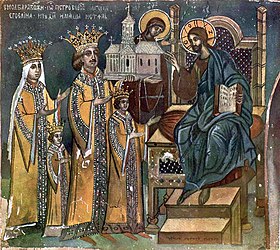 Peter Raresh | |||||||
| |||||||
| Predecessor | Stephen IV | ||||||
| Successor | Stefan V Lacusta | ||||||
| |||||||
| Predecessor | Alexander Kornia | ||||||
| Successor | Ilya II Raresh | ||||||
| Birth | OK. 1487 | ||||||
| Death | September 3, 1546 Suceava, Principality of Moldova | ||||||
| Kind | Musati | ||||||
| Father | Stephen III the Great | ||||||
| Mother | |||||||
| Spouse | Elena, daughter of John Brankovich | ||||||
| Children | Ilya II Raresh , Stefan VI Raresh , Yanku Sasul ( bastard ) | ||||||

Content
First board
Peter was the illegitimate [4] son of Stephen III the Great from from Hirlau [5] . His mother, Maria, was the wife of a rich boyar nicknamed Raresh - "beardless." This nickname was inherited by Peter [6] .
In 1526, Hungary lost the battle of Mojac and this led to the strengthening of the Ottoman Empire. Under such conditions, Peter IV Raresh, who came to power in 1527, was forced to increase the amount of tribute to the Ottomans from 8 thousand to 10 thousand gold [7] . Peter IV Raresh led an active foreign policy. Initially, in the struggle for the Hungarian throne, he supported Ferdinand I of Habsburg . But under Ottoman pressure, he changed politics. He entered into an agreement with Janos I Zapolyayi that Peter provides support, but for this he receives the Rodna and Bistrita fortresses and the silver mines in Transylvania. On June 22, 1529, Peter Raresh defeated the troops of Ferdinand's supporters at Feldvar. An attempt to capture Bystrica and Brasov in the fall of 1529 ended in failure. Peter Rareş received from the Janos Zapolyai fortresses Ungurash, Chicheu, Cetati de Balté and the bishopric of Wad [8] . In 1530, Peter again tried to return Pokutye (once again ceded to Poland by the Moldavian ruler Bogdan III Krivoy in 1505 ). In the winter of 1530, the Moldovan troops occupied the disputed territory, but after the Polish army defeated the Battle of Obertin on August 22, 1531 , the Moldovan troops retreated [9] , losing artillery. Peter Rareš was wounded. In 1532, peace was concluded with Poland [10] .
He tried to continue his father's policy of strengthening central authority. Relying on small boyars, he limited the influence of large ones. The discontent of the latter resulted in conspiracies. Peter Raresh began preparations for the liberation of Moldova from Turkish rule and for this purpose established relations with the governments of many countries. In 1533, trying to find new allies, Peter IV Raresh sent ambassadors to Russia . In 1535 he entered into a secret anti-Ottoman treaty with Ferdinand I of Habsburg. In Europe, the Holy League formed , which planned to use the involvement of the Ottoman Empire in the war with Persia . In September 1538, the Turkish army headed to Sultan Suleiman headed for Moldova, Crimean Tatars invaded from the east, and Poles from the north. The troops of Peter Raresh initially resisted the Ottomans and even defeated them under Khotyn . But after the Turkish army took the capital of the Principality of Suceava and the betrayal of the boyars, who expressed allegiance to the Sultan, Peter Raresh fled the country. Since that time, Moldova has finally come under the rule of the Ottoman Empire . The Sultan subjugated the areas between the Prut and the Dniester , and the Crimean Tatars received Budzhak . The new lord was imprisoned by Stefan Lacusta [11] .
Second board
Peter Raresh, finding no support from the boyars, hid in Transylvania [12] . Stefan V Lacusta died as a result of a conspiracy, Alexander Kornya also tried to free himself from Turkish rule. In this situation, in 1541, Peter Raresh again became the sovereign, having received the throne of Moldova from the Turkish Sultan. But for this, he undertook to increase the size of the tribute to 12 thousand gold, recognized the territorial losses of 1538, the Turkish garrison was located in Suceava, and his son Ilya went to Istanbul as a hostage [13] . Peter this time began to strengthen the central government, executed the leaders of the boyar opposition. In 1542 he entered into an agreement with the Habsburgs , supported anti-Turkish forces, was connected with Russia , receiving material assistance from there. Peter Raresh founded several monasteries and churches in Bae, Botosani, Hirlau, Targu Frumos and Roman [14] .
Family and Children
Husband 1) Maria 2) from April 1530 Elena, daughter of John Brankovic , Serbian despot (-1552) [15]
- Ilya II Raresh (c. 1531 - January 1562), ruler of the Principality of Moldavia in 1546–1551 [16]
- Stephen VI Raresh , ruler of the Principality of Moldavia in 1551–1552 [17]
- Constantine (- March 26, 1554) [18]
- Iancu Sasul . The illegitimate son of Peter [19] , born of the Transylvanian German Catherine Weiss , Lutheran by religion , ruler of the Principality of Moldova in 1579-1582. Husband of Maria Palaiologus ( English Palaiologina ) [20]
- Anna (- 1542/1546). The wife of Vlad VII Inekatula (the Drowned Man) , ruler of Wallachia in 1530-1532 [21]
- Maria (-1614/1616) In a number of sources, she is called the daughter of Peter from her first marriage with Mary Chernet, which is unlikely. Most plausible is her descent from Elena Brankovich . Wife 1) Isaac Balish 2) John the Grave , the ancestor of the rulers from the family of Graves [22] .
- , wife of Mircea V Shepherd, Lord of Wallachia [23]
- (- 1570) Wife of Alexander III Lepusnianu [24] , ruler of the Principality of Moldova in 1552-1561 and 1564-1568
Notes
- ↑ BDT: Peter Raresh
- ↑ BDT: Peter Raresh
- ↑ Muşatin family
- ↑ BDT: Peter Raresh
- ↑ Muşatin family
- ↑ BDT: Peter Raresh
- ↑ Brief History of Romania p. 64
- ↑ BDT: Peter Raresh
- ↑ Brief History of Romania p. 65
- ↑ BDT: Peter Raresh
- ↑ Brief History of Romania p. 65
- ↑ BDT: Peter Raresh
- ↑ Brief History of Romania p. 65
- ↑ BDT: Peter Raresh
- ↑ Muşatin family
- ↑ Muşatin family
- ↑ Muşatin family
- ↑ Muşatin family
- ↑ Muşatin family
- ↑ Muşatin family
- ↑ Muşatin family
- ↑ Muşatin family
- ↑ Muşatin family
- ↑ Muşatin family
Literature
- A brief history of Romania. / Executive Editor, Doctor of Historical Sciences Vinogradov V.N. - Moscow: Nauka, 1987. - P. 64 - 65. - 34,200 copies.
Links
http://istoria.md/articol/84/Petru_Rare%C5%9F
Postage stamp Moldova, 1995
Commemorative Coin of Moldova, 2007
Bust of Peter Rares in the Moldovitsa Monastery, Suceava County, Romania.
The tomb of Peter Raresh and Madame Helena (his wife) is the tomb of the church of the monastery of Probota, Romania.
| Predecessor: Stephen IV | Ruler of the Principality of Moldova 1527 - 1538 | Successor: Stefan V Lacusta |
| Predecessor: Alexander Kornia | Ruler of the Principality of Moldova 1541 - 1546 | Successor: Ilya II Raresh |