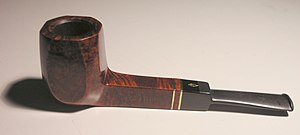
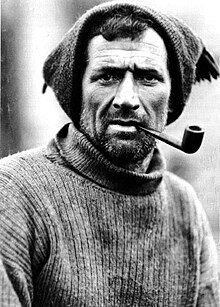
A pipe is a smoking device for specially prepared and chopped tobacco .
Smoking a pipe is one of the first ways to use tobacco. The pipe was widespread until the middle of the 20th century, when it was heavily crowded with cigarettes and cigarettes . Depending on the shape, the tube has its own name. For example, brandy, poker, liverpool, etc. .. In conversation with the Slavs, the tube is called a cradle .
The eastern modification of the smoking pipe is a hookah , but it has a more complex system and is used not only for smoking for tobacco, but for fruit and tobacco mixtures.
Content
History
Materials used for manufacturing
A good pipe, as a rule, is a briar or, less often, a punkan one .
Tree
One of the best materials is briar , used since the 19th century. Such tubes are called heather or briar. The main advantage of briar is fire resistance. Sometimes - for the sake of cheapness, or because of a lack of briar - a pear or beech is used. Other wood is even worse; coniferous wood is not suitable at all. Briard for tubes can be of very different quality, and, accordingly, price. It is distinguished by country of origin, by fiber structure, by genus and number of defects such as voids and ingrown sand grains. The quality of the original briar significantly affects the taste and appearance of the tube. The procurement of good material is a special skill, it must be collected, cut, boiled in water in a special way, dried, aged.
Sea foam
Good material is sand ( meerschaum ) - a white porous mineral whose main deposits are in Turkey. Used since the 19th century. Such tubes are called punk. Foam tubes are usually decorated with carvings. At the ancient pipes, only a cup was made of the foam itself, and the forelock and mouthpiece were usually wooden. The more expensive tubes had a foam chubuk made up of several parts, amber was used for mouthpieces. Modern foam tubes in shape and design are close to briar ones. Cheap tubes are usually made of pressed crumbs, which does not compare with a real tube from a solid monolithic piece of foam. When smoking, the white foam acquires brownish hues.
Clay and Porcelain
The oldest and once the most massive variety of pipes. European tubes were usually solid and had a small cup and a long thin chubuk (aka the mouthpiece). They had a characteristic protrusion under the cup, designed to ensure that a very hot tube could be safely held without burning. Such tubes easily broke, but they were mass-produced and were cheap. Such a pipe could be allowed to be used (for example, in a hotel - to guests). For hygiene, a new person could simply break off the tip of the mouthpiece or calcine a red-hot tube on a fire in a stove or fireplace. Turkish clay pipes, on the contrary, had an earthenware bowl, a wooden mouthpiece and were similar in structure to foam.
Gourd Gourd (Calabash)
The main feature of pumpkin tubes is an air chamber located below the bowl, in which the smoke is cooled, dried and softened. Usually associated with the image of Sherlock Holmes , which is a fallacy. [one]
Corn Stalk
Quite high-quality and cheap pipes of this type were common in America in the 19th - early 20th centuries. Corn tube is considered by connoisseurs to be an inexpensive alternative to briar tubes in terms of “taste”. They quickly burn out (in less than 2 years), after which they have to be replaced with new ones, since this is not a problem due to their low price. One of the most famous users of this type of tube was General Douglas MacArthur , captured with such tubes (usually produced by Missouri Meerschaum Company) in many of his famous photographs.
Morta
Fossil oak wood (the so-called "bog oak"), which has been without air in water bodies for thousands of years, acquires special properties: fire resistance and hardness. This material is usually used by pipe masters both for the manufacture of tubes and for the manufacture of decor for tubes (rings, inserts, etc.)
Metal
Metal for tobacco pipes is used only for the manufacture of parts chubuk, mouthpiece or finish. Tubes with a metal cup (usually of Oriental origin), as well as wooden tubes with a strictly conical bowl, are usually intended for drugs like hashish and opium.
Stone
Indians , in particular Sioux , used the Catlinite mineral to make tubes .
Other materials
The tubes are made of birch , mahogany or even bread crumb. Recently, plastic tubes have appeared. Due to the poor characteristics of these materials - these tubes can be considered souvenir.
Handset device
The tube consists of several parts, each of which performs certain functions. They are, in principle, the same for all types of tubes
A bowl is a round, wide part of the tube with a tobacco chamber inside. The size of the bowl depends on the type of tobacco used: large bowls are best suited for tobaccos that burn relatively quickly, and small ones for slowly smoldering ones.
Tobacco chamber - part of the bowl of the pipe filled with tobacco. A layer of carbon deposits forms on the walls of the tobacco chamber during smoking, which protects wood and absorbs moisture. Such a protective layer is sometimes applied already in the manufacture of the pipe (this process is called carbonization), but this does not eliminate manual smoking.
Chubuk - is a continuation of the cup, they are often made from one piece. The hollow inside the cup serves as a conductor of smoke from the cup to the mouthpiece. Some pipes have holes in the chubuk through which air enters the smoke channel and mixes with smoke, which makes smoking supposedly easier.
The mouthpiece is a part of the pipe, one end of which the smoker holds in his mouth, and the other is connected to the pipe. It creates a tight connection with the chubuk, but it must be cleaned separately.
The mouthpiece (bite) is the end of the mouthpiece that is held between the teeth and lips. Its shape largely determines the sensations obtained by smoking.
The usual mouthpiece is of the traditional and most common form: the end of the mouthpiece is flat, and the smoke from the channel widening towards the exit falls directly onto the tongue. To avoid this, a special type of mouthpiece was invented - the Peterson P-Lip system. In this case, smoke exits through an opening in the upper part of the mouthpiece in the direction of the palate. The tip of the tongue is located in a small recess of the mouthpiece. The advantages of this form must be assessed yourself - for some smokers, the smoke going to the palate is less pleasant than when in contact with the tongue. True, tubes with such mouthpieces are much more difficult to clean.
The neck of the mouthpiece (trunnion) is the part of the mouthpiece by which it is connected to the chubuk. Usually, this is the weakest part of the design. It can be made metal on a cone - usually silver, such a connection is called "spigot" or "pseudospigot" depending on the design.
Smoke channel - the space through which smoke passes from the cup to the mouthpiece through the forelock. Can be designed to use an insert filter. The quality of the channel dressing greatly affects the properties of the tube as a whole.
The filter is a removable insert in the flue channel for regulating and cooling the flue stream. Usually made in the form of a cardboard sleeve with activated carbon or paper twist with a diameter of 3, 6 or 9 mm. There are filters in the form of balsa cylinders, as well as other exotic and home-made designs. The tube is specially made for a filter of a certain size, but the filter tube can be used without a filter, or with a special reusable insert that replaces it. It is believed that the filter also serves to adsorb nicotine and tar, as well as to reduce the moisture content in tobacco smoke, but its role is much less important than that of a cigarette filter, since the pipe smoker does not drag out. Almost all filters affect the taste, and if the tobacco is too aromatic or spicy, the filter can protect against burning tongue. But when smoking high-quality tobacco blends, the most delicate taste tones are sometimes absorbed, which, in fact, give pleasure to the smoker. Less than others, the filters are made of balsa wood, foam or paper. If you do not remove the filter after smoking, then it returns the moisture accumulated by it to the wood and the pipe simply deteriorates.
Pipe Accessories
Before smoking, the pipe must be filled; when smoking, the ash must be properly compacted; after smoking, cleaned. The handset needs to be stored somewhere and worn in some way. For these reasons, the handset requires a number of related items:
- Trampler, otherwise - tamper. Serves to seal the tobacco in the bowl when stuffing and when smoking. It happens both as a separate item and as part of a “tee” along with an awl and a spoon. May be subject to art and collectibles.
- Yorshik . Usually brushes - disposable, sold in packs. There are different colors, thicknesses and lengths. They can be used for crafts, including children’s - they can be bent, they are fluffy, keep their shape.
- All kinds of cans for tobacco. An essential requirement for them is that the jar is tightly closed and does not have its own strong smell. For this reason, the range of cans is very wide: from laundered cans to special, expensive and piece. If a pouch is used, it is only for carrying a stock for several days. In factory packaging, tobacco can only be stored for a long time until the packaging is printed.
- All sorts of storage racks, from the simplest to large cabinets and display cases.
- Knives and other various devices for the care of soot.
- Tube bags. Designed for several pipes, they usually have a place for minimal supplies - tobacco, filters, brushes.
- Pipe lighters. Good pipe lighters do not give an odor, their flame tongue, unlike ordinary lighters , is directed to the side. However, almost the usual means of lighting remain ordinary matches - they only need to be allowed to flare up.
- Care products, such as polishes to improve the look, cleaning products, pastes for smoking, etc. The benefits of using various chemicals for smoking and daily cleaning of the pipe are debatable.
On the other hand, quite a few smokers do not care for their pipes in any way and store them in a heap, anywhere. However, they are quite happy with their pipes. When cleaning (which sooner or later will still be required), such tubes require more radical means, in addition, the running pipe of a good master is still valued lower than the one that was kept neatly.
Smoking pipe
Stuffing Methods
Stuffing a pipe is a purely individual matter, both for a person and for tobacco and a pipe. There are a lot of ways of stuffing.
Pipe smoking
Every pipe must be smoked to achieve the best possible taste. There is no reliable recipe on exactly how to do this. In any case, smoking means the transfer of a pipe from a new state to a working state. We can say that a new tube always requires careful handling, if only because its properties are not yet fully known. Smoking can lead to unexpected effects - both a strong improvement in the properties of the pipe, and to identify unpleasant defects and disappointment.
Smoking approaches are highly dependent on the material of the pipe, its construction, tobacco used, personal preferences, traditions and prejudices. Occasionally there is a highly controversial opinion that only an experienced smoker should smoke a pipe. The so-called “pre-bored” pipes are, in fact, only processed in a special way to reduce the risk of burnout and facilitate smoking (the so-called “carbonization”).
Health Impact
Like other methods of smoking tobacco , excessive pipe smoking has a lasting negative effect on the health of the smoker and the health of those around him or her non-smokers.
In contrast to this opinion, one can point to some people who have lived to a very old age and have constantly smoked a pipe (for example, the famous English philosopher Bertrand Russell , 1872-1970). Thus, we can say that the effect of pipe smoking on health has not yet been sufficiently studied (the effect of cigarette smoking on human health is much better studied).
Famous people who smoked and smoked a pipe
Real:
- Yakir Aaronov , Israeli theoretical physicist
- Bob Marley , a Jamaican musician, cleric, and poet.
- Vsevolod Aksyonov , Russian actor
- Pavel Antokolsky , Soviet poet
- Pavel Bazhov , writer
- Bach, Johann Sebastian , German composer, virtuoso organist
- Alexander Graham Bell , scientist and inventor, creator of one of the first phones
- Igor Birman , Soviet-American economist
- Grigory Bongard-Levin , Russian Orientalist, Academician
- Niels Bohr , Danish theoretical physicist
- Yul Brynner , American actor
- Rolan Bykov , Soviet and Russian actor
- Alexander Vasilevsky , Soviet military leader, Marshal of the Soviet Union
- Yuri Vizbor , Soviet bard
- Georgy Vilinbakhov , Russian historian
- Evelyn Waugh , English writer
- Vladimir Voroshilov , author and host of “ What? Where? When? "
- Robert Wood , American experimental physicist
- Pelam Grenville Woodhouse , English writer
- Igor Vsevolozhsky , Soviet writer
- Arkady Gaidar , Soviet writer
- North Gansovsky , Soviet science fiction writer
- Jaroslav Hasek , Czech writer
- William Clark Gable , American actor, "King of Hollywood"
- Gilbert Ryle , English philosopher
- Stanislav Govorukhin , director and screenwriter
- Vincent Van Gogh , artist
- Stanislav Gagarin , Soviet writer
- Grigory Gorin , writer, playwright
- Clement Gottwald , Czechoslovak politician
- David Goloshchyokin , jazz musician, composer
- Gunter Grass , German writer, Nobel laureate
- Edmund Husserl , German philosopher, founder of phenomenology
- Allen Dulles , Director of the CIA, 1953-1961
- Jacques Derrida , French philosopher
- , American chemist
- Georgy Dimitrov , Bulgarian politician
- Walt Disney , American animator
- Ivan Dykhovichny , actor and director
- Sergey Yesenin , poet
- Ivan Efremov , Soviet writer
- Alexander Zguridi , film director
- Immanuel Kant , German thinker and founder of German classical philosophy
- Lev Kantorovich , Soviet writer
- Pyotr Kapitsa , Soviet physicist, Nobel laureate
- Isaac Kikoin , Soviet physicist, academician of the USSR Academy of Sciences
- Yuri Koval , Soviet children's writer
- Mikhail Kozakov , Soviet, Russian and Israeli actor and director
- Helmut Kohl , Federal Chancellor of Germany
- Arthur Conan Doyle , Doctor and Writer
- Ivan Konev , Soviet military leader, Marshal of the Soviet Union
- Yefim Kopelyan , Soviet actor
- Yuri Levitan , poet
- Leonid Leonov , writer
- Clive Staples Lewis , English writer
- Madonna , singer
- Douglas MacArthur , US military commander
- Evgeny Mironov , Russian actor
- George Edward Moore , English philosopher, co-founder of analytic philosophy
- Vasily Molokov , Soviet polar pilot
- Alexander Nevzorov , Russian journalist
- Pablo Neruda , Chilean poet
- Andrey Nechaev , Russian politician
- David Ogilvy , Founder of Advertising Agencies
- Sean O'Casey , Irish playwright
- George Orwell , English writer
- Julius Robert Oppenheimer , American theoretical physicist, “father of the atomic bomb”
- Maxim Litvinov , Soviet revolutionary and diplomat
- Wolfgang Pauli , German theoretical physicist
- Peter I , the Russian emperor
- Boris Pilnyak , Soviet writer
- Vyacheslav Polozov , Soviet and Russian opera singer
- Panteleimon Ponomarenko , Soviet statesman
- Karl Radek , Soviet party leader
- Bertrand Russell , English philosopher and mathematician
- Nikolai Rastorguev , singer
- Ronald Reagan , American President
- Norman Rockwell , American artist
- Yuri Rost , Russian photographer
- David Samoilov, poet
- Jean-Paul Sartre , philosopher, writer
- Gennady Seleznev , Russian politician
- Sitting Bull , leader of the Hunkpapa Indian tribe
- Georges Simenon , French writer
- Konstantin Simonov , Soviet poet and journalist
- Frank Sinatra , American singer
- Vincent Schiavelli , American actor
- Dr. Seuss , American children's writer and animator
- Valentin Smirnitsky , Soviet and Russian actor
- Andrey Sommer , Major General of Tank Forces, Hero of the Soviet Union
- Joseph Stalin , Soviet leader
- Mikael Tariverdiev , Soviet composer
- Mikhail Tanich, songwriter
- Mark Twain , American writer
- Konstantin Telegin , Soviet military leader
- Vyacheslav Tikhonov , Soviet artist
- John Ronald Roel Tolkien , writer
- Alexey Tolstoy , Soviet writer
- Igor Ugolnikov , Russian actor, showman and producer
- Oscar Wilde , English writer
- , Rhodesian politician, Prime Minister of Southern Rhodesia
- Maria Ulyanova , sister of V.I. Lenin
- Alan Watts , British writer and philosopher
- Konstantin Fedin , Soviet writer
- Ronald Aylmer Fisher , English statistician, evolutionary biologist and geneticist
- Gerald Ford , American President
- Edwin Hubble , American Astronomer
- Friedrich von Hayek , Austrian economist and thinker, founder of libertarianism
- Daniil Harms , Russian / Soviet poet and writer
- Golfrey Harold Hardy , English mathematician
- Ruslan Khasbulatov , Russian politician
- Eduard Khrutsky , Soviet writer and screenwriter
- Hugh Hefner , founder and chief editor of Playboy magazine
- Osip Zadkin , French sculptor
- Baadur Tsuladze , Soviet and Georgian actor and film director
- Charlie Chaplin , American actor
- Valery Chkalov , Soviet pilot
- Alexander Shirvindt , Soviet / Russian actor and director
- Mikhail Sholokhov , Soviet writer
- Erwin Schrödinger , Austrian theoretical physicist
- Albert Einstein , German and American theoretical physicist
- Ilya Erenburg , Soviet writer
- Carl Gustav Jung , Swiss Psychiatrist and Educator, Parent of Analytical Psychology
- Felix Yavorsky , actor
- Oleg Yankovsky , Soviet and Russian actor
Fictional:
- Taras Bulba , an old Cossack - character of the story of the same name by Nikolai Vasilyevich Gogol
- Manilov, Nozdryov - landowners from the poem-novel by Nikolai Vasilyevich Gogol " Dead Souls "
- Silvio, a retired hussar officer from Alexander Sergeyevich Pushkin's novel “Shot”
- Vladimir Andreevich Dubrovsky, the main character of the novel by Alexander Sergeyevich Pushkin "Dubrovsky"
- Karl Bogdanovich Becker, power acrobat from the story of Dmitry Vasilievich Grigorovich "Gutta-percha boy"
- Commissioner Magray , detective from the works of Georges Simenon
- Sherlock Holmes , detective from the works of Arthur Conan Doyle (in later stories also Dr. Watson)
- John Sharkey, pirate captain from Arthur Conan Doyle's short stories
- Bilbo Baggins and other hobbits , Gandalf , Aragorn , Gimli - characters of the epic saga of John Tolkien " The Lord of the Rings "
- Grandmother - a character from the song of Garik Sukachev
- Grandma is a character from Alla Pugacheva’s song “When I Become Grandma”
- Snusmumrik and Yuksare, characters of Touve Jansson 's fairy tales about Moomins
- Tom Sawyer and Huck Finn , characters of the works of Mark Twain
- Davy Jones is a fictional character in the films Pirates of the Caribbean: Dead Man's Chest and Pirates of the Caribbean: At World's End
- Lanky John Silver, Dr. David Livesey, Esquire John Trelawney, Captain Alexander Smollett - characters from Robert Lewis Stevenson ’s Treasure Island
- Pierre-Cervan-Malo Antifer, the protagonist of Jules Verne’s novel “The Amazing Adventures of Uncle Antifer”
- Tartaren of Tarascon, the hero of the novels of Alphonse Dode
- Captain Peter Blood , the hero of the novels by Rafael Sabatini
- Captain Vrungel , Khristofor Bonifatyevich - the main character of the story of Andrei Sergeyevich Nekrasov "The Adventures of Captain Vrungel" (in the cartoon, his team is also - the headman Lom and the sailor Fuchs)
- Josef Schweik, innkeeper Palivets - characters of the novel “The Adventures of the Good Soldier Schweik” by Yaroslav Hasek
- Uncle Remus, the hero of Joel Chandler Harris’s book “Tales of Uncle Remus”
- Karabas-Barabas , the hero of the story of Alexei Nikolayevich Tolstoy "The Golden Key, or The Adventures of Pinocchio"
- The tightrope walker Tibul, character of the novel “Three Fat Men” by Yuri Karlovich Olesha
- Charlie Black, one-legged sailor from the stories of Alexander Melentievich Volkov about the Magic Land
- The red-bearded fisherman, the father of Penta, is a character in the fairy tale story by Korney Ivanovich Chukovsky “Doctor Aibolit”
- Old guard, hero of Arkady Petrovich Gaidar's story “Hot Stone”
- Carlson , character of Astrid Lindgren ’s book “The Kid and Carlson, Who Lives on the Roof”
- A soldier, the protagonist of the fairy tale by Hans Christian Andersen "Flint"
- Duvanov, a pest and a simulator from the novel “Golden Calf” by Ilya Ilf and Evgeny Petrov
- Victor Kovrov, a researcher at the NUINU Institute (feature film “ Wizards ”)
- Corwin, the hero of the epic R. Zhelyazny "The Chronicles of Amber"
- Crocodile Gena , character of fairy tales by Eduard Nikolaevich Uspensky
- Sir Juffin Halley - character of the series of works "Exo Labyrinths" by writer Max Fry
See also
- Peace tube
- Hookah
- Tree Heather (Erica aborea)
- Pipe tobacco
Notes
- ↑ http://www.pipes.org/Articles/140_Different_Varieties.text Archived July 5, 2008 at Wayback Machine John Hall. 140 Different Varieties. Ian Henry books. ISBN 0-9522545-1-4
Literature
- Gaev D. Tubes. - M .: Publishing house of Anton Zhigulsky, 2006. - 304 p. - The circulation is not specified. - ISBN 5-902617-21-9