Kurenberg ( German: Der von Kürenberg, Kürenberger ) is a German medieval poet of the early Minnesang period.
| Kurenberg | |
|---|---|
| Kuerenberg, Kuerenberger | |
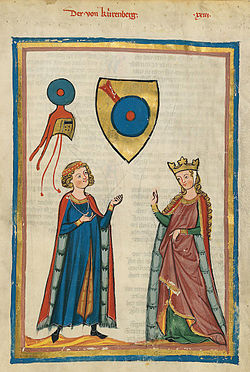 Codex of Manes , 14th Century | |
| Date of Birth | |
| Place of Birth | |
| Date of death | |
| Citizenship |  Holy Roman Empire Holy Roman Empire |
| Occupation | poet |
| Years of creativity | 1150 - 1170 years |
| Direction | lyrics |
| Genre | minnesang |
| Language of Works | Middle High German |
Content
Biography
Like Ava , the first woman poet to write in Middle High German , Kurenberg lived and worked in an area near Linz near the Danube . It is assumed that the poet borrowed his name from the name of this area [1] . However, among the serving noblemen of Austria and Bavaria, several persons testified who named themselves in this way [2] .
Kurenberg is considered one of the earliest minnesingers. His works, tentatively dated 50 - 70 years of the XII century , have survived to this day mainly in medieval songbooks , for example, in the Codex of Manes .
Creativity
The poet’s work, which German literary scholars have traditionally attributed to the folk direction of the Minnesang, is more or less free from the courtly canons of the Provençal-French lyrics and bears traces of its original origin [3] [4] [5] . This is evidenced by the archaic style of versification and traditional poetic images dating back to folk song and heroic epic . So, poems, as a rule, are one-stropic , characterized by paired, often inaccurate rhymes , a simple metric and accent structure; in some works there is the so-called " Nibelung stanza " [Note. 1] :
| Example | |
|---|---|
(translation by B. Yarho [6] ) | in Middle High German |
“I stood late at night at the loophole | "Ich stuont mir nehtint spâte an einer zinne, |
In addition, the concept of love of Kurenberg, like that of other early poets, differs significantly from the doctrine of courtesy of the Lady. Minnesinger glorifies
| ... not a refined, not conditional, artificial love that obeys certain rules and order, but a simple, healthy, very real feeling [3] . |
Many songs are composed in the original lyrical genre of “female song”, often addressed specifically to a young unmarried woman, a girl complaining of loneliness and leaving her lover.
| Example | |
|---|---|
(translation by V. Mikushevich [7] ) | in Middle High German |
“This clear falcon was tamed by me. | "Ich zôch mir einen valken mêre danne ein jâr. |
Longing for love, longing for a beloved is considered the inheritance of a woman, a man, as a rule, is portrayed as a proud and domineering knight, a winner in a love struggle [8] . Traditional folklore images are used: for example, the happy or woeful experiences of heroes are embodied in images of spring or autumn; a man is compared to a falcon, and a woman is compared to a rose.
| Example | |
|---|---|
(translation by V. Mikushevich [9] | in Middle High German |
"When in one shirt, sleepless, I stand | "Swenne ich stân aleine in mînem hemede, |
Notes
- ↑ The poet himself calls it "the size of Kurenberg", which gave rise to some scholars to consider him the author of one of the earliest editions of the Song of the Nibelungs .
- Sources
- ↑ Purishev B.I. Lyric poetry of the Middle Ages // Poetry of the troubadours. The poetry of the minnesingers. Vagant poetry / comp. Purishev B.I. - M.: Fiction, 1974. - V. 23. - S. 5-28. - 348 p. - (BVL)
- ↑ Purishev B.I. Foreign Literature of the Middle Ages: Reader / comp. Purishev B.I. - M.: Higher school, 2004 .-- 816 p.
- ↑ 1 2 Ivanov K. A. Troubadours, Truvers and Minnesingers. - PG: Tipolithography of M.P. Frolova, 1915. - 348 p.
- ↑ Matyushina I.G. Minnesingers // Dictionary of Medieval Culture / Pod. ed. A. Ya. Gurevich. - M.: ROSSPEN, 2003 .-- 664 p. - (Summa Culturologiae). - ISBN 5-8243-0410-6
- ↑ Zhirmunsky V.M. , Purishev B.I. et al. History of German literature in 5 vols. - M.: Publishing House of the Academy of Sciences of the USSR, 1962. - T. 1. - 470 p.
- ↑ Kurenberg . “I stood late at night at the loophole ...” // Foreign literature of the Middle Ages: anthology / Comp. B.I. Purishev. - M .: Higher. school, 2004.
- ↑ Kurenberg . “This clear falcon was tamed by me ...” // Foreign literature of the Middle Ages: anthology / Comp. B.I. Purishev. - M .: Higher. school, 2004.
- ↑ Alekseev M.P., Zhirmunsky V.M. et al. History of Foreign Literature. Middle Ages and Renaissance. - M.: Higher School, 1987. - p. 84
- ↑ Kurenberg . “When in one shirt, sleepless, I stand ...” // Lyric poetry of the Middle Ages // Poetry of the troubadours. The poetry of the minnesingers. Vagant poetry / comp. Purishev B. I - M.: Fiction, 1974. - V. 23. - (BVL).
Literature
- Kurenberg // Brockhaus and Efron Encyclopedic Dictionary : in 86 volumes (82 volumes and 4 additional). - SPb. , 1890-1907.
- Lachmann K. / Haupt M. Minnesangs Frühling. - Leipzig / Stuttgart, 1875 / 1959. = Lachmann K. / Haupt M. - Spring minnesang. - Leipzig / Stuttgart, 1875/1959.