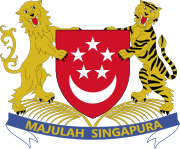
The coat of arms of Singapore is the official symbol of the island state of Singapore , located in Southeast Asia. The coat of arms was adopted in 1959, when Singapore gained self-government as part of the British Empire. The committee, led by Deputy Prime Minister To Chin Chai, adopted the coat of arms, as well as the national flag and anthem of Singapore. Only the government can use the state emblem, but it is widely used on state money and insignia, as well as on the passport of Singapore citizens. In 1963, as a result of a referendum, Singapore entered the Federation of Malaysia, on the emblem of which were presented the emblems of its constituent territories. After Singapore left the Federation in 1965, the former coat of arms of 1959 was restored.
| Coat of arms of Singapore | |
|---|---|
 | |
| Details | |
| Approved by | 1959 |
| Shield | a scarlet shield in which silver crescent horns up and above it 5 five-pointed stars in a circle |
| Shield holders | Lion and tiger |
| Base | Palm leaves |
| Motto | Majulah singapura |
Content
Description
The coat of arms of Singapore is a scarlet shield, which depicts a silver crescent with its horns up and five five-pointed stars placed in a circle above it. Shield holders - a rising lion and a tiger (looking straight) in natural colors, standing on two golden palm leaves with a azure ribbon on which the motto in Malay is inscribed with golden letters: "Majulah Singapura".
Symbols
The new moon symbolizes a young nation on the rise, and five white stars reflect various national ideas, including multiculturalism. The coat of arms is supported by the uprising lion and tiger on guard, symbolizing Singapore and Malaysia proper, into which it previously entered, respectively. Below them is a blue ribbon with a gold inscription Majulah Singapura , which is translated from Malay means "Forward, Singapore!".
History
After Singapore gained self-government in 1959, Prime Minister Lee Kuan Yew decided to create a new national emblem to replace the British emblem that was in use until then [1] . A committee for the development of state symbols was created, headed by Deputy Prime Minister To Chin Chai. According to his vision, the flag and coat of arms of Singapore should reflect the unity of the state and its multinational society. The state symbols committee headed by To Chin Chai created within two months. Minister of Culture S. Rajaratnam submitted to parliament a bill on new state symbols, approved in November 1959. On December 3, 1959, the national emblem, flag and anthem were first presented to the peoples of Singapore [2] .
Chin Chai recalled in an interview in 1989 that when he received the task of creating state symbols, in addition to the anthem, he also had to create a flag and coat of arms. And then he felt that the new flag of Singapore should be waving next to the British [3] . To Chin Chai about development of the coat of arms
“For the national emblem, we took five stars and a young month ... A lion next to a tiger. The tiger, of course, is an animal more inherent in our area than a lion. The old city council used the lion symbol. It really resonated with our own ideas about Singapore's self-government. ”
Symbolism
The emblem's central emblem is a red shield and five white stars resting above a white crescent. Similar stars and a crescent moon are used in the Singapore flag and the national maritime flag for civilian vessels. Red color symbolizes “common brotherhood and equality of people”, and white symbolizes “comprehensive and eternal purity and virtue.” The crescent reflects “a young nation that is growing,” and five stars - “national ideals: democracy, peace, progress, justice and equality” [4] . The shield is supported by a lion on the left, and a tiger on the right. The lion symbolizes Singapore [5] , and the tiger is a close historical connection between Singapore and Malaysia, which it included in from 1963 to 1965. The motto of Singapore is written in gold letters on the blue ribbon at the bottom of the coat of arms: Majulah Singapura, which in Malay means "Go Singapore!" The national anthem has the same name. Malay is one of the official state languages of Singapore.
Usage
In 1985, the Monetary Authority of Singapore (MAS) began issuing a second series of coins. On their back was a state emblem, surrounded by an inscription with the name of Singapore in the four official languages (Chinese, Malay, Tamil and English), as well as the year of minting. In 1987, dollar coins with a similar image were issued [6] . According to the MAS management, the emblem also appeared on all Singapore banknotes, starting with the "orchid" series in 1967 [7] . Singapore state awards also contain coats of arms. For example, the medallions Darjah Utama Temasek and Sijil Kemuliaan use the full coat of arms [8] [9] , while the medal Darjah Utama Bakti Cemerlang only shows a shield [10] .
Recommendations for use
According to the Singapore National Coat of Arms, Flag and Anthem Act, only the government may use the emblem. Without a properly issued permit from the Ministry of Information, Communication and Arts (MICA), no citizen or group of citizens has the right to print (in the form of leaflets, business cards, etc.), squeeze out (books, magazines, etc.), produce or sell items, in which the state emblem is used, and it is also forbidden to actively or idly promote such illegal actions. It is also forbidden to use any symbols that can be easily confused with the emblem. To use the state emblem in literary work, you must obtain prior permission from the ministry. The law provides the only exception: the emblem can be used by governments and ministers in the external design of their homes, as well as on printed documents [11] .
Notes
- ↑ State Crest (inaccessible link) . Singapore: The Encyclopedia . Editions Didier Millet and the National Heritage Board (2008). Date of treatment December 25, 2008. Archived on October 6, 2011.
- ↑ Zaubidah Mohamed. National coat of arms (State crest) . Infopedia . National Library Board Singapore (June 9, 2003). Date of treatment December 25, 2008. Archived December 19, 2012.
- ↑ That, Chin Tea. Dr. Toh Chin Chye [oral history interview, accession no. A1063, reel 1]: journal. - National Archives of Singapore, 1989 .: State symbols . Access to Archives Online (a2o), National Archives of Singapore. Date of treatment November 4, 2007. Archived December 19, 2012.
- ↑ Second Schedule of the Singapore Arms and Flag and National Anthem Rules (Cap. 296, R 1, 2004 Rev. Ed.), As amended by the Singapore Arms and Flag and National Anthem (Amendment) Rules 2007 (S 377/2007) . See also Lee, Kuan Yew. The Singapore Story: Memoirs of Lee Kuan Yew. - Singapore: Times Editions, 1998 .-- P. 342–343. - ISBN 981-204-983-5 (hbk.).
- ↑ National Coat of Arms . Ministry of Information, Communications and the Arts (2010). Date of treatment August 30, 2011. Archived December 19, 2012.
- ↑ Singapore Circulation Coins - Second Series (link not available) . Monetary Authority of Singapore (March 19, 2007). Date of treatment December 24, 2008. Archived on June 7, 2007.
- ↑ Singapore Circulation Notes - Orchid Series (link not available) . Monetary Authority of Singapore (March 19, 2007). Date of treatment December 24, 2008. Archived on June 7, 2007.
- ↑ National Honors and Awards - The Order of Temasek . Office of the Prime Minister of Singapore (December 11, 2008). Date of treatment December 24, 2008. Archived December 19, 2012.
- ↑ National Honors and Awards - The Certificate of Honor . Office of the Prime Minister of Singapore (September 26, 2008). Date of treatment December 24, 2008. Archived December 19, 2012.
- ↑ National Honors and Awards - The Distinguished Service Order . Office of the Prime Minister of Singapore (September 26, 2008). Date of treatment December 24, 2008. Archived December 19, 2012.
- ↑ Singapore Arms and Flag and National Anthem Rules Archived July 10, 2010. (Cap. 296, R 1, 2004 Rev. Ed.), As amended by the Singapore Arms and Flag and National Anthem (Amendment) Rules 2007 Archived July 3, 2010. (S 377/2007).