Sodium lauryl sulfate ( English sodium lauryl sulfate, SLS ) or sodium dodecyl sulfate ( English sodium dodecyl sulfate, SDS ) - sodium salt of lauryl sulfuric acid, an anionic surfactant . It is an amphiphilic substance used in industry as a strong cleaning and wetting agent, machine oils, in the production of most detergents, shampoos , toothpaste, and cosmetics for the formation of foam . Also used in steelmaking. [one]
| Sodium Lauryl Sulfate | |
|---|---|
 | |
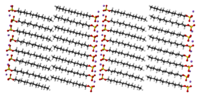 | |
| General | |
| Chem. formula | C 12 H 25 SO 4 Na CH 3 (CH 2 ) 11 OSO 3 Na |
| Physical properties | |
| Molar mass | 288.38 g / mol |
| Density | 1.01 g / cm³ |
| Thermal properties | |
| T. melt. | 206 ° C |
| T. decomp. | 216 ° C |
| Classification | |
| Reg. CAS number | 151-21-3 |
| PubChem | |
| Reg. EINECS number | |
| Smiles | |
| Inchi | |
| Codex Alimentarius | |
| Chebi | |
| ChemSpider | |
In protein electrophoresis, it is used to denature polypeptides and neutralize the charge of molecules. Used in lysis buffers to isolate nucleic acids from biological samples.
Content
Physical Properties
The powder is white. Combustible, spontaneous combustion temperature 310.5 ° C. Solubility in water - at least 130 g / l (at 20 ° C). The color of the aqueous solution of sodium lauryl sulfate is yellow to tan. In aqueous solutions forms a stable foam.
Biodegradability of sodium lauryl sulfate exceeds 90%, does not form toxic products upon decomposition .
Application
It is used as a powerful detergent in industry, pharmacology, cosmetology. The most common surfactant, often as part of various mixtures, such as Avirol and others. It is included in most cleaning formulations, including many toothpastes, shampoos, as it is cheap and provides effective foaming and cleansing. It is used in liquid chromatography as an ion-pair agent for the dynamic modification of sorbents.
Health Impact
Sodium lauryl sulfate can seriously worsen skin problems in patients with atopic dermatitis [2] [3] [4] .
As a component of toothpaste, it can cause stomatitis and the occurrence of aphthae [5] [6] [7] . Using toothpastes without sodium lauryl sulfate can reduce ulcers [8] .
It was shown that sodium lauryl sulfate irritates the skin of the face only with prolonged exposure (more than an hour) [9] .
According to the experts of the organization , which checks the safety of cosmetic ingredients), sodium lauryl sulfate and its related ammonium lauryl sulfate at a concentration of 2% cause skin irritation in experimental animals and some people. The irritating effect of these ingredients increases with increasing concentration and skin contact time. Therefore, prolonged use of detergents with sodium lauryl sulfate (or ammonium) can lead to dry skin, peeling, hair loss, comedones , and dermatitis. However, neither carcinogenic nor embryotoxic effects were detected in either sodium lauryl sulfate or ammonium lauryl sulfate (even in high concentrations).
Getting
Sodium lauryl sulfate can be obtained by esterification of dodecanol with sulfuric acid , followed by neutralization with sodium carbonate .
Industrial methods for producing sodium lauryl sulfate:
- sulfonation of lauryl alcohol with chlorosulfonic acid, evacuation, neutralization with sodium hydroxide, filtration, washing with alcohol, drying [1] ;
- sulfation of dodecyl alcohol with chlorosulfonic acid, treatment with amyl alcohol, neutralization, filtration, drying, recrystallization of the final product [10] ;
- sulfonation of lauryl alcohol with chlorosulfonic acid, removal of hydrogen chloride, neutralization with an alkali solution, filtration, drying (see USSR AS No. 682512)
See also
- Polyacrylamide gel electrophoresis of proteins in the presence of sodium lauryl sulfate
Notes
- ↑ 1 2 Patent RU 2271351. A method for producing sodium lauryl sulfate.
- ↑ Agner T. Susceptibility of atopic dermatitis patients to irritant dermatitis caused by sodium lauryl sulphate (Eng.) // Acta Derm. Venereol. : journal. - 1991. - Vol. 71 , no. 4 . - P. 296-300 . - PMID 1681644 .
- ↑ Nassif A., Chan SC, Storrs FJ, Hanifin JM Abnormal skin irritancy in atopic dermatitis and in atopy without dermatitis (Eng.) // Arch Dermatol : journal. - 1994 .-- November ( vol. 130 , no. 11 ). - P. 1402-1407 . - DOI : 10.1001 / archderm.130.11.1402 . - PMID 7979441 .
- ↑ Löffler H., Effendy I. Skin susceptibility of atopic individuals (neopr.) // Contact Derm .. - 1999. - May ( vol. 40 , No. 5 ). - S. 239-242 . - DOI : 10.1111 / j.1600-0536.1999.tb06056.x . - PMID 10344477 .
- ↑ Herlofson B., Barkvoll P. Sodium lauryl sulfate and recurrent aphthous ulcers. A preliminary study. (Eng.) // Acta Odontol Scand : journal. - 1994. - Vol. 52 , no. 5 . - P. 257—259 . - DOI : 10.3109 / 00016359409029036 . - PMID 7825393 . Archived December 17, 2008.
- ↑ Chahine L., Sempson N., Wagoner C. The effect of sodium lauryl sulfate on recurrent aphthous ulcers: a clinical study // Compend Contin Educ Dent: journal. - 1997 .-- December ( vol. 18 , no. 12 ). - P. 1238-1240 . - PMID 9656847 .
- ↑ Herlofson BB, Barkvoll P. The effect of two toothpaste detergents on the frequency of recurrent aphthous ulcers ( Act .) // Acta Odontol. Scand. : journal. - 1996 .-- June ( vol. 54 , no. 3 ). - P. 150-153 . - DOI : 10.3109 / 00016359609003515 . - PMID 8811135 .
- ↑ Healy C., Paterson M., Joyston-Bechal S., Williams D., Thornhill M. The effect of a sodium lauryl sulfate-free dentifrice on patients with recurrent oral ulceration. (English) // Oral Dis: journal. - 1999. - Vol. 5 , no. 1 . - P. 39-43 . - DOI : 10.1111 / j.1365-2133.2005.06490.x . - PMID 10218040 .
- ↑ Marrakchi S., Maibach HI Sodium lauryl sulfate-induced irritation in the human face: regional and age-related differences (Eng.) // Skin Pharmacol Physiol : journal. - 2006. - Vol. 19 , no. 3 . - P. 177-180 . - DOI : 10.1159 / 000093112 . - PMID 16679819 .
- ↑ GOST TU 6-09-07-1563-86