Fire salamander [1] [2] , or spotted salamander [1] [2] , or ordinary salamander [3] [2] ( lat. Salamandra salamandra ) - a species of animal from the salamander genus of the order of tailed amphibians . One of the most famous salamander species in Europe and the largest representative of the Salamandridae family. Fiery salamanders have a noticeable bright black-yellow color. Differ in big life expectancy. The species was first described in 1758 by the Swedish naturalist Karl Linnaeus .
| Fire salamander | |||||||||||||||||||||||||||||||||||
 | |||||||||||||||||||||||||||||||||||
| Scientific classification | |||||||||||||||||||||||||||||||||||
|---|---|---|---|---|---|---|---|---|---|---|---|---|---|---|---|---|---|---|---|---|---|---|---|---|---|---|---|---|---|---|---|---|---|---|---|
| |||||||||||||||||||||||||||||||||||
| International scientific name | |||||||||||||||||||||||||||||||||||
Salamandra salamandra Linnaeus , 1758 | |||||||||||||||||||||||||||||||||||
| Area | |||||||||||||||||||||||||||||||||||
| |||||||||||||||||||||||||||||||||||
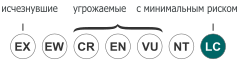
| Security status | |||||||||||||||||||||||||||||||||||

Content
- 1 Distribution
- 2 Description
- 3 Life cycle
- 4 Lifestyle
- 5 Subspecies
- 6 Security
- 7 In culture
- 8 Notes
- 9 References
Distribution
Fiery salamander lives in the forests and rolling hills of most of Western, Southern and Central Europe , as well as in the northern part of the Middle East .
The western border of the range covers the territory of Portugal , the east and north of Spain , as well as France .
The northern border of the range extends to the north of Germany , and the southern part of Poland . The eastern border reaches the territory of the Ukrainian Carpathians , Romania , Bulgaria and Iran .
There is evidence of a small population in eastern Turkey .
The range also includes the territories of Greece , Hungary , Italy , Albania , Andorra , Austria , Switzerland , Belgium , Bosnia and Herzegovina , Croatia , Slovakia , the Czech Republic , Luxembourg , Macedonia , Serbia , Montenegro .
The species is not found in the British Isles . [four]
In Ukraine, the species is found in Transcarpathian , Ivano-Frankivsk , Chernivtsi and Lviv regions. [5]
Description
Adult fire salamanders reach 23 cm in length, according to some sources up to 30 cm, the average body length is 16-19 cm, including the tail . The tail length is less than half of the total body length. The tail is round in cross section, very movable (can move the tip). The stocky body is predominantly colored intensely black with irregular yellow or orange spots. The shape and location of the spots are varied and variable. Often the spots merge and form strips. Often the spots on the head and paws are symmetrical, the rest are placed differently, but evenly over the body. The bright, contrasting color of the salamander (also called aposematic , that is, warning) serves to warn enemies that their prey is poisonous. The abdomen is usually black or brown, colored monotonously, lighter spots are possible. The limbs are short and strong, without swimming membranes. On the front legs four fingers and five on the back.
The head of the salamander is massive and round. Large bulging eyes are completely black, the eyelids are well developed. One can distinguish a female from a male by larger body sizes, shorter limbs and less convex cesspool . Females are wider. [6]
On the head are the parotid glands - parotids with an alveolar structure . The glands produce poison , which in its appearance is a viscous milky liquid with a specific odor of almonds or garlic . Its main components are steroidal alkaloids samandarin , samandaron , cycloneosamandaron and others. In total, the poison of the salamander contains 9 structurally similar alkaloids. [7] For mammals, the poison is toxic (the average lethal dose is 20-30 mg / kg for mice). The poison acts as a neurotoxin , causing paralysis , arrhythmia, and seizures . It also has antibacterial and antifungal effects. For salamanders, poison serves as protection against predators and infections. For humans, salamander venom is not dangerous, but the ingestion of poison on the mucous membranes causes a burning sensation. [8] In severe stress, the salamander can spray poison over a short distance. [9]
Life Cycle
The process of propagation of fire salamanders is not fully understood. In addition, significant differences in the breeding cycles of salamander of this species depending on the habitat and its height above sea level are known. [5]
The breeding season usually begins in early spring. At this time, the male in the area of the cloaca becomes more pronounced convex gland, producing a spermatophore.
Two subspecies of fire salamanders - S. s. fastuosa and S. s. bernardezi - viviparous animals, the female does not lay eggs, but produces larvae or, sometimes, even individuals that have completely undergone metamorphosis. The remaining subspecies practice egg production . Rare cases are known (when kept in captivity) when the female laid her eggs, but even in such cases, the larvae hatch very quickly.
Representatives of the species reach puberty at the age of 3 years. Life expectancy in the natural environment is up to 14 years; some specimens survived up to 50 years in captivity.
Lifestyle
The fiery salamander prefers deciduous or mixed forests , foothill and mountainous areas, and river banks. In the highlands it is found at an altitude of 2 km above sea level. Fire salamanders have a fairly strong attachment to a certain permanent habitat. [5]
Leads mainly night and twilight lifestyle. It does not tolerate high temperatures. Avoids the sun's rays, hides during the day under fallen trees, stones, in rotten stumps, abandoned burrows, in humid secluded places. Although her limbs are not adapted to burrowing actions, sometimes the salamander independently digs holes in soft soil. [5] On rainy days, with high humidity (about 90% or more) it can show normal activity, for which residents of the Ukrainian Carpathians sometimes call it the "rain lizard". [10]
The fiery salamander is an inactive animal, moves slowly on the ground, its body slightly bends, and its tail drags freely. [11] It swims poorly (it can even drown in deep water), therefore it approaches water bodies only during the breeding season. It feeds on various invertebrates : caterpillars of butterflies , dipterous larvae, spiders , slugs , earthworms , and can also eat small newts and young frogs . The salamander catches its prey by rushing forward with his whole body, and then trying to swallow it whole. [eleven]
From October-November it usually leaves for the winter until March. Winter is spent hiding under the roots of trees, under a thick layer of fallen leaves, often in large groups from twenty to several hundred specimens. [5]
The natural enemies in nature for salamanders are snakes ( common and water already ), predatory fish, birds and wild boars .
Subspecies
- Salamandra salamandra salamandra Linneaus, 1758 is a nominative subspecies that lives on the territory of the Balkan Peninsula , northern Italy , eastern Germany , southeast France and the Carpathians [12] .
- Salamandra salamandra alfredschmidti
- Salamandra salamandra almanzoris Müller and Hellmich, 1935
- Salamandra salamandra bejarae Mertens and Müller, 1940
- Salamandra salamandra bernardezi Gasser, 1978 - found in the Spanish province of Asturias and northern Spain. [12]
- Salamandra salamandra beschkovi Obst, 1981
- Salamandra salamandra crespoi Malkmus, 1983
- Salamandra salamandra fastuosa (bonalli) Eiselt, 1958
- Salamandra salamandra galliaca Nikolskii, 1918
- Salamandra salamandra gigliolii Eiselt and Lanza, 1956
- Salamandra salamandra hispanica Mertens and Muller, 1940
- Salamandra salamandra infraimmaculata
- Salamandra salamandra longirostris Joger and Steinfartz, 1994
- Salamandra salamandra morenica Joger and Steinfartz, 1994
- Salamandra salamandra semenovi
- Salamandra salamandra terrestris Eiselt, 1958 - distributed in France and western Germany. [12] The subspecies are distinguished by smaller average sizes. [5]
Security
The fire salamander is listed in the Red Book of Ukraine and is assigned to category II (vulnerable species). [13] In Europe, the species is protected by the Berne Convention for the Protection of European Species of Wild Fauna and their Habitats , concluded in 1979 (indicated in Appendix III - “Species of animals to be protected”) [14] .
In Culture
- The fiery salamander has always attracted a lot of attention from a person, largely due to its unusual appearance. Known myths and legends associated with the fire salamander, its image is used as symbolism. The ancient people were misunderstood the fact of the “appearance” of the salamander from the fire, which is simply explained in reality: if people threw a wet log with a salamander hidden in it from the sun, a moist tree extinguished the fire, and the salamander crawled out.
- In 2003, in Ukraine, the National Bank introduced the Salamander commemorative coin dedicated to the fire salamander - the only salamander species found in Ukraine. The coin is made of gold ; its face value is equal to two hryvnias . [15] [16]
- “Salamander” - Bonus Track from the album of the famous Russian neo-Gothic folk singer Helavisa (Natalya O'Shey) “Luciferase (Deluxe)”, which was released on December 14, 2018.
Notes
- ↑ 1 2 Animal life. Volume 5. Amphibians. Reptiles / ed. A. G. Bannikova , Ch. ed. V. E. Sokolov . - 2nd ed. - M.: Education, 1985. - S. 39. - 399 p.
- ↑ 1 2 3 Ananyeva N. B. , Borkin L. Ya. , Darevsky I.S. , Orlov N.L. The pagan language dictionary of animal names. Amphibians and reptiles. Latin, Russian, English, German, French. / edited by Acad. V. E. Sokolova . - M .: Rus. Yaz., 1988 .-- P. 33 .-- 10,500 copies. - ISBN 5-200-00232-X .
- ↑ Kuzmin S. L. Amphibians of the former USSR. - M.: Partnership of scientific publications of KMK, 2012. - 2nd ed. - S. 65 .-- 370 p. - ISBN 978-5-87317-871-1
- ↑ Description and Distribution Archived April 4, 2008 on the Wayback Machine on the Global Amphibian Assessment website
- ↑ 1 2 3 4 5 6 Pisanets E. M. Amphibian of Ukraine (a guide-determinant of amphibians of Ukraine and adjacent territories). - Kiev: Zoological Museum of the NNPM NAS of Ukraine, 2007. - P. 58-66. - ISBN 966-02-4176-3 .
- ↑ View description on the AmphibiaWeb website
- ↑ "Poisonous Amphibians Part 3. Dancing on Fire" on the Bufo-do site
- ↑ B.N. Orlov, D.B. Gelashvili, A.K. Ibrahimov. Poisonous animals and plants of the USSR: A reference guide for university students on special. "Biology". - Moscow: Higher School, 1990. - 272 p. - ISBN 5-06-001027-9 .
- ↑ Species description on the Animal Diversity Web site of the University of Michigan
- ↑ Zenkevich L.A. Amphibians and reptiles // Animal Life. - Moscow: Enlightenment, 1969 .-- T. 4.
- ↑ 1 2 Sosnovsky I.P. Amphibians and reptiles of the forest. - Moscow: Timber industry, 1983. - S. 26-30.
- ↑ 1 2 3 Guide to subspecies of fire salamander on the Caudata.org website
- ↑ List of names of animals listed in the Red Book of Ukraine
- ↑ Text of the Berne Convention (English)
- ↑ NBU introduces a salamander commemorative coin with a face value of 2 hryvnias
- ↑ Description and photo of the commemorative coin on the website of the National Bank of Ukraine (Inaccessible link) . Date of treatment December 14, 2007. Archived December 16, 2007.
Links
- Description of the view on the ZooClub website
- Description of the species on the World Conservation Union website
- Fiery salamander on the website of the newspaper " Biology "
Photos: